
@samesight/verify
v0.1.0
Published
Catches PowerSync sync configs that send devices rows Supabase RLS refuses, by syncing headless devices on your local stack: audit and policy verification

Maintainers
 rayanyedaly
Readme
@samesight/verify
PowerSync replicates with a role that bypasses Postgres row level security, so the sync config is the only filter between your tables and a device. When the sync config is wider than RLS, nothing fails: devices quietly hold rows their users may not read. This package finds those rows, against your local Supabase and PowerSync stack (audit mode can start its own PowerSync).
Audit a project with hand-written RLS and a hand-written sync config, with no Samesight policy. It needs the project's local Supabase stack and Docker. samesight audit, from the samesight CLI, forwards to samesight-verify audit:
npm install -D samesight @samesight/verify supabase
npx supabase start
npx samesight audit --project . --sync-config sync-config.yaml
# the same run: npx samesight-verify audit --project . --sync-config sync-config.yaml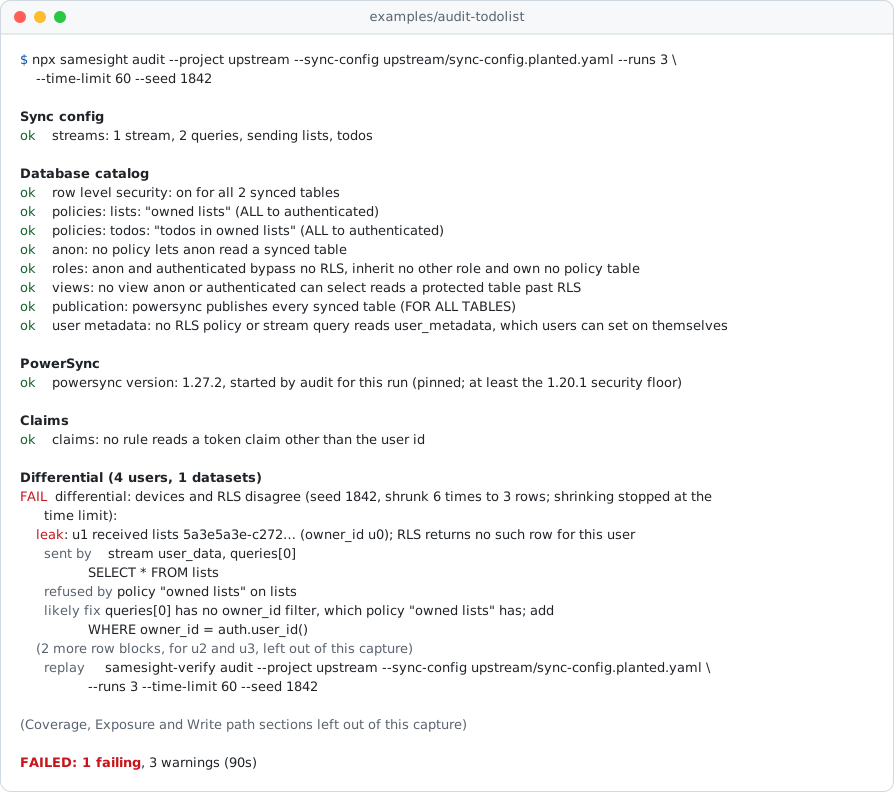
With a samesight policy, it checks that the generated RLS and sync streams agree:
npx samesight-verify            # static, catalog, differential, write path
npx samesight-verify --mutate   # and show the tests would catch a weakened rule
With a policy, it runs:
- Static checks: generated files match the policy, every stream query carries the tenant gate, the client schema covers every synced table, and PowerSync is 1.20.1 or newer.
- Catalog checks: RLS, policies, grants,
anonreach, role bypasses, views, the token hook and the publication, plus a rolled-back re-apply of the generated migration that names any drift. - Differential test: real users for every role, generated data (fast-check, shrunk on failure), a headless PowerSync device per user, and RLS reads with the same token. Every synced row must be one RLS returns, and every RLS row must sync.
- Write path: forged upload batches (other tenants, forged authors, append-only edits, protected columns, replays, self-promotion) must be refused.
- Mutation test (
--mutate): each rule in the RLS and the sync config is weakened in turn, and the differential must catch every one.
Audit mode (samesight-verify audit) runs the catalog checks, the differential and a write check on any Supabase + PowerSync project, with no Samesight policy. It reads Edition 3 sync streams and legacy sync rules (bucket_definitions). It needs only supabase start and Docker: unless given --powersync, it starts a PowerSync service of its own for the run (the official FSL-licensed image, pulled once, never redistributed) and removes it, and everything it made, at the end (unless --keep-powersync keeps it for the next audit). Its run users hold the app_metadata values the rules compare (roles, an org id), and a Coverage section says which policies and streams were seen both allowing and refusing a row.
It refuses to run against anything but this machine: every address must be local, NODE_ENV must be development or test, and hosting platform variables must be absent. It reads addresses and keys from supabase status, using the Supabase CLI in node_modules/.bin or on your PATH. Needs Node 22.18 or newer, and Docker when audit starts PowerSync.
MIT