
@splatkit/react-native
v0.1.0-alpha.3
Published
SplatKit Fabric view with native Metal and Vulkan adapters


Readme
SplatKit for React Native
Real-time 3D Gaussian splatting in a React Native view, rendered natively on Metal and Vulkan.
Point SplatKitView at an .spz file on disk, give it a collider, and walk through the scene.




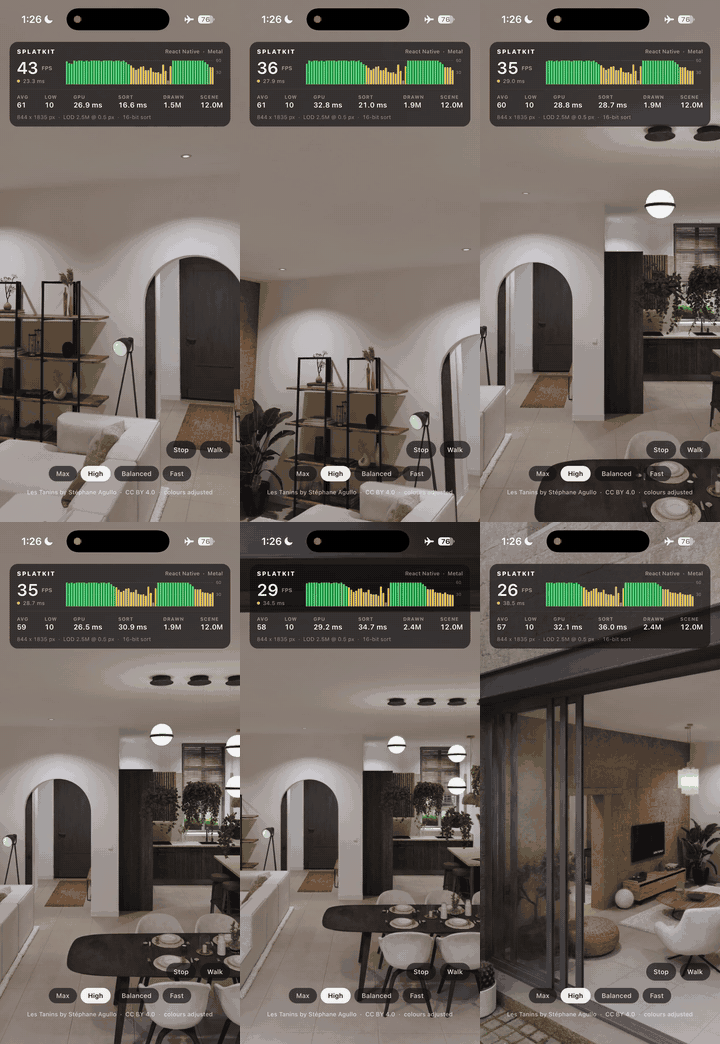
Experimental alpha. The API changes before 1.0, and every release so far is a prerelease published under the
nextdist-tag. Verified on physical devices only: an iPhone 17 Pro and a Xiaomi Mi 9 (Adreno 640).
Contents
- Why
- Requirements
- Installation
- Quick start
- Loading a world
- Navigation
- Quality and performance
- API reference
- Error codes
- Troubleshooting
- Example app
- Related
Why
- Native, not a port. Metal on iOS and Vulkan on Android, behind one Fabric component. No WebGL, no WebView, no JS renderer.
- No bytes cross the bridge. The view reads the world from an absolute local path and never receives splat data from JavaScript.
- It scales down. Hierarchical LOD and residency streaming with budgets you set, so a 6M splat capture runs on a phone from 2019.
- It tells you what it did. Every quality request is validated natively and reported back through
onCapabilitiesandonPolicyEvent, with diagnostics for each fallback. Nothing degrades silently. - Walking is real collision. Load a collider mesh and the camera becomes a character that stands on floors, is blocked by walls and climbs steps.
- The UI is yours. The SDK draws no joystick, no HUD and no buttons. It exposes commands and events; you build the controls.
Requirements
| | Minimum |
| --- | --- |
| React Native | 0.87 or newer (peer dependency >=0.87.0 <0.89.0; only 0.87.1 is validated) |
| React | ^19.2.3 |
| Architecture | New Architecture (Fabric). SplatKitView has no legacy bridge fallback. |
| iOS | 17.0+, Apple GPU family 7 (A14/M1 or newer), Xcode with CocoaPods |
| Android | API 29+, Vulkan 1.1, arm64-v8a only |
| Node | ^22.13.0, ^24.3.0 or >=26.0.0 |
React Native 0.87 is the minimum. The adapter is Fabric-only and relies on the 0.87 template's iOS 26 scene lifecycle, and only 0.87.1 is validated; older releases fail to resolve the peer dependency or to build.
Run it on a physical device.
The renderer's shaders use SIMD prefix reductions, which the iOS Simulator does not implement, so it reports Metal is unavailable on this device and loads nothing.
Emulators are not a supported target on either platform.
Installation
npm install @splatkit/react-native@next
cd ios && pod install
The @next tag is required while the package is in alpha.
iOS.
The podspec vendors SplatKitCore.xcframework, which is fetched and checksum-verified when the package is packed, so there is nothing to build.
iOS 26 terminates apps that skip the UIScene lifecycle, so a React Native 0.87 template app needs a scene delegate; the example app has one.
Android.
The module autolinks through the app's com.facebook.react Gradle plugin, which also runs Fabric Codegen, and pulls io.github.xget7:splatkit-android from Maven Central.
Set minSdkVersion = 29 and reactNativeArchitectures=arm64-v8a in the host app.
Quick start
import {useMemo, useState} from 'react';
import {StyleSheet} from 'react-native';
import {
  QualityPreset,
  SplatKitBuilder,
  SplatKitView,
  conservativeCapabilities,
  nativeCapabilitiesFromEvent,
  toNativeViewProps,
} from '@splatkit/react-native';

export function Scene({worldPath}: {worldPath: string}) {
  // An engine reports its real limits through onCapabilities, and those arrive only once it
  // exists. Build the first request against conservativeCapabilities, the narrowest limits
  // every shipped adapter accepts, then rebuild when the real ones arrive.
  const [capabilities, setCapabilities] = useState(conservativeCapabilities);

  const configuration = useMemo(
    () =>
      new SplatKitBuilder()
        .withWorld({requestId: 'lobby', filePath: worldPath, maxShDegree: 3})
        .withPreset(QualityPreset.balanced)
        .build(capabilities),
    [worldPath, capabilities],
  );

  return (
    <SplatKitView
      style={StyleSheet.absoluteFill}
      {...toNativeViewProps(configuration)}
      onCapabilities={event =>
        setCapabilities(nativeCapabilitiesFromEvent(event.nativeEvent))
      }
    />
  );
}
That renders the world and lets one finger drag to look around. Walking needs a collider, which Navigation covers.
Do not ask for limits above conservativeCapabilities before the first onCapabilities arrives.
A request an adapter rejects is refused before any engine exists, so no capabilities event ever follows and the view has no way to tell you what it wanted instead.
Loading a world
filePath must be an absolute, readable local path, never a URL, a require() asset or a content URI.
Supported formats are .spz, .ply and .lodsplat.
world is a transaction, not a setting.
Native reloads when requestId changes and ignores every other edit to the object, so changing a load-time budget means changing the id too.
Getting a world file onto a device
Worlds are not bundled with the app.
Push one into the app's sandbox and point filePath at it.
# Android, into the app's external files directory
adb push world.spz /sdcard/Android/data/<your.application.id>/files/world.spz

# iOS, into the app's Documents directory on a connected device
xcrun devicectl device copy to --device <device-id> --domain-type appDataContainer \
  --domain-identifier <your.bundle.id> --source world.spz --destination Documents/world.spz
Restart the app after copying a new world.
Navigation
The SDK ships no navigation UI.
SplatKitView handles a one-finger drag to look; every other control is yours to draw.
- Load a collider mesh through the
colliderprop,{requestId, filePath}, pointing at an absolute path to a collider GLB. - Show your controls when
onColliderEventreportsColliderPhase.ready.ColliderPhase.failedcarrieserrorCodeandmessage. - Shape the walker with the
characterprop,{eyeHeight, bodyRadius, stepHeight}in meters, applied immediately and to any collider loaded later. - Drive the camera with
SplatKitCommands.
Commands go straight to the native view and bypass React's render and commit cycle, so a stick can steer at touch rate without a re-render per frame.
import {useCallback, useRef, useState} from 'react';
import {PanResponder, View} from 'react-native';
import {ColliderPhase, SplatKitCommands, SplatKitView} from '@splatkit/react-native';

const WALK_SPEED = 1.4; // meters per second at full deflection
const RADIUS = 62;
const clamp = (value: number) => Math.max(-1, Math.min(1, value));

export function WalkableScene(props: {worldPath: string; colliderPath: string}) {
  const view = useRef<React.ComponentRef<typeof SplatKitView>>(null);
  const [walking, setWalking] = useState(false);

  const stick = useRef(
    PanResponder.create({
      onStartShouldSetPanResponder: () => true,
      onPanResponderMove: (_event, gesture) => {
        const target = view.current;
        if (!target) return;
        SplatKitCommands.setWalkVelocity(
          target,
          clamp(-gesture.dy / RADIUS) * WALK_SPEED,
          clamp(gesture.dx / RADIUS) * WALK_SPEED,
        );
      },
      onPanResponderRelease: () => {
        const target = view.current;
        if (target) SplatKitCommands.setWalkVelocity(target, 0, 0);
      },
    }),
  ).current;

  const onColliderEvent = useCallback(
    (event: {nativeEvent: {phase: ColliderPhase}}) =>
      setWalking(event.nativeEvent.phase === ColliderPhase.ready),
    [],
  );

  return (
    <>
      <SplatKitView
        ref={view}
        world={{requestId: 'world', filePath: props.worldPath}}
        collider={{requestId: 'floor', filePath: props.colliderPath}}
        character={{eyeHeight: 1.5, bodyRadius: 0.35, stepHeight: 0.35}}
        onColliderEvent={onColliderEvent}
      />
      {walking && <View {...stick.panHandlers} style={{width: RADIUS * 2, height: RADIUS * 2}} />}
    </>
  );
}
An empty collider.requestId releases walk mode and returns the camera to free look.
Quality and performance
SplatKitBuilder resolves what you ask for against what the host and the adapter allow, and returns a SplatKitConfiguration carrying world, render and performance (requested, effective, diagnostics).
import {
  QualityPreset,
  SplatKitBuilder,
  toNativePolicyProp,
  toNativeViewProps,
} from '@splatkit/react-native';

const configuration = new SplatKitBuilder()
  .withWorld({requestId: 'lobby-1', filePath: '/absolute/path/lobby.spz', maxShDegree: 3})
  .withPreset(QualityPreset.high)
  .withPerformance({lodBudgetSplats: 2_500_000})
  .build(capabilities);

// <SplatKitView {...toNativeViewProps(configuration)} policy={toNativePolicyProp(configuration, revision)} />withWorld()takes world identity, file path and the load-time maximum SH degree.withRender()takespaused.withPreset(preset)replaces the policy with one of the presets below.withPerformance(options)overrides fields on top of the current preset and marks the policymanual.build(capabilities)clamps budgets to the limits, capsshDegreeat the world'smaxShDegree, and records every fallback inperformance.diagnostics. Malformed numbers, invalid enums and unknown options throw.
Presets
Every preset rasterizes in hardware, with frustum culling and early termination on.
| Preset | Render scale | SH | LOD budget | Residency | Tile | LOD error px | Alpha | Sub-pixel | Hi-Z | Sort |
| --- | ---: | ---: | ---: | ---: | ---: | ---: | ---: | ---: | :---: | ---: |
| highEnd | 1.25 | 3 | 4,000,000 | 4,000,000 | 16 | 0.75 | 1/255 | 0.35 | Yes | 32 |
| high | 1.0 | 3 | 3,000,000 | 3,000,000 | 16 | 1.0 | 1/255 | 0.5 | Yes | 32 |
| balanced | 0.85 | 2 | 2,000,000 | 2,000,000 | 16 | 1.25 | 1/255 | 0.65 | No | 16 |
| performance | 0.65 | 1 | 1,000,000 | 1,000,000 | 8 | 2.0 | 2/255 | 1.0 | No | 16 |
Lower lodErrorPixels sharpens the far field, which is where a captured room looks soft, and costs fill rate.
withPerformance({raster: RasterStrategy.hybrid}) opts into experimental screen-tile compositing, which helps only where many large translucent splats overlap one pixel and costs more on sparse scenes.
Only the iOS adapter builds hybrid today, and computeTile is not implemented anywhere.
Splat budgets
| Knob | Set through | Effect |
| --- | --- | --- |
| lodCapacitySplats | withPerformance({lodBudgetSplats}) | LOD tree budget. 0 disables tree building. Load-time. |
| residencyCapacitySplats | withPerformance({residencyCapacitySplats}) | Resident streaming splats, not a memory guarantee. Load-time. |
| maxShDegree | withWorld() | Load-time cap on stored spherical-harmonics degree. |
| shDegree | withPerformance({shDegree}) | Draw-time SH degree, 0 to 3, clamped to maxShDegree. |
| renderScale | withPerformance({renderScale}) | Render resolution scale, [0.1, 2]. |
The first two are read while the engine builds the world, so raising one takes a new requestId and a reload.
Everything else updates in place.
classifyPolicyChange(previous, next) tells you which case you are in before you commit to it.
The policy prop and revisions
policy carries the live renderer policy under a revision.
Native revalidates the whole policy and never trusts JavaScript state, so give every change a new positive revision; 0 or less means no policy.
Native reapplies the current revision to each new engine, and a world reload creates one, so expect onPolicyEvent again after a reload.
onCapabilities fires once per engine, before that engine's first policy event, and reports the limits, the GPU features and exactly which policy fields the adapter applies.
onPolicyEvent reports PolicyPhase.applied, PolicyPhase.warning (a field fell back, message says why) or PolicyPhase.rejected (the previous policy stayed in effect), and always carries the effective values.
API reference
SplatKitView props
Extends the standard ViewProps.
| Prop | Type | Default | Description |
| --- | --- | --- | --- |
| world | WorldRequest | - | Load transaction: requestId, absolute filePath, maxShDegree, lodCapacitySplats, residencyCapacitySplats. Omit to render nothing. |
| collider | ColliderRequest | - | {requestId, filePath}. An empty requestId releases walk mode. |
| character | Character | - | {eyeHeight, bodyRadius, stepHeight} in meters. |
| policy | NativeRenderPolicy | - | The requested renderer policy, under a revision. |
| paused | boolean | false | Freezes rendering. |
| renderScale | number | 1 | Render resolution scale. |
| shDegree | number (0-3) | 3 | Draw-time spherical-harmonics degree. |
| linearBlending | boolean | false | Blends in linear light instead of the encoded space training used. |
| cullMarginDegrees | number | 10 | Angular culling margin for the CPU fallback; the GPU path uses projected bounds. |
| motionEnabled | boolean | false | Drives the camera from the gyroscope. Ignored where the sensor is missing. |
| touchLookEnabled | boolean | true | Whether a one-finger drag turns the camera. |
| lookSensitivity | number | 0.004 | Radians per point dragged. |
| cameraPoseInterval | number | 0 | Seconds between onCameraPose events. 0 never sends one. |
Events
| Event | Payload |
| --- | --- |
| onWorldEvent | {requestId, phase: WorldPhase, loadedSplats, errorCode, message}. errorCode and message are set only on failed. |
| onColliderEvent | {requestId, phase: ColliderPhase, errorCode, message}. |
| onStats | {requestId, loadedSplats, drawnSplats, frameMillis, gpuMillis, sortMillis} with a *TimingAvailable flag beside each timing. Throttled to 2 Hz. |
| onCameraPose | {x, y, z, yaw, pitch} in the world's frame, throttled to cameraPoseInterval and sent only when the pose changed. |
| onPolicyEvent | {revision, phase: PolicyPhase, errorCode, message} plus every effective policy field. |
| onCapabilities | The adapter's limits, GPU feature support and applied policy fields. Once per engine. |
A *TimingAvailable flag of false means its paired value is not a measurement; pass both through optionalTimingMillis() to get number | null.
Commands
Each takes the view ref first and returns nothing.
| Command | Signature | Notes |
| --- | --- | --- |
| setWalkVelocity | (ref, forward, right) | Meters per second, held until called again. Forward is where the camera looks. Needs walk mode ready. |
| look | (ref, deltaYaw, deltaPitch) | Radians. Pitch is clamped, and this is ignored while the gyroscope drives the view. |
| setCameraPose | (ref, x, y, z, yaw, pitch) | Teleports. While walking, the camera settles onto the floor under the new point. |
Constants
Every enumerated value is a frozen object with a matching type, so there are no bare strings to misspell.
| Export | Members |
| --- | --- |
| QualityPreset | highEnd, high, balanced, performance |
| qualityPresets | every preset in order, for rendering a picker |
| WorldPhase | uploaded, frameReady, failed |
| ColliderPhase | ready, failed |
| PolicyPhase | applied, warning, rejected |
| RasterStrategy | hardware, computeTile, hybrid |
| PerformanceMode | auto, manual |
| PolicyChangeKind | none, nativePropUpdate, worldReload, unavailable |
| conservativeCapabilities | the narrowest limits every shipped adapter accepts, for the first request |
Builder and helpers
| Export | Purpose |
| --- | --- |
| SplatKitBuilder | withWorld(), withRender(), withPerformance(), withPreset(), build(capabilities). |
| toNativeViewProps(configuration) | The world, paused, renderScale and shDegree props. |
| toNativePolicyProp(configuration, revision) | The policy prop for a positive revision. |
| nativeCapabilitiesFromEvent(event) | An onCapabilities payload as a DeviceCapabilities snapshot for build(). |
| classifyPolicyChange(previous, next) | Whether a change needs nothing, a prop update, a world reload, or is unavailable. |
| optionalTimingMillis(available, value) | value, or null when unavailable. Zero is a valid measurement. |
Validators
validateWorldRequest(request, limits), validateColliderRequest(request), validateCharacter(character) and validateRenderOptions(options) throw on structural violations.
None of them touch the filesystem or the GPU.
PerformanceDiagnostic explains every fallback build() made:
| code | Meaning |
| --- | --- |
| limit-clamped | Clamped to a host or native limit. |
| native-option-fallback | The adapter does not apply this field; it fell back to the native default. |
| native-support-unknown | Capabilities have not arrived, so support is unknown. |
| capability-fallback-unavailable | The requested raster strategy is unsupported; hardware is the candidate. |
| fabric-option-unavailable | The option has no Fabric prop. targetFps only, which is a request and never enables dynamic quality. |
Error codes
Both adapters share these, so a host branches on errorCode without checking the platform.
| Code | Reported on | Meaning |
| --- | --- | --- |
| INVALID_REQUEST | onWorldEvent, onColliderEvent | The request failed structural validation before native tried to load it. |
| WORLD_LOAD_FAILED | onWorldEvent | The world file could not be decoded or loaded. |
| GPU_UNAVAILABLE | onWorldEvent | The GPU backend could not be initialized. |
| COLLIDER_LOAD_FAILED | onColliderEvent | The collider GLB could not be loaded. |
| INVALID_POLICY | onPolicyEvent | The policy failed validation. |
| POLICY_PREPARATION_FAILED | onPolicyEvent | The policy was valid but native could not prepare it; the previous one stays. |
Troubleshooting
The view is blank.
Check that world is set and that onWorldEvent fires at all; a view with no world renders nothing.
Prefer a physical device: emulators often lack full Vulkan 1.1, which reports GPU_UNAVAILABLE.
The world fails to load.
filePath must be absolute, local and readable.
Confirm the file is really at that path in the sandbox, and read message for the loader's reason.
Nothing renders and the log mentions Fabric or Codegen.
SplatKitView is Fabric-only.
Confirm the New Architecture is enabled and that a full rebuild picked up SplatKitSpec.
The scene is sharp up close and soft further out.
That is the LOD error threshold.
Lower lodErrorPixels below the preset's value, and watch onStats for the fill-rate cost.
The HUD shows no frame rate.
A timing whose *TimingAvailable flag is false was not measured, which is not the same as zero.
The Vulkan backend reports submitted frames rather than presented ones, and neither backend measures GPU time without timestamp queries.
Example app
apps/react-native is a React Native 0.87.1 app from the community template that installs this package, draws a thumb stick and a stats and quality HUD, and walks a 6M splat capture.
Its README lists every change a fresh template needs.
Related
- splatkit, the Vulkan and Metal SDKs and the shared C++ engine.
- splatkit-ios, the Metal SDK.
Contributing
This package is generated from a monorepo; see CONTRIBUTING.md.