
@stelis/say-ur-intent
v0.1.0
Published
Say Ur Intent is a local-first toolkit for helping AI applications and users inspect Sui DeFi actions before execution.
Downloads
1,407

Maintainers
 daoauth
Readme
Say Ur Intent
Say Ur Intent is a local-first Sui review and evidence layer for AI clients.
It turns a supported AI-requested Sui action into a local review page where the user reads the transaction summary, inspects the transaction (PTB) as a graph, and signs in their own wallet. The AI client never receives signing authority or executable transaction bytes.
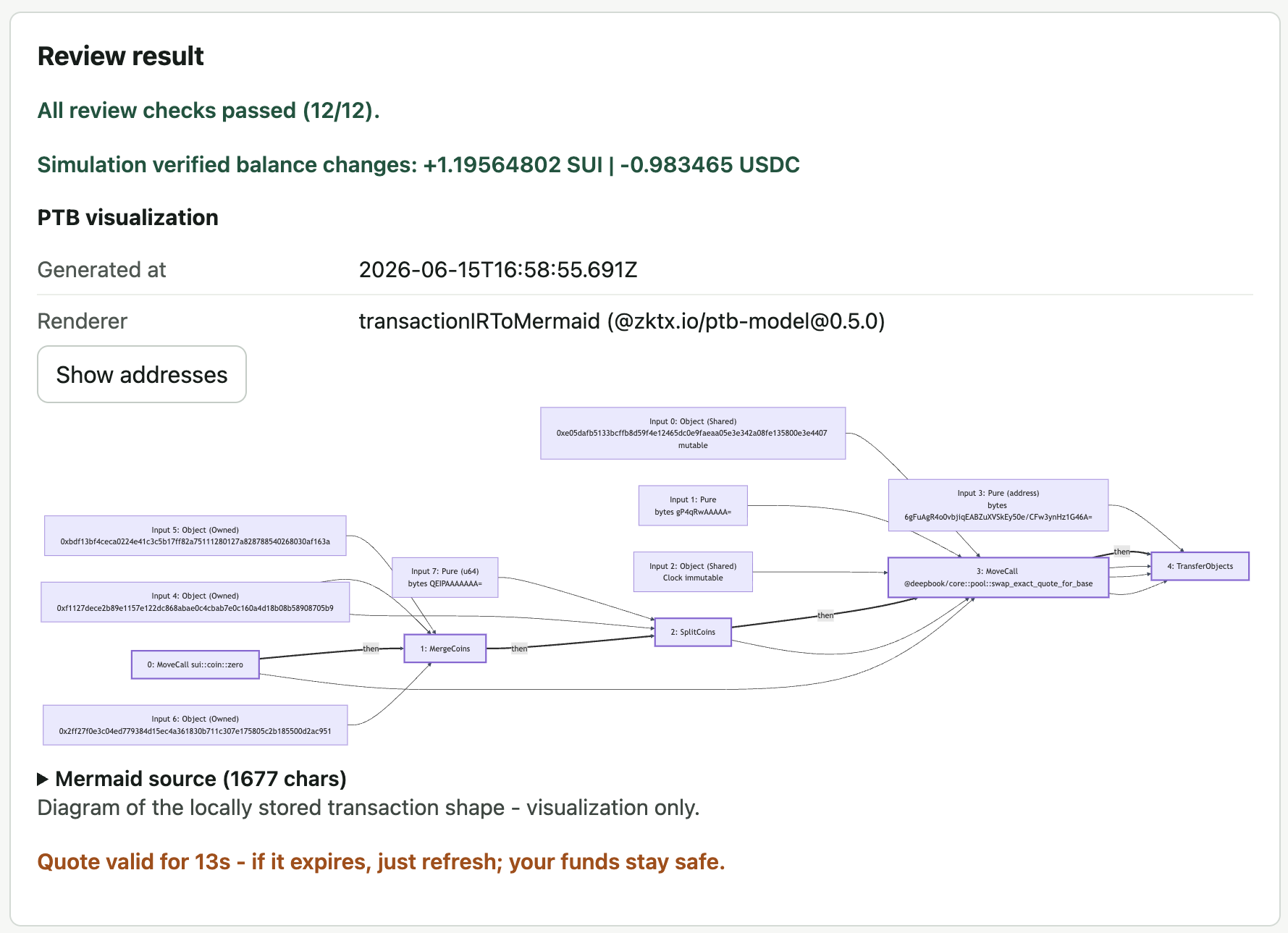
The local review page: deterministic review checks, review-time simulation evidence, and the transaction shown as a labeled PTB graph — what the user reviews before signing in their own wallet.
For natural-language Sui DeFi questions, the current release also returns verified, AI-readable evidence before any transaction is built. That answer path stays separate from account-bound swap review, where the review server builds local unsigned transaction material internally and, once every review evidence stage completes, the local review page offers a digest-gated byte handoff, user-controlled wallet signing, and execution-receipt recording. MCP responses never sign, execute, or return transaction bytes; the only transaction-byte path is the same-machine, digest-gated wallet handoff initiated from the local review page.
Users can ask ordinary questions:
- "Can I cover a 1000 dollar payment with my assets?"
- "How much are my USD-denominated assets together?"
- "What is the shortfall?"
The broader product direction does not stop at pre-execution review. From verified evidence, Say Ur Intent aims to carry an AI client's or MCP server's Sui payment or action request through a human-readable local review and on to user-controlled wallet signing and execution receipt evidence — only after Say Ur Intent independently builds or verifies the transaction material. The three layers below state what is implemented today, what is deliberately sequenced next, and what stays permanently out of scope. For any such request, Say Ur Intent explains what current verified evidence supports, what choices remain with the user, and what claims are unsupported.
Product Direction in Three Layers
Say Ur Intent is one product, but it must be read at three distinct layers. Do not collapse them:
- Implemented today: Sui mainnet evidence, local review, and signable review adapters for the DeepBook and FlowX swap routes. The account-bound DeepBook swap review builds unsigned transaction material into a local in-process material store, internally binds a Sui transaction digest to that stored material, derives object ownership, quote/policy provenance, human-readable review facts, and review-time simulation evidence from the same private review artifacts, emits a schema-validated wallet review contract with a PTB visualization on a
ready_for_wallet_reviewstate, and serves a digest-gated byte handoff to the same-machine review page for user-controlled wallet signing with execution receipts recorded on the session. MCP responses do not contain transaction bytes, signing data, or signing readiness. - Deliberately sequenced next (planned order, ships only after verified review): server-side receipt verification against chain state, further protocol adapters beyond DeepBook and FlowX registered through the descriptor contract (protocol names appear only after a concrete support decision), and richer local analysis views. Each step ships only from independently built or verified transaction material with a human-readable local review.
- Never (permanently unsupported at every layer): no private-key custody, no MCP or AI autonomous execution, no forwarding of opaque external transaction bytes to a wallet, no silent settlement-token or route choice, no fiat cash-out, no P&L, no peg guarantee.
In one sentence: Say Ur Intent is a local-first Sui intent evidence and review layer that progresses from verified evidence to user-controlled wallet signing only after Say Ur Intent independently builds or verifies the transaction material and shows a human-readable local review.
DeepBook and FlowX are the current Sui liquidity and price sources in this release: DeepBook provides scoped conversion, price, and orderbook evidence, and FlowX provides indicative CLMM route quotes. Wallet and Sui balance reads describe held assets. They do not define the whole product.
Say Ur Intent does not custody funds, hold private keys, or autonomously trade on behalf of users. By current design, it does not rank venues, choose routes, make best-price recommendations, or silently choose settlement tokens for users.
The current release can build local unsigned transaction material inside the account-bound DeepBook and FlowX swap review paths. It does not expose transaction bytes. Wallet signing is user-controlled on the local review page after a digest-gated handoff; MCP responses never request signatures, provide signing readiness, or execute payments.
Current review sessions are local evidence-review records only. DeepBook review state may show that local transaction material was built, internally bound to a Sui transaction digest, and used to derive object ownership, quote/policy provenance, human-readable review facts, and review-time simulation evidence. Review sessions do not contain public transaction bytes, signing requests, or executable wallet actions.
The current release flow is:
The user states an intent in natural language.
Say Ur Intent resolves the supported Sui mainnet evidence surface.
The AI answers only from returned evidence and boundaries.
Supported swap transaction material build is an account-bound review step, not
part of the natural-language intent evidence answer.
The current release implements intent evidence for supported Sui mainnet reads. It can also create a read-only, non-signable local review session from a structured external payment or Sui action proposal. External proposal ingestion does not trust external transaction material or send anything for wallet signing.
For setup, see docs/MCP_SETUP.md. For the MCP API reference, see docs/MCP_TOOLS.md. For the AI-client answer playbook, see docs/AGENT_BEHAVIOR.md. For manual maintainer and developer utilities, see docs/UTILITY_INDEX.md.
User-question flows for USD-denominated coverage, balance totals, and shortfall answers live in docs/AGENT_BEHAVIOR.md. The response fields for those answers live in docs/MCP_TOOLS.md.
What Works Today
The current release can run as a local stdio MCP server and expose mainnet Sui DeFi evidence:
- wallet balances with verified display units;
- coin-balance classification;
- USD-denominated settlement asset groups derived from pinned DeepBook SDK registry metadata;
- intent evidence with response summaries for natural-language USD-denominated payment coverage, balance-total, and shortfall questions;
- DeepBook pools, tokens, mid price, orderbook context, raw quotes, display-amount quotes, and account inventory;
- FlowX CLMM pools and indicative single-hop swap route quotes from the chain-verified pinned registry;
- user-requested bounded Sui transaction digest lookup, account activity scans, sent-function activity scans with known-wallet-only persistence, and stored normalized activity summaries;
- read-only external proposal review sessions that display proposed action, asset flow, recipient or target, freshness, missing evidence, user choices, unsupported claims, and non-signable reason;
- local Say Ur Intent review evidence and review-session status reads;
- account-bound DeepBook and FlowX swap review progress through local unsigned transaction material build, internal Sui transaction digest binding, object ownership evidence, quote/policy provenance binding, human-readable review facts, and review-time simulation evidence; when every stage completes the review reaches
ready_for_wallet_reviewand the local review page offers a digest-gated byte handoff, user-controlled wallet signing, and execution-receipt recording. MCP responses never sign, execute, or return transaction bytes; transaction bytes flow only through the same-machine, digest-gated wallet handoff initiated from the local review page.
It also includes:
- a local review server bound to
127.0.0.1; - a local SQLite store for active account read context and review evidence;
- MCP output checks that reject forbidden executable, signing, token, seed, and key-material field names from responses.
Current Limits
Not Implemented
Server-side receipt verification against chain state is not implemented. The full analysis page is not implemented. External proposal execution is not implemented. Transaction material build, contract emit, digest-gated wallet handoff, and user-controlled signing are implemented for the account-bound DeepBook and FlowX swap review through a plan-factory registry.
External proposal ingestion is implemented only for read-only local review sessions. It accepts structured proposal facts, rejects forbidden executable or signing fields, recognized Sui private-key strings, valid English BIP39 mnemonic phrases, obvious sensitive markers, and suspicious raw secret-like payloads before storage, and records why the review is non-signable.
Blocked signing is session-scoped: a review session stays blocked while
required review evidence is missing for that session (for example
wallet_review_contract_emit_missing). When an account-bound supported swap
review completes local transaction material, digest binding, object ownership,
quote/policy provenance, human-readable review evidence, and review-time
simulation evidence, the review layer emits a schema-validated
WalletReviewAdapterContract bound to the same transaction commitment on a
ready_for_wallet_review state. Wallet handoff is gated on a recomputed
digest matching that commitment, and the review page then offers
user-controlled wallet signing with the execution receipt recorded on the
session. Review-time simulation and the emitted contract are evidence about
stored local material only; they are not signing readiness, wallet readiness,
or execution readiness. They are not a user bypass state.
The signable adapter and PTB visualization boundary is documented in
docs/SIGNABLE_ADAPTER_CONTRACT.md. The runtime path emits
WalletReviewAdapterContract as pre-signing review evidence when every
required evidence stage is complete; the contract carries the transaction
commitment hash only.
Wallet signing and the digest-gated byte handoff happen only on the local review page through the user's own wallet, never through MCP responses. MCP responses do not return executable transaction material or signing data, and do not provide signing readiness.
Fiat cash-out, P&L, tax, and cost-basis support are not part of the current release.
Permanent Safety and Correctness Boundaries
These are product boundaries and must not be relaxed by ordinary feature work:
- Say Ur Intent does not custody funds, hold private keys, or autonomously trade.
- It does not treat USDC, USDT, or any USD-denominated settlement asset as fiat USD, a bank cash-out amount, or a USDC/USD peg guarantee.
- It does not turn quote-only conversion candidates into payment coverage, shortfall evidence, funding readiness, payment execution readiness, or signing readiness.
Out of Scope by Current Design
These product behaviors are out of scope in the current release by design:
- It does not silently choose USDC, USDT, or another settlement token for a user. It can report supported settlement asset groups and can use a settlement token only when the user selected it explicitly.
- It does not rank venues, choose routes, or make best-price recommendations.
Quote Response Limits
Quote tools such as read.quote_deepbook_action and
read.quote_deepbook_display_amount return scoped quote facts and raw quote
evidence only.
Their semantics mark quote output as price evidence, not payment coverage or shortfall evidence. Coverage and shortfall answers come from read.preview_intent_evidence.responseSummary.
For quote responses alone, these conclusions are unsupported:
- payment coverage is not available;
- shortfall contribution is not available;
- route-dependent payment support is not available;
- final min-out values are not available;
- route recommendations are not available;
- venue comparisons are not available;
- effective-price claims are not available;
- price-impact calculations are not available;
- quote-vs-mid slippage is not available;
- fiat cash-out estimates are not available;
- external market lookups are not available;
- USDC/USD peg assumptions are not available;
- P&L is not available;
- cost basis is not available;
- actionable signing data is not available.
Install
Install from the MCP registry (server io.github.stelis-dev/say-ur-intent) or with npx -y @stelis/say-ur-intent. For per-client configuration (Claude Code, Claude Desktop, Codex, Cursor) and running from a local checkout, see docs/MCP_SETUP.md.
After the MCP server is connected, use docs/MCP_SETUP.md for first-use setup, docs/MCP_TOOLS.md for API fields and statuses, and docs/AGENT_BEHAVIOR.md for user-question flow and response wording.
Mainnet-Only Product Surface
Product docs, registry, AI responses, UX copy, and signable actions are mainnet-only.
Unsupported protocol experiments are not product functionality and are not included in the package docs, MCP resources, registry support lists, UX copy, or signable-action lists.
MCP Tools
The canonical MCP API reference lives in docs/MCP_TOOLS.md.
The server also exposes read.get_server_status. It returns the package version, evidence policy version, implementedToolsCount, and implemented tool list at runtime.
DeepBook pool-price context is exposed through read.get_deepbook_mid_price. Use docs/MCP_TOOLS.md for the response fields and unsupported conclusions.
Tool names use dot prefixes because the MCP spec recommends ASCII letters, digits, underscore, hyphen, and dot for tool names. action.prepare_sui_action_review returns a reviewSessionId and reviewUrl; it does not return executable transaction bytes.
Documentation Map
The server exposes only a subset of repository documents as MCP resources.
Runtime-facing MCP resources currently include:
- this README;
docs/MCP_SETUP.md;docs/MCP_TOOLS.md;docs/WALLET_IDENTITY.md;docs/AGENT_BEHAVIOR.md;protocols/deepbook-v3.md;protocols/deepbook-margin.md.
Protocol resources are explanatory references. Current support is declared by read.get_server_status, read.list_supported_protocols, concrete tool schemas, and concrete tool responses, not by protocol Markdown alone.
Development-only or release-review documents can define contributor rules and checks.
AI client answer behavior must be mirrored in runtime-facing instructions, resources, prompts, schemas, or returned evidence fields before it is treated as product behavior.
README.md: Public entry document: product purpose, current release boundary, setup path, and documentation map.docs/MCP_SETUP.md: Setup guide: installation, MCP client connection, first-use flow, settings, and troubleshooting.docs/MCP_TOOLS.md: API reference: tool contracts, response fields, statuses, follow-up fields, and output boundaries.docs/AGENT_BEHAVIOR.md: Answer playbook: user-question flows, tool selection, and response wording boundaries.docs/WALLET_IDENTITY.md: Wallet identity reference: active-account read context and same-machine capture boundaries.protocols/deepbook-v3.md: Protocol reference only; use MCP tool responses and read.list_supported_protocols for current support.protocols/deepbook-margin.md: Protocol reference only; no margin MCP read tools or signable actions are exposed in this release.docs/golden-scenarios/INTENT_EVIDENCE_MATRIX.md: current-release question, tool-path, and standard-answer matrix for AI client release review.docs/golden-scenarios/BEHAVIOR_MATRIX.md: broader behavior scenario matrix for supported and unsupported user prompts.docs/TRANSACTION_ACTIVITY_LOG.md: transaction activity evidence, storage, scan, and summary boundaries.docs/UTILITY_INDEX.md: manual maintainer and developer utilities. Utility rows are not MCP tools unless they explicitly name an MCP tool, and source-checkout scripts are not packaged product commands.docs/LOCAL_DB_ARCHITECTURE.md: local SQLite storage boundaries for maintainers.docs/SDK_API.md: pinned SDK API notes and source-verification boundaries.docs/FRONTEND_POLICY.md: review-app frontend implementation policy for coding agents.docs/SIGNABLE_ADAPTER_CONTRACT.md: wallet-review adapter and PTB visualization contract. It defines the pre-signing review evidence and commitment boundary; wallet signing still happens only through the local review page, not through MCP.AGENTS.md: root repository development contract and non-negotiable product boundaries for coding agents working on this codebase.docs/AGENT_DEVELOPMENT_POLICY.md: detailed binding development, review, documentation, source-of-truth, and completion policies for coding agents.
Contract Name Registry
The PTB visualization on the review page can show human-readable labels in place of raw addresses, with a toggle back to raw addresses and a copyable Mermaid source that always keeps raw addresses. A label is identity display only, not a safety, trust, route-quality, or signing-readiness signal, and only registered addresses are relabeled.
Two pinned, context-aware registries in
src/core/action/contractNameRegistry.ts
drive this:
- packages, relabeled only in
<address>::path position — the DeepBook swap package by its Move Registry (MVR) name@deepbook/core, and the Sui framework packages by their Move aliases (std,sui,sui_system); - well-known Sui system objects, relabeled only as a bare object id —
Clock,SuiSystemState,Random,DenyList,CoinRegistry, and the address-based balanceAccumulatorRoot.
If you maintain a Sui DeFi protocol that has a registered MVR name and want its package to display that name in the review graph, open a pull request adding your mainnet package address and MVR name to the package registry. Every unregistered address keeps its raw form.