
@stevenpg/cesium-h3
v0.0.1
Published
H3 hexagonal grid helpers for CesiumJS: view-driven cell cover, batched rendering, entities and neighborhood traversal

Maintainers
 stevenpg
Readme
@stevenpg/cesium-h3



H3 hexagonal grid helpers for CesiumJS.
Cover the current view with cells, render thousands of them as one batched primitive, and traverse
the grid — without touching h3-js yourself.
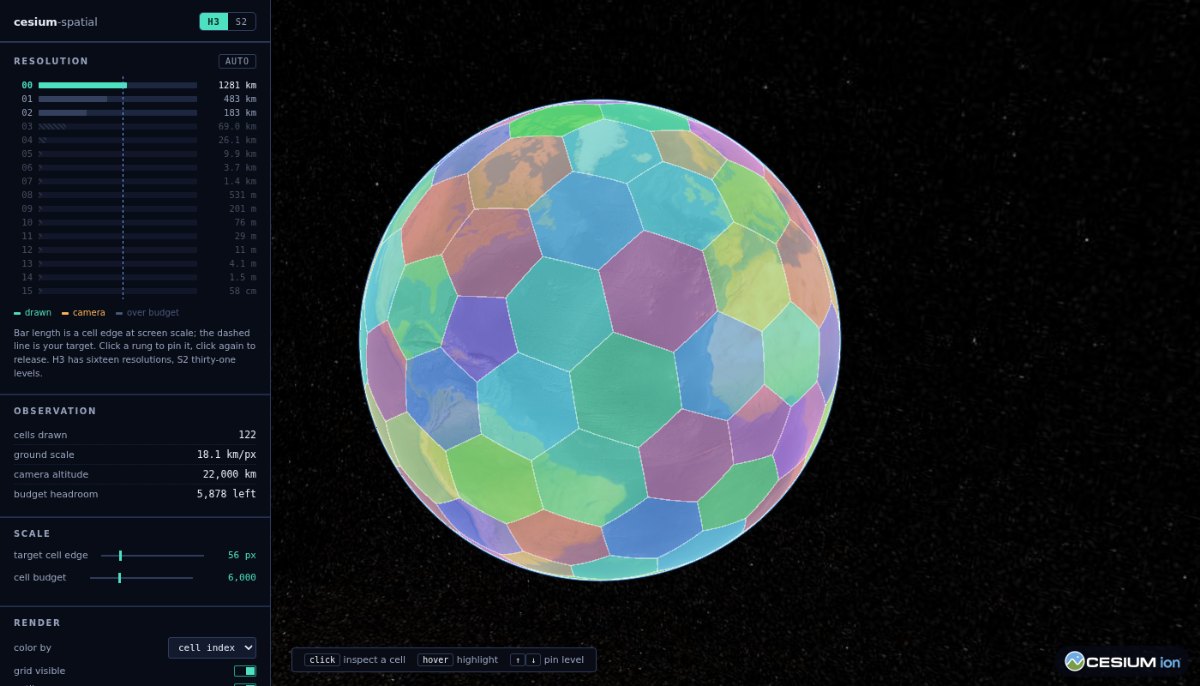
A layer that follows the camera
import { Viewer } from 'cesium';
import { H3ViewLayer } from '@stevenpg/cesium-h3';

const viewer = new Viewer('cesiumContainer');

const layer = new H3ViewLayer(viewer.scene, {
  maxCells: 8000,        // budget; coarsens rather than overrunning
  targetEdgePixels: 72,  // how big a cell should look on screen
  outlines: true,
  onUpdate: ({ cells, resolution }) => console.log(cells.length, 'at res', resolution),
});
It watches the camera, derives a resolution from the view's ground resolution, covers the visible extent, and rebuilds only when the set of cells actually changes.
Or drive it yourself
import { cellAt, disk, parent, H3CellLayer } from '@stevenpg/cesium-h3';
import { Color } from 'cesium';

const origin = cellAt(-122.4194, 37.7749, 9);   // longitude first, Cesium-style
const patch = disk(origin, 12);                 // 469 cells

const layer = new H3CellLayer(viewer.scene, {
  style: (cell) => ({ color: cell === origin ? Color.ORANGE : Color.CYAN.withAlpha(0.3) }),
});

layer.setCells(patch);
layer.setCellStyle(parent(origin), { color: Color.MAGENTA });  // no rebuild
Picking
Batched primitives report geometry instances rather than application objects, so resolving a click back to a cell needs a hand:
import { CellPicker } from '@stevenpg/cesium-h3';

new CellPicker(viewer.scene, [layer], {
  onClick: ({ id }) => console.log('clicked', id),
  onHover: ({ id }) => layer.setCellStyle(id, { color: Color.WHITE }),
});
API
Cells
cellAt(longitude, latitude, resolution), cellAtCartographic, isValid, resolutionOf,
isPentagonCell, cellAreaMeters.
neighbors, disk, ring, diskByDistance, areNeighbors, distanceBetween, pathBetween.
parent, ancestors, children, centerChild, compact, uncompact.
Neighbor and ring queries use H3's pentagon-safe traversals, so the twelve pentagons return five neighbors rather than nothing.
Geometry
cellToRing (flat [lng, lat, ...] degrees), cellToCellBoundary, cellsToBoundaries,
cellToPositions, cellToCartographic, cellToCartesian, cellToLngLat, cellToRectangle,
cellsToRectangle.
getCellBoundary / getCellBoundaries memoize behind a bounded cache and are safe to call every
frame. clearBoundaryCache empties it.
Cover
cellsInRectangle, cellsInPolygon, coverRectangle (budget-aware), estimateCellCount,
cellsInView.
H3 treats any polygon whose consecutive longitudes jump more than 180° as crossing the
antimeridian, with no way to say otherwise — so asking for the 200° around Greenwich silently
returns the 160° around the dateline. cellsInRectangle splits wide extents into quarter-turn
segments first, which removes the ambiguity and handles Cesium's wrapping rectangles
(west > east) as a side effect.
estimateCellCount works from rectangle area rather than generating cells, so a budget can back
off to a coarser resolution without first materialising a set that could be millions of cells.
Resolution
H3_RESOLUTIONS (read from h3-js, not hard-coded), resolutionForMetersPerPixel,
createResolutionSelector (adds hysteresis), resolutionEdgeMeters, resolutionAreaMeters,
clampResolution.
Layers
H3ViewLayer — camera-driven, debounced, budget-aware.
H3CellLayer — batched primitives. Thousands of cells, one draw. Adding or removing cells rebuilds;
setCellStyle and restyle do not.
H3EntityLayer — one Cesium entity per cell. Far more expensive, but each cell becomes a real
entity you can select, describe or animate. Accepts an options bag or a full entityFactory hook.
All three support terrain clamping, extrusion into prisms, and optional outlines.
Cesium compatibility
Cesium is a peer dependency (>= 1.95), so this never bundles a second copy of the engine.
@cesium/engine is supported as an optional peer; everything used lives in engine, so an
engine-only project can alias cesium to @cesium/engine in its bundler.
h3-js is a regular dependency. It is compiled C and around 500 KB, which is why H3 lives in its
own package rather than a combined one.
See also
@stevenpg/cesium-s2 does the same job for the
S2 grid, on the same core.
Apache-2.0.