
@supersec-ai/superman
v2.0.1
Published
The agentic backend framework for building the future of AI applications.

Maintainers
 euferro
Readme
Superman is a next-generation declarative framework for building rock-solid backend applications. Engineered from the ground up for agentic development, it features out-of-the-box Model Context Protocol (MCP) server generation, incredibly low token utilization, and crystalline readability for both humans and AI agents.
Simply define your configuration, controllers, and modules—Superman handles the rest.
Features
| 🌟 Feature | 📖 Description | 🚀 Impact |
| :--- | :--- | :--- |
| 🏗️ Declarative Structure | No hidden side effects or imperative middleware chains. The entire app is defined in ~3 function calls. | Easy to parse for both humans and AI agents in a single pass. |
| 🤖 Automatic MCP Server | Instantly generate a Model Context Protocol server exposing your API to AI tools. | Zero manual configuration for AI agentic integrations. |
| 🧠 Low Token Utilization | ~15-20 lines of pure declarations vs. 50-60 lines of imperative Express code. | AI agents spend ~60% fewer tokens reading and modifying code. |
| 🛡️ Predictable Error Handling | Throw an HttpException anywhere, and the framework catches and formats it automatically. | Consistent error responses without hunting for try/catch blocks. |
| 📚 Auto-Generated OpenAPI 3.1 | A single /spec route returns a valid OpenAPI document built directly from your declarations. | No manual docs to maintain or drift out of sync. |
| ✨ Interactive Scalar UI | Built-in Scalar interactive UI rendered from the OpenAPI document (openapi.docs.enabled). | Beautiful, out-of-the-box API documentation interface. |
| 🚦 Rate Limiting & Throttling | Built-in per-IP rate limiting configurable per controller with simple presets. | Protect your endpoints automatically with X-RateLimit headers. |
| 📋 Built-in Schema Validation | Chainable DSL for validating body, query, headers, cookies, and path parameters. | Typed DTOs inferred directly from schemas. |
| 🔐 Auth & Role Guards | Out-of-the-box requireAuth and requireRoles middlewares. | Secure your endpoints effortlessly with auto-emitted 401/403 docs. |
| 📝 Structured Event Logging | Six categories of typed JSON logs (System, Request, Response, Error, Audit, Security). | Comprehensive observability and logging without boilerplate. |
| ⚡ Cross-Runtime Support | Runs on Node.js (Primary), Bun (Native ESM), and Deno with zero native dependencies. | Deploy anywhere with maximum performance. |...
Introduction
This framework was designed with the future of AI-assisted development in mind. As AI becomes integral to how we build and maintain software, codebases must be readable, predictable, and consistent—not just for human developers, but for AI agents as well.
Traditional Express applications often scatter configuration, routing, error handling, logging, and rate limiting across dozens of files. These imperative patterns are hard to parse and reason about. We replace all of that with a small set of powerful declarative functions (defineConfig, defineController, defineModule) that make your entire application structure explicit and self-documenting.
Why this matters for AI (and human) development:
- 🧩 Consistency — Every project follows identical patterns for configuration, routing, errors, and logging. An AI reading one project instantly understands them all.
- 🏗️ Declarative Structure — Say goodbye to hidden side effects and tangled middleware chains. The entire app is defined in ~3 function calls, allowing AI to parse the architecture in a single pass.
- 🤖 Auto-generated OpenAPI 3.1 — The framework automatically exposes a
/specroute that returns a valid OpenAPI document built directly from your declarations. No manual documentation to maintain or drift out of sync. Opt-in toopenapi.docs.enabledto expose/docs, a beautiful built-in Scalar interactive UI. - 📉 ~60% Fewer Tokens — A typical module definition takes only 15-20 lines of pure declarations, compared to 50-60 lines of imperative Express code. This means AI agents spend significantly fewer tokens reading, understanding, and modifying your codebase.
- 🛡️ Predictable Error Handling — Throw an
HttpExceptionanywhere and the framework catches and formats it automatically. No more hunting for missingtry/catchblocks or dealing with inconsistent error responses.
The result: A framework that is exponentially easier to write, read, and maintain—empowering both human developers and AI agents to work at their absolute best.
Framework Comparison
Here's how Superman stacks up against the most popular TypeScript server frameworks when it comes to out-of-the-box features tailored for modern, AI-assisted development.
| Feature | 🦸♂️ Superman | 🦁 NestJS | 🚄 Fastify | 🦊 Hono | 🚂 Express | | :--- | :---: | :---: | :---: | :---: | :---: | | Declarative Structure | ✅ | ✅ | ❌ | ❌ | ❌ | | Automatic MCP Server | ✅ | ❌ | ❌ | ❌ | ❌ | | Low Token Utilization (AI) | ✅ | ❌ | ⚠️ | ✅ | ❌ | | Auto-Generated OpenAPI 3.1 | ✅ | 🔌 | 🔌 | 🔌 | ❌ | | Interactive Scalar UI | ✅ | 🔌 | 🔌 | 🔌 | ❌ | | Built-in Schema Validation | ✅ | 🔌 | ✅ | 🔌 | ❌ | | Built-in Rate Limiting | ✅ | 🔌 | 🔌 | 🔌 | ❌ | | Built-in Auth & Role Guards| ✅ | ✅ | 🔌 | ❌ | ❌ | | Structured JSON Logging | ✅ | 🔌 | ✅ | ❌ | ❌ | | Cross-Runtime (Node/Bun/Deno)| ✅ | ❌ | ❌ | ✅ | ❌ |
Legend: ✅ = Built-in & ready to use ❌ = Not available or requires significant manual implementation 🔌 = Requires installing and configuring third-party plugins or middleware ⚠️ = Partial support or requires boilerplate
🚀 Is Superman Really Innovative?
If you look purely at HTTP and JSON, we aren't doing magic. Fastify, NestJS, and Hono already handle HTTP brilliantly. Superman’s true innovation is a paradigm shift in who it considers the "developer".
Historically, frameworks optimized for human ergonomics. Superman is the first backend framework engineered for AI ergonomics.
📉 1. The Token-Optimized Architecture
When an AI reads a standard Express app, it has to trace tangled middleware chains across dozens of files. This wastes tokens and context windows.
Superman’s declarative structure means an AI can parse a single
defineControllerblock and instantly know the routes, auth guards, rate limits, schemas, and errors. It reduces the "token cost" of understanding your codebase by over 60%, supercharging your AI coding assistants.
🤖 2. Native MCP Integration
Model Context Protocol (MCP) is the new standard for AI agents interacting with local tools. By automatically exposing your API as an MCP server out-of-the-box, Superman allows AI agents to directly consume your backend as native tools—zero translation layers required.
💎 3. "Zero-Drift" Cohesion
Instead of gluing together 5 different libraries, Superman unifies them. You declare a route once, and it drives runtime validation, OpenAPI docs, TypeScript types, rate-limiting, and MCP tools automatically.
🏆 The Verdict
Superman isn't reinventing the HTTP wheel—it's pioneering the AI-Native backend. If you are building software where AI agents will assist you, maintain the code, or consume the API, Superman is a massive leap forward.
Install
npm install @supersec-ai/superman       # Node / npm
bun add @supersec-ai/superman           # Bun
# Deno: import from 'npm:@supersec-ai/superman'
Fastify is a peer dependency and must be installed in the consuming application. The bundle itself is ~45 KB and ships both CommonJS (dist/index.js) and ES Module (dist/index.mjs) entries, resolved via the exports map.
Supported runtimes
| Runtime | Minimum version | Notes |
|---|---|---|
| Node.js | 20 | Primary target. CI runs here. |
| Bun | 1.0 | Consumes the ESM entry natively. bun add @supersec-ai/superman just works. |
| Deno | any recent | Import via npm:@supersec-ai/superman. Deno's npm compatibility layer resolves the package exports map. |
The framework only uses cross-runtime-safe APIs: process.env, process.stdout/stderr, process.on('SIGTERM'|'SIGINT'), process.exit, os.hostname, fs, path. No __dirname, no require.resolve, no Node-only native modules.
Principles
Depend on interfaces, not implementations
Services, repositories, gateways, and any other dependency should never receive or reference a concrete class directly. Always depend on an interface (contract) and inject the implementation.
// ✅ Correct — depends on interface
class UsersService implements IUsersService {
constructor(private readonly repository: IUsersRepository) {}
}
// ⌠Wrong — depends on concrete class
class UsersService {
constructor(private readonly repository: UsersRepository) {}
}This applies at every layer:
- Controllers depend on a service interface (
IUsersService), never onUsersService - Services depend on a repository interface (
IUsersRepository), never onUsersRepository - Services depend on gateway interfaces (
IPaymentGateway), never onStripeGateway
This makes your code testable (swap real implementations for mocks), decoupled (change the database without touching the service), and explicit about its contracts.
Quick Start
Step 1 — Define your config
Tip: To automatically load your local
.envfile variables intoprocess.env, install thedotenvpackage (npm install dotenv) and addimport 'dotenv/config';at the very top of your config file.
// src/server.config.ts
import 'dotenv/config'; // side-effect — loads .env into process.env
import { defineConfig } from '@supersec-ai/superman';

defineConfig({
  port: { env: 'PORT', default: 3000 },
  prefix: '/api',
  jsonLimit: '10mb',

  environments: {
    development: {
      endpoints: {
        usersApi: 'https://dev.api.example.com/users',
      },
    },
    staging: {
      endpoints: {
        usersApi: 'https://staging.api.example.com/users',
      },
    },
    production: {
      endpoints: {
        usersApi: 'https://api.example.com/users',
      },
    },
  },

  env: {
    DATABASE_URL: { required: true },
    JWT_SECRET: { required: true },
    MY_CUSTOM_ENV_VAR: { default: 'my_custom_env_var' },
  },

  // Optional — see docs/mcp-server.md
  mcpServer: {
    enabled: true,                         // also honors `MCP_ENABLED=true`
    path: '/mcp',                          // mounts at `{prefix}{path}` → `/api/mcp`
    name: 'my-app-mcp',                    // default `<package.json name>-mcp`
    version: '0.1.0',                      // default `<package.json version>`
    description: 'Read-only AI tools for inspecting customer data.',
    throttle: 'PERMISSIVE',                // preset name or full ThrottleConfig
  },
});
The framework validates required env vars on startup, resolves endpoints for the active environment (via ENV environment variable), and makes everything available through the config singleton. The prefix is prepended to all module routes automatically.
Step 2 — Define module schemas
Park your module's schemas in a co-located *.schemas.ts file using the framework's chainable schema builder (s.*). No Zod or other dep required — the builder emits plain JSON Schema 2020-12 under the hood, the framework's built-in validator consumes it at runtime, and the OpenAPI doc is built from the very same object. Infer<typeof Schema> gives you the TypeScript type for free, so DTOs can't drift from the schema — and the service layer can consume the same inferred types directly.
// src/modules/users/user.schemas.ts
import { s, type Infer } from '@supersec-ai/superman';

export const UserResponse = s.object({
  id:        s.string().uuid(),
  name:      s.string().min(1),
  email:     s.string().email(),
  createdAt: s.string().datetime(),
}).describe('A user record.');

export type User = Infer<typeof UserResponse>;
// ➡️ { id: string; name: string; email: string; createdAt: string }

export const CreateUserBody = s.object({
  name:  s.string().min(1).describe('Full name.'),
  email: s.string().email().describe('Primary email.'),
});

export type CreateUserDto = Infer<typeof CreateUserBody>;
// ➡️ { name: string; email: string }

export const ListUsersQuery = s.object({
  page:  s.integer().min(1).default(1).describe('Page number.'),
  limit: s.integer().min(1).max(100).default(20).describe('Items per page.'),
  q:     s.string().optional().describe('Search query.'),
});

export type ListUsersDto = Infer<typeof ListUsersQuery>;

export const TenancyHeaders = s.object({
  'X-Tenant-Id': s.string().uuid().describe('Tenant identifier.'),
});
Raw JSON Schema objects are still accepted everywhere — useful for hand-written schemas, generated schemas (typia,
z.toJSONSchema()), or features the DSL doesn't cover. See docs/schemas.md.
Step 3 — Define a service
Define an interface for the contract and implement it with a plain class. Controllers depend on the interface, never on the implementation. Use the DTO types inferred from your schemas — one declaration drives the schema, the validator, the OpenAPI spec, and the service contract.
// src/modules/users/services/users.services.ts
import { NotFoundException } from '@supersec-ai/superman';
import type { User, CreateUserDto, ListUsersDto } from '../user.schemas';

export interface PaginatedResult<T> { data: T[]; page: number; limit: number; total: number }

export interface IUsersService {
  findAll(params: ListUsersDto): Promise<PaginatedResult<User>>;
  findById(id: string): Promise<User>;
  create(data: CreateUserDto): Promise<User>;
}

class UsersService implements IUsersService {
  constructor(private readonly repository: IUsersRepository) {}

  async findAll(params: ListUsersDto) {
    return this.repository.findAll(params);
  }

  async findById(id: string) {
    const user = await this.repository.findById(id);
    if (!user) throw new NotFoundException('User not found');
    return user;
  }

  async create(data: CreateUserDto) {
    return this.repository.create(data);
  }
}
Step 4 — Define controllers
The middleware list describes what arrives. Each framework middleware validates at runtime and brands its piece of the context — so the handler receives a fully-typed { body, query, params, headers, cookies, user, service, req, res } object with no manual casts. Return whatever you want; the framework writes it as JSON and picks the status from responses (defaults to 200).
// src/modules/users/controllers/users.controllers.ts
import {
  defineController,
  validateBody, validateQuery, validateHeaders,
  requireAuth, requireRoles,
} from '@supersec-ai/superman';
import type { IUsersService } from '../services/users.service';
import {
  ListUsersQuery, TenancyHeaders, CreateUserBody, UserResponse,
} from '../user.schemas';

export const listUsersController = defineController<IUsersService>({
  middlewares: [
    requireAuth('bearerAuth'),
    requireRoles('admin'),
    validateHeaders(TenancyHeaders),
    validateQuery(ListUsersQuery),
  ],
  responses: { 200: { schema: UserResponse, description: 'Paginated list of users.' } },
  operationId: 'listUsers',
  summary: 'List users.',
  handler: async ({ query, service }) => service.findAll(query),
  //                ^^^^^ ListUsersDto (inferred from validateQuery)
});

export const createUserController = defineController<IUsersService>({
  middlewares: [
    requireAuth('bearerAuth'),
    requireRoles('admin'),
    validateHeaders(TenancyHeaders),
    validateBody(CreateUserBody),
  ],
  responses: { 201: { schema: UserResponse, description: 'User created.' } },
  operationId: 'createUser',
  throttleConfig: 'STRICT',
  handler: async ({ body, service }) => service.create(body),
  //                ^^^^ CreateUserDto (inferred from validateBody)
  //  ➡️ 201 Created (framework picks the single declared 2xx status)
});
responsesis optional. Omit it and successful returns get200 OK. Declare a single2xxstatus and the framework uses it. Declare multiple2xxs and you must opt into one explicitly viareply(data, { status: 202 }).Multi-media-type responses (
content: { 'application/json': ..., 'application/xml': ... }): default returns are JSON-encoded. For realAccept-header negotiation either branch onreq.accepts(...)and returnreply(body, { mediaType: 'application/xml' })for non-JSON, or drop intoctx.res.format({...})directly.Legacy
(req, res, service)handlers still work unchanged — the framework detects the 3-arg arity and routes through the old path. Useful for streaming endpoints or any case where you need full control overres.
Flat-context shorthand
Leaf properties from body / query / params / headers / cookies are also spread at the context root, so you can destructure values directly without going through the structural slot. Both styles compile, both work at runtime — pick whichever reads best per handler:
// Structural
handler: async ({ body, params, user, service }) =>
  service.update(params.id, body, user.id)

// Flat — leaves at the root
handler: async ({ id, name, email, user, service }) =>
  service.update(id, { name, email }, user.id)

// Mixed
handler: async ({ id, body, user, service }) =>
  service.update(id, body, user.id)
Precedence when the same leaf name appears in multiple sources (higher wins): params > body > query > headers > cookies. Reserved structural keys (req, res, service, body, query, params, headers, cookies, user) are never overwritten — a body field literally called service stays accessible at ctx.body.service, not ctx.service. The user principal stays structural only (ctx.user) — its inner fields don't get spread, since collapsing user.id into ctx.id would conflict with path params.
What the framework derives from those middlewares — no extra declarations needed:
| Middleware | Validates at runtime | Auto-emits in OpenAPI |
|---|---|---|
| validateBody(schema) | req.body | requestBody, auto 400 |
| validateQuery(schema) | req.query (string ➡️ typed) | parameters[in:query], auto 400 |
| validateHeaders(schema) | req.headers (string ➡️ typed) | parameters[in:header], auto 400 |
| validateCookies(schema) | req.cookies | parameters[in:cookie], auto 400 |
| validatePathParams(schema) | req.params | refined path-param schemas, auto 400 |
| validateContentType(...) | Content-Type header | requestBody.content keys, auto 415 |
| requireAuth('scheme') | runs the verifier; sets req.user | security: [{ scheme: [] }], auto 401 |
| requireRoles(...) / authorize({ scopes }) | checks req.user.roles / scopes | scopes merge onto preceding scheme, auto 403 |
The framework still auto-injects 429, 500, default, and the X-RateLimit-Remaining / Retry-After response headers on every operation. You only declare success responses and route-specific errors (e.g. 404, 409, 422) in responses / errors.
defineController is generic and returns a factory. Call the factory with your service implementation to get a SupermanController.
Step 5 — Define a module
The module file is the composition root — you instantiate implementations, wire dependencies, and declare routes.
// src/modules/users/users.module.ts
import { defineModule } from '@supersec-ai/superman';
import { listUsersController, findUserController, createUserController } from './controllers/users.controllers';

const usersDb = new UsersPostgresDb();
const usersRepository = new UsersRepository(usersDb);
const usersService = new UsersService(usersRepository);

defineModule({
  name: 'UsersModule',
  prefix: '/users',
  routes: [
    { method: 'GET',  path: '/',    controller: listUsersController(usersService) },
    { method: 'GET',  path: '/:id', controller: findUserController(usersService) },
    { method: 'POST', path: '/',    controller: createUserController(usersService) },
  ],
});
Each controller factory is called with the service — you can see exactly which implementations are being used. Swap a database or service implementation by changing one line.
With prefix: '/api' in defineConfig and prefix: '/users' in the module, the framework generates these routes:
GET  /api/users
GET  /api/users/:id
POST /api/users
Step 6 — Register an MCP Tool (Optional)
Instantly expose any capability to AI agents by wrapping your service logic in a Model Context Protocol tool. The framework automatically wires up the endpoints and schema translations.
// src/modules/users/mcp/users.tools.ts
import { mcpServer } from '@supersec-ai/superman';
import { z } from 'zod';
import type { IUsersService } from '../services/users.services';

export const registerUsersTools = (service: IUsersService) => {
  mcpServer.registerTool(
    'list-users',
    {
      title: 'List users',
      description: 'List all registered users.',
      inputSchema: {
        page: z.number().optional().describe('Page number')
      },
    },
    async ({ page }) => {
      const result = await service.findAll({ page: page || 1, limit: 10, q: '' });
      return {
        content: [{ type: 'text', text: JSON.stringify(result, null, 2) }]
      };
    }
  );
};
Call this registration function in your module's composition root before calling defineModule.
Step 7 — Main
// src/server.ts
import './server.config'; // side-effect — runs defineConfig()
import { app, config, logger } from '@supersec-ai/superman';

const log = logger.child('Server');

const main = async () => {
  // Add any db connection or any other logic you need here...

  app.listen(() => {
    log.info(`🚀 Server started successfully!`);
    log.info(`🌍 API URL: http://localhost:${config.port}${config.prefix}`);
    log.info(`📚 Swagger Docs: http://localhost:${config.port}${config.prefix}/docs`);
    log.info(`🤖 MCP Server: http://localhost:${config.port}${config.prefix}/mcp`);
  });
};

main();
That's it. Config, logging, rate limiting, exception handling, and graceful shutdown — all automatic.
API Summary
| Export | Type | Sync? | Description |
|--------|------|-------|-------------|
| defineConfig() | function | sync | Registers app config: port, prefix, env vars, environment endpoints, structured logger, OpenAPI security schemes + auth verifiers, custom schemaValidator |
| defineController() | function | sync | Generic factory — returns ControllerFactory<TService> |
| defineModule() | function | sync | Declares a module with routes. |
| config | singleton | — | Access resolved config: config.port, config.env.X (or config.get('X')), config.endpoints.X, config.logger, config.openapi, config.schemaValidator |
| app | singleton | — | Server singleton: app.listen(), app.shutdown(), app.useMiddleware() |
| logger | singleton | — | Free-form logger (logger.info(), logger.child('Context')) + typed events (logger.events.system(), .request(), .response(), .error(), .audit(), .security()) |
| s | schema-builder namespace | — | Chainable Zod-like DSL: s.string(), s.number(), s.object({...}), s.array(...), s.union(...), etc. Emits JSON Schema under the hood, runs runtime validation, and types DTOs via Infer. See docs/schemas.md |
| Schema / Infer / SchemaInput | types | — | Schema<T> is the builder base class; Infer<typeof S> extracts the TypeScript type from a schema; SchemaInput = JsonSchema \| Schema<unknown> is the union every validate* middleware accepts |
| Schema.parse() / .safeParse() | methods | sync | Validate ad-hoc data inside services (queue messages, webhooks, cron jobs). .parse() throws BadRequestException with metadata.errors; .safeParse() returns a result object |
| JsonSchema | type | — | Permissive alias for any JSON Schema 2020-12 object — the escape hatch for hand-written or generated schemas. Middlewares accept both s.* builders and raw JsonSchema |
| validateBody validateQuery validateHeaders validateCookies validatePathParams | middleware factories | — | Take a SchemaInput, validate the corresponding request slot at runtime, contribute the schema to the OpenAPI doc, auto-document 400. Query/header/cookie/path coerce strings ➡️ typed values. See docs/api-middlewares.md |
| validateContentType() | middleware factory | — | Guards Content-Type to a set of allowed media types. Throws UnsupportedMediaTypeException (415); auto-documents 415 |
| requireAuth() | middleware factory | — | Auth guard. Looks up the verifier in config.openapi.auth[scheme] (or per-call verify override), populates req.user, throws UnauthorizedException. Auto-emits security + 401 |
| requireRoles() / authorize() | middleware factories | — | Role / scope check against req.user. Throws ForbiddenException. Auto-emits 403; scopes merge onto the preceding auth scheme |
| validateJsonSchema() | function | sync | The framework's built-in JSON Schema validator. Subset of 2020-12 — see docs/schemas.md. Plug a full validator (e.g. AJV, Zod) via defineConfig({ schemaValidator }) |
| attachOpenApiMeta() / readOpenApiMeta() | functions | sync | Lets you author your own self-documenting middleware — attach an OpenApiMiddlewareMeta annotation so it contributes to /spec just like the built-ins |
| reply() | function | sync | Return-value wrapper for handlers. return reply(data, { status, headers, mediaType }) overrides the framework's defaults. Without it, returning a value JSON-encodes with status from responses (single 2xx) or 200 |
| HandlerContext / HandlerContextOf / TypedHandler | types | — | HandlerContext<TService, Ctx> is the destructured handler argument; HandlerContextOf<MWs> derives Ctx from a middleware tuple; TypedHandler<K, T> brands custom middlewares so they participate in context inference |
| EventType, SecurityEvents, SystemEvent, AuditEvents, AuthOutcome, EventSeverity | enums | — | Discriminators for typed structured logs (see Automatic Event Logging) |
| THROTTLE_CONFIG | constant | — | Rate limit presets: SECURITY, STRICT, STANDARD, PERMISSIVE, EXTRA_PERMISSIVE |
| *Exception | classes | — | 15 HTTP exception classes (400–504), including UnsupportedMediaTypeException (415). Throw anywhere, caught by framework |
Lifecycle: defineConfig() ➡️ defineController() ➡️ defineModule() ➡️ app.listen()
Single source of truth for schemas: the same s.* schema you pass to validateBody / validateQuery / etc. is what shows up in GET /spec and what Infer<typeof Schema> types your DTOs from and what Schema.parse() validates inside services. One declaration, four surfaces, no drift. See docs/schemas.md for the full CRUD recipe and the chain-method matrix.
Core API
defineConfig(options)
Registers application configuration. Call once at the top of your entry point.
import 'dotenv/config';
import { defineConfig } from '@supersec-ai/superman';

defineConfig({
  port: 3000,                          // static number
  port: { env: 'PORT', default: 3000 },// or from env var with fallback
  prefix: '/api',                      // prepended to all module prefixes
  jsonLimit: '10mb',                   // JSON body limit

  environments: {                      // endpoint sets per NODE_ENV
    development: { endpoints: { api: 'https://dev.api.com' } },
    staging:     { endpoints: { api: 'https://staging.api.com' } },
    production:  { endpoints: { api: 'https://api.com' } },
  },

  env: {                               // custom env vars
    DB_URL: { required: true },        // throws on startup if missing
    MY_CUSTOM_ENV_VAR: { default: 'my_custom_env_var' },    // optional with default
  },

  logger: {                            // structured event logs (optional)
    enabledEventTypes: [               // default: all 6 types
      EventType.SYSTEM, EventType.REQUEST, EventType.RESPONSE,
      EventType.ERROR,  EventType.AUDIT,   EventType.SECURITY,
    ],
    fileOutput:    { enabled: true, directory: '/var/log/superman' }, // default: disabled
    consoleOutput: {
      enabled: true,                  // default: enabled — silences ALL console output (free-form + events) when false
      enableEventDebug: true,       // default: false — when true, prints event JSON bodies to the dev console
    },
  },

  openapi: {                          // OpenAPI 3.1 security schemes + verifiers + global default
    securitySchemes: {
      bearerAuth: { type: 'http', scheme: 'bearer', bearerFormat: 'JWT' },
    },
    security: [{ bearerAuth: [] }],   // applied to every operation unless overridden per-controller
    auth: {                            // verifiers consulted by `requireAuth('bearerAuth')`
      bearerAuth: async (req) => {
        const token = (req.headers.authorization ?? '').replace(/^Bearer\s+/i, '');
        const claims = await verifyJwt(token);
        return { id: claims.sub, roles: claims.roles ?? [] };
      },
    },
  },
});
config
Singleton with resolved configuration. Available after defineConfig().
import { config } from '@supersec-ai/superman';

config.port                  // number
config.prefix                // string (e.g. '/api')
config.jsonLimit             // string
config.environment           // 'development' | 'staging' | 'production' | ...
config.endpoints.api         // resolved for active environment
config.env.MY_VAR            // validated env var value (direct record access)
config.get('MY_VAR')         // same value — idiomatic getter; returns `string | undefined`
config.isProduction()        // boolean
config.isInitialized()       // boolean
defineController<TService>(options)
Generic factory that returns a ControllerFactory<TService>. The handler receives (req, res, service) — the service is injected by defineModule at registration time.
import {
  defineController,
  validateBody, validateQuery, validateHeaders, validateCookies, validatePathParams,
  validateContentType,
  requireAuth, requireRoles,
  s,
} from '@supersec-ai/superman';

const createPostController = defineController<IPostsService>({
  middlewares: [
    requireAuth('bearerAuth'),                                                   // ➡️ security + auto 401
    requireRoles('author', 'admin'),                                             // ➡️ scopes + auto 403
    validateContentType('application/json'),                                     // ➡️ content keys + auto 415
    validateHeaders(TenancyHeaders),                                             // ➡️ header parameters + auto 400
    validateBody(CreatePostBody, { message: 'Please supply a valid post payload.' }),  // ➡️ requestBody + auto 400 with custom message
  ],
  throttleConfig: 'STANDARD',                                                    // preset or { limit, ttl }
  operationId: 'createPost',
  summary: 'Create a post',
  deprecated: false,
  responses: {
    201: {
      schema: PostResponse,
      headers: {                                 // `X-RateLimit-Remaining` is auto-injected; declare only custom ones
        'X-Request-Id': { schema: s.string(), description: 'Correlation id echoed back.' },
      },
    },
  },
  errors: [                                      // beyond the auto-injected 400/401/403/415/429/500
    { status: 404, description: 'Author not found.' },
    {
      status: 422,
      description: 'Validation failed.',
      metadataSchema: s.object({ field: s.string() }),
    },
  ],
  handler: async ({ body, user, service }) =>                                    // typed: body=CreatePostDto, user=Principal
    service.create({ ...body, authorId: user.id }),
});
The middlewares are the single source of truth: each one validates at runtime and contributes its schema/security/error status to the OpenAPI doc. No request: field on the controller — request shape lives entirely on the middleware list.
Parameters. query / headers / cookies schemas passed to the corresponding validate* middleware are object schemas (s.object({...}) or raw JSON Schema). Each top-level property becomes one OpenAPI parameter; properties listed in required[] are marked required. Path parameters (/:id) are extracted automatically; pass them to validatePathParams(schema) if you want type coercion (e.g. id must be a UUID) and richer documentation. Standard headers (Authorization, Accept, Content-Type) cannot be declared as parameters under OpenAPI 3.1 — use requireAuth(...) and validateContentType(...) for those.
Multi-media-type request bodies — pass validateBody a media-type map:
validateBody({
  'application/json':    UserJsonBody,
  'multipart/form-data': UserMultipartBody,
})
Multi-media-type responses on the same status:
responses: {
  200: {
    description: 'User',
    content: {
      'application/json': { schema: UserResponse, example: { id: '1' } },
      'application/xml':  { schema: s.string(),  example: '<user><id>1</id></user>' },
    },
  },
},
Streaming (SSE / NDJSON / file downloads) — just another media type:
responses: {
  200: {
    description: 'SSE stream of order updates.',
    content: {
      'text/event-stream': {
        schema: OrderEvent,
        example: 'data: {"orderId":"123","status":"shipped"}\n\n',
      },
    },
  },
},
Custom schema validator — if you need keywords beyond the built-in subset (e.g. $ref, patternProperties, full Zod refinements), plug in AJV / Zod / any compatible validator via defineConfig({ schemaValidator }). All validate* middlewares delegate to it transparently; the s.* authoring surface keeps working since builders serialise to plain JSON Schema.
defineModule(options)
Declares a module with routes. The module is queued and registered automatically when app.listen() is called. Routes receive built SupermanController instances — call your defineController factories with the service implementation in the routes array.
import { defineModule } from '@supersec-ai/superman';

const ordersService = new OrdersService(new OrdersRepository(db));

defineModule({
  name: 'OrdersModule',
  prefix: '/orders',
  routes: [
    { method: 'GET',  path: '/',    controller: listOrdersController(ordersService) },
    { method: 'GET',  path: '/:id', controller: findOrderController(ordersService) },
    { method: 'POST', path: '/',    controller: createOrderController(ordersService) },
  ],
  middlewares: [requireAuth],  // applied to all routes in this module
  destroy: async () => {       // called on graceful shutdown
    await closeConnections();
  },
});
app
The application singleton. No need to instantiate — it's created by the framework.
import { app } from '@supersec-ai/superman';

// Add global middleware
app.useMiddleware(cors());

// Start the server (flushes all queued modules, then listens)
app.listen(() => { /* optional callback */ });

// Graceful shutdown (calls destroy() on all modules)
await app.shutdown(); // async — awaits all module destroy functions
logger
Two APIs on one singleton:
Free-form methods — colored console output for developer messages.
Controlled by LOG_LEVEL.
import { logger } from '@supersec-ai/superman';

logger.info('App started', { port: 3000 });

const log = logger.child('MyService');
log.debug('Processing', { id: '123' });
log.warn('Slow query', { duration: '500ms' });
log.error('Failed', { error: err });
Log levels: debug | info | warn | error | silent
NODE_ENV=productiondefaults toinfoNODE_ENV=testdefaults tosilent- Otherwise defaults to
debug LOG_LEVELoverrides all defaults
Typed events — structured JSON logs that match SystemLog, RequestLog,
ResponseLog, ErrorLog, AuditLog, SecurityLog. Goes through the
configured sinks (console + file) and respects logger.enabledEventTypes.
import { logger, SecurityEvents, AuthOutcome, EventSeverity } from '@supersec-ai/superman';

logger.events.security({
  ip: req.ip,
  traceId: res.locals.traceId,
  requestId: res.locals.requestId,
  securityEvent: SecurityEvents.LOGIN_FAILED,
  authOutcome: AuthOutcome.DENIED,
  securityMessage: `Invalid password for ${email}`,
  eventSeverity: EventSeverity.WARN,
});
Infra fields (@timestamp, appName, appVersion, environment,
serverInstanceUid, hostname, uptimeMs, memoryUsage, cpuUsage,
context) are filled in automatically. See Automatic Event Logging
for the full event model, the status-code ➡️ security mapping, and file
layout.
What Happens Automatically
- Request logging — incoming/outgoing requests with method, URL, status, duration
- Exception handling —
HttpExceptionsubclasses return structured JSON; unhandled errors return 500 - Rate limiting — every controller has per-IP throttling (configurable per controller)
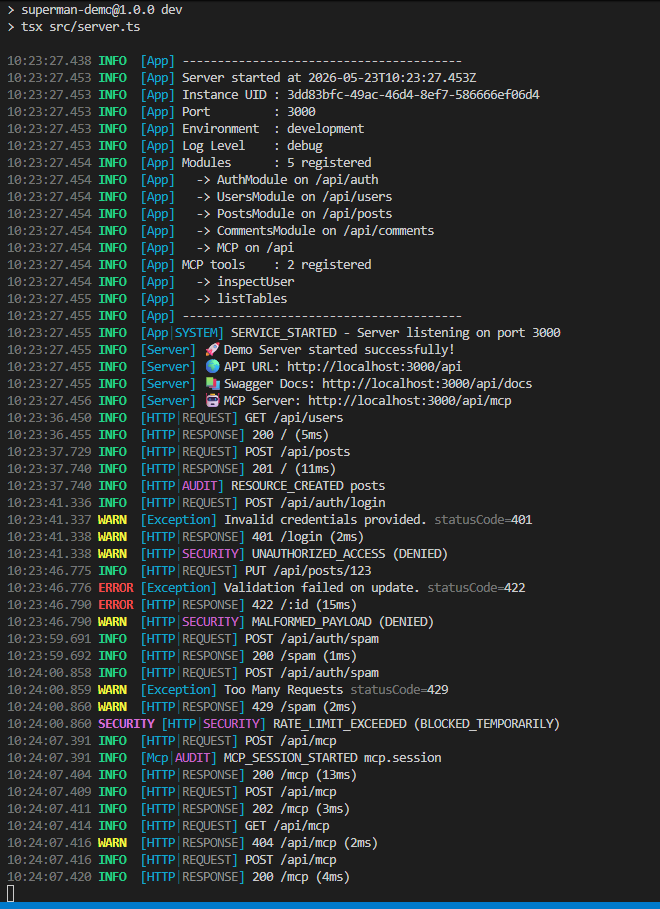
- Startup banner — instance UID, port, environment, debug level, registered modules
- Structured event logs — every request, response, error, mutation, security-relevant status, and lifecycle signal is emitted as a typed log (see Automatic Event Logging below)
14:32:05.123 INFO  [App] ----------------------------------------
14:32:05.123 INFO  [App] Server started at 2026-04-13T14:32:05.123Z
14:32:05.123 INFO  [App] Instance UID : a1b2c3d4-e5f6-7890-abcd-ef1234567890
14:32:05.123 INFO  [App] Port         : 3000
14:32:05.123 INFO  [App] Environment  : development
14:32:05.123 INFO  [App] Debug Level  : debug
14:32:05.123 INFO  [App] Modules      : 1 registered
14:32:05.123 INFO  [App]   -> UsersModule on /api/users
14:32:05.123 INFO  [App] ----------------------------------------
Auto-Generated OpenAPI Spec
The framework exposes a single GET {prefix}/spec route that returns a valid OpenAPI 3.1.0 document describing every registered module and route. It is built from your defineModule / defineController declarations at request time, so it never drifts out of sync with the code.
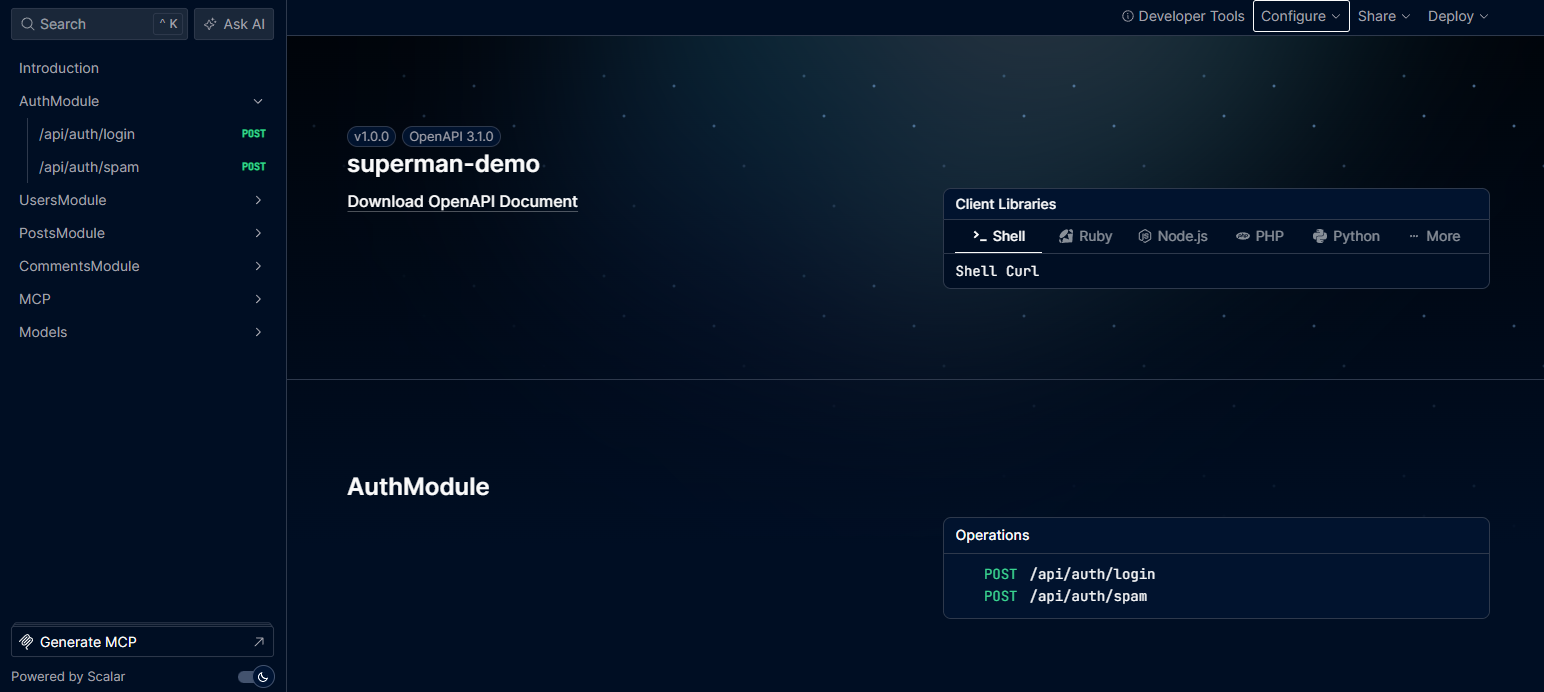
GET /api/specInteractive docs UI (opt-in). Set
openapi.docs.enabled: trueindefineConfigto also exposeGET {prefix}/docs— a Scalar HTML rendering of the same document (endpoints grouped by module/tag in the sidebar, schemas, parameters, "Send API Request" panel). The default page is fully rendered out of the box — no template engine required. Need full control? Plug a Pug/EJS/Handlebars template viaopenapi.docs.template. Toggle without redeploys via theDOCS=true/falseenv var (wins overdefineConfig); production requests get a plain-text 503 unlessexposeInProduction: true. Seeopenapi.docsin docs/api-config.md.
{
  "openapi": "3.1.0",
  "info": { "title": "my-service", "version": "1.2.3" },
  "tags": [
    { "name": "UsersModule" },
    { "name": "ExampleModule" }
  ],
  "paths": {
    "/api/example/authorize": {
      "post": {
        "tags": ["ExampleModule"],
        "summary": "Authorize a new example resource",
        "operationId": "authorizeExample",
        "x-rate-limit": { "preset": "STRICT", "limit": 10, "ttl": 60000 },
        "security": [{ "bearerAuth": [] }],
        "parameters": [
          { "name": "X-Tenant-Id",     "in": "header", "required": true,  "schema": { "type": "string" } },
          { "name": "Idempotency-Key", "in": "header", "required": false, "schema": { "type": "string" } }
        ],
        "requestBody": {
          "required": true,
          "description": "Example payload",
          "content": {
            "application/json": {
              "schema":  { "type": "object", "properties": { "...": "..." } },
              "example": { "...": "..." }
            }
          }
        },
        "responses": {
          "201": {
            "description": "Example authorized",
            "content": { "application/json": { "schema": { "...": "..." } } },
            "headers": {
              "X-RateLimit-Remaining": { "schema": { "type": "integer" } },
              "Retry-After":           { "schema": { "type": "integer" } }
            }
          },
          "401": { "description": "Authentication required or invalid.", "content": { "application/json": { "schema": { "$ref": "#/components/schemas/FrameworkError" } } } },
          "422": {
            "description": "Validation failed.",
            "content": { "application/json": { "schema": { "allOf": [
              { "$ref": "#/components/schemas/FrameworkError" },
              { "type": "object", "properties": { "metadata": { "type": "object", "properties": { "field": { "type": "string" } } } } }
            ] } } }
          },
          "429": { "description": "Rate limit exceeded — too many requests.", "content": { "application/json": { "schema": { "$ref": "#/components/schemas/FrameworkError" } } } },
          "500": { "description": "Internal server error.", "content": { "application/json": { "schema": { "$ref": "#/components/schemas/FrameworkError" } } } },
          "default": { "description": "Standard framework error envelope.", "content": { "application/json": { "schema": { "$ref": "#/components/schemas/FrameworkError" } } } }
        }
      }
    }
  },
  "components": {
    "schemas": {
      "FrameworkError": {
        "type": "object",
        "description": "Standard error envelope emitted by the global exception handler for any caught HttpException or uncaught runtime error.",
        "properties": {
          "error": { "type": "string" },
          "metadata": { "type": "object", "additionalProperties": true }
        },
        "required": ["error"],
        "example": { "error": "Validation failed", "metadata": { "field": "email", "errorId": "err_3f2a9c8e" } }
      }
    },
    "securitySchemes": {
      "bearerAuth": { "type": "http", "scheme": "bearer", "bearerFormat": "JWT" }
    }
  }
}
Highlights:
info.title/info.versionare read fromprocess.env.npm_package_name/npm_package_version(set automatically when starting vianpm/yarnscripts), falling back to'API'/'1.0.0'.429,500, anddefaultresponses are auto-injected on every operation. When security is required,401is auto-injected too. All reference the sharedFrameworkErrorschema.errors[].metadataSchemaindefineControlleris rendered asallOf [FrameworkError, { metadata: <your-schema> }], so consumers know exactly what to expect insidemetadata.x-rate-limitvendor extension exposes each route's throttle budget so clients can pace themselves.- Parameters — path (
/:id➡️/{id}), query, request-headers, and cookies are all emitted; each top-level property of the corresponding object schema becomes one parameter. - Response headers are documented under each Response Object's
headersmap. - Security — schemes declared in
defineConfig.openapi.securitySchemesflow tocomponents.securitySchemes; per-opsecurity(or the config-level default) attaches the requirement. - Schemas, examples, and descriptions are forwarded straight from your JSON Schema inputs — the schema is the single source of truth.
Drop the JSON into Swagger Editor, Redoc, Postman, Insomnia, or any OpenAPI-aware codegen tool.
Adding descriptions to routes
Pass an optional description to any route in defineModule:
defineModule({
  name: 'ExampleModule',
  prefix: '/example',
  routes: [
    {
      method: 'POST',
      path: '/authorize',
      controller: createAuthorizeController(exampleService),
      description: 'Authorize a new example resource',
    },
  ],
});
Using spec for AI-assisted development
The /spec endpoint is a machine-readable contract of your entire API. You can use it to accelerate AI-assisted development:
- Client generation — Pass the spec JSON to an AI in plan mode and ask it to generate a typed HTTP client, SDK, or frontend service layer. The AI has every route, method, path, and rate limit — it can produce deterministic, correct code without reading the server source.
- Test generation — Give the spec to an AI and ask it to generate integration tests for every endpoint. The throttle config tells it exactly how many requests it can make before hitting 429.
- Documentation — Feed the spec into an AI to generate human-readable API docs, Postman collections, or OpenAPI schemas.
- Cross-service contracts — When building microservices, the spec of one service can be passed to an AI building another service's client. The contract is always up-to-date because it's generated from the actual running code.
- Code review — An AI reviewing a PR can fetch
/specbefore and after the change to understand exactly what API surface changed.
Since the spec is auto-generated from your defineModule and defineController declarations, it never drifts out of sync with the actual implementation. It's the single source of truth for your API surface.
Automatic Event Logging
The framework emits six categories of typed, structured logs out of the box.
Every HTTP request, every exception, every resource mutation, every
security-relevant status code, and every lifecycle transition is captured as a
JSON object that matches one of the *Log interfaces in
superman — no application code required.
Enabling
import { defineConfig, EventType } from '@supersec-ai/superman';

defineConfig({
  port: 3000,
  logger: {
    enabledEventTypes: [
      EventType.SYSTEM, EventType.REQUEST, EventType.RESPONSE,
      EventType.ERROR, EventType.AUDIT, EventType.SECURITY,
    ],
    fileOutput: { enabled: true, directory: '/var/log/superman' },
    consoleOutput: { enabled: true },
  },
});
Defaults: all six event types enabled, console output ON, file output OFF.
Pass a subset of enabledEventTypes to silence categories you don't need (e.g.
only SECURITY + ERROR for low-volume security audit trails).
Event types
| Event | When it fires | Shape |
|------------|----------------------------------------------------------------|------------------|
| SYSTEM | Server start, manual shutdown, SIGTERM/SIGINT received | SystemLog |
| REQUEST | Every incoming HTTP request | RequestLog |
| RESPONSE | Every completed HTTP response | ResponseLog |
| ERROR | Every caught exception (HTTP and runtime) | ErrorLog |
| AUDIT | Successful mutations — POST/PUT/PATCH/DELETE with 2xx status | AuditLog |
| SECURITY | 401, 403, 413, 422, 429 responses (auto-mapped) | SecurityLog |
Status ➡️ security event mapping
| HTTP status | securityEvent | authOutcome |
|-------------|---------------------------|--------------------------|
| 401 | UNAUTHORIZED_ACCESS | DENIED |
| 403 | FORBIDDEN_ACTION | DENIED |
| 413 | PAYLOAD_TOO_LARGE | DENIED |
| 422 | MALFORMED_PAYLOAD | DENIED |
| 429 | RATE_LIMIT_EXCEEDED | BLOCKED_TEMPORARILY |
Method ➡️ audit event mapping
| Method | Status | auditEvent |
|---------|--------|-----------------------|
| POST | 2xx | RESOURCE_CREATED |
| PUT | 2xx | RESOURCE_UPDATED |
| PATCH | 2xx | RESOURCE_UPDATED |
| DELETE | 2xx | RESOURCE_DELETED |
The resource is inferred from the first URL segment after your prefix
(e.g. POST /api/users ➡️ resource: "users").
The audit log is a correlation-only marker — it records the action, the
resource type, the actor, and a requestId; it does not carry the
affected id or a payload/diff. Recover "what changed" by joining to the
correlated REQUEST / RESPONSE logs via their shared requestId. So change
detail survives only while those bodies are persisted: disabling savePayload
on REQUEST drops them. As a safeguard, when the AUDIT event keeps its
payload (savePayload: true, the default), the REQUEST log retains its
requestBody for mutating methods (POST/PUT/PATCH/DELETE) even if REQUEST's
own savePayload is false. See docs/api-logging.md for
details.
File layout
When fileOutput.enabled is true, one NDJSON file is created per event type
per day:
/var/log/superman/
  system-logs-2026-04-17.log
  error-logs-2026-04-17.log
  request-logs-2026-04-17.log
  response-logs-2026-04-17.log
  audit-logs-2026-04-17.log
  security-logs-2026-04-17.log
Each line is a single JSON object — ready for Filebeat / Fluentd / Vector /
Datadog agent ingestion. The directory option accepts both absolute
(/var/log/superman) and relative (./logs, logs) paths. If the process
lacks permission to create the directory, the file sink disables itself with a
single diagnostic and the app keeps running — it never crashes your service.
Request / Trace IDs
Every incoming request is tagged with a X-Request-Id header (generated via
crypto.randomUUID() when absent, honoured when the client supplies one). The
id is echoed back on the response and attached to every log line for the same
request — so you can trace REQUEST ➡️ RESPONSE ➡️ AUDIT ➡️ SECURITY ➡️ ERROR
across logs with a single grep. X-Trace-Id is also honoured when present
(falls back to requestId otherwise).
Emitting your own events
The typed emitter is also available for app-level logs via
logger.events.*:
import { logger, SecurityEvents, AuthOutcome, EventSeverity } from '@supersec-ai/superman';

const log = logger.child('Auth');

log.events.security({
  ip: req.ip,
  traceId: res.locals.traceId,
  requestId: res.locals.requestId,
  securityEvent: SecurityEvents.LOGIN_FAILED,
  authOutcome: AuthOutcome.DENIED,
  securityMessage: `Invalid password for ${email}`,
  eventSeverity: EventSeverity.WARN,
});
The emitter fills in infra fields automatically (@timestamp, appName,
appVersion, environment, serverInstanceUid, hostname, uptimeMs,
memoryUsage, cpuUsage, context) and respects your
enabledEventTypes filter.
Graceful shutdown
On SIGTERM / SIGINT the framework emits a SYSTEM_SIGNAL_RECEIVED event,
runs every module's destroy(), and flushes all file streams before calling
process.exit(0) — no truncated NDJSON lines on deployment.
MCP Server (AI tools)
The framework can host a Model Context Protocol server alongside the regular HTTP API. Turn it on:
defineConfig({
  // ...
  mcpServer: { enabled: true }, // or set MCP_ENABLED=true
});
Register tools anywhere:
import { mcpServer } from '@supersec-ai/superman';
import { z } from 'zod';

mcpServer.registerTool(
  'lookup_customer_by_id',
  { title: 'Lookup customer', description: 'Fetch a customer by id.',
    inputSchema: { id: z.string().describe('Customer id') } },
  async ({ id }) => ({ content: [{ type: 'text', text: await fetch(`/api/customers/${id}`).then(r => r.text()) }] }),
);
The framework auto-registers POST {prefix}/mcp with Streamable HTTP transport,
audit events (MCP_SESSION_STARTED / MCP_TOOL_EXECUTED), and an OpenAPI entry.
Install @modelcontextprotocol/sdk in the consumer.
Full guide: docs/mcp-server.md.
Rate Limiting
Every controller has built-in per-IP rate limiting. Configure via throttleConfig in defineController.
| Preset | Limit | TTL | Use case |
|---|---|---|---|
| SECURITY | 5 req | 60s | Login, password reset, MFA |
| STRICT | 10 req | 60s | Write operations, payments |
| STANDARD | 100 req | 60s | General API endpoints (default) |
| PERMISSIVE | 1,000 req | 60s | High-traffic reads |
| EXTRA_PERMISSIVE | 10,000 req | 60s | Public assets, health checks |
When a client exceeds the limit, the framework returns HTTP 429 with a Retry-After header. Every response includes X-RateLimit-Remaining.
Custom config:
defineController<IPostsService>({
  throttleConfig: { limit: 3, ttl: 300_000 },                   // 3 requests per 5 minutes
  handler: async ({ service }) => service.findAll(),
});
Middleware
Per-Controller
defineController<ICommentsService>({
  middlewares: [
    requireAuth('bearerAuth'),
    validatePathParams(PostIdParam),                            // ➡️ params: { postId }
    validateBody(CreateCommentBody),
  ],
  responses: { 201: { schema: CommentResponse } },
  handler: async ({ postId, body, user, service }) =>           // flat: postId from params
    service.create(postId, { ...body, authorId: user.id }),
});
Middlewares run after rate limiting and before the handler. If a middleware throws an HttpException, the chain stops.
Per-Module
defineModule({
  name: 'AdminModule',
  prefix: '/admin',
  routes: [/* ... */],
  middlewares: [requireAuth], // applied to all routes
});
Exceptions
Throw anywhere in handlers or middleware — the framework catches and formats the response.
import { NotFoundException, BadRequestException } from '@supersec-ai/superman';

throw new NotFoundException('Order not found');
// -> 404 { "error": "Order not found" }

throw new BadRequestException('Invalid email');
// -> 400 { "error": "Invalid email" }
| Class | Status |
|---|---|
| BadRequestException | 400 |
| UnauthorizedException | 401 |
| ForbiddenException | 403 |
| NotFoundException | 404 |
| ConflictException | 409 |
| GoneException | 410 |
| PayloadTooLargeException | 413 |
| UnprocessableEntityException | 422 |
| TooManyRequestsException | 429 |
| InternalServerErrorException | 500 |
| NotImplementedException | 501 |
| BadGatewayException | 502 |
| ServiceUnavailableException | 503 |
| GatewayTimeoutException | 504 |
Project Structure
src/
  server.config.ts              # defineConfig()
  server.ts                     # main + app.listen()
  modules/
    users/
      users.module.ts           # defineModule()
      controllers/
        users.controllers.ts    # defineController() factories
      middlewares/
        users.middlewares.ts     # Zod validation, auth guards
      services/
        users.service.ts        # implements IUsersService
        users.service.interface.ts
      repositories/
        users.repository.ts     # implements IUsersRepository
      schemas/
        users.schemas.ts        # Zod schemas
NPM Scripts for Consumer Projects
A project consuming superman only needs four scripts. The single start script covers development, staging, and production because the framework resolves per-env behaviour at runtime via NODE_ENV (or simply ENV) — one build, three environments.
{
  "scripts": {
    "dev":   "tsx watch src/server.ts",
    "build": "tsc",
    "start": "node dist/server.js",
    "test":  "jest"
  }
}
| Script | Command | When to run |
|--------|---------|-------------|
| dev | tsx watch src/server.ts | Local dev loop — TS direct, reload on save |
| build | tsc | Compile to dist/ before deploying |
| start | node dist/server.js | Run the compiled artifact; inherits NODE_ENV (or ENV) from the shell / orchestrator |
| test | jest | Unit tests (colocation, *.test.ts) |
npm run dev                                      # development
npm run build
NODE_ENV=staging npm start                       # staging — loads environments.staging.endpoints
NODE_ENV=production LOG_LEVEL=info npm start     # production
Full explanation — why one start is enough, why tsc (not tsup) for consumer apps, Jest + ts-jest setup, and a full example test — in docs/scripts.md.
Framework Development
Scripts on this repo (for working on the framework itself):
npm run build     # Compile TypeScript via tsup
npm run dev       # Watch mode
npm test          # Run the framework's own 230+ tests
npm publish       # Publish to registry