
@transifex/react
v8.0.3
Published
i18n React framework using Transifex Native

Maintainers
 transifex
Readme
Transifex Native SDK: React i18n
React component for localizing React application using Transifex Native.
Related packages:
Learn more about Transifex Native in the Transifex Developer Hub.
How it works
Step1: Create a Transifex Native project in Transifex.
Step2: Grab credentials.
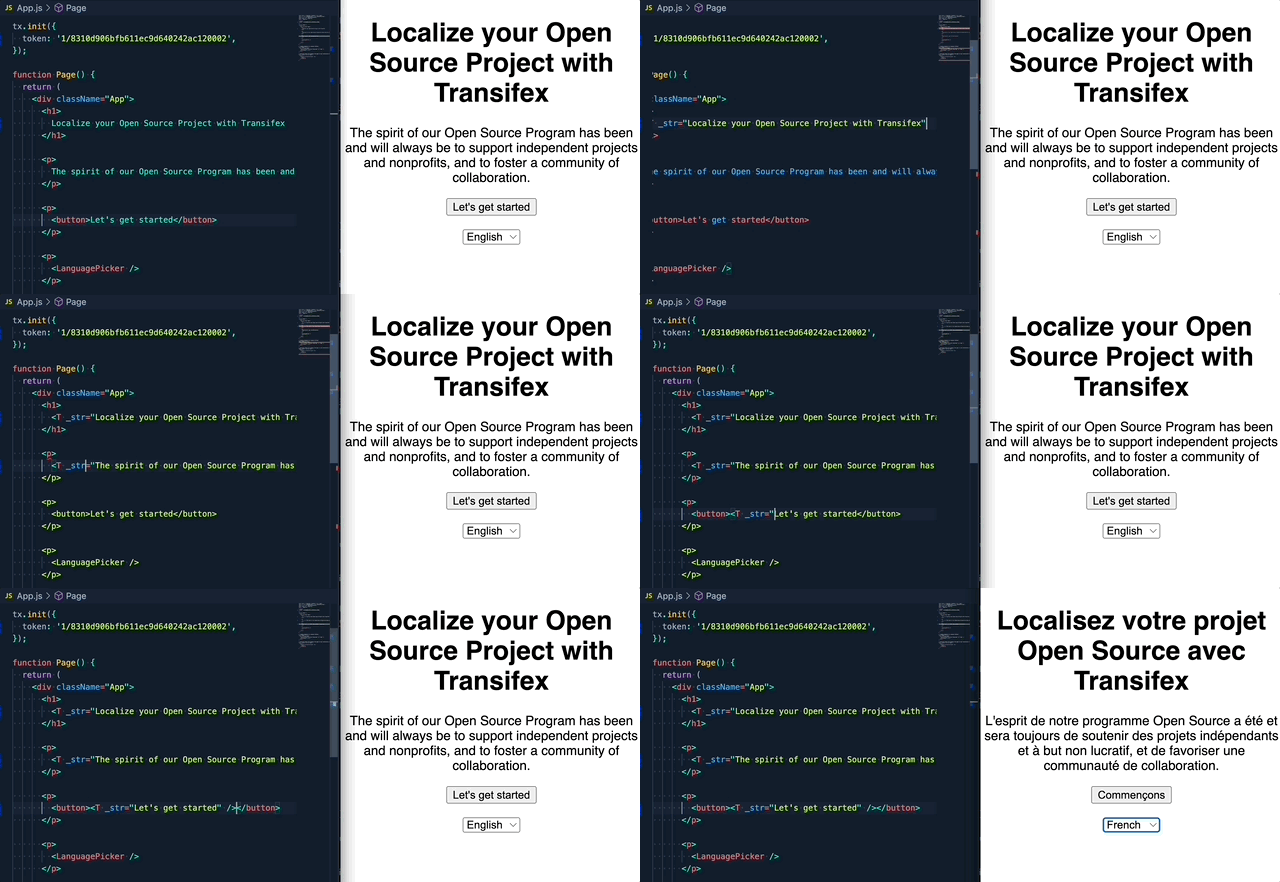
Step3: Internationalize the code using the SDK.
Step4: Push source phrases using the @transifex/cli tool.
Step5: Translate the app using over-the-air updates.
No translation files required.
Upgrade to v2
If you are upgrading from the 1.x.x version, please read this migration guide, as there are breaking changes in place.
Install
Install the library and its dependencies using:
npm install @transifex/native @transifex/react --saveUsage
T Component
import React from 'react';

import { T } from '@transifex/react';

function Example() {
  return (
    <div>
      <T _str="Hello world" />
      <T _str="Hello {username}" username={user} />
    </div>
  );
}
Available optional props:
| Prop | Type | Description | |------------|--------|---------------------------------------------| | _context | String | String context, affects key generation | | _key | String | Custom string key | | _comment | String | Developer comment | | _charlimit | Number | Character limit instruction for translators | | _tags | String | Comma separated list of tags |
The T-component can accept React elements as properties and they will be rendered properly, ie this would be possible:
<T
  _str="A {button} and a {bold} walk into a bar"
  button={<button><T _str="button" /></button>}
  bold={<b><T _str="bold" /></b>} />
This will render like this in English:
A <button>button</button> and a <b>bold</b> walk into a barAnd like this in Greek:
Ένα <button>κουμπί</button> και ένα <b>βαρύ</b> μπαίνουν σε ένα μπαρAssuming the translations look like this:
| source | translation | |-----------------------------------------|--------------------------------------------------| | A {button} and a {bold} walk into a bar | Ένα {button} και ένα {bold} μπαίνουν σε ένα μπαρ | | button | κουμπί | | bold | βαρύ |
The main thing to keep in mind is that the _str property to the T-component
must always be a valid ICU messageformat template.
UT Component
import React from 'react';

import { UT } from '@transifex/react';

function Example () {
  return (
    <div>
      <UT _str="Hello <b>{username}</b>" username={user} />
      <p>
        <UT _str="Hello <b>{username}</b>" _inline username={user} />
      </p>
    </div>
  )
}
UT has the same behaviour as T, but renders source string as HTML inside a
div tag.
Available optional props: All the options of T plus:
| Prop | Type | Description |
|---------|---------|-------------------------------------------------|
| _inline | Boolean | Wrap translation in span |
Note: If you supply React elements as properties to the UT component, it
will misbehave by rendering [object Object]. Only use React elements as
properties with the T component.
useT hook
Makes the current component re-render when a language change is detected and returns a t-function you can use to translate strings programmatically.
You will most likely prefer to use the T or UT components over this, unless
for some reason you want to have the translation output in a variable for
manipulation.
import React from 'react';

import { useT } from '@transifex/react';

function Capitalized() {
  const t = useT();
  const message = t('Hello world');
  return <span>{message.toUpperCase()}</span>;
}
Optionally useT can take as param a custom Native Instance:
import { useT } from '@transifex/react';
import { createNativeInstance } from '@transifex/native';

const customTX = createNativeInstance({
  token: 'token',
  secret: 'secret',
});

function Component() {
  const t = useT(customTX);
  // ...
}
useLanguages hook
Returns a state variable that will eventually hold the supported languages of the application. Makes an asynchronous call to the CDS.
import React from 'react';
import { useLanguages } from '@transifex/react';

function LanguageList () {
  const languages = useLanguages();
  return (
    <ul>
      {languages.map(({ code, name }) => (
        <li key={code}>
          <strong>{code}</strong>: {name}
        </li>
      ))}
    </ul>
  );
}
Optionally useLanguages can take as param a custom Native Instance:
import { useT } from '@transifex/react';
import { createNativeInstance } from '@transifex/native';

const customTX = createNativeInstance({
  token: 'token',
  secret: 'secret',
});

function Component() {
  const languages = useLanguages(customTX);
  // ...
}
useLocale hook
Returns a state variable with the currently selected locale.
import React from 'react';
import { useLocale } from '@transifex/react';

function DisplayLocale () {
  const locale = useLocale();
  return (
    <p>Currently selected locale is {locale}</p>
  );
}
Optionally useLocale can take as param a custom Native Instance:
import { useT } from '@transifex/react';
import { createNativeInstance } from '@transifex/native';

const customTX = createNativeInstance({
  token: 'token',
  secret: 'secret',
});

function Component() {
  const locale = useLocale(customTX);
  // ...
}
useTX hook
Returns a state variable with the Native instance.
import React from 'react';
import { useTX } from '@transifex/react';

function SetLocale () {
  const tx = useTX();
  return (
    <button onClick={() => tx.setCurrentLocale('el')}>
      Set to Greek
    </button>
  );
}
LanguagePicker component
Renders a <select> tag that displays supported languages and switches the
application's selected language on change.
Uses useLanguages and useLocale internally.
import React from 'react';
import { T, LanguagePicker } from '@transifex/react';

function App () {
  return (
    <div>
      <T _str="This is a translatable message" />
      <LanguagePicker />
    </div>
  );
}
Accepts properties:
className: The CSS class that will be applied to the<select>tag
If you want something different than a <select>, it should be easy to write
your own language picker using useLanguages:
import React from 'react';
import { tx } from '@transifex/native';
import { useLanguages, useLocale } from '@transifex/react';

function MyLanguagePicker () {
  const languages = useLanguages();
  const locale = useLocale();

  return (
    <>
      {languages.map(({ code, name }) => (
        <button key={code} onClick={() => tx.setCurrentLocale(code)}>
          {name} {locale === code ? '(selected)' : ''}
        </button>
      ))}
    </>
  );
}
useTranslations hook - aka Lazy Loading
Fetches translations tagged with a specific combination of tags when a component first renders. This way, you can pull translations from the CDS in batches and only when needed:
tx.init({ token: ..., filterTags: 'home' });

export default function App() {
  return (
    <>
      <T _str="This will be translated as soon as possible" _tags="home" />
      {someCondition() && <Inner />}
    </>
  );
}

function Inner() {
  useTranslations('inner');
  return <T
    _str="This will be translated when the inner component is rendered"
    _tags="inner" />;
}
The hook returns a boolean state variable called ready that you can use to
handle a loading state:
function Inner() {
  const { ready } = useTranslations('inner');
  if (!ready) { return 'Loading...'; }
  return <T
    _str="This will be translated when the inner component is rendered"
    _tags="inner" />;
}
If you don't handle the loading state, the source string will be rendered first and then replaced with the translation when it becomes available.
You can also use the hook in parent components that don't need the tagged translations themselves. This will make the translations available sooner for child components that may potentially need them:
tx.init({ token: ..., filterTags: 'home' });

export default function App() {
  const { ready: innerReady } = useTranslations('inner');
  return (
    <>
      <T _str="This will be translated as soon as possible" _tags="home" />
      {someCondition() && <Inner ready={innerReady} />}
    </>
  );
}

function Inner({ ready }) {
  if (!ready) { return 'Loading...'; }
  return <T
    _str="This will be translated when the inner component is rendered"
    _tags="inner" />;
}
Optionally useTranslations can take as a second param a custom Native Instance:
import { useT } from '@transifex/react';
import { createNativeInstance } from '@transifex/native';

const customTX = createNativeInstance({
  token: 'token',
  secret: 'secret',
});

function Component() {
  const { ready } = useTranslations('inner', customTX);
  // ...
}
TXProvider provider
If you need to use more than one Transifex Native instances - like for example if you have a component library - you can use this provider to pass the desired instance to the children components.
import { tx, createNativeInstance } from '@transifex/native';
import { TXProvider, LanguagePicker, T } from '@transifex/react';

const myOtherTXInstance = createNativeInstance();
myOtherTXInstance.init({ token: 'othertoken' })

tx.init({
  token: 'token',
});

// Make tx aware of the other instances so they can be synced when changing
// language
tx.controllerOf(myOtherTXInstance);

export default function App() {
  return (
    <>
      <LanguagePicker />
      <TXProvider instance={myOtherTXInstance}>
        <T _str="Hello {username}" username="John" />
      </TXProvider>
      <T _str="Hello World" />
    </>
  );
}
Next.js
App Router
All components and hooks in this package are Client Components (they rely on
React hooks and context), and the built bundle is published with the
"use client" directive. This means you can import T, UT, LanguagePicker,
TXProvider and the hooks directly inside the Next.js App Router without getting
the "you're importing a component that needs useState ..." error, as long as
they render inside a Client Component subtree.
Because the App Router renders on the server across concurrent requests, do
not rely on the global tx singleton for server rendering. Instead create a
per-request instance with createNativeInstance so locales from different
requests cannot leak into each other.
Rendering translations in a Server Component
Create a small per-request helper:
// app/i18n/getServerTx.js
import { createNativeInstance, normalizeLocale } from '@transifex/native';

export async function getServerTx(locale) {
  const txLocale = normalizeLocale(locale); // e.g. pt-br -> pt_BR
  const instance = createNativeInstance({
    token: process.env.NEXT_PUBLIC_TRANSIFEX_TOKEN,
    currentLocale: txLocale,
  });
  await instance.fetchTranslations(txLocale);
  return instance;
}
Use it inside an async Server Component (for example a [locale] segment):
// app/[locale]/page.jsx
import { getServerTx } from '../i18n/getServerTx';

export default async function Page({ params }) {
  const { locale } = await params;
  const tx = await getServerTx(locale);
  return <h1>{tx.t('Hello world')}</h1>;
}
In Next.js 15+,
paramsis a Promise and must be awaited (as shown above). In Next.js 14 and earlier,paramsis a plain object, so you can readparams.localedirectly withoutawait.
You can enumerate the available locales for generateStaticParams with
tx.getLocales().
Hydrating Client Components
For interactive parts that use T, hooks or the LanguagePicker, fetch the
translations on the server and pass them into a Client Component that seeds a
TXProvider:
// app/i18n/TxClientProvider.jsx
'use client';

import { useMemo } from 'react';
import { createNativeInstance } from '@transifex/native';
import { TXProvider } from '@transifex/react';

export default function TxClientProvider({ locale, translations, children }) {
  const instance = useMemo(() => {
    const tx = createNativeInstance({ currentLocale: locale });
    tx.cache.update(locale, translations);
    return tx;
  }, [locale, translations]);

  return <TXProvider instance={instance}>{children}</TXProvider>;
}
// app/[locale]/layout.jsx (Server Component)
import { normalizeLocale } from '@transifex/native';
import { getServerTx } from '../i18n/getServerTx';
import TxClientProvider from '../i18n/TxClientProvider';
export default async function LocaleLayout({ children, params }) {
const { locale } = await params;
const txLocale = normalizeLocale(locale);
const tx = await getServerTx(locale);
const translations = tx.cache.getTranslations(txLocale);
return (
<TxClientProvider locale={txLocale} translations={translations}>
{children}
</TxClientProvider>
);
}Client Components rendered inside the provider can then use T and the hooks as
usual.
App Router notes and limitations
- The App Router does not use the
i18noption innext.config.js. Set up locale routing with a[locale]dynamic segment (or middleware) instead. publicRuntimeConfigis not available in the App Router. Use environment variables (NEXT_PUBLIC_*) for the public token.- Live language switching, over-the-air auto-refresh and
LanguagePickerrequire Client Components. - Server-side rendering of translations (
tx.t(...)in a Server Component) uses the per-request instance and does not ship JavaScript for that content.
Pages Router
The Pages Router uses Next.js built-in Internationalized Routing
(i18n in next.config.js) together with getServerSideProps to fetch
translations on the server and hydrate the client. In this model the global tx
singleton is the recommended approach — each getServerSideProps call runs in
isolation per request.
Configure locales and token
// next.config.js
module.exports = {
  i18n: {
    locales: ['en', 'fr', 'de', 'pt-BR'],
    defaultLocale: 'en',
    localeDetection: false,
  },
  publicRuntimeConfig: {
    TxNativePublicToken: process.env.NEXT_PUBLIC_TRANSIFEX_TOKEN,
  },
};
Create a Transifex utility
// lib/i18n.js
import { tx, normalizeLocale } from '@transifex/native';
import getConfig from 'next/config';

const { publicRuntimeConfig } = getConfig();

/**
 * Used by SSR to pass translations to the browser.
 *
 * @param {{ locale: string, locales: string[] }} context
 * @returns {{ locale: string, locales: string[], translations: object }}
 */
export async function getServerSideTranslations({ locale, locales }) {
  tx.init({
    token: publicRuntimeConfig.TxNativePublicToken,
  });

  const txLocale = normalizeLocale(locale);
  await tx.fetchTranslations(txLocale);

  return {
    locale,
    locales,
    translations: tx.cache.getTranslations(txLocale),
  };
}

/**
 * Initialize the client-side Transifex Native cache from server props.
 *
 * @param {{ locale: string, translations: object }} props
 */
export function setClientSideTranslations({ locale, translations }) {
  if (!locale || !translations) return;
  tx.init({ currentLocale: locale });
  tx.cache.update(locale, translations);
}
Load translations per page
// pages/index.js
import { T } from '@transifex/react';
import { getServerSideTranslations, setClientSideTranslations } from '../lib/i18n';

export default function Home(props) {
  setClientSideTranslations(props);

  return (
    <div>
      <T _str="Hello world" />
    </div>
  );
}

export async function getServerSideProps(context) {
  const data = await getServerSideTranslations(context);
  return { props: { ...data } };
}
Set translations globally in _app.js
To avoid calling setClientSideTranslations on every page, initialize the
client cache once in your custom App:
// pages/_app.js
import { setClientSideTranslations } from '../lib/i18n';

export default function MyApp({ Component, pageProps }) {
  setClientSideTranslations(pageProps);
  return <Component {...pageProps} />;
}
You still need getServerSideProps on each page that requires translations,
because _app.js does not support data fetching methods.
Pages Router notes and limitations
- Locale routing is handled by Next.js
i18nconfig — no[locale]segment or middleware is required. publicRuntimeConfigis available and is the documented way to pass the public token to server-side code.T,UT, hooks andLanguagePickerwork directly in page components without a"use client"boundary (the Pages Router does not use React Server Components).- For over-the-air translation refresh without a server restart, add a TTL-based
refresh in
getServerSideTranslations(see the Next.js guide). - For large sites, consider content splitting with tagged fetches to reduce data transfer.
License
Licensed under Apache License 2.0, see LICENSE file.