
@trevixal/angular
v1.0.5
Published
Angular bindings for the Trevixal editor: a signal-backed snapshot and view lifecycle, with no Angular compiler required.
Downloads
495

Maintainers
 adityabhalsod
Readme
@trevixal/angular




Documentation · Live editor · Changelog · Issues
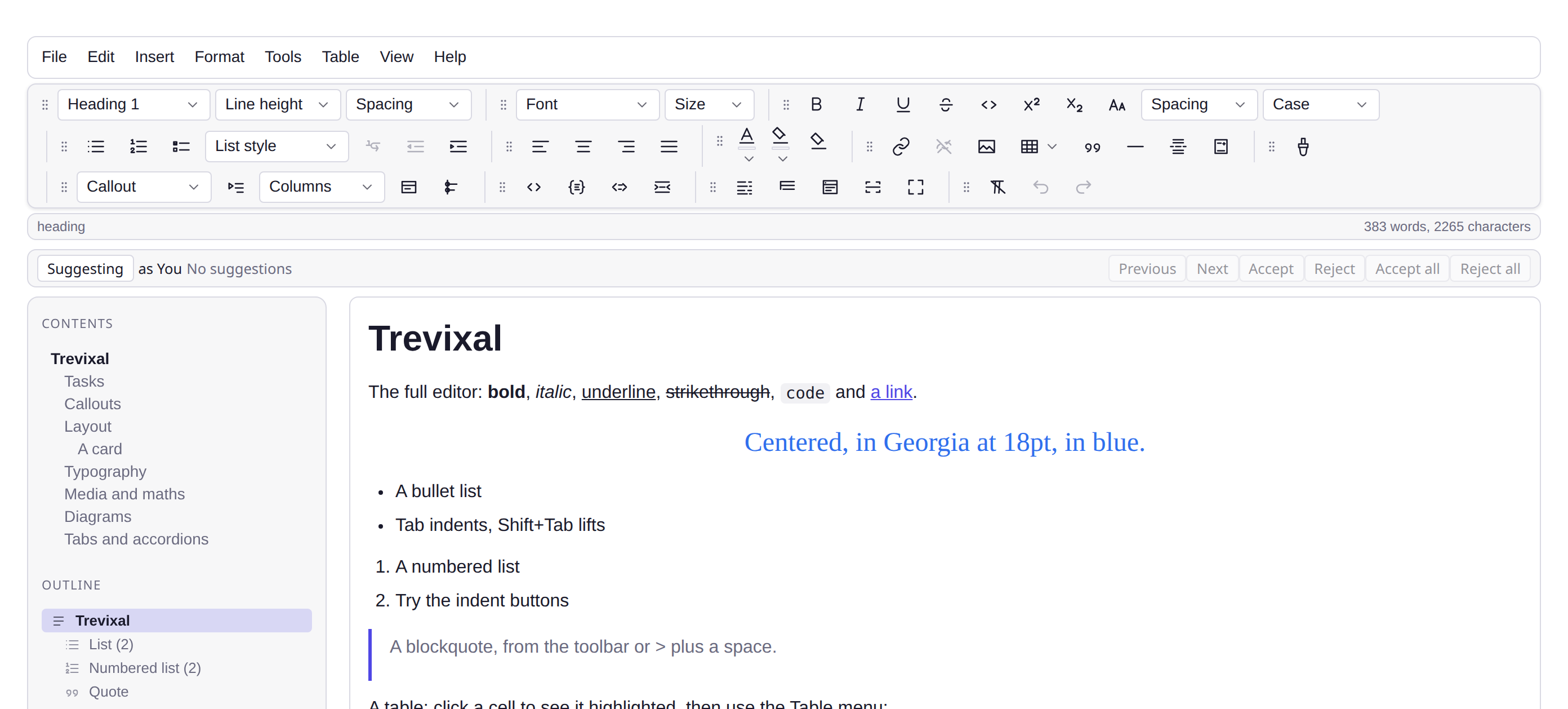
Features
- A signal-backed snapshot and a view lifecycle tied to the component
- No Angular compiler required: it is a plain library, not a schematic
- 0.3 kB minified and gzipped, with TypeScript types in the package
Angular bindings for the Trevixal editor: a signal-backed snapshot and the view lifecycle, with no Angular compiler required.
npm install @trevixal/core @trevixal/angularUsage
import { Component, DestroyRef, ElementRef, afterNextRender, computed, inject, viewChild } from '@angular/core'
import { Schema, defaultMarks, defaultNodes } from '@trevixal/core'
import { createAngularEditor } from '@trevixal/angular'

const schema = new Schema({ nodes: defaultNodes(), marks: defaultMarks() })

@Component({
  selector: 'app-editor',
  standalone: true,
  template: `
    <button
      [attr.aria-pressed]="isBold()"
      (mousedown)="$event.preventDefault()"
      (click)="editor.commands.toggleMark('bold')"
    >Bold</button>

    <div class="trevixal" #host></div>
  `,
})
export class EditorComponent {
  private readonly host = viewChild.required<ElementRef<HTMLElement>>('host')
  private readonly binding = createAngularEditor({ schema })

  readonly editor = this.binding.editor
  readonly isBold = computed(() => this.binding.snapshot()?.activeMarks.includes('bold') ?? false)

  constructor() {
    afterNextRender(() => this.binding.attach(this.host().nativeElement))
    inject(DestroyRef).onDestroy(() => this.binding.destroy())
  }
}
mousedown is cancelled rather than handled on click: the toolbar must not
take the selection the command is about to act on.
No compiler, and why that matters
There is no @Component, @Directive or @Injectable in this package. A
package that ships those has to be built by Angular's own compiler into
partial-Ivy output, a second toolchain for a few dozen lines of glue, and a
hand-rolled imitation of that output would be worse than shipping nothing.
That is why this adapter was deferred for a long time
(ADR-0007).
What the glue actually needs from Angular is signal, which is an ordinary
function. So this ships ordinary functions. Your component owns the
decorators; nothing here needs compiling beyond TypeScript, and the package
builds with the same tsup pipeline as every other one in the repository.
Zoneless by construction
The snapshot is a signal, so a change notifies exactly the templates that read
it. No NgZone, no markForCheck, and nothing else re-renders while somebody
types.
It goes further than that: the snapshot keeps its identity while nothing a
toolbar would draw differently has changed, so ten keystrokes produce one
signal change, the first, which flips canUndo, rather than ten.
Server rendering
createAngularEditor touches no DOM. The view is built only by attach, so a
component can construct the binding in a field initialiser, before its
template exists and on a server that has no document at all.
Exports
| Export | What it does |
| --- | --- |
| createAngularEditor(options) | The editor, its snapshot signal, attach(host) and destroy() |
| editorSnapshotSignal(editor) | Just the signal, for an editor you already have |
| AngularEditor, AngularEditorOptions | The types |
attach returns a disposer, and calling it again replaces the view rather
than stacking a second one, so a host that re-renders its container does not
end up with two editors on one document.
License
Apache-2.0