
@trevixal/core
v1.0.5
Published
Framework-agnostic WYSIWYG rich text editing engine. Immutable state, schema-validated documents, invertible transactions.

Maintainers
 adityabhalsod
Readme
@trevixal/core




Documentation · Live editor · Changelog · Issues
Features
- Immutable document model: schema-validated JSON you can store, diff and transform
- Invertible transactions, so undo is step inversion rather than a second history
- Runs headless in Node with no DOM, for migrations, tests and server rendering
- Imported HTML parsed inside an inert template through an allowlist
- 36.2 kB minified and gzipped, with TypeScript types in the package
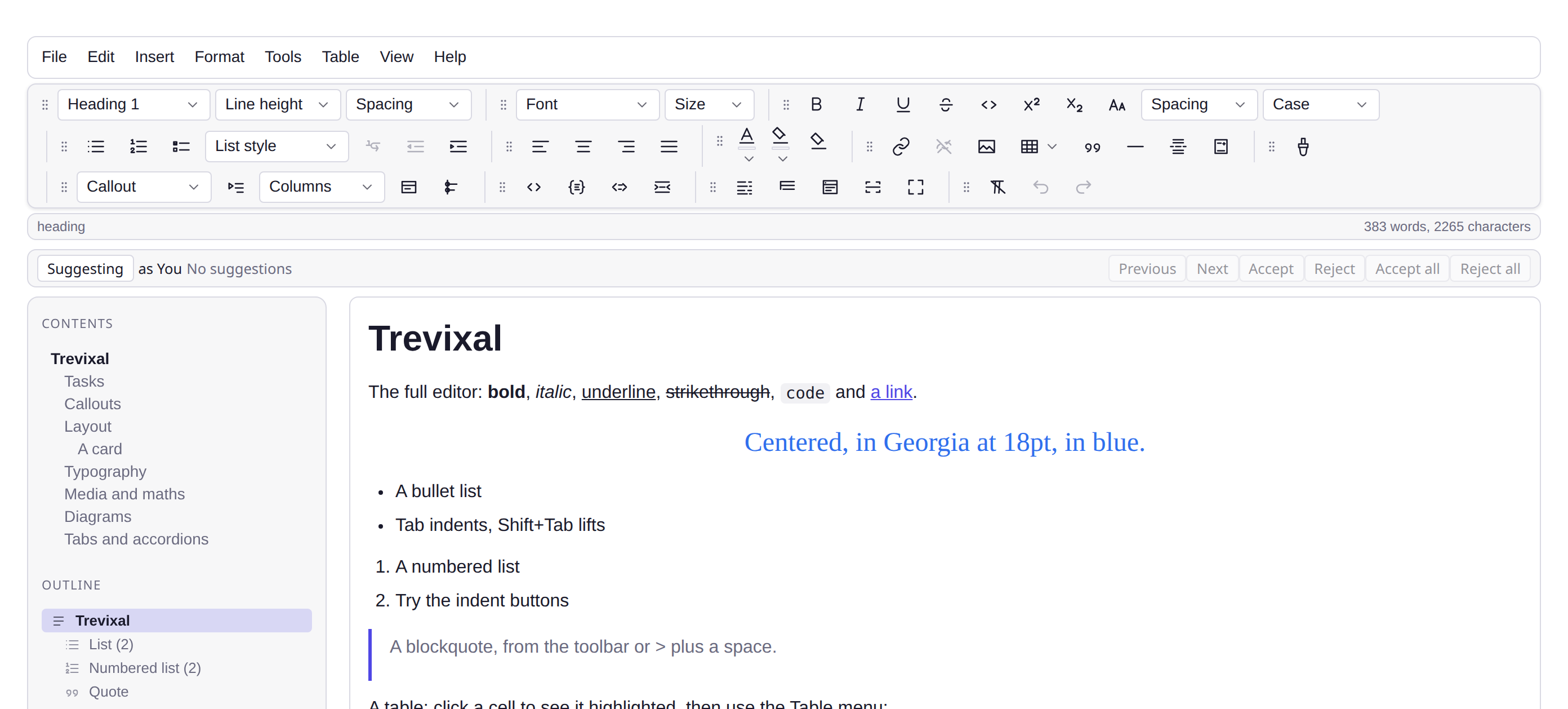
The editing engine: an immutable document model, invertible transactions, and a contenteditable view that treats the DOM as a render target rather than the truth. No framework code, no runtime dependencies, safe to import on a server.
npm install @trevixal/coreUsage
import { createEditor, Schema, defaultNodes, defaultMarks } from '@trevixal/core'

const editor = createEditor({
  schema: new Schema({ nodes: defaultNodes(), marks: defaultMarks() }),
  element: document.querySelector('#editor'), // omit for a headless editor
  placeholder: 'Write something…',
  onChange: ({ json }) => save(json),
})

editor.commands.toggleMark('bold')
editor.chain().focus().setHeading(2).insertText('Hello').run()
editor.getJSON()   // what you store
editor.getHTML()   // an export format, not the storage format
Omit element and the identical engine runs with no DOM at all, for
server-side processing, migrations and tests.
The shape of it
| Area | What lives there |
| --- | --- |
| model/ | EditorNode, Fragment, Mark, Schema, content expressions, and positions as { path, offset } |
| state/ | EditorState, Transaction, and ten invertible step types |
| commands/ | (state) => Transaction \| null functions; editor.commands is a facade over them |
| view/ | The renderer, beforeinput handling, the IME composition machine, MutationObserver repair, decoration layers |
| history/ | Undo over inverted steps, with time and adjacency grouping |
| serialize/ | HTML, Markdown and text out; sanitized HTML in; paste-source cleanup |
| suggest/ | The trigger driver behind / and : menus |
| a11y/ | The live-region announcer for edits a screen reader cannot see coming |
Three things worth knowing
The DOM is never the source of truth. State is immutable; the surface is an input source and a render target. Everything else follows from that.
Every change is an invertible step. Undo is step inversion, not a second bookkeeping system, and every step remaps positions, so selections, decorations and suggestion ranges survive arbitrary edits. A property test applies 200 random steps, inverts them, and checks the document is restored.
Imported HTML is parsed inside an inert <template> through an allowlist,
with a protocol allowlist on every URL. Scripts cannot run during parsing, and
an XSS corpus holds it to that.
The DOM is patched, never rewritten. An attribute is only written when
its value actually changed. Assigning one the value it already has is still a
write. It invalidates style, it shows up as a mutation to anything watching,
and on an <iframe> assigning src reloads the frame. Since a decoration
layer puts the whole document through the renderer again, and extensions
refresh those on a timer, writing unconditionally restarted every embed in the
document a few hundred milliseconds after every keystroke.
Focusing the surface never moves the page. view.focus() hands focus back
without scrolling: it is called after a menu, a dialog or the command palette
took focus, and the caret can be a whole document away from what the reader is
looking at. Navigation says so instead: view.scrollSelectionIntoView().
Extending it
Four public hooks, and every extension package in this repository is built on
them alone: onTransaction, addDispatchTransform, setDecorationLayer, and
the suggestion trigger module, plus schema merging, keymap, inputRules
and nodeViews. If something needs more, the hook set is incomplete; see
ADR-0008.
License
Apache-2.0