
@underactive/pi-topping-persona-audit
v0.1.3
Published
Pi extension implementing /persona-audit — multi-persona code reviews with TUI expert selection and findings review


Readme
pi-topping-persona-audit
A Pi coding agent extension that implements /persona-audit — multi-persona code reviews with interactive TUI expert selection and findings triage.
Features
- Multi-persona reviews — Runs parallel reviewer agents with distinct personalities (security, correctness, style, performance, etc.)
- Deterministic orchestration — The entire audit is driven by TypeScript, not by an LLM following instructions; LLMs run only where judgment is required (reviewer passes, adjudication, fix application), each in an isolated in-process agent session
- TUI expert picker — Interactive terminal UI to select which reviewer personas to include: one multi-select list of all 40 reviewers, grouped under tier headers with type-to-filter, so a run can mix tiers freely —
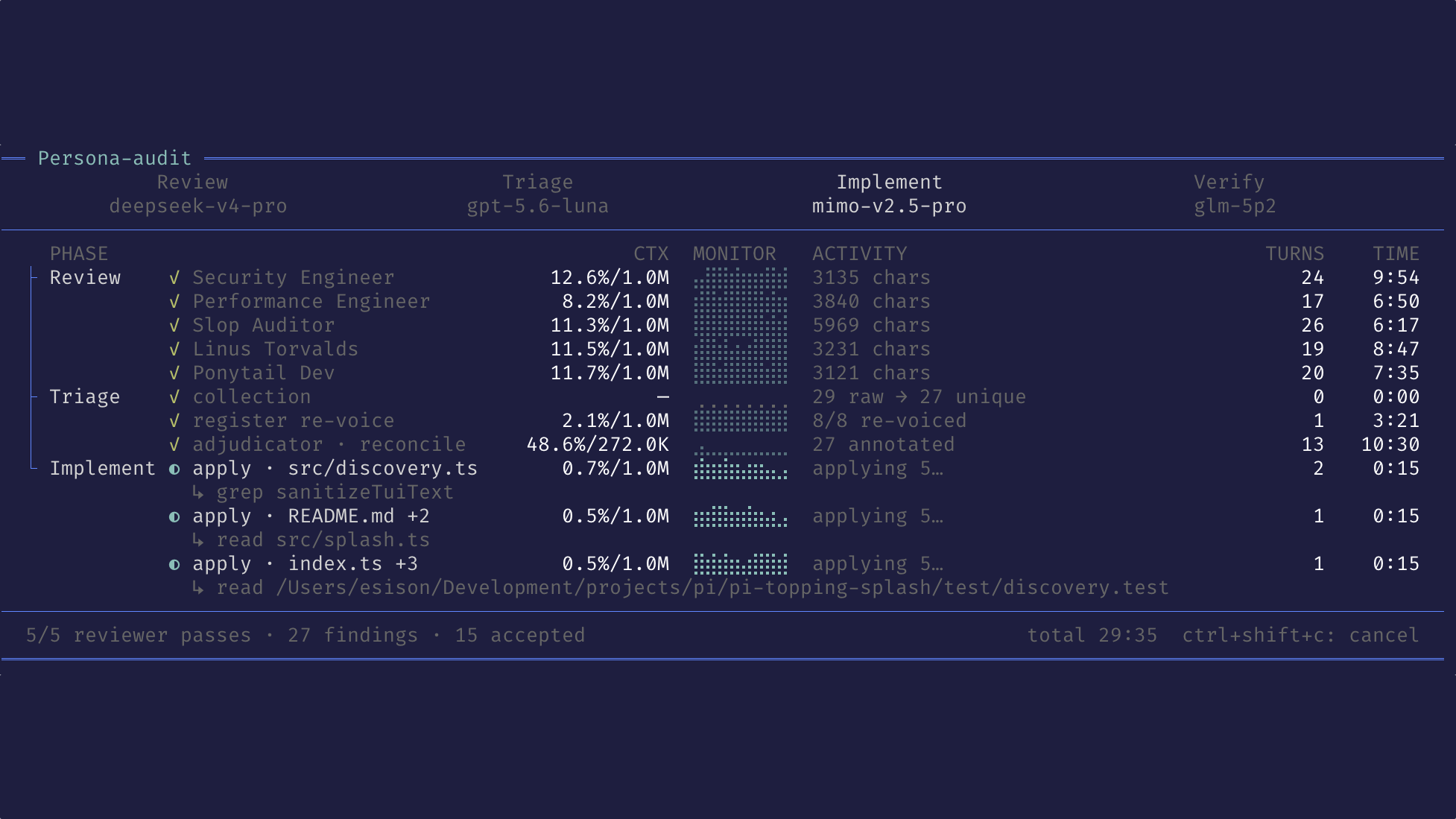
Spacetoggles a reviewer,←/→set the pass count (1-5),Enterconfirms - Live progress table — One compact table above the editor tracks every reviewer pass, adjudicator run, and verification script with live context usage, an output-activity meter, the tool call in flight, turn count, and elapsed time; a phase/model band shows which model is assigned to each phase and highlights the one in progress, and a frozen copy is left in the transcript on completion, visible but excluded from the model's context on later turns
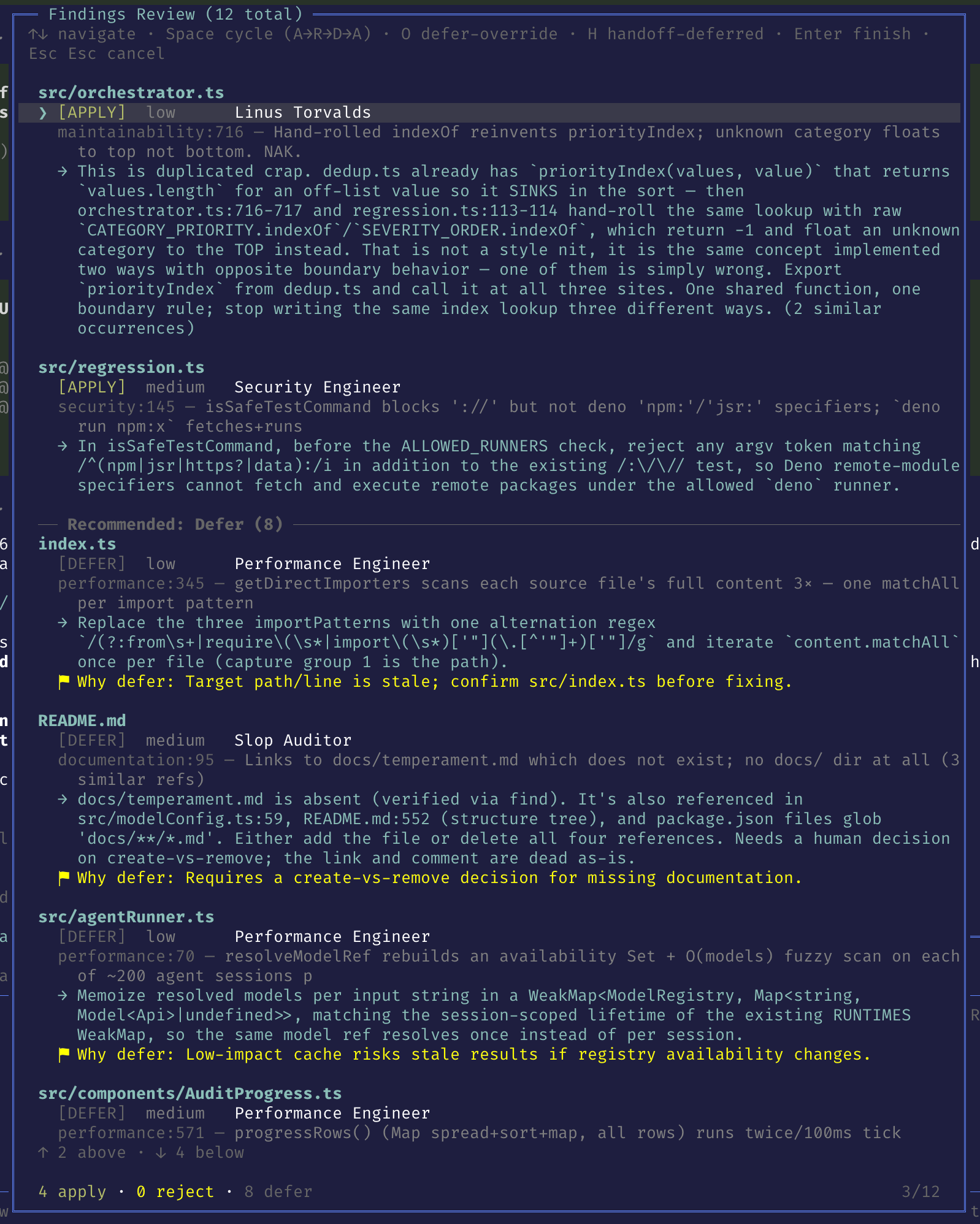
- Findings review — Accept, reject, or defer individual findings before applying fixes (press Esc twice to cancel — the first press arms the confirmation, any other key resumes; press
Hduring review to write deferred findings to a handoff file under.pi/persona-audit/handoffs/;Spacecycles a finding apply → reject → defer,Opromotes a deferred finding straight to apply,Enterconfirms) - Auto-fix — Accepted findings are partitioned by file and applied by parallel edit-capable adjudicator agent sessions, then verified against the project's own
check/lint/testscripts - Fix verification — Every accepted fix gets its own verdict: the file is hashed before and after the implement phase, a verifier agent session diffs each change against its finding, and high-severity bug/security fixes get a regression test the harness proves fails without the fix
- Incremental cache — Reviewer passes are cached by manifest+selection hash; unchanged re-runs skip agent-session spawns
- Durable progress — A partial report is updated after every reviewer pass; cancellation or failure never loses completed work
- Audit report viewer — Opens the completed report in a scrollable Markdown overlay; use arrows to scroll,
u/dto page,g/Gfor top/bottom, andEscto close. Cancelled audits do not open the viewer. - Audit report — Generates a structured report in
.pi/persona-audit/audits/ - Settings menu —
/persona-audit-settingsconfigures the progress table's activity monitor (color and scroll direction), the Linus Torvalds reviewer's temperament, and the fix + verify round cap
Install
pi install npm:@underactive/pi-topping-persona-auditRestart Pi (or run /reload) to pick it up.
The extension registers itself automatically via package.json — Pi discovers it when installed as a dependency or linked into a Pi workspace.
Usage
Via Pi chat
/persona-audit --diff [--base <commit>] [path]
/persona-audit --full [path]
Exactly one of --diff or --full is required.
--diff— focused reviews of only changed files and their direct importers. Requires a git repository.--full— a deterministic whole-tree scan of the given path. No git repository required — use this for plain-filesystem projects, generated exports, or any directory that isn't (yet) a git repo.
Command Options
--diff— Enable diff-based mode (mutually exclusive with--full)--full— Enable full-tree mode, no git required (mutually exclusive with--diff)--base <commit>— Base commit to diff against,--diffonly (default: merge-base with main)[path]— Optional path filter (default: ".")
Examples
# Review changes since merge-base with main
/persona-audit --diff

# Review changes since a specific commit
/persona-audit --diff --base abc123

# Review changes in src/ directory only
/persona-audit --diff src/

# Review changes since 5 commits ago in components
/persona-audit --diff --base HEAD~5 src/components

# Audit an entire project that isn't a git repo
/persona-audit --full

# Audit only a subdirectory of a non-git (or git) project
/persona-audit --full src/components
Settings
/persona-audit-settings| Setting | Values | Default |
| --- | --- | --- |
| Token activity monitor color | accent, border, borderAccent, success, error, warning | accent |
| Token activity monitor direction | Left to Right, Right to Left | Right to Left |
| Linus Torvalds temperament | neutral (min), caustic, LKML (max) | neutral (min) |
| Max fix + verify rounds | 1–10 | 3 |
The first two control the progress table's MONITOR column (see Progress table).
Max fix + verify rounds caps the automatic gate-repair loop (see Fix + verify rounds):
round 1 is the initial verify, and each round after it is one auto-repair attempt, so 1 turns
auto-repair off and 10 allows up to nine repairs before the run gives up.
Temperament sets the register of the Linus Torvalds reviewer only — tone, not substance: the
focus areas and severity grading are identical at every level, and no level permits abuse
of the author. caustic and LKML (max) produce deliberately hostile-reading prose in a report
humans have to triage; LKML (max) is the register of a vintage kernel-list mail.
All of these take effect on the next audit, and changing temperament invalidates the reviewer cache.
Saving writes to <pi agent dir>/persona-audit/settings.json, the same file the per-phase model
picker uses, leaving that picker's saved choices untouched.
Requirements
- Pi 0.84.2 (
@earendil-works/pi-coding-agentand@earendil-works/pi-tuiare pinned to this exact version in package.json) — agent tasks run in-process via the publiccreateAgentSession()SDK; nopiCLI on PATH is required. - Node.js ≥ 22.x (uses
--experimental-strip-typesor erasable syntax) - A configured Pi provider/model (providers registered by extensions are replayed onto a fresh runtime by
buildRuntimeWithExtensionProviders)
Reviewer personas
The extension includes 40 reviewer personalities. Tiers group them under headers in the picker; they do not constrain a selection, which may draw from any combination of the three:
Holistic Tier — Big-picture reviewers:
- Principal Engineer
- Software Architect
- Full-Stack Engineer
- Reliability Engineer
- Staff Engineer
Specialist Tier — Focused domain experts:
- Code Quality Engineer
- Security Engineer
- Testing Engineer
- Frontend Engineer
- Backend Engineer
- Performance Engineer
- Accessibility Engineer
- DevOps Engineer
- Data Engineer
- Infrastructure Engineer
- DX Engineer
- Mobile Engineer
- Documentation Writer
- AI Engineer
- Slop Auditor
Persona Tier — Famous engineers (and one fictional archetype) and their philosophies:
- Martin Fowler
- Kent Beck
- Sandi Metz
- Rich Hickey
- Anders Hejlsberg
- John Ousterhout
- Kamil Mysliwiec
- Kent Dodds
- Tanner Linsley
- Vladimir Khorikov
- Michael Feathers
- Rob Pike
- Bryan Cantrill
- Charity Majors
- Barbara Liskov
- Casey Muratori
- Titus Winters
- Julia Evans
- Linus Torvalds
- Ponytail Dev
Diff Mode Workflow
- Changed file detection — programmatically scans git diff for changed files (no LLM)
- Importer scanning — heuristic JS/TS relative-path matching for direct importers of changed modules
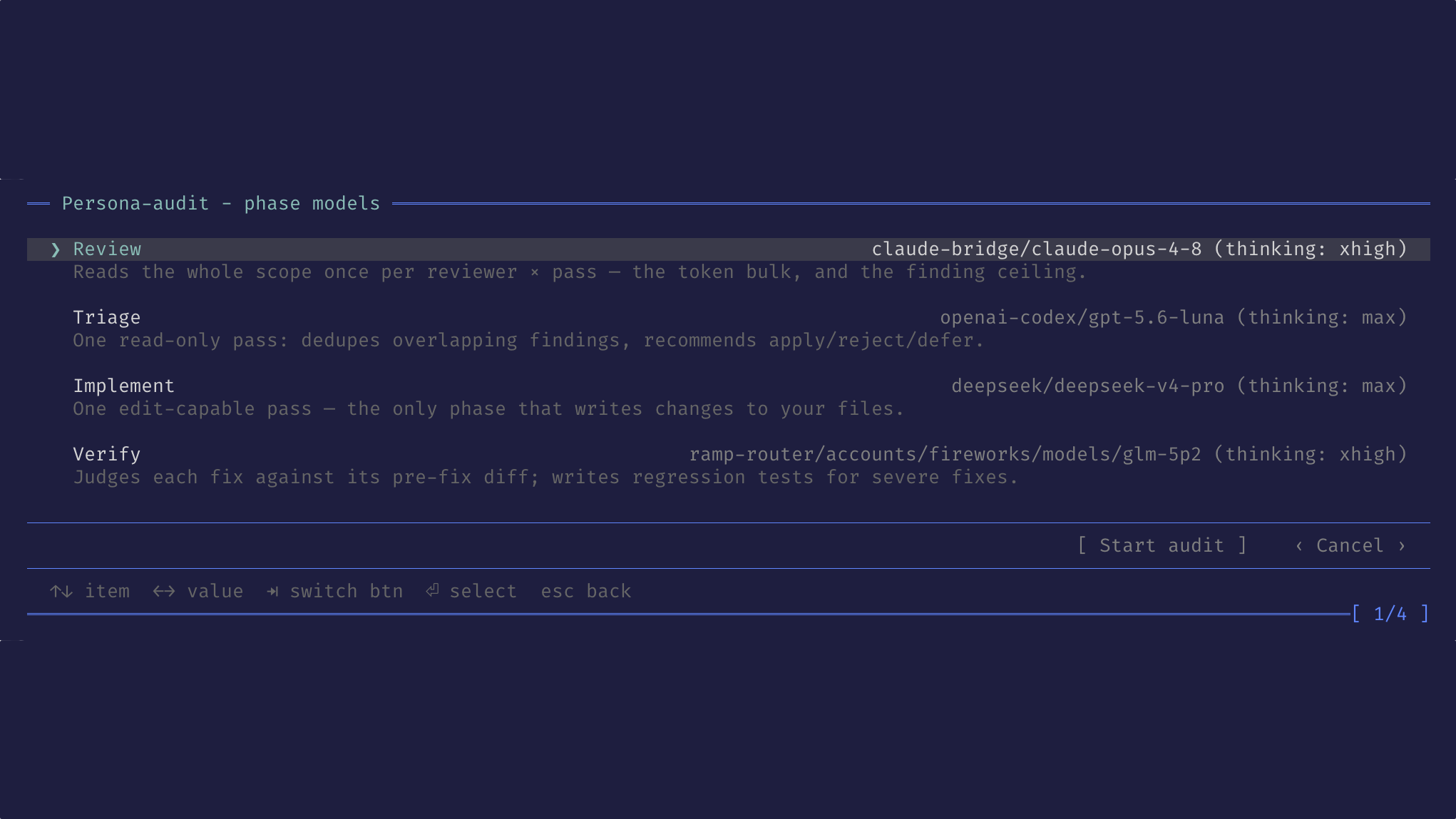
- Reviewer selection — a TUI picker opens for selecting expert personas and passes (no LLM thinking), followed by a per-phase model + thinking-level picker. Reviewers are listed together under tier headers, so any cross-tier combination is selectable
- Parallel review — the extension spawns each selected reviewer×pass as an isolated in-process agent session (max 5 concurrent), skipping passes already in the incremental cache
- Collection & dedup — reviewer JSON-lines outputs are parsed, validated, and deduplicated deterministically in TypeScript
- Adjudicator reconciliation — a read-only adjudicator agent session annotates each finding with an apply/reject/defer recommendation
- Findings triage — results are presented in a TUI for accept/reject/defer (press
Hto write current deferred findings to.pi/persona-audit/handoffs/; Esc twice cancels and a partial report is kept) - Fix, verify & report — edit-capable adjudicator agent sessions apply accepted fixes in parallel, one per disjoint set of files, the extension verifies each fix individually (see Verification), runs the project's
check/lint/testscripts, writes the report to.pi/persona-audit/audits/, posts a summary in chat, then opens the report viewer (except for cancelled audits)
Full-Tree Mode Workflow
--full replaces steps 1–2 above with a single deterministic step and needs no git repository at all:
- Directory scan — programmatically scans the whole directory tree under
[path](no LLM), using a broad, language-agnostic extension allowlist (not just JS/TS) and excluding common vendor/build/cache directories (node_modules,.git,dist,build,.venv,target,.idea, lockfiles, etc.) - Deterministic cap — the manifest is sorted, then capped at 500 files; if the scan finds more, the extra files are excluded (never sampled) and a warning is shown plus noted in the report so you can narrow the scope path
- Steps 3–8 are identical to diff mode (reviewer selection, parallel review, collection & dedup, adjudicator reconciliation, findings triage, fix/verify/report)
Workflow
flowchart TD
  A[/persona-audit --diff or --full/] --> B[Git diff file scan OR full-tree scan]
  B --> C[Importer scanning, diff-only]
  C --> D[Expert picker TUI]
  D --> D2[Model + thinking picker]
  D2 --> E[Incremental cache check]
  E --> F[Reviewer agent sessions × passes]
  F --> G[Deterministic collection + dedup]
  G --> H[Adjudicator reconcile agent session]
  H --> I[Findings review TUI]
  I --> J[Adjudicator apply agent session]
  J --> K1[Verify: fix-landed check + verifier agent session + regression tests]
  K1 --> K2[Verification gate: npm run check/lint/test]
  K2 -->|round passed| L[Write audit report to .pi/persona-audit/audits/]
  K2 -->|round failed, rounds < cap| M[Gate repair agent session]
M --> K1- File scan —
--diffdetects changed files using git diff against a base commit;--fullinstead does a deterministic whole-tree directory scan (sorted, capped, no git required). - Importer scanning —
--diffonly: heuristic JS/TS relative-path matching for direct importers of changed modules. - Reviewer selection — choose personas and passes in the TUI picker — one cross-tier list,
Spacetoggles, typing filters by name, description, or focus area — then assign a model and thinking level per phase in the follow-up picker. - Parallel review — spawn isolated in-process agent sessions per reviewer×pass (cache-aware, concurrency 5). If any reviewer pass fails, the ReviewerRetry checkpoint lets you retry failed passes (optionally on a different model) or skip them before triage begins.
- Collection & adjudication — parse/dedup findings deterministically, then a read-only adjudicator agent session adds recommendations.
- Findings review — accept, reject, or defer findings in the TUI; press
Hto write current deferred findings to.pi/persona-audit/handoffs/. - Fix & verify — accepted fixes are partitioned by file and applied by up to 3 edit-capable adjudicator agent sessions running in parallel (see Parallel fix application); the extension then verifies each fix individually and runs the project's verification scripts. If the verifier run itself fails, the VerifierRetry checkpoint lets you re-run it on a different model or skip verification.
- Gate repair (rounds 2+) — a round that does not pass
passedis handed to a repair agent, then every verification layer re-runs from scratch (see Fix + verify rounds). This repeats automatically, no checkpoint required, until a round passes or the configured round cap (Max fix + verify rounds, default 3) is hit. - Report — write the audit report to
.pi/persona-audit/audits/and post a chat summary.
Conflict Resolution
When multiple reviewers flag findings that touch the same code region — the same function or expression, or within 20 lines of each other — the adjudicator reconciles them using a fixed precedence chain:
- Category —
security > bug > performance > maintainability > style/documentation - Severity (tie-break within the same category) —
critical > high > medium > low > info - Blast radius — fewer lines changed wins
- Root cause over symptom
For example, a HIGH security fix and a HIGH performance fix that both target the same region: the security fix wins on category priority alone (rule 1 decides it before severity is consulted). The losing fix is recommended for rejection, with the adjudicator's reason shown against that finding in the report.
Fixes that touch the same file but different regions (different functions, more than 20 lines apart) are not contradictory — both are applied, with the adjudicator re-reading the file before each edit so earlier changes do not invalidate later ones.
At most 40 fixes are applied per run. The orchestrator enforces that cap with the same precedence chain before any agent is spawned; findings ranked past it are reported as deferred rather than dropped.
Parallel fix application
Accepted fixes are applied by up to 3 adjudicator agent sessions running concurrently. The orchestrator partitions the work deterministically before any agent starts:
- Rank all accepted findings by the precedence chain above.
- Cap the list at 40; the remainder becomes overflow, reported as deferred.
- Group by file — every finding targeting the same file goes into the same
batch, so in-file edits stay sequential. Parallel agents editing one file
would invalidate each other's
oldTextanchors as lines shift. - Pack the file groups into at most 3 batches, heaviest group into the lightest batch, so agents finish at roughly the same time. Bounding the batch count also bounds the prompt overhead each extra agent session re-pays.
Each agent is told which files it owns and applies every finding it is handed;
it never sees the other batches. The progress table shows one Implement row
per batch:
  ├ Implement  ✓ apply · src/auth.ts             fixes applied
  │            ◐ apply · src/api/handler.ts +2   applying 5…
  └ Verify     ○ fix landed                      queued
The agents' reports are concatenated into the single document the verifier and self-report parser already consume. A batch that fails does not sink the run: the others still land, its own findings are written in as explicit deferrals, and verification proceeds against whatever actually reached disk. Only a run in which every batch failed skips verification.
Snapshotting is unaffected — every target file is captured once, before any agent starts, so the fix-landed check compares against a clean baseline regardless of how the work was split.
Suggested fixes, applied fixes, and generated regression tests are all held to the Slop Auditor's own criteria (no narration comments, no unrequested guards, no speculative indirection). A finding that can't be fixed without violating those criteria surfaces as deferred, with the violated rule named, rather than being silently applied or rejected.
Verification
A green npm run check says the tree still compiles. It does not say that the
fix you accepted was ever written. The verify phase answers that per finding, in
three layers, before the script gate runs.
1. Did the fix land? Every accepted finding's target file is hashed and
copied to .pi/persona-audit/snapshots/<slug>/pre/ before the implement agent session
starts. Afterwards each file is re-hashed. A byte-identical file is proof the fix
never landed, and that verdict is final — no claim from any LLM can override it.
The implement agent's own "Fixes Applied" report is parsed too, but only as a
cross-check signal: it is the least trustworthy evidence available, since the
agent is reporting on itself.
2. Does the change address the finding? A persona-audit-verifier agent session
(the Verify model slot) receives each finding along with the path of its pre-fix
snapshot, and runs diff -u <snapshot> <live> itself. It returns one verdict per
finding — fixed, partial, not-fixed, or cannot-verify — with evidence it
has to point at. Passing snapshot paths rather than diff text keeps the prompt
proportional to the number of findings instead of the size of the change.
3. Does a test actually catch the bug? For critical/high findings in the
bug and security categories whose fix verified as fixed or partial (at
most 3 per run), the verifier authors one regression test each. The harness — not
the LLM — then rules on it:
- A detached
git worktreeis created in a temp directory and overlaid with the current content of every audited and uncommitted file, so it reproduces your working tree rather than bareHEAD. - The test runs there once and must pass. If it does not, the result is inconclusive rather than guessed at.
- Only the finding's own file is then reverted to its pre-fix snapshot, and the test runs again. It must now fail.
provenrequires both. A test that passes either way downgrades its finding fromfixedtopartial.
The revert happens only inside the throwaway worktree. Your working tree is never
written to, so an interrupted run cannot lose uncommitted work. Creating the
worktree does write .git/worktrees/ metadata, which is removed when the run
ends. The authored test files are the one thing that lands in your tree — they
are the deliverable. Test commands are executed with execFile and no shell,
and must be a single plain invocation of a known test runner.
Without a git repository (--full on a non-repo) layer 3 degrades to a single
run against the working tree, reported as green-only, and never blocks.
The report ends with a per-finding verdict table and the red/green evidence. The
overall status is passed only when every accepted fix verified and every script
passed; a fix that never landed makes the run failed even when the scripts are
green. A project with no check/lint/test script in package.json has no gate
to pass, so its runs settle at partial rather than passed.
Fix + verify rounds
A round that does not come back passed is not the end of the run. Round 1 is
the original implement + verify pass above; when it does not pass, the same
edit-capable adjudicator agent gets one more job — repair exactly what
verification found wrong — and then every layer (fix-landed check, verifier,
regression tests, script gate) re-runs from scratch. This repeats until a round
passes or the round cap is hit — the Max fix + verify rounds setting, default
3, configurable from 1 (auto-repair off) to 10 in /persona-audit-settings — no
checkpoint or user action is required in between.
What counts as a repair target. A round hands the repair agent every
not-fixed or partial verdict, every cannot-verify verdict the verifier
could actually judge (excluding files it could not even read), every
non-discriminating regression test, and every failed verification script.
Findings that already verified fixed ride along as read-only context so the
repair agent does not re-touch them. If nothing is actionable — for example a
script failed for a reason no finding here touches — the loop stops rather than
spinning.
Why re-verification is full, not incremental. Every re-check uses the same round-1 baseline snapshots, not the previous round's live tree, because a repair can regress a layer that already passed (fixing one finding can break another file's fix, or a repaired regression test can start failing the script gate). A partial re-check would miss that.
What a repair agent is not allowed to do. The repair directive explicitly forbids weakening a gate to make it pass — no deleting or loosening a regression test's assertions, no relaxing a verification script's command or config, no removing the code path a fix verdict is judging. Repairing the fix itself is always the expected path; an unrepairable failure is left unresolved and named in the round's report entry, not papered over.
Stopping conditions. The loop stops when a round passes, when the run is
cancelled, when nothing is actionable, when a round's failures did not change
from a round already seen, or after the configured round cap (the Max fix +
verify rounds setting, default 3 — round 1 plus up to that many minus one
repairs; set it to 1 to disable auto-repair) — whichever comes first. The stagnation stop compares each round's
actionable failure set (each fix keyed by its verdict, so not-fixed →
partial still counts as progress and does not trip it) against every earlier
round's, which also catches an A → B → A oscillation; when a repair leaves the
set unchanged or returns it to an earlier state, another pass will not move it,
so the remaining round budget is not spent. The final report's Fix + Verify
Rounds table shows every round's status, verdict counts, script gate result, and
what the repair agent reported doing; the per-finding verdict table and chat
summary reflect only the last round.
Progress table
The eight steps above are the audit's internal state machine. On screen they are
grouped into four phases in a single aboveEditor widget, which stays mounted
for the whole run and is torn down on completion, cancellation, /reload, and
/new:
══ Persona-audit ═══════════════════════════════════════════════ src/ ══
Review Triage Implement Verify
claude-opus-4 claude-opus-4 gpt-5 claude-haiku-4-5
───────────────────────────────────────────────────────────
PHASE CTX MONITOR ACTIVITY
├ Review ✓ Security Engineer 21.2%/200.0K ⣿⣶⣤⣀⣀⢀⢀⢀ 812 chars
│ ◐ Slop Auditor 8.4%/200.0K ⣴⣤⣤⣀⢀⢀⢀⢀ reviewing…
↳ grep "handleRequest"
│ ○ Perf Engineer — ⢀⢀⢀⢀⢀⢀⢀⢀ queued
└ Triage ✓ collection — ⢀⢀⢀⢀⢀⢀⢀⢀ 84 raw → 31 unique
◐ adjudicator · reconcile 59.5%/200.0K ⣶⣤⣀⢀⢀⢀⢀⢀ annotating…
───────────────────────────────────────────────────────────────────────
2/3 reviewer passes · 31 findings · verify 1/2- PHASE / model band — two rows above the
PHASEheader show which model is assigned to each phase, centered under that phase's own column. Between adjacent columns stands a two-row powerline chevron — a\(U+E0B9) on the name row stacked over a/(U+E0BB) on the model row so the halves read as one tall right-chevron — tracing the Review→Triage→Implement→Verify flow (needs a Powerline/Nerd Font to render). The phase currently in progress (Triage, above) renders at normal brightness, and the chevrons touching it brighten with it; the rest stay dim. Sourced from the per-phase model + thinking picker shown after ExpertPicker; the band is omitted entirely when no phase has an assigned model, or when the terminal is too narrow to keep all four columns readable. - PHASE —
Review(one row per reviewer×pass),Triage(deterministic collection, then adjudicator reconciliation),Implement(adjudicator fix application),Verify(the fix-landed check, the verifier, regression tests, then one row per discovered script — individual findings get their own row only when they come backnot-fixedorcannot-verify). A round that does not pass adds agate repair Nrow underVerify, followed by a fresh set of fix-landed/verifier/regression/script rows for the next round (see Fix + verify rounds) — repeated rounds stay visible rather than overwriting the previous round's. The phase name prints once per group, on the first row, which also carries the group's tree connector —├for every phase but the last,└for the last. Rows beneath keep the branch alive with│until the final phase, and each row's status icon precedes its label. - CTX — the latest turn's context size as a percentage of the model's
context window. When the window cannot be resolved from the provider/model the
agent session reported, the raw token count is shown instead of a guessed
percentage. Rows with no model at all (verification scripts) show
—. - MONITOR — an eight-cell meter driven by generated-output rate. Providers
that stream
usage.outputdrive it exactly; otherwise it is estimated from streamed text/thinking deltas. Its color and scroll direction are set in/persona-audit-settings. - ACTIVITY — the row's status, with the tool call currently executing on an
indented
↳sub-row beneath it. - TURNS / TIME — assistant turns completed and elapsed time, frozen once the row settles. Both are dropped first when the terminal is too narrow.
The table aims for roughly half the terminal height, but keeps a minimum chrome
floor; on a short terminal the ↳ sub-rows and their reserved placeholders are
dropped before any agent row is.
On completion the sticky widget unmounts, and a frozen, read-only copy of the
finished table — settled rows, final meter traces, the footer summary, and an
all-dim band since no phase is active anymore — is written into the transcript
immediately ahead of the Audit Summary message. Unlike that summary message,
the frozen copy is a custom session entry (pi.appendEntry) rather than a chat
message, so it stays visible for the user to scroll back to but is excluded
from the model's context on later turns.
The widget never takes keyboard focus — the ExpertPicker and FindingsReview overlays remain the only input surfaces.
Architecture
Everything that coordinates the audit is deterministic TypeScript. There is no child LLM session and no registered audit tools — the former "orchestration instructions" prose has been replaced by code, and LLM reasoning is confined to isolated in-process agent sessions: reviewer passes, adjudicator reconcile, adjudicator implement, the per-finding verifier, and regression-test authoring:
- Command shell (
src/index.ts) —/persona-auditand/persona-audit-settingsarg parsing, git diff scan + importer scan (--diff) or deterministic whole-tree scan (--full, no git required), cache-key computation, ExpertPicker TUI, progress-widget mounting and context-window resolution, and the final chat summary. - Orchestrator (
src/orchestrator.ts) — the audit state machine: cache load/merge, reviewer agent-session batches, deterministic collection, adjudicator agent sessions, FindingsReview TUI, verification (including the automatic gate-repair round loop, see Fix + verify rounds), and report writing. Writes a durable partial report after every reviewer pass and on cancellation/failure. - Agent runner (
src/agentRunner.ts) — runs each LLM task as an isolated in-process agent session viacreateAgentSession(), with model resolution, extension-provider replay, idle-timeout abort, and live telemetry. - Agent discovery & telemetry (
src/subprocess.ts) — agent-config discovery from*.mdfrontmatter (tools/model), concurrency helper, and shared output-activity tracking used by agentRunner.ts. - Progress surface (
src/components/AuditProgress.ts,src/components/ReportViewer.ts,src/components/SettingsMenu.ts,src/activityMeter.ts) — the phasedaboveEditortable, post-audit report overlay, the activity monitor's settings menu, and output-rate meter. The table and meter are ported from pi-moa-plan's fan-out widget so the two extensions stay visually consistent while remaining independently installable. - Reviewer retry checkpoint (
src/components/ReviewerRetry.ts) — shown after a review batch settles with failures; lets the user retry failed passes (optionally on a different model) or skip them before triage. - Verifier retry checkpoint (
src/components/VerifierRetry.ts) — shown only when the verifier agent process itself fails to run (a provider error, not a fix verdict); lets the user re-run it on a different model (which then also authors the regression tests) or skip verification. Ordinarynot-fixed/partialverdicts and failed scripts do not reach this checkpoint — they trigger the orchestrator's automatic gate-repair round instead, with no user action needed. - Report & verification (
src/report.ts,src/verify.ts) — pure report templates (full/compact/partial + chat summary), thecheck/lint/testverification gate, and the rule that folds per-finding verdicts and script results into one status. - Fix verification (
src/snapshot.ts,src/regression.ts) — pre/post file hashing with pre-fix snapshots and apply-report parsing, and the red/green regression harness that runs authored tests against a throwawaygit worktree. - Prompt data (
src/skillContent.ts) — the 40 reviewer personalities plus the reviewer output contract and adjudicator directives composed into agent-session prompts. - Agent definitions (
agents/*.md) — source of truth for agent-sessiontools/model(frontmatter) and base system-prompt bodies, appended to pi's default system prompt at session creation (appendSystemPromptOverrideinsrc/agentRunner.ts). These ship with the extension and are resolved from the module location, so/persona-auditworks in any repository without an install step.
Agent resolution order — discoverAgents() layers three directories, each
overriding the previous on a name collision:
agents/bundled with this extension (always present)~/.pi/agent/agents/— user-level overrides- the nearest
.pi/agents/walking up from the audited repository — project-level overrides, exceptpersona-audit-*agents, which this layer may never redefine: it is part of the repository under review.
A stale copy in ~/.pi/agent/agents/ therefore shadows the bundled definitions;
delete it if edits to agents/*.md appear to have no effect.
Cancellation semantics — Esc in the ExpertPicker cancels cleanly, and two
Escs in FindingsReview do (partial report written, no fixes applied). Esc in the ReviewerRetry
checkpoint, shown when reviewer passes fail, is non-destructive by default: it skips
the failed passes and continues the audit; only the explicit "Cancel audit" button
cancels. Mid-run, ctrl+shift+c aborts the audit: the command handler owns its
own AbortController, since ctx.signal is unavailable inside command handlers, and it aborts
in-flight agent sessions.
Key Features
Diff-Based Auditing
- Smart base detection — automatically finds merge-base with main if no base specified
- Changed file detection — uses
git diff --name-only --diff-filter=ACMRfor accurate file selection - Direct importer scanning — heuristically finds JS/TS direct importers of changed modules via relative-path matching
- Scope filtering — supports path-based filtering of changed files
- Deterministic results — no sampling or truncation, consistent file selection
Importer Detection
The system heuristically scans JS/TS source files for relative-path import/require/export statements:
import ... from './file'require('./file')import('./file')export ... from './file'
This ensures that when you change a module, all files that depend on it are also reviewed.
Full-Tree Auditing (--full)
- No git required — works on any directory, including plain-filesystem projects, extracted archives, or generated exports that were never git-initialized
- Language-agnostic scan — unlike the diff-mode heuristic JS/TS importer scan, the full-tree manifest uses a broad extension allowlist covering many common languages and config formats
- Deterministic, capped, never sampled — the manifest is sorted and capped at 500 files; if the scan finds more, the excess is excluded (not randomly sampled) and a warning is surfaced in chat and in the report so you can narrow
[path] - Same excludes as diff mode, plus more — skips
node_modules,.git, build/output directories, virtualenvs, and common lockfiles across ecosystems - Security note: the verify gate runs the audited tree's scripts — after fixes are applied, the verify gate runs whatever
check/lint/testscripts the audited directory's ownpackage.jsondeclares (npm run <script>, from the project root), and the authored regression tests execute against the tree. Auditing an untrusted directory — an extracted archive or downloaded export — is therefore arbitrary code execution on your machine: audit only trees you trust, or reviewpackage.jsonscripts before accepting fixes.
Project structure
pi-topping-persona-audit/
├── index.ts                  # Extension entry point registered by package.json — re-exports src/index.ts
├── src/
│   ├── index.ts              # Extension shell: /persona-audit command, git/full-tree scan, cache key
│   ├── orchestrator.ts       # Deterministic audit state machine
│   ├── agentRunner.ts        # In-process agent-session runner (createAgentSession)
│   ├── subprocess.ts         # Agent discovery + shared telemetry
│   ├── modelConfig.ts        # Per-phase model/thinking, monitor + temperament settings, persisted
│   ├── modelCatalogue.ts     # Model registry catalogue for the picker
│   ├── report.ts             # Full/compact/partial report + chat summary templates
│   ├── verify.ts             # Verification gate (check/lint/test) + status aggregation
│   ├── snapshot.ts           # Pre-fix file snapshots, change detection, apply-report parsing
│   ├── regression.ts         # Red/green regression harness (throwaway git worktree)
│   ├── findingsTransport.ts  # Reviewer output parsing/collection (pure)
│   ├── dedup.ts              # Deterministic finding dedup (pure)
│   ├── skillContent.ts       # 40 personalities + agent-session prompt contracts
│   ├── activityMeter.ts      # Vendored output-rate meter + streaming word counter
│   ├── types.ts              # Shared types
│   └── components/
│       ├── AuditProgress.ts  # Live phased progress table (aboveEditor widget)
│       ├── ExpertPicker.ts   # TUI overlay for reviewer selection
│       ├── FindingsReview.ts # TUI overlay for findings triage
│       ├── ModelPicker.ts    # Per-phase model + thinking picker
│       ├── ReviewerRetry.ts  # TUI checkpoint to retry or skip failed reviewer passes
│       ├── ReportViewer.ts   # Scrollable report overlay opened after a completed audit
│       ├── ReviewerData.ts   # Condensed reviewer data for the picker
│       ├── SettingsMenu.ts   # /persona-audit-settings menu for the monitor + reviewer temperament
│       ├── VerifierRetry.ts  # TUI checkpoint to re-model or skip a failed verifier run
│       └── menuChrome.ts     # Box-drawing chrome + settings-menu component
├── agents/                   # Bundled agent definitions — tools/model frontmatter + base prompts
│   ├── persona-audit-reviewer.md
│   ├── persona-audit-adjudicator.md
│   └── persona-audit-verifier.md
├── test/                     # Offline unit tests (node --test)
├── .pi/                      # Runtime output only — gitignored
│   └── persona-audit/
│       ├── audits/           # Generated audit reports (full + partial)
│       ├── snapshots/        # Pre-fix copies of audited files, for diffing and revert
│       └── handoffs/         # Deferred-findings handoffs
├── package.json
├── tsconfig.json
└── README.md
Benefits of Diff-Based Auditing
Focused Reviews
- Only reviews changed files and their direct dependents
- Eliminates noise from unrelated files
- Improves review quality and relevance
Cost Efficiency
- Reduces number of files reviewed
- Lower token usage for LLM processing
- Faster audit completion
Better Workflow
- Aligns with common "review my PR" intent
- Deterministic file selection (no sampling)
- Clear visibility into what's being reviewed
Development
# Type check only (no emit — erasableSyntaxOnly)
npm run check

# Run tests
npm test
License
MIT