
@vanillagreen/pi-output-policy
v1.1.1
Published
OMP-style large-output policy for Pi tool results: minimization, bounded truncation, and spill-file preservation.

Maintainers
 vanillagreencom
Readme
pi-output-policy
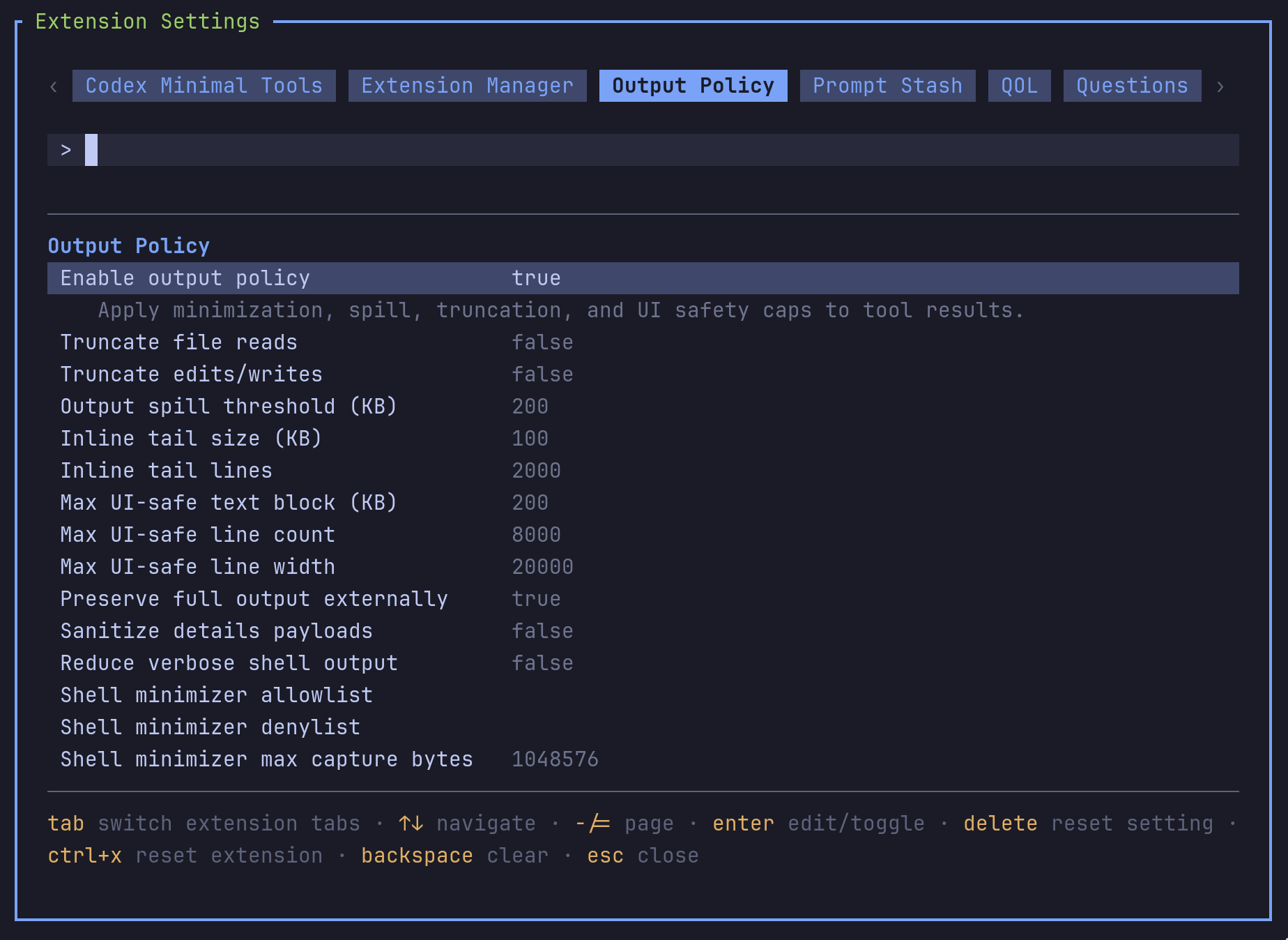
Large-output policy for Pi tool results: minimization, bounded truncation, and full-output preservation. Tuned to keep long autonomous runs under provider request-buffer limits without losing the full tool output (it lands on disk).
Two budgets, one policy
Output policy enforces two related but distinct budgets:
- Compact renderer UI — how big a tool block can be without breaking Pi's TUI. Caps line width, hard line count, and absolute block size.
- Model transcript / session JSONL — how much each tool result adds to the request body that gets resent on every turn. Long runs with many "fine" 50–200 KB results have crashed with
HTTP 507: exceeded request buffer limit while retrying upstreameven when no individual block was UI-pathological.
Earlier defaults only had teeth on the first budget. The default balanced policy mode now also constrains the second, while leaving the full text on disk via per-session artifacts.
Policy modes
Pick the trade-off via Policy mode (or policyMode in JSON):
| Mode | Spill (KB) | Inline tail (KB / lines) | Max block (KB) | Max lines | Max line width | sanitizeDetails |
| --- | --- | --- | --- | --- | --- | --- |
| balanced (default) | 48 | 16 / 400 | 24 | 400 | 3 000 | on (with allowlist) |
| compact | 16 | 6 / 200 | 8 | 200 | 2 000 | on (with allowlist) |
| compat | 200 | 100 / 2 000 | 200 | 8 000 | 20 000 | off |
balanced keeps any single non-read/non-mutation tool result under ~24 KB inline while preserving the full output to disk. compact is for very long autonomous runs that need to stretch the request buffer further. compat is the legacy UI-safety-only profile — no transcript-size protection, but it still applies the old caps (200 KB block / 8 000 lines / 20 000-char lines). For truly untruncated inline output, set enabled: false instead.
Any per-knob value you set in vstack.extensionManager.config["@vanillagreen/pi-output-policy"] overrides the mode default; unset knobs follow the mode.
Highlights
- Preserves oversized tool output to disk and includes the artifact path in results.
- Head truncation for search/listing tools; tail truncation for command/log tools.
- Explicit truncation notices show size, line count, direction, artifact path, per-turn/session bytes saved, and continuation guidance.
- File reads and edit/write results pass through unmodified by default — opt in per category.
- Tool-result
detailsare sanitized by default inbalanced/compact(off incompat); state-bearing tools (tasks_write,bg_task,subagent, …) bypass sanitization so sidecar restore semantics stay safe. - When
detailsare sanitized, the result carries avstackOutputPolicySanitizedmarker (and capped arrays/objects include a sentinel string) so consumers can detect the truncation. - Shell output minimizer compresses noisy git/npm/cargo/test output before truncation while preserving warnings, errors, and summaries.
Install
Via npm:
pi install npm:@vanillagreen/pi-output-policyVia vstack:
cargo install --git https://github.com/vanillagreencom/vstack.git vstack
vstack add vanillagreencom/vstack --pi-extension pi-output-policy --harness pi -y
Restart Pi after installation.
Settings
Open /extensions:settings; settings appear under the Output Policy tab.
Project settings in .pi/settings.json apply only after Pi marks the workspace trusted; before trust, vstack Pi extensions read user/global settings only.
General
| Setting | What it does |
| --- | --- |
| Enable output policy | Master toggle. |
| Policy mode | balanced (default), compact, or compat. See Policy modes. |
Truncation
| Setting | What it does |
| --- | --- |
| Truncate file reads | Apply spill/truncation to read results. |
| Truncate edits/writes | Apply spill/truncation to edit/write results. |
| Output spill threshold (KB) | Preserve full output externally above this size. Unset = mode default. |
| Inline tail size (KB) | Bytes kept inline for tail-truncated command/log output. Unset = mode default. |
| Inline tail lines | Lines kept inline for tail-truncated command/log output. Unset = mode default. |
UI safety
| Setting | What it does |
| --- | --- |
| Max UI-safe text block (KB) | Hard cap on text blocks even when spill is off. Unset = mode default. |
| Max UI-safe line count | Hard line cap for rendered text. Unset = mode default. |
| Max UI-safe line width | Truncate pathological wide lines. Unset = mode default. |
| Sanitize details payloads | Cap nested tool-result details. Unset = mode default (balanced/compact on, compat off). |
| Sanitize details allowlist | Comma-separated tool names whose details bypass sanitization. Empty = built-in list (tasks_write, tasks_read, bg_task, bg_status, subagent, subagent_run, stop_subagent, steer_subagent, get_subagent_result). |
Storage
| Setting | What it does | | --- | --- | | Preserve full output externally | Write oversized output to an artifact file when possible. |
Shell minimizer
| Setting | What it does | | --- | --- | | Reduce verbose shell output | Compress git/npm/cargo/test output before truncation. On by default; disable when you need full successful build logs inline. | | Allowlist | Comma-separated command families to minimize. | | Denylist | Comma-separated command families to leave alone. | | Max capture bytes | Skip minimizer on output larger than this; truncate directly. |
Switching back to verbatim behavior
compat mode restores the legacy generous UI-safety caps (200 KB block, 8 000 lines, 20 000-char lines) and turns off sanitizeDetails, but it is not "fully untruncated" — anything above those caps still spills. Pick it when those caps are wide enough for your workflow:
{
  "vstack": {
    "extensionManager": {
      "config": {
        "@vanillagreen/pi-output-policy": {
          "policyMode": "compat"
        }
      }
    }
  }
}
For truly untruncated inline output (no spill, no minimizer, no sanitization), disable the policy entirely:
{
  "vstack": {
    "extensionManager": {
      "config": {
        "@vanillagreen/pi-output-policy": { "enabled": false }
      }
    }
  }
}
Notes
Pi's built-in tools may truncate before reaching this extension. Custom tools that return full large text benefit most from spill preservation.
For truncated file reads, continue reading the original file with offset/limit. For truncated command output, the inline notice points at the artifact file on disk and reports per-turn and per-session bytes saved so users can see the transcript impact at a glance.
Extension-produced custom messages (pi.sendMessage) are not policed by this extension; add per-package caps in extensions that emit large custom messages.