
@vitalie27dev/ngx-signal-devtools
v0.1.1
Published
Dev-only overlay for Angular signals: dependency graph, recomputation counters and leak detection, with zero production cost.

Maintainers
 vitalie27dev
Readme
@vitalie27dev/ngx-signal-devtools
Dev-only overlay for Angular signals: dependency graph, recomputation counters and leak detection — with zero production cost.




live demo · GitHub repository · showcase app · CHANGELOG · issues
Angular's signal graph is invisible while you develop: you cannot see which computed recomputes 400 times per second, which effect tracks nothing, or which component keeps writing a signal after it has been destroyed. This library makes that graph visible inside the running application and tells you when something looks like a bug.
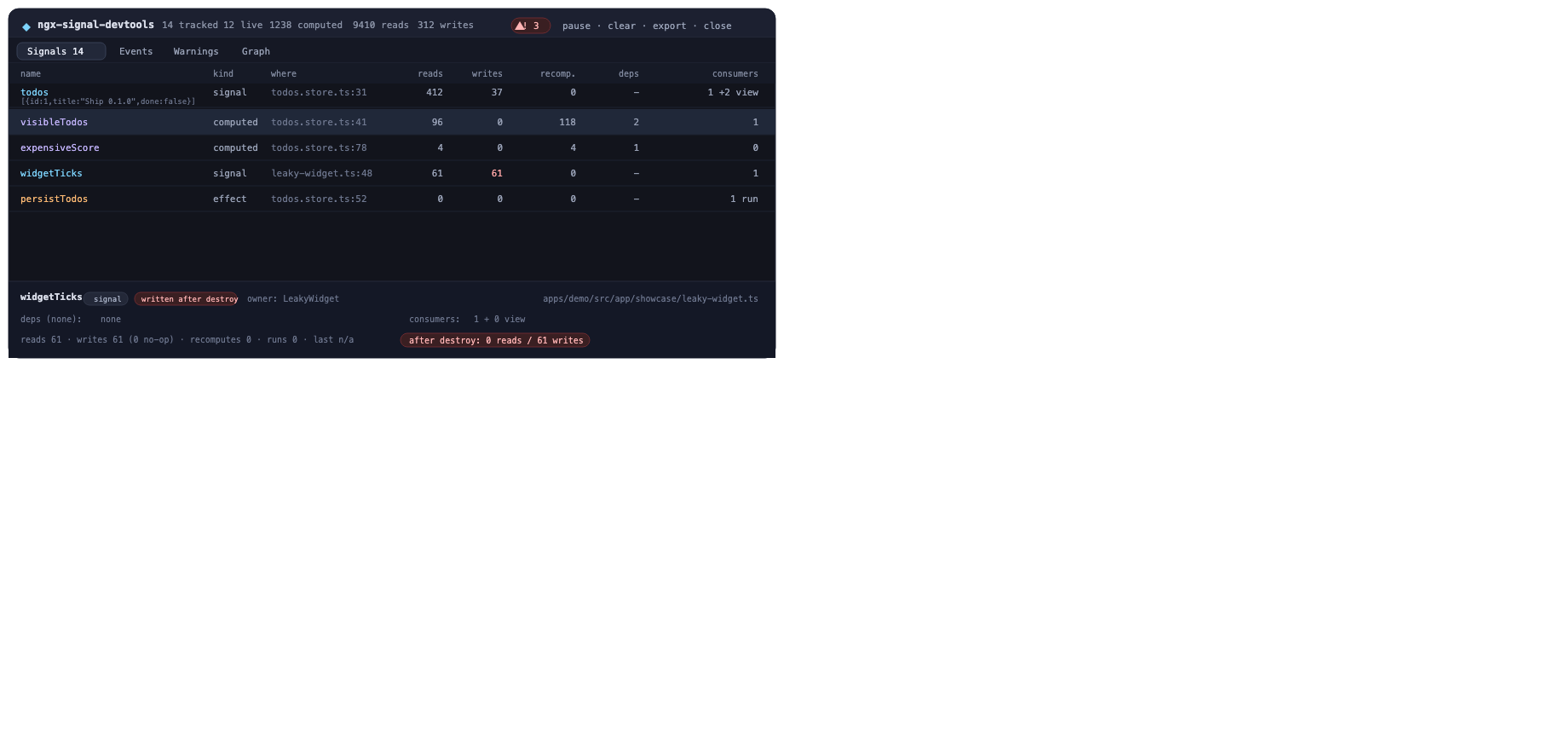
+-- ngx-signal-devtools ------------- 14 tracked  12 live  1238 computed  9410 reads  3 warnings --+
| Signals  Events  Warnings  Graph                                                               |
| name            kind      where                reads  writes  recomp.  deps  consumers          |
| todos           signal    todos.store.ts:31      412      37         0     0      1 +2           |
| visibleTodos    computed  todos.store.ts:41       96       0       118     2        1           |
| expensiveScore  computed  todos.store.ts:78        4       0         4     1        0           |
| widgetTicks     signal    leaky-widget.ts:48      61      61         0     0        1           |
+-----------------------------------------------------------------------------------------------+
Features
- Dependency graph — real producer/consumer edges read from the private reactive graph through
ɵSIGNAL, laid out as SVG without a charting dependency. - Recomputation counters — how often each
computedran and how long it took. - Leak detection — signals are tied to the
DestroyRefthat owns them; reads and writes after destruction are reported (read-after-destroy,write-after-destroy,leaked-consumers). - Diagnostics with hints — no-op writes, effects that track nothing, hot computeds, signals without an owner, deduplicated with counters instead of a log flood.
- Zero production cost —
provideSignalDevtools()defaults toisDevMode(); when disabled the instrumented helpers delegate tosignal()/computed()/effect()and the overlay is a lazy chunk that is never requested. - JSON export —
snapshot()returns a serializable dump (signals, warnings, events, graph) for bug reports or CI artifacts. - Zoneless and standalone first — no NgModules, no
zone.js, no runtime dependency other thantslib.
Installation
npm install --save-dev @vitalie27dev/ngx-signal-devtools// app.config.ts
import { ApplicationConfig } from '@angular/core';
import { provideSignalDevtools } from '@vitalie27dev/ngx-signal-devtools';
export const appConfig: ApplicationConfig = {
providers: [
provideSignalDevtools(), // enabled automatically in development builds
],
};Open the overlay with Ctrl + Shift + S, from the console (ngSignalDevtools.toggle()), or from your
own button:
@Component({
  template: `<button type="button" (click)="devtools.toggle()">Open signal devtools</button>`,
})
export class DebugBar {
  protected readonly devtools = injectSignalDevtools();
}
Quick start
import { Component } from '@angular/core';
import { devComputed, devEffect, devSignal } from '@vitalie27dev/ngx-signal-devtools';

@Component({
  selector: 'app-cart',
  template: `
    <p>{{ summary() }}</p>
    <button type="button" (click)="add()">Add item</button>
  `,
})
export class CartComponent {
  private readonly items = devSignal<string[]>([], { name: 'items' });

  protected readonly summary = devComputed(() => `${this.items().length} items`, {
    name: 'summary',
  });

  constructor() {
    devEffect(() => console.debug('cart changed', this.items()), { name: 'logCart' });
  }

  protected add(): void {
    this.items.update((items) => [...items, `item-${items.length + 1}`]);
  }
}
They are drop-in replacements for signal(), computed() and effect(): same return types, same
reactive behaviour. When the devtools are disabled they call the Angular primitives directly.
API
| Export | Purpose |
| ---------------------------------------------------------------------------- | ---------------------------------------------------------------------------------------------------------------------------------------------------------------------------------------------------------------------------------------------------------------- |
| provideSignalDevtools(config?) | Installs the registry and the overlay. Call once, at bootstrap. |
| injectSignalDevtools() | Handle with reactive counters and commands: toggle(), show(), hide(), paused, records, stats, warnings, events, graph(), snapshot(), download(), pause(), resume(), clear(). Always injectable, even when the devtools are disabled. |
| devSignal(initial, options?) | signal() with instrumentation: reads, writes, no-op writes, value preview. |
| devComputed(fn, options?) | computed() with instrumentation: recomputation count, duration, dependency discovery. |
| devEffect(fn, options?) | effect() with instrumentation: run count, duration, “tracks nothing” detection. |
| trackSignal(signal, options?) | Observes a signal you already have. Identity is preserved; writes are detected by sampling the reactive node version. |
| layoutSignalGraph(input, options?) | Pure layered layout (depth, x, y, SVG path per edge) — reuse it in your own UI. |
| parseSignalOrigin(stack), ownerFromOrigin(origin), previewValue(value) | Helpers used for origin detection and value previews; exported because they are handy on their own. |
| isInternalsAvailable() | true when the private reactive graph can be read for this Angular version. |
Configuration
provideSignalDevtools({
  enabled: !environment.production, // default: isDevMode() on the browser
  hotkey: 'ctrl+shift+s', // default; `false` disables the shortcut
  position: 'bottom-right', // bottom-left | top-right | top-left
  captureReads: false, // record an event per read (noisy)
  captureValues: true, // truncated value previews
  maxSignals: 500, // oldest destroyed records are evicted first
  maxEvents: 200, // activity ring buffer
  maxWarnings: 100,
  warnOnNoopWrite: true,
  warnOnNoDependencies: true,
  hotSignalThreshold: 120, // recomputations before a computed is flagged
  refreshIntervalMs: 500, // resampling while the overlay is open
  notifyThrottleMs: 16, // minimum delay between two UI refreshes (0 notifies per microtask)
  globalKey: 'ngSignalDevtools', // console handle; `false` to disable
});
// app.config.server.ts — keep SSR inert
providers: [provideSignalDevtools({ enabled: false })];Diagnostics
| Code | Severity | What it means |
| ----------------------------- | -------- | -------------------------------------------------------------------------------- |
| noop-write | info | A signal was written with an equal value; consumers were not notified. |
| write-after-destroy | error | A destroyed signal keeps being written — usually a leaked interval/subscription. |
| read-after-destroy | error | Something still reads a destroyed signal. |
| leaked-consumers | error | A destroyed signal still has live consumers (template, effect, resource). |
| effect-without-dependencies | warning | The effect read no instrumented signal, so it will never run again. |
| hot-signal | info | A computed exceeded hotSignalThreshold recomputations. |
| unowned-signal | info | The signal was created outside an injection context, so its lifetime is unknown. |
| duplicate-provider | warning | provideSignalDevtools() was called more than once. |
| event-buffer-overflow | info | The activity buffer dropped events (raise maxEvents). |
The overlay
| Tab | Content | | ------------ | ------------------------------------------------------------------------------------------------------------------------------------------------------------------------------------------------------------------------------ | | Signals | Every tracked signal: kind, creation site, reads, writes (incl. no-op), recomputations, dependency and consumer counts. Click a row for the detail footer (owner, file, dependencies, consumers, timings, post-destroy usage). | | Events | Ring buffer of activity with relative timestamps and durations; writes detected by sampling are labelled. | | Warnings | Deduplicated diagnostics with severity, occurrence count, message and a hint about the likely fix. | | Graph | Layered SVG: producers left, consumers right, destroyed nodes dimmed, click to cross-select with the table. |
Header actions: freeze/resume the panel, collapse, clear, export JSON, close. The panel is draggable by
its header, closes with Esc, and never participates in your application's change detection — it
refreshes itself.
Zero production cost
Measured on the showcase app in apps/demo (ng build demo, Angular 22.2, production):
Initial chunk files | Names                        |  Raw size | Estimated transfer size
chunk-ENKM75QW.js   | -                            | 145.90 kB |  43.63 kB
main-KFJ3X235.js    | main                         | 104.78 kB |  27.50 kB
                    | Initial total                | 250.68 kB |  71.13 kB

Lazy chunk files    | Names                                                    | Raw size
chunk-CA5URME4.js   | vitalie-ngx-signal-devtools-overlay-component            |  18.13 kB
The overlay (component, template, styles, graph renderer) is a separate chunk that is only downloaded
the first time the devtools are opened. Registry and instrumentation are dev-only: in a production
build provideSignalDevtools() installs nothing, and every devSignal()/devComputed() falls back to
the plain Angular primitive after a single null check.
How it works
provideSignalDevtools()creates a registry (plain TypeScript, no Angular dependency) and installs it in a module-level slot, so the instrumented helpers can find it from constructors and field initializers without DI.devSignal/devComputed/devEffectwrap the Angular primitives, keep the original return type, count activity and re-brand the wrapper withɵSIGNALso Angular internals keep working.- Dependency edges come from the private reactive graph (
producers/consumerslinked lists in Angular 20+,producerNode/consumerNodearrays in 17-19), read defensively throughɵSIGNAL. When the shape is unknown, the devtools degrade to declared/manual dependencies instead of failing. - Lifetime comes from
DestroyRef: a signal created in an injection context is marked destroyed with its owner, and later reads/writes are reported. - Notifications are coalesced per microtask, so a hot loop cannot thrash the overlay.
npm run probe:internals prints the reactive node shape of the installed Angular version — run it
after upgrading Angular to see whether the adapter still has what it needs.
Compatibility
| Angular | Status |
| -------------- | -------------------------------------------------------------------------------------------------------- |
| 22.x | Supported and tested (peerDependencies: ^22.0.0) |
| 21.x | Expected to work (no 22-only API is used), not covered by CI yet — widen the peer range after validating |
| 20.x and older | Not supported: devSignal/devComputed rely on 20+ signal internals for graph discovery |
Works with zoneless and zone-based change detection, standalone components and OnPush. Signal
primitives the library does not instrument (input(), model(), resource(), linkedSignal()) are
visible through trackSignal().
Limitations
- The dependency graph depends on a private API. It is feature-detected, never required for the tool to work, and covered by tests that pin the shape.
trackSignal()cannot intercept reads and samples writes from the node version: treat its write counts as approximate and usedevSignal()when exact numbers matter.- Effect dependencies are reported as “tracks something / tracks nothing”, because the effect node is not reachable through a public handle.
- Module-level registry slot: for SSR, keep
enabled: falseon the server (the default) so nothing is shared between requests. - The overlay is a debug tool: it renders outside your application's view tree, uses
ViewEncapsulation.Nonewith.sdt--prefixed rules andz-index: 2147483000.
Roadmap
- [ ] Secondary entry point
@vitalie27dev/ngx-signal-devtools/testingwithexpectNoSignalLeaks(). - [ ] Custom reporters (
console,benchmark, CI artifacts). - [ ] CI matrix that validates and widens the Angular peer range (21.x).
- [ ] Record/replay of signal activity to diff two interactions.
- [ ] Timing waterfall per recomputation.
Development
npm run build:lib      # build the library (ng-packagr)
npm run watch:lib      # rebuild on change, for the demo app
npm run test:lib       # vitest + coverage
npm run start          # demo/showcase app on http://localhost:4200
npm run lint
npm run probe:internals
License
MIT — see LICENSE.