
@xtandard/flags
v0.1.8
Published
Self-hosted, embeddable, OpenFeature-compatible feature flag control plane with pluggable storage and memory-first runtime evaluation.

Maintainers
 xantiagoma
Readme
The control plane can be down — and your applications keep evaluating flags. After the first load, evaluation is fully in-process; if storage drops afterward, the provider serves the last-known-good snapshot (marked
stale).
Contents
- Why another flag tool?
- How it works — the two planes
- Quickstart
- Evaluate flags at runtime (OpenFeature)
- The flag model
- Storage backends
- Subpath exports
- Examples
- Screenshots
- CLI
- Docs
Why another flag tool?
Unleash / Flagsmith / GO Feature Flag are great, but most assume a server in (or
near) the request path and a heavier deployment. @xtandard/flags owns a narrow,
sharp gap:
- 🏠 Self-hosted OpenFeature admin — your data, your infra, no SaaS.
- 🔌 Pluggable storage — memory, file, Redis, Postgres, MongoDB, SQLite, libSQL/Turso, Cloudflare KV, or any unstorage driver. Bring your own with four methods.
- ⚡ Local-first evaluation — a tiny, zero-dependency evaluator + provider run in-process (JS/TS). The panel can be offline.
- 🌐 Any language, standard protocol — every other language evaluates over OFREP (the OpenFeature Remote Evaluation Protocol): point any OpenFeature SDK's generic OFREP provider at the panel — no vendor SDK to write or install.
- 🧩 Embeddable or standalone — mount the panel in your app, or run the Docker image.
- 📦 One npm package — explicit subpath exports, optional peer deps; install only what you use.
- 🎛️ Bundled admin SPA — consumers mounting the panel don't install React.
It is intentionally not a LaunchDarkly clone: no experiment analytics, no hosted SaaS, no mandatory Redis/Postgres/auth. Batteries included, not required — everything official is just an implementation of a public contract you can replace.
How it works — the two planes
flowchart LR
  subgraph Admin["🛠️  Admin / control plane"]
    direction TB
    UI["Admin UI / CLI"] --> API["JSON API"]
    API --> SRC[("Source storage<br/>drafts · history · audit")]
    API -- "publish → compile<br/>immutable snapshot" --> RT[("Runtime storage<br/>published snapshots")]
  end

  subgraph App["🚀  Application runtime"]
    direction TB
    PROV["OpenFeature provider"] -- "load snapshot once" --> MEM[["In-memory snapshot"]]
    MEM --> EVAL["Evaluate in-process<br/>(zero deps, never throws)"]
    PROV -. "background refresh<br/>(poll or watch)" .-> RT
  end

  RT --> PROV
| Plane | What | Reads / writes | | ------------------------- | -------------------- | ----------------------------------------------------------------------------------------------- | | Admin / control plane | UI + JSON API + CLI | reads/writes source storage; compiles immutable snapshots; publishes to runtime storage | | Application runtime | OpenFeature provider | loads a whole snapshot into memory; evaluates in-process; refreshes in the background |
type FlagsPanelOptions = {
  sourceStorage: FlagsStorage; // canonical: drafts, history, audit
  runtimeStorage?: FlagsStorage; // published snapshots (default = sourceStorage)
};
See ADR 0002 — memory-first runtime evaluation.
Quickstart
Install
bun add @xtandard/flags
# optional integrations (peer deps) — install only what you use:
bun add redis pg mongodb @libsql/client unstorage @openfeature/server-sdk elysia hono express
Run the standalone (Docker)
docker run --rm -p 3000:3000 \
  -e SOURCE_STORAGE_DRIVER=redis -e RUNTIME_STORAGE_DRIVER=redis \
  -e REDIS_URL=redis://host.docker.internal:6379 \
  -e AUTH_MODE=basic -e AUTH_USERNAME=admin -e AUTH_PASSWORD_HASH='scrypt$...' \
  ghcr.io/xantiagoma/xtandard-flags:latest
Visit http://localhost:3000. Health check at /healthcheck.
Configured entirely by env vars — PORT, BASE_PATH, TITLE, LOGO_URL,
READONLY, STREAMING (OFREP SSE), AUTH_MODE/AUTH_USERNAME/AUTH_PASSWORD[_HASH],
and the SOURCE_/RUNTIME_STORAGE_DRIVER family (memory/file/redis/postgres/
mongodb/sqlite/unstorage). Full reference + per-driver vars:
docs/DEPLOYMENT.md. The same set works with serve (run
npx @xtandard/flags serve --help).
Or run it without Docker (npx / bunx)
Same server, same env vars — no container:
PORT=4000 \
  SOURCE_STORAGE_DRIVER=redis RUNTIME_STORAGE_DRIVER=redis \
  REDIS_URL=redis://localhost:6379 \
  AUTH_MODE=basic AUTH_USERNAME=admin AUTH_PASSWORD=secret \
  npx @xtandard/flags serve          # or: bunx @xtandard/flags serve
serve runs under both Node (npx) and Bun (bunx). With no env it defaults to
file storage under ./.flags/ in the current directory (a source/ and a
runtime/ subdir) and no auth — fine for a quick local look. It prints the
resolved storage paths on startup; set an absolute SOURCE_FILE_DIR /
RUNTIME_FILE_DIR (or a different driver) to persist elsewhere, and set
AUTH_MODE=basic before exposing it.
Or embed the admin panel in your app
import { Elysia } from "elysia";
import { flagsPanel } from "@xtandard/flags/elysia";
import { createRedisStorage } from "@xtandard/flags/storage/redis";
import { basicAuth } from "@xtandard/flags/auth/basic";

new Elysia()
  .mount(
    "/flags",
    flagsPanel({
      basePath: "/flags",
      sourceStorage: createRedisStorage({ url: process.env.REDIS_URL!, prefix: "flags:source" }),
      runtimeStorage: createRedisStorage({ url: process.env.REDIS_URL!, prefix: "flags:runtime" }),
      auth: basicAuth({
        users: [{ username: "admin", passwordHash: process.env.FLAGS_ADMIN_PASSWORD_HASH! }],
      }),
    }),
  )
  .listen(3000);
import { Hono } from "hono";
import { flagsPanel } from "@xtandard/flags/hono";
import { createUnstorageStorage } from "@xtandard/flags/storage/unstorage";
import { createStorage } from "unstorage";
const app = new Hono();
app.route(
"/flags",
flagsPanel({
basePath: "/flags",
sourceStorage: createUnstorageStorage({ storage: createStorage() }),
}),
);
export default app;import express from "express";
import { flagsPanel } from "@xtandard/flags/express";
import { createFileStorage } from "@xtandard/flags/storage/file";
const app = express();
// Mount the panel BEFORE body-parsing middleware — it reads the raw body.
app.use(
"/flags",
flagsPanel({ basePath: "/flags", sourceStorage: createFileStorage({ dir: "./.flags" }) }),
);
app.listen(3000);Then open http://localhost:3000/flags, create a flag, and Publish.
Evaluate flags at runtime (OpenFeature)
Two ways, both standard OpenFeature — pick by language:
| Path | For | Eval runs | Resilience | | ------------------------------------- | ---------------- | ---------------------------- | -------------------------------------------------------------------- | | In-process provider (recommended) | JS / TS | inside your app, from memory | control plane down → fine; storage down after load → last-known-good | | OFREP (remote) | any language | on the server, over HTTP | run the standalone next to your app + ETag/304 caching |
In-process — JS/TS, memory-first (recommended)
import { OpenFeature } from "@openfeature/server-sdk";
import { createOpenFeatureProvider } from "@xtandard/flags/openfeature";
import { createRedisStorage } from "@xtandard/flags/storage/redis";

OpenFeature.setProvider(
  createOpenFeatureProvider({
    projectKey: "default",
    environmentKey: "production",
    storage: createRedisStorage({ url: process.env.REDIS_URL!, prefix: "flags:runtime" }),
    refreshIntervalMs: 10_000,
  }),
);

const client = OpenFeature.getClient();
const theme = await client.getStringValue("theme", "normal", {
  targetingKey: user.id,
  country: user.country,
  plan: user.plan,
});
After the first load the provider serves from memory. If the admin panel goes
away, evaluation is unaffected. If storage goes down after the first load, the
provider keeps serving the last-known-good snapshot (marked stale). Missing
flags return the caller's default with FLAG_NOT_FOUND. The evaluator is pure and
never throws — invalid config falls back to the caller default with ERROR. This
is the path to use for JS/TS services.
Any language — OFREP (remote evaluation)
Go, Python, Rust, Java, .NET, … evaluate over OFREP, the OpenFeature Remote Evaluation Protocol — a standard HTTP contract. Point any OpenFeature SDK's generic OFREP provider at your panel; there's no vendor library to write or install.
# pip install openfeature-sdk openfeature-provider-ofrep
from openfeature import api
from openfeature.contrib.provider.ofrep import OFREPProvider

api.set_provider(OFREPProvider(base_url="https://flags.example.com"))
enabled = api.get_client().get_boolean_value("new-checkout", False, ctx)
The panel serves OFREP bulk + single evaluation with ETag/304 caching and an
opt-in SSE stream for live updates. Runnable clients (Python / Go / plain TS) are
in examples/ofrep-clients (bun run examples:ofrep-clients);
full details in docs/OPENFEATURE.md.
Which should I use? For JS/TS, prefer the in-process provider above — it's memory-first and keeps working if the control plane is down. OFREP puts the server in the request path, so for the same resilience run the standalone server next to your app and lean on ETag/304 caching.
The flag model
Every flag — even boolean — is variant-based. Evaluation is a deterministic order; the first thing that resolves wins:
flowchart TD
  A([evaluate flag, context]) --> B{enabled?}
  B -- no --> Z["default variant · DISABLED"]
  B -- yes --> S{"within schedule window?"}
  S -- no --> Z2["default variant · SCHEDULED / EXPIRED"]
  S -- yes --> P{"prerequisites all satisfied?"}
  P -- no --> Z3["default variant · PREREQUISITE_FAILED"]
  P -- yes --> O{"exact override on bucketing key?"}
  O -- yes --> ZO["override variant · STATIC"]
  O -- no --> R{"targeting rule matches? first match wins"}
  R -- yes --> ZR["rule variant · TARGETING_MATCH / SPLIT"]
R -- no --> F["fallthrough · STATIC / SPLIT"]- Splits are deterministic:
same flagKey + same targetingKey + same salt → same variant(MurmurHash3, neverMath.random). Weights need not total 100. - Targeting rules are conditions combined with AND / OR / NOT groups (nest arbitrarily; a flat list is a plain AND). Operators cover equality, membership, string, numeric, dates (ISO-8601 / epoch /
Date/Temporalvia ordering operators), semver,inSegment/notInSegment, andmatches/notMatches— a JSON query document evaluated by a pluggable matcher (built-inregex, orsift/mingovia a registered matcher). - Value objects are understood out of the box for ordering/equality (the whole Temporal family +
BigInt); for types that don't follow that convention — Dinero, Decimal — register a custom comparator. - Reusable segments are named audiences referenced by rules; prerequisites express flag-to-flag dependencies (acyclic, validated at publish).
- Scheduled active window (
schedule.enableAt/disableAt) — outside it the evaluator serves the default variant (SCHEDULED/EXPIRED); behavioral, checked live, never flipsenabled. - Organizational metadata: tags, owner, archiving (excluded from snapshots), and advisory stale detection (a
lifecyclepolicy that only shows a badge — it never changes behavior).
Full reference: docs/OPERATORS.md.
Storage backends
One four-method contract; pick the backend per plane (a common split is a durable source and a fast, close-to-the-app runtime).
| Backend | Import | Runtime | Best for |
| ----------------- | --------------------------------------- | ---------- | --------------------------------------------------- |
| Memory | @xtandard/flags/storage/memory | any | tests, single-process experiments |
| File | @xtandard/flags/storage/file | any | local dev, GitOps drafts in VCS |
| Redis | @xtandard/flags/storage/redis | any | multi-node, push-based refresh (watch) |
| Postgres | @xtandard/flags/storage/postgres | any | durable, transactional source |
| MongoDB | @xtandard/flags/storage/mongodb | any | you already run Mongo |
| SQLite | @xtandard/flags/storage/sqlite | Bun | single-node persistence, zero deps |
| libSQL/Turso | @xtandard/flags/storage/libsql | any / edge | edge-replicated runtime, serverless SQLite |
| Cloudflare KV | @xtandard/flags/storage/cloudflare-kv | Workers | runtime snapshots inside Cloudflare Workers |
| Anything else | @xtandard/flags/storage/unstorage | any | 20+ drivers (Upstash, Vercel KV, S3/R2, Netlify, …) |
// Bring your own — any object with these four methods is valid storage:
import type { FlagsStorage } from "@xtandard/flags";
const myStorage: FlagsStorage = {
  getItem: (k) => db.get(k),
  setItem: (k, v) => db.set(k, v),
  removeItem: (k) => db.delete(k),
  getKeys: (prefix) => db.keys(prefix),
};
Same story for AuthProvider and AuthorizationProvider — the built-ins
(auth/none|basic|delegated, authorization/none|roles|delegated) are just
implementations of public contracts. See docs/STORAGE.md.
Subpath exports
| Import | What |
| ------------------------------------------------------------------------------------------------------------ | ------------------------------------------------------------------------ |
| @xtandard/flags | core types, evaluator, snapshot, createFlagsCore, createFetchHandler |
| @xtandard/flags/openfeature | OpenFeature provider |
| @xtandard/flags/storage/{memory,file,redis,unstorage,postgres,mongodb,sqlite,libsql,cloudflare-kv,drizzle} | storage adapters |
| @xtandard/flags/drizzle/{pg,mysql,sqlite} | Drizzle table factories for the drizzle storage adapter |
| @xtandard/flags/match/sift | sift query matcher for matches / notMatches |
| @xtandard/flags/hooks/{webhook,log,test-gate} | bundled control-plane hooks (webhook, log, publish test-gate) |
| @xtandard/flags/auth/{none,basic,delegated} | auth providers |
| @xtandard/flags/authorization/{none,roles,delegated} | authorization providers |
| @xtandard/flags/{elysia,hono,bun,express} | framework adapters |
| @xtandard/flags/react | embeddable <FlagsDashboard/> component (advanced; React peer) |
| @xtandard/flags/testing | in-memory panel + flag builders |
Examples
Runnable mini-projects in examples/ — each mounts the panel and
shows flags driving real behavior (change a flag, publish, watch the app change):
| Example | Shows |
| -------------------------------------------------- | --------------------------------------------------------------------- |
| elysia/ | Mount the panel + a route whose response a flag controls. |
| hono/ | Same, on Hono. |
| express/ | Same, on Express. |
| auth/ | Auth + RBAC flexibility: none/basic/header/cookie/JWT/query. |
| hooks/ | Control-plane hooks: log + publish gate + signed webhook + test-gate. |
| flags-sdk/ | Next.js + Vercel Flags SDK; panel mounted + a home page flags drive. |
| openfeature-redis/ | Evaluate at runtime via the OpenFeature provider over Redis. |
| ofrep/ | Remote eval via OFREP over HTTP — bulk/single, ETag/304, SSE. |
| ofrep-clients/ | Consume flags from Python, Go, plain TS via OpenFeature + OFREP. |
| storage-drivers/ | One contract, every backend. |
| react-embed/ | Embed <FlagsDashboard/> in an existing React app. |
| standalone-docker/ | The Docker image + Redis via docker compose. |
bun run build               # build dist/ + dist/ui once
bun run examples:elysia     # → ▶ elysia → http://localhost:NNNN/flags
Screenshots
| | |
| ----------------------------------------------------------------------------------------------------------------- | ------------------------------------------------------------------------------------------------------------------------------ |
|  |
| 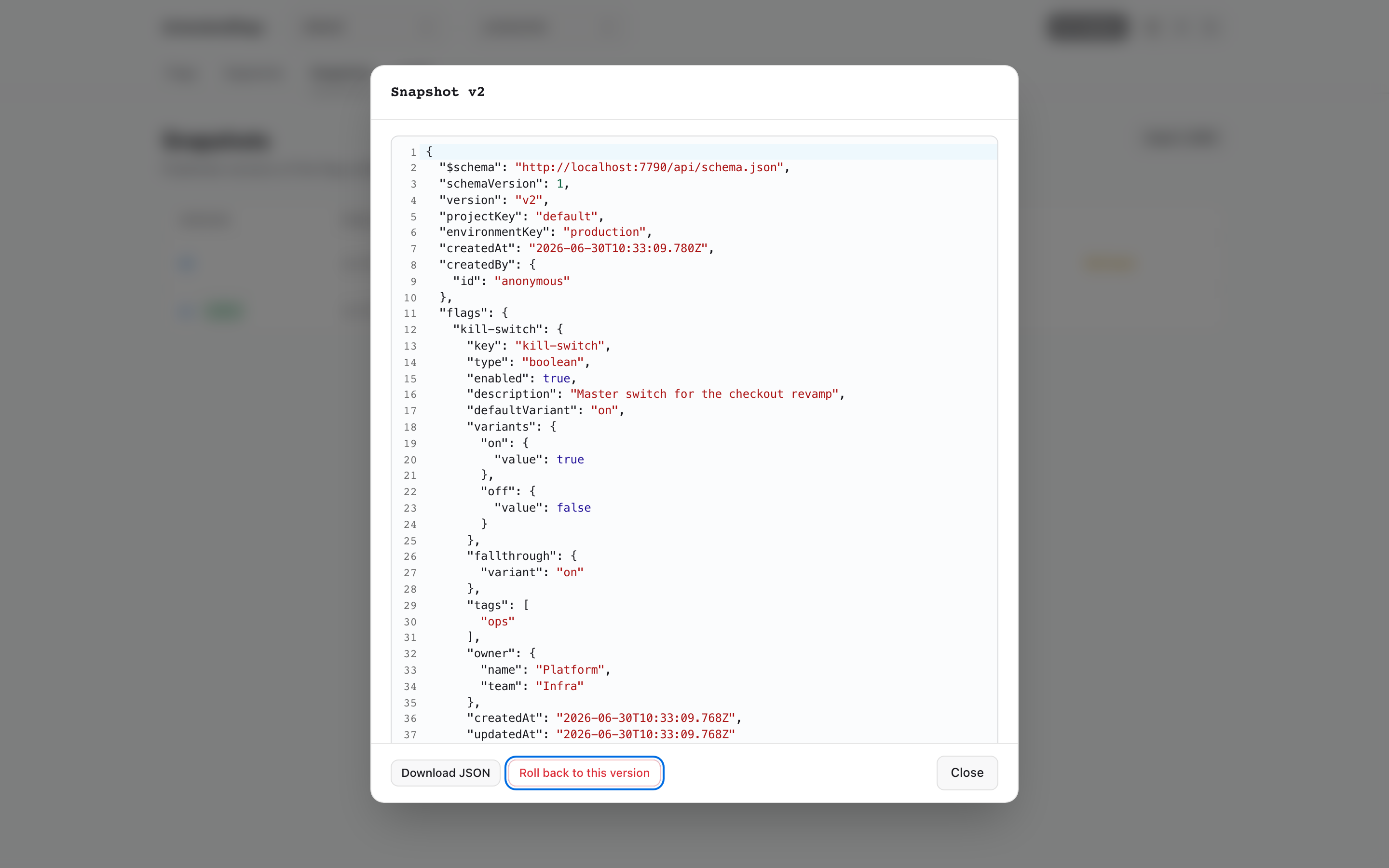 |
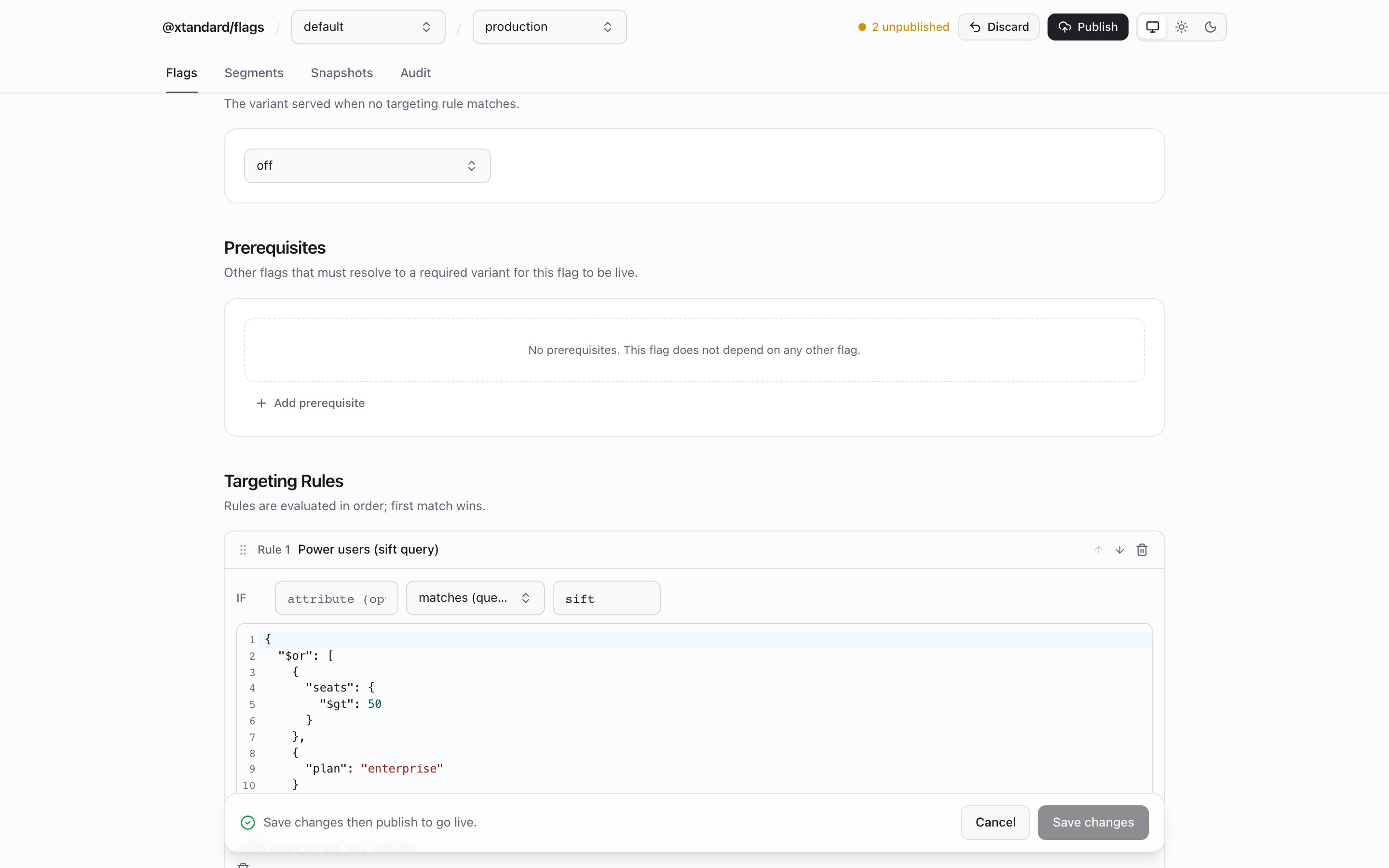
| Flag editor — variants, rules, query targeting | Snapshots — immutable versions, download/import JSON |
|
|
| Flag editor — variants, rules, query targeting | Snapshots — immutable versions, download/import JSON |
|  |
| 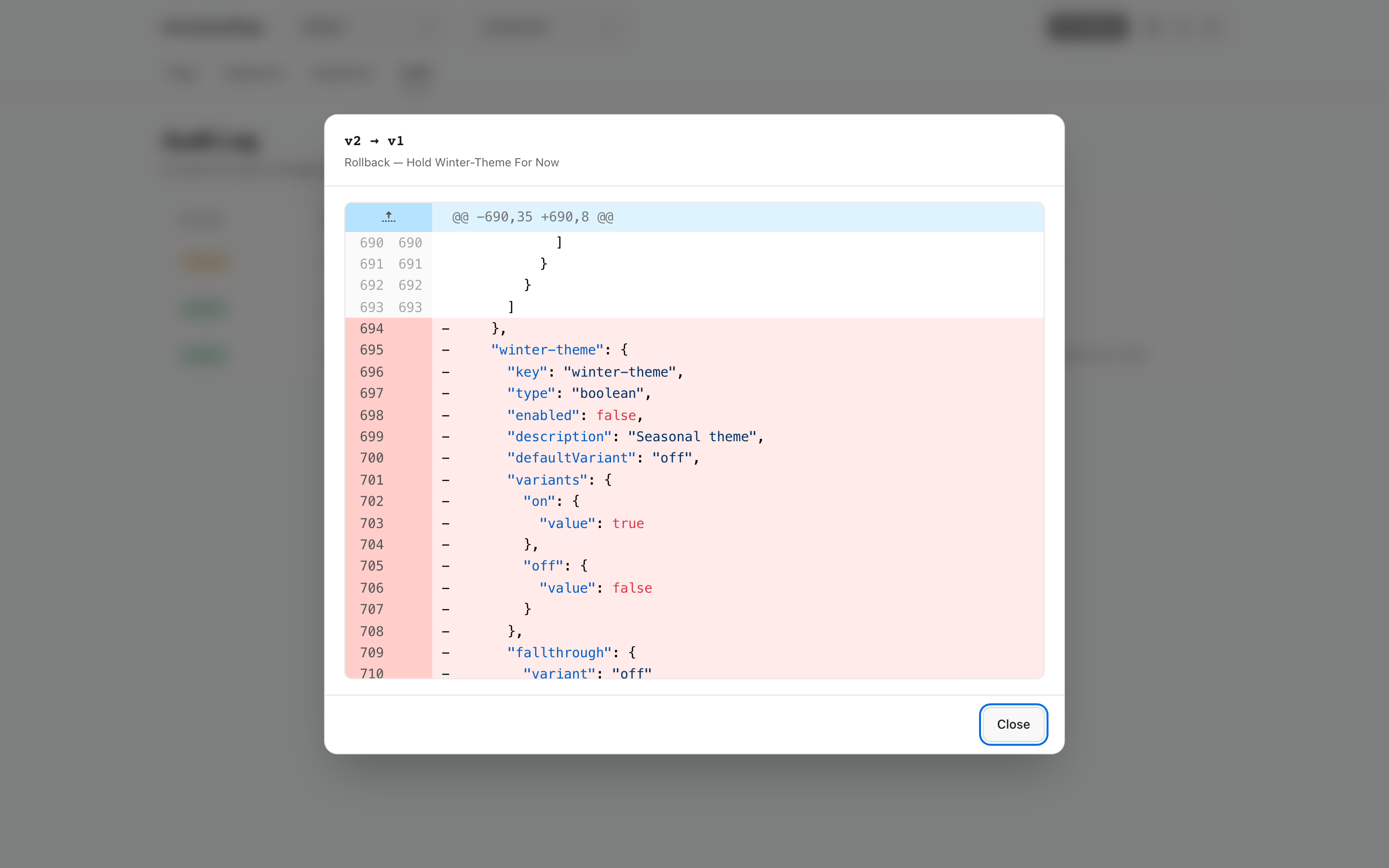 |
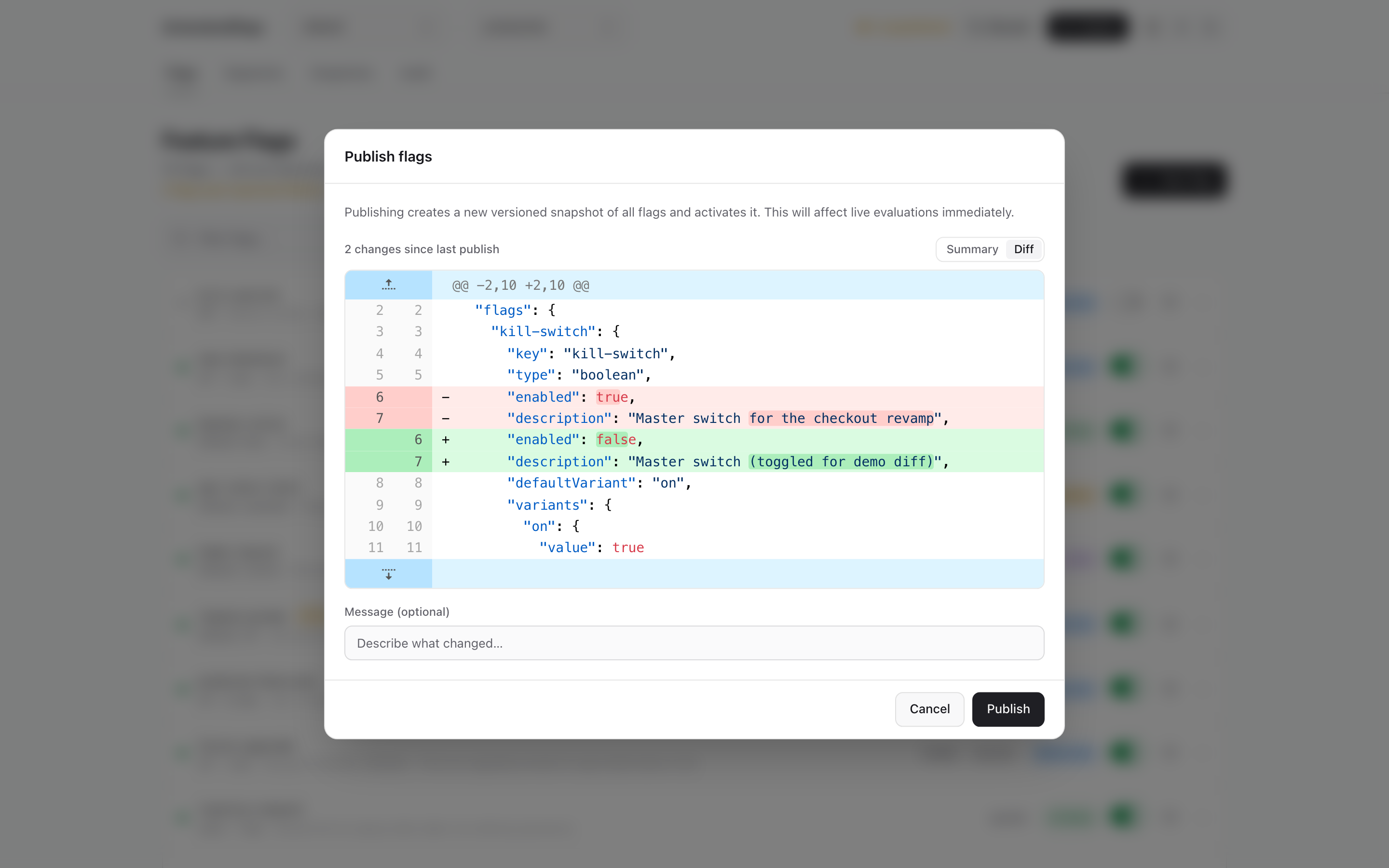
| Publish — git-style diff of unpublished changes | Audit — per-version diff of every change |
|
| Publish — git-style diff of unpublished changes | Audit — per-version diff of every change |
CLI
xtandard-flags serve       # run the panel + API server (no Docker; honors the env vars above)
xtandard-flags init        # create default project/env + empty draft
xtandard-flags list        # list flags in the draft
xtandard-flags validate    # validate the draft (exit 1 if invalid)
xtandard-flags publish     # compile draft → snapshot → activate
xtandard-flags rollback v3 # re-point active version
xtandard-flags inspect     # print the active snapshot
Run any command via npx @xtandard/flags <cmd> or bunx @xtandard/flags <cmd>
without installing.
Docs
- Architecture · Getting started
- Storage · Auth · Authorization · Hooks
- OpenFeature · UI · Operators · Adapters
- Deployment · Testing · Releases
- ADRs in docs/ADR
- API reference (TSDoc):
bun run docs:api→ generatesdocs/api(TypeDoc).
Project status
Functional and tested (v0.x). The headless runtime (evaluator, snapshots,
provider, storage), admin API, auth/authz, framework adapters, bundled UI,
standalone Docker app, and CLI are all implemented and covered by tests.
Versioning follows ZeroVer: the major stays at 0
indefinitely (no planned 1.0). Within 0.x, a minor bump (0.x.0) may
carry breaking changes and a patch (0.x.y) is fixes + additive changes —
so pin with ^0.x.y. See docs/RELEASES.md.
License
MIT © Santiago Montoya