
@zakkster/lite-signal-decorators
v1.5.1
Published
Standard-decorators layer over @zakkster/lite-signal (TC39 decorators proposal, Stage 2.7 since 2026-05; TS 5.x / Babel 2023-11 emit unchanged). The reactive class layer where an instance has a measured cost, deterministic teardown, and a churn benchmark.

Maintainers
 zakkster
Readme
@zakkster/lite-signal-decorators









Standard decorators (TC39 decorators proposal, Stage 2.7 since 2026-05; TS 5.x / Babel 2023-11 emit unchanged) that turn a plain class into a reactive view-model with a measured per-property cost, one deterministic teardown, and poison-on-dispose safety -- built on @zakkster/lite-signal.
@reactive accessor fields, @derived getters, @reactiveEffect methods, @batched actions, one @reactiveHost wiring site -- and disposeReactive() tears the whole instance down in one call, every time, with nothing left dangling. A decorated read costs ~1.0x a hand-written instance-field signal read. An instance costs exactly P + L + D + E + 1 pool nodes and gives all of them back on dispose. A buildless twin, defineReactive(), delivers the identical feature set with zero transpiler.
import { reactive, derived, reactiveHost, disposeReactive } from "@zakkster/lite-signal-decorators";

@reactiveHost
class Vector {
  @reactive accessor x = 3;
  @reactive accessor y = 4;
  @derived get len() { return Math.hypot(this.x, this.y); }
}

const v = new Vector();
v.len;              // 5
v.x = 6;
v.len;              // 7.211...
disposeReactive(v); // cascade teardown; later touches throw ReactiveDisposedError
No base class to extend. No makeObservable(this, {...}) mirror object to keep in sync. No "did I remember to dispose the reaction?" -- the instance IS the lifetime, and when it ends, every box, computed, and effect it owns ends with it, provably (a 4096-cycle leak gate and a wall-clock churn soak run on every change).
Contents
- The reactive class layer the ecosystem was missing
- What you get
- How it works
- The half-alive view-model trap
- API reference
- Composability
- The numbers
- Design decisions worth knowing
- Testing (for clients & QA)
- Compatibility
- Migrating from MobX 7 & signal-utils
- What this is not
- Ecosystem
- FAQ - License
The reactive class layer the ecosystem was missing
Fine-grained signal engines are function-shaped: signal(), computed(), effect(). Real applications are often class-shaped: an entity in a fleet, a HUD panel, a document model -- a thing with identity, N reactive properties, derived state, reactions, and a death. The gap between the two is where reactive class layers historically go wrong: MobX-style decorators bring GC pressure and administration objects; hand-rolling this.x = signal(0) per class brings copy-pasted dispose lists that drift out of sync with the fields.
lite-signal-decorators is that layer done with lite-signal's discipline: zero allocation on the hot path, a measured cost for everything else, and fail-closed on every unverified state. Every property you declare is accounted for -- created at a known point, owned by a known root, destroyed by one call, poisoned afterward so a stale reference throws by name instead of misbehaving silently.
Install
npm i @zakkster/lite-signal-decorators @zakkster/lite-signal@zakkster/lite-signal (>=1.5.0 <2.0.0) is a peer dependency, and that is a correctness requirement, not a formality: your decorated instances, your raw signals, and the engine's node pool must live in ONE reactive graph. A second nested copy of the engine would silently split that graph. Install both at the top level.
ESM-only. Ships TypeScript definitions. Node >= 18. The @ syntax needs a standard-decorators toolchain (TypeScript 5 or Babel 2023-11 -- see Compatibility); defineReactive needs nothing.
Quick start
import {
  reactive, derived, reactiveEffect, batched, reactiveHost, disposeReactive,
} from "@zakkster/lite-signal-decorators";

@reactiveHost
class Player {
  @reactive accessor hp = 100;
  @reactive accessor shield = 50;

  @derived get effectiveHp() { return this.hp + this.shield * 0.5; }
  @derived get status() { return this.effectiveHp > 60 ? "healthy" : "critical"; }

  // Auto-runs as an effect once the instance is wired; re-runs only when
  // `status` actually CHANGES -- the derived's equality cutoff absorbs the rest.
  @reactiveEffect onStatus() { hud.textContent = this.status; }

  // Both writes coalesce into ONE propagation flush.
  @batched hit(dmg) {
    const absorbed = Math.min(this.shield, dmg);
    this.shield -= absorbed;
    this.hp -= dmg - absorbed;
  }
}

const p = new Player();  // exactly 2 + 0 + 2 + 1 + 1 = 6 pool nodes (P + L + D + E + 1)
p.hit(80);               // shield 0, hp 70 -> status still "healthy": effect does NOT re-run
p.hit(20);               // hp 50 -> "critical": effect runs once
disposeReactive(p);      // effect stopped, deriveds + boxes disposed, slots poisoned
No transpiler? The buildless twin takes a plain class and a spec, and routes through the same wiring core (shared by function identity, not merely behaviorally alike) -- this exact form runs in stock Node:
import { batch } from "@zakkster/lite-signal";
import { defineReactive, disposeReactive } from "@zakkster/lite-signal-decorators";

class Player {
  hit(dmg) {
    batch(() => {
      const absorbed = Math.min(this.shield, dmg);
      this.shield -= absorbed;
      this.hp -= dmg - absorbed;
    });
  }
}

const ReactivePlayer = defineReactive(Player, {
  signals: { hp: 100, shield: 50 },
  deriveds: {
    effectiveHp: (self) => self.hp + self.shield * 0.5,
    status: (self) => (self.effectiveHp > 60 ? "healthy" : "critical"),
  },
  effects: { onStatus: (self) => { hud.textContent = self.status; } },
});
What you get
@reactive accessor x = v-- a per-instance signal box in a unique symbol slot. The read body is one slot load + one monomorphic box call: zero branches, zero allocation.@derived get y()-- a lazy computed owned by the instance's anchor, with optional customequalsfor change-cutoff.@localTo(source) accessor x = v-- upstream-keyed resettable local state: reads followsource(self)until you write, a write overrides, and a changed upstream resets it -- glitch-free by compare-on-read, no effect, no extra tick. With an initializer the field starts there and resets on the first upstream move; without one it follows upstream from wiring. One signal box + one plain seen-slot per member; the read is pure, so it is legal inside any@derived.@reactiveEffect m()-- a method that auto-runs as an effect after wiring. Manual calls are leak-guarded (a call inside a foreign tracking scope is untracked, so it records zero stray dependencies) and identity-guarded (a foreign receiver throws by name instead of running against garbage).@batched m()-- the method body inside one engine batch: N writes, one flush. Action-grade by design, with a measured per-call cost -- not a per-frame path.@reactiveHost-- the single wiring site. Its most-derived constructor builds the anchor, every derived, and every effect exactly once, after all fields of all classes in the chain initialize.@reactiveHost({ registry })binds the whole chain to an isolated lite-signal registry.defineReactive(Class, spec)-- the complete feature set with zero decorator syntax.- One deterministic teardown --
disposeReactive(vm)(or ausingblock): anchor cascade, box disposal, poison swap, idempotent, allocation-free on the success path. - Fail-closed everything -- statics, private
#members, unknown options, duplicate keys, orphaned members, invalid registries, half-valid specs: all named throws at decoration time, with a nearest-key did-you-mean where a typo is likely. - Interop that stays raw --
boxOf(vm, key)hands you the live engine box;rootOf(vm)hands the anchor descriptor toforEachOwned/ lite-devtools. Decorated and hand-written signals share one graph. - Introspection & migration (1.3.0) --
forEachReactive(vm, fn, arg)walks every value-bearing member in plan order (signal/local/derived, effects excluded) with a zero-allocfn(key, box, kind, arg)callback;snapshotOf(vm)returns a shallow plain-object copy read through the accessors under oneuntrack-- the nativetoJSthis package now ships, safe to call inside an effect. - Live per-instance cost (1.4.0) --
costOfInstance(vm)walks one wired instance's own graph and reports what it costs RIGHT NOW:costOf(Factory)answers "what will an instance of this class cost" (it forces every derived to the constructed ceiling),costOfInstanceanswers "what does THIS instance cost" -- an unforced lazy derived or an untaken branch shows fewer links until the graph is exercised, and reading every derived once makes the two agree exactly. Twin-free: it needs no stats() ledger, so it measures instances on hand-rolled registries wherecostOffails closed. - One-call pooled fleets (1.5.0) --
createFleet(inventory, bind, opts?)composes the shipped primitives (capacityForsizes the registry,createRegistrybuilds it,releaseReactive/reinitReactivepark and revive) into one fixed-capacity fleet handle{ registry, Class, capacity, acquire, release, at, size, stats, dispose }. It EAGER-prefills and parks every member at construction, soacquire(initials?)never constructs -- it pops anInt32Arrayfree-list and revives a parked member with ZERO allocation, andrelease(vm)parks it back after a per-fleet slot-stamp check. Six named fail-closed misuses (exhausted, foreign vm, double release, use-after-dispose, out-of-rangeat, badbind);dispose()tears every member LIVE and PARKED plus the fleet-owned registry. The gamedev release: spawn/kill worlds and respawn-heavy scenes on a zero-GC steady state (decisions/0013 criterion (d) -- the demo's hand-rolled pool was deleted for it).
How it works
flowchart TB
    A["new Player()"] --> B["field init: each @reactive creates its<br/>signal box in a symbol slot<br/>(scratch-frame tracked)"]
    B --> C["most-derived wrapper wires ONCE:<br/>anchor root -> every @derived -> every @reactiveEffect"]
    C --> D["LIVE: reads track, writes propagate,<br/>effects re-run on real changes"]
    D --> E["disposeReactive(p) / end of using block"]
    E --> F["anchor cascade: effects + deriveds die"]
    F --> G["each signal box disposed -> nodes return to the pool"]
    G --> H["every slot swapped for POISON:<br/>any later touch throws ReactiveDisposedError"]
    B -. "throw at ANY point" .-> R["frame drained LIFO:<br/>zero nodes leak (atomic construction)"]
    C -. "throw at ANY point" .-> R
Decoration happens once per class: each decorator validates its placement (fail closed) and registers the member in the class's wiring plan. Construction happens per instance: field initializers create the signal boxes, then the most-derived @reactiveHost wrapper -- and only it, so inheritance chains wire exactly once -- creates one anchor root and, under that owner, every derived and every effect in declaration order. Disposal reverses it: the anchor cascade takes the deriveds and effects, the boxes are disposed explicitly, and every slot is replaced by a poison handle.
The hot path is canon. The accessor bodies are frozen as:
function makeGet(slot) { return function () { return this[slot].get(); }; }
function makeSet(slot) { return function (v) { this[slot].set(v); }; }
One symbol-slot load, one monomorphic call, no branch, no closure state beyond the slot. The zero-GC torture lane diffs behavior against this shape on every change; the storage layout (a unique per-property Symbol on the instance) was chosen over a private-backing or dictionary layout on measured fleet behavior and poison-mechanism consistency (decisions/0003).
Ownership is asymmetric on purpose. The anchor (one createRoot per instance) owns the deriveds and effects, so one cascade kills them all in the engine. Signal boxes are created bare -- not adopted by the anchor -- and disposed explicitly by disposeReactive. That split is what makes the accessor read body branch-free: a box that can never be half-owned needs no liveness check on the hot path; the poison swap provides the post-dispose throw instead.
Poison is a slot swap, not a flag. After dispose, instance[SLOT] holds a poison handle whose get/set throw ReactiveDisposedError naming Class.key. The read body stays the unbranched canon -- disposal changes what the slot holds, never what the accessor does.
Effects wire last and guard their manual door. The auto-effect wraps the original method and starts at wiring, after every field and every derived of the whole chain exists. The public method you call by hand is a guard: inside a foreign tracking scope it runs the body untrack-ed (zero stray edges); on a receiver that was never wired to this member's class family it throws by name (byKey identity, so a subclass instance calling a base-declared method passes).
Construction is atomic at every capacity point. Signal boxes are born during super() field initialization -- before any try/catch of the wiring phase could exist. A module-level scratch frame records each box as it is created; the frame is owned by the most-derived wrapper only, so a CapacityError (or any throw) at ANY point -- K-th box, the anchor, m-th derived, m-th effect, on either construction path -- drains the frame LIFO through the bound registry and rethrows. new either returns a fully-wired instance or leaves the pool exactly as it found it. Nested constructions (a field initializer building another reactive VM) unwind correctly because the frame marker is a stack index. (decisions/0002, D-2h -- including the two hardenings review and torture forced.)
The half-alive view-model trap
The failure mode this package is built against is not "reactivity doesn't work" -- it is the half-alive instance: an object that looks disposed from one side and alive from the other. It has three classic doors, and each one is closed and torture-pinned:
1. The dangling-teardown door. In ad-hoc class reactivity you collect dispose functions by hand; miss one and a dead panel keeps recomputing forever. Here the instance's whole graph hangs off one anchor plus a box list the package maintains, disposeReactive is idempotent, and -- the part hand-rolled layers never do -- every slot is poisoned afterward. A stale captured reference doesn't quietly read a frozen value or resurrect an effect; it throws ReactiveDisposedError with the class and key in hand. A scripted resurrection storm (every post-dispose call sequence: captured-box writes, using re-entry, double dispose, cross-instance writes) must produce zero effect executions and zero derived recomputes, on every release.
2. The cross-registry door. lite-signal's default dispose is documented as a silent no-op across registries -- the engine's one fail-open corner. A class layer that creates boxes on a custom registry but disposes through top-level helpers would leak every node while returning normally. So the package refuses the door entirely: @reactiveHost({ registry }) binds the WHOLE host chain, every engine call routes through the bound registry, and a subclass trying to bind a different registry is a named throw. One chain, one graph, no silent mismatch.
3. The mid-construction door. A capacity overflow while the K-th of P boxes is being created would classically leak boxes 1..K-1 -- new throws, nobody owns the orphans, conservation is off by K-1 forever. The scratch-frame protocol (deep-dive above) makes construction transactional: any throw at any creation point tears down exactly what was built, LIFO, and rethrows. The torture suite primes a registry to N-epsilon and drives the overflow into every failure point on both construction paths, asserting node-exact conservation and that the identical construction succeeds once headroom returns.
API reference
Member decorators
The first four take a bare form and a factory form (@reactive and @reactive({...}) both work); @localTo is the exception -- it always takes a required source argument (detailed below the table).
| Decorator | Placement | Options | Behavior |
|---|---|---|---|
| @reactive | accessor x = v | equals(a, b) | Per-instance signal box in a symbol slot. Read tracks; write propagates; custom equals suppresses no-op writes. |
| @derived | get y() | equals(a, b) | Lazy computed owned by the anchor. Recomputes on dependency change; equals cuts propagation when the result is unchanged. |
| @reactiveEffect | m() | scheduler(run) | Auto-runs as an effect at wiring, re-runs on tracked changes. scheduler defers re-runs (frame coalescing etc.). Manual calls: leak-guarded + identity-guarded. |
| @batched | m() | -- | Runs the body inside one engine batch: all writes flush once, at close. Nesting flushes at the outermost close. Action-grade -- see the numbers. |
| @localTo | accessor x = v | equals(a, b) | Upstream-keyed resettable local state. Read follows source(self) until written, a write overrides, a changed upstream resets. Compare-on-read (pure); equals governs the upstream compare only. Takes a REQUIRED source argument -- see below. |
localTo(source, { equals? }?)
@localTo(source) declares a field that follows an upstream value until someone writes it, then resets when upstream changes -- the "local copy you can edit, that re-syncs on a real update" pattern, done glitch-free with no effect and no extra tick. source is a REQUIRED tracked (self) => value function, read inline on every get (no extra node). The get is pure -- it compares source(self) to a per-instance last-seen slot and returns the local box when upstream is unchanged, else the upstream value; it never writes a box, so a @localTo read is legal inside any @derived. A write always overrides (the write path never compares). { equals } (default Object.is) governs the upstream compare only.
Two field flavors, selected by the natural syntax (the initial-value unification rule):
@reactiveHost
class Field {
  @reactive accessor upstream = "server";
  @localTo((self) => self.upstream) accessor draft;        // no initial: FOLLOWS upstream from wiring
  @localTo((self) => self.upstream) accessor pinned = "";  // initial: STARTS "", resets on first upstream move
}
The ABA contract (honest, shipped, never softened). The upstream compare is VALUE-based -- lite-signal exposes no public revision counter, and reaching for a private one would be impure. So the reset triggers when upstream changes relative to the last adoption, not when it has moved transitively: upstream A -> local write X -> upstream B -> upstream back to an equals-A value leaves the read showing the stale local X. tracked-toolbox's @localCopy has the same property. A coarse custom equals widens override survival on purpose. See the compare-on-read design bullet.
Class decorator
| Form | Behavior |
|---|---|
| @reactiveHost | The single wiring site; wraps the class so the anchor + deriveds + effects are built exactly once, after all fields of the whole chain initialize. A subclass of a host may itself be a host (inheriting or repeating the chain's registry) -- however many hosts a chain carries, only the most-derived one wires. A decorated member in a hierarchy that never gets a host is the orphan throw. |
| @reactiveHost({ registry }) | Same, with every engine call routed through a Registry from lite-signal's createRegistry(). The value is duck-checked (all 11 engine methods); one registry per host chain -- a subclass may repeat the same object or omit it, never substitute another. |
defineReactive(Class, spec) -> Class'
The buildless twin. Installs the members on Class.prototype, wraps the class through the same host step, returns the wrapped class.
| Spec key | Shape | Notes |
|---|---|---|
| signals | ["a", "b"] or { key: value \| { initial \| init \| equals } } | A plain non-function value is the initial. initial is taken verbatim; init(self) computes per instance; a bare function is a named throw (ambiguous -- wrap it). |
| deriveds | { key: (self) => value \| { get, equals } } | |
| locals | { key: { source, equals?, initial? } } | Map only. The buildless twin of @localTo. source REQUIRED and a (self) => value fn (missing/non-fn is a named throw); equals governs the upstream compare; initial (verbatim) selects the reset-from flavor, its absence the follow-from-wiring flavor. |
| effects | { key: (self) => void \| { run, scheduler } } | Map only. |
| host | { registry } or omitted | Same validation as @reactiveHost. |
Symbol keys work (Reflect.ownKeys). A spec key colliding with an own property of Class.prototype is a named throw. The class's own constructor runs before wiring, so it must not touch spec-declared members (a prewired handle turns any such touch into a named error) -- put initials in the spec. There is no batched section: buildless callers use batch/registry.batch directly. Post-construction behavior is in full parity with the decorator path -- a 300-seed fuzzer holds both forms in lockstep to prove it.
Lifecycle & interop
| Export | Signature | Behavior |
|---|---|---|
| disposeReactive | (vm) => boolean | Cascade + poison teardown. true on the first call, false after (idempotent). Also wired to Symbol.dispose, so using vm = new Player() disposes at block exit. Refuses a frozen instance up front (named throw, nothing half-done). |
| releaseReactive | (vm) => boolean | Park a LIVE instance to the engine pool: cascade the anchor, dispose each box, swap every slot to a PARKED handle (touch throws ReactiveDisposedError with a parked message), keep the prebuilt wiring closures. A parked instance holds ZERO engine nodes. true on first release, false on park->park (idempotent). Fails closed on a disposed, unwired, frozen, or non-reactive value. Pooled-lifetime contract: decisions/0010, 0011. |
| reinitReactive | (vm, initials?) => vm | Revive a PARKED instance: rebuild each box (initials[key] wins, else the plan initial), rebuild anchor + deriveds + effects through the SAME prebuilt closures, restore live slots (values reset). Atomic -- a throw mid-reinit lands the instance DISPOSED (a failed revival is final). Fails closed on a live, disposed, frozen, unwired, or non-reactive value. |
| boxOf | (vm, key) => SignalBox \| ComputedBox | The live engine box behind a @reactive/@derived member -- .peek(), .subscribe(), raw interop. Unknown key: named throw with a did-you-mean. After dispose: ReactiveDisposedError. |
| rootOf | (vm) => NodeDescriptor | The instance's anchor descriptor -- feeds forEachOwned and lite-devtools. Throws ReactiveDisposedError after dispose. |
Introspection & audit (1.0.0)
| Export | Signature | Behavior |
|---|---|---|
| costOf | (Factory) => { nodes, links, signals, deriveds, effects } | The measured, settled per-instance cost, probed on the class's bound registry (frozen result, cached per class). Double-probed: an inconclusive or polluted probe THROWS -- never a guess. nodes is exactly P + L + D + E + 1; links is the first-full-read link count. |
| costOfInstance (1.4.0) | (vm) => { nodes, links, signals, locals, deriveds, effects } | The LIVE cost of one wired instance right now, walked from its own graph -- no probe, no ctor args, no registry pollution. The delta from costOf IS the feature: costOf forces every derived to the constructed CEILING ("what will an instance of this class cost"), costOfInstance reports "what does THIS instance cost right now" -- an unforced lazy derived or an untaken branch has formed no links, so links reads BELOW costOf until the graph is exercised (nodes matches regardless; read every derived once and the two agree exactly). UNCACHED -- a live graph mutates, so a cached number would lie. Needs no stats() ledger, so it measures instances on hand-rolled registries where costOf fails closed. Allocates its frozen result by design (one object per call, ~71 B/op -- reported, never gated). Fails closed on a disposed/parked instance with a NAMED throw (a parked vm holds zero nodes; a silent { nodes: 0 } is indistinguishable from a bug) and on unwired/no-plan/prewired values. |
| capacityFor | (inventory, { headroom }?) => RegistryConfig | Sizes a createRegistry config from [Factory, count] pairs: nodes exact, links x headroom (floored at the engine minimum of 1), prealloc: "eager", onCapacityExceeded: "throw". Fail-closed inventory and options validation. Link policy + caveats: decisions/0007. |
| enableLabels / labelOf | (on) / (idOrHandle, registry?) => string \| undefined | Opt-in devtools identity (default OFF): while on, wiring registers per-registry nodeId -> "Class.prop" / "Class#method" / "Class@anchor"; dispose unregisters. labelOf misses return undefined, never throw. |
| auditReactive | (on) | Opt-in leak auditor (default OFF): a lazily-created FinalizationRegistry reports any instance collected WITHOUT disposeReactive, naming class and shape. Holds no instance references itself; zero cost and zero registrations while off. |
The costOf/costOfInstance split reads as a class-vs-instance pair:
const cls = costOf(Enemy);            // ceiling: every derived forced
const fresh = costOfInstance(inst);   // fresh.links < cls.links (a lazy derived unread)
inst.threat; inst.range;              // exercise the deriveds, then re-measure
costOfInstance(inst).links === cls.links;  // now exact
With labels and audit off, the zero-GC budgets are byte-identical to 0.3.0 -- the hot accessor canon is untouched by all four (review-diffed against the published 0.3.0 tarball).
Introspection walk & snapshot (1.3.0)
| Export | Signature | Behavior |
|---|---|---|
| forEachReactive | (vm, fn, arg) => count | Cold value-member walk. Calls fn(key, box, kind, arg) once per value-bearing member and returns the visit count. kind is "signal" \| "local" \| "derived"; @reactiveEffect/@batched are EXCLUDED (non-value-bearing). Order is PLAN order -- signals, then locals, then deriveds, each declaration-ordered and ancestor-first (never Reflect.ownKeys, so it is stable across reinit). Four scalar args, zero descriptor object, and the arg pass-through kills the caller's closure: the walk is a gated zero-alloc body. Symbol keys are visited. Fails closed on a non-reactive, unwired, parked, or disposed value with the same named errors as rootOf. |
| snapshotOf | (vm) => object | A shallow plain-object copy of every value-bearing member, keyed by member key. Values are read through the ACCESSOR vm[key], NOT box.get, so a @localTo compare-on-read resets honestly and a @derived computes on read (PD-62: reading the box directly would show a stale local after an untracked upstream move -- the accessor is the documented read). The whole walk runs under ONE untrack when the caller is tracking, so snapshotOf inside an effect subscribes to nothing. SHALLOW by design: a nested VM is copied by reference, not recursed. Symbol keys included. Fails closed on parked/disposed (ReactiveDisposedError, parked vs disposed flavor) and non-reactive values. This export ALLOCATES the returned object by design (~96 B/op measured) -- reported, never gated; the walk under it stays zero-alloc. |
Fleet (1.5.0)
| Export | Signature | Behavior |
|---|---|---|
| createFleet | (inventory, bind, opts?) => Fleet | A fixed-capacity pool of reactive instances over the shipped primitives. COLD construction: capacityFor(inventory, opts) sizes a registry, createRegistry builds it, bind(registry) binds the caller's decorated class to it and returns it (the helper never wraps or redefines the class), then one member per inventory unit is EAGER-constructed and PARKED. The handle is { registry, Class, capacity, acquire(initials?), release(vm), at(i), size(), stats(), dispose() }. HOT: acquire pops an Int32Array free-list and revives a parked member (initials override the reset values); release validates a per-fleet symbol slot stamp (a plain symbol-keyed integer field, NOT a WeakMap) and parks the member back. Both hot bodies allocate ZERO. Six named fail-closed misuses: FleetExhaustedError (acquire at capacity, pre-checked), FleetForeignMemberError (release of a vm this fleet never handed out), FleetDoubleReleaseError (release of an already-parked vm), FleetDisposedError (any call after dispose()), a RangeError (at(i) out of [0, capacity)), and a TypeError (a bind that is not a function or does not return a constructor). Construction is ATOMIC (a mid-prefill throw disposes what was built + destroys the registry). dispose() disposes every member LIVE and PARKED then destroys the fleet-owned registry. |
The fleet is the demo's pool, extracted -- one call for a spawn/kill world:
const fleet = createFleet([[Entity, 4096]], (reg) => {
  @reactiveHost({ registry: reg })
  class Bound extends Entity {}
  return Bound;
});
const e = fleet.acquire({ x: 10, y: 20 });   // revive a parked member, zero alloc
fleet.at(0);                                  // slot read (bounds-checked)
fleet.release(e);                             // park it back; nodes return to the pool
fleet.dispose();                              // every member + the registry torn down
acquire never constructs: all capacity members are built and parked at construction, so the steady state is allocation-free. That moves the construction cost to load (the demo pays ~7ms one-time to prefill 4096 members) in exchange for a zero-GC spawn/kill loop.
Errors & constants
| Export | Value |
|---|---|
| ReactiveDisposedError | extends Error; name: "ReactiveDisposedError"; fields className, key. Thrown on ANY touch of a disposed instance's surface. |
| VERSION | "1.4.0" |
The rejection matrix
Everything below is a named throw at decoration/definition time -- never a silent downgrade: legacy (experimental) decorator emit; wrong decorator kind; static members; private # members; unknown option keys (nearest-key did-you-mean); non-function equals/scheduler; double @reactiveHost; unknown host options; orphaned members (a decorated member whose class never gets a host); duplicate keys (subclass redeclaration or two stacked package decorators on one member); an invalid or partial registry; a heterogeneous registry chain; and every malformed defineReactive spec shape.
Composability
Decorated instances, raw engine code, an isolated registry, and devtools introspection -- one graph, end to end. This block is buildless, so it runs verbatim in stock Node:
import { createRegistry } from "@zakkster/lite-signal";
import { defineReactive, disposeReactive, boxOf, rootOf } from "@zakkster/lite-signal-decorators";

// An isolated world: its own node pool, its own graph.
const world = createRegistry({ maxNodes: 256, onCapacityExceeded: "throw" });

class Ship {}
const ReactiveShip = defineReactive(Ship, {
  signals: { hull: 100 },
  deriveds: { dead: (self) => self.hull <= 0 },
  host: { registry: world },
});

const fleet = Array.from({ length: 3 }, () => new ReactiveShip());

// A RAW engine effect in the same graph, reading a decorated member:
const stop = world.effect(() => {
  console.log("dead ships:", fleet.filter((s) => s.dead).length);
});                                    // logs: dead ships: 0

fleet[1].hull = 0;                     // decorated write -> raw effect: dead ships: 1

// boxOf hands the live box -- raw writes flow back the other way:
boxOf(fleet[0], "hull").set(-5);       // raw write -> decorated derived: dead ships: 2

// rootOf feeds the registry's ownership walk (and lite-devtools):
world.forEachOwned(rootOf(fleet[2]), (d) => console.log("owned node:", d.kind));

// Deterministic shutdown, conservation-exact:
world.dispose(stop);
for (const s of fleet) disposeReactive(s);
console.log(world.stats().activeNodes); // 0 -- every node returned to the pool
The default registry never notices any of it: bound-registry churn leaves outside stats() frozen (torture-pinned). And because boxOf returns the engine's box, everything lite-signal composes with -- subscriptions, peek, batch, untrack, lite-raf frame effects -- composes with decorated members too.
Predicate-gated watchers (@zakkster/lite-watch-ex)
lite-watch-ex adds one-shot, pausable, and change-gated watchers over the same engine. Its sources are plain thunks (() => vm.hp, never a box handle), and every watcher creates its effect node in the default registry -- so wire one only to a default-registry instance (one with no host.registry), never across a custom-registry fleet, where the edge would cross a boundary the engine's default dispose cannot see:
import { watchUntil } from "@zakkster/lite-watch-ex";
import { defineReactive } from "@zakkster/lite-signal-decorators";

// Default-registry instance -- no host.registry, so it lives in the default graph.
const ReactivePlayer = defineReactive(class Player {}, { signals: { hp: 100 } });
const vm = new ReactivePlayer();

// Fires ONCE when hp crosses the threshold, then self-disposes:
watchUntil(() => vm.hp, (h) => h <= 25, (h) => console.log("low hp:", h));

vm.hp = 40;  // predicate false -> no fire
vm.hp = 20;  // predicate true  -> "low hp: 20", watcher disposes itself
The fleet-playground demo shows the safe split at scale: decorated entity VMs in an enforced custom registry, all watchers on a separate default-registry telemetry plane.
The numbers
Measured, not asserted: every figure below comes from a committed probe you can re-run, and the repository's gates fail if the zero-allocation claims drift. Rig for the figures quoted: Node v26.3.1, arm64 (Apple M4 Pro), lite-signal 1.5.0, K=10 cold child processes, inner median-of-5, anti-DCE sink. The ratios are what is stable across machines, not the absolute nanoseconds.
The honest read cost (spikes/storage-bench.mjs)
The fair baseline for a decorated property is a hand-written instance field (this.bx.get()) -- not a module-level signal, which no one writes in a class:
| Read | vs module-const box | vs instance-field box | 10k-instance fleet (ns/op) |
|---|---:|---:|---:|
| Module-const signalBox (floor) | 1.000x | 0.464x | 5.22 |
| Hand-written instance field | 2.13x | 1.000x | 6.57 |
| Decorated accessor (this package) | 2.12x | ~1.0x (median 1.01x, worst cold-vs-cold 1.08x) | 7.81 |
| String-keyed dict layout (rejected) | 2.19x | 1.03x | 9.93 |
A decorated reactive property costs ~1.0x a hand-written instance-field signal read; both are ~2x a module-level signal because that is the cost of per-instance storage, paid either way -- an engine indirection, not a decorator tax. Writes are ~2.5-3x a module-const read across all instance layouts (box .set propagation dominates; inherent to any reactive write). The rejected dictionary layout is the one that degrades at fleet scale (cross-instance IC megamorphism) -- the hazard only a class-shaped benchmark exposes, and the reason this package doesn't use one.
A @localTo read measures 1.69x a plain decorated read -- two tracked reads (upstream source + the local box) plus a value compare, versus the one box read of @reactive -- and it pays that cost with 0.000 B/op under the read/write storms (gc.major 0, observed maxPauseMs 0.07-0.08 against the 4.0 gate); the compare-on-read is honest arithmetic, not free.
@batched per call (spikes/batched-cost.mjs)
| Path | ns/op |
|---|---:|
| Plain unbatched method (2 writes) | 11.67 |
| Raw batch(fn) | 15.25 |
| @batched method | 22.12 |
The ~7 ns over raw batch is the guarded thunk + rest-array the decorator allocates per call -- by design. @batched is action-grade (one call per user intent), deliberately excluded from the zero-GC gates; per-frame hot lanes stay on plain accessor writes.
Per instance
P + L + D + E + 1 pool nodes -- one per signal, per local, per derived, per effect, plus the anchor. All of them return to the pool on dispose: conservation is node-exact (activeNodes to baseline, zero pool growths, allocations minus disposals reconciled) over 4096-cycle churn and a wall-clock soak.
createFleet acquire/release (1.5.0). The fleet's hot loop measures 1.649 B/cyc at 8N against a 0.234 B/cyc in-process zero-alloc control (a +2 limit); gc.major 0, 2 minors against a limit of 129, maxPauseMs 0.36. A release(vm) frees exactly P + L + D + E + 1 nodes -- on the demo Entity shape that is a -8 activeNodes delta per release. 1000 fleet lifecycles at N=512 return activeNodes to the exact baseline with poolGrowths 0, and the lane's TORTURE_BREAK control catches a leaky variant at 42.881 B/cyc.
| Operation | Allocates | Notes |
|---|---|---|
| vm.x read | none | this[SLOT].get() -- allocation-free within measurement resolution (<= the 0.589 B/op noise-floor control; gc.major === 0 in every lane) |
| vm.x = v write | none | this[SLOT].set(v); propagation runs on engine pool nodes, not fresh heap |
| @derived get read | none | lazy computed read |
| Effect re-run | none retained | gated: zero major GC across the read/write torture lanes |
| @batched m() call | 1 thunk + 1 rest array | the documented, measured exception (+7 ns vs raw batch); action-grade only |
| new Host() | P + L + D + E + 1 pool nodes | plus the instance itself; nodes recycle on dispose (F-0 conservation) |
| disposeReactive(vm) | none | allocation-free success path; poison handles are prebuilt per member at decoration time |
| boxOf / rootOf / any throw | cold path | introspection and failure paths may allocate; never on the hot path |
| forEachReactive walk | none | gated: 1e6 hoisted-callback walks measure 0.002 B/walk (vs the 0.000 B/op zero-alloc control -- within a +2-byte limit), gc.major === 0; the 4-scalar fn(key, box, kind, arg) carries no descriptor object and the arg pass-through kills the caller's closure |
| snapshotOf(vm) | 1 plain object | by design -- the returned copy allocates (95.8 B/op measured, 1e5 cycles); REPORTED in the torture summary line, never gated. The walk under it stays zero-alloc; cold, off any frame path |
| costOfInstance(vm) | 1 frozen object | by design -- the per-call frozen result allocates (71.3 B/op measured, 1e4 calls); the measurement itself is gc.major === 0 over those 1e4 calls -- REPORTED, never gated. The graph walk under it allocates nothing (module-slot visitors, no per-call closure); cold, off any frame path |
| fleet.acquire / fleet.release | none | gated: the fleet's hot loop measures 1.649 B/cyc at 8N (vs a 0.234 B/cyc zero-alloc control, +2 limit), gc.major 0, maxPauseMs 0.36; acquire pops an Int32Array free-list + revives a parked member, release parks it after a symbol-slot-stamp check -- no WeakMap, no per-call closure |
The gates that hold it (run on every change, all green at 1.5.0):
npm test/npm run test:gc-- 372/372 on both lanes.- Suite gate (lite-leak + lite-gc-profiler):
leak=size 0/0 findings=0 warnings=0 | gc major=0 minor=0 maxMs=0.00 | ok. - Torture: 19 scenarios (zero-GC read/write lanes at
maxMajor 0, maxPauseMs 4; 4096-cycle leak gate at 0 live / 0 findings / 0 warnings; capacity atomicity at every overflow point; a 300-seed x 20k-op oracle with zero divergences; thereinit-tortureacquire/release gate; thelocalto-torturezero-alloc read/write storm + ABA-stale interleave lattice + pooled park/reinit; theintrospection-torture1e6 hoisted-callbackforEachReactivewalk atmaxMajor 0with the snapshot-allocates figure reported, never gated; thefleet-torture4096 acquire/release cycles at zero-alloc budgets + 1000 lifecycles to exact baseline) -- 17 run + 2 that skip correctly below their peer floors (scope-adoptionneeds 1.6.0,using-disposeneeds 1.9.0; the installed peer is 1.5.0). A skip below a floor is the forward-compat design working; a skip at or above it is a FAIL (run.mjs enforces floor-escalation). Every scenario carries aTORTURE_BREAKsabotage control that must exit non-zero -- 19/19 controls prove each gate can actually fail. churn-soak+fleet-soak: sustained construct/use/dispose and a 10s 2k-VM fleet tick; pools at floor and retained heap flat at every sample.
The cross-framework matrix lives in bench/ (private, never shipped): six engines -- both our tiers, the hand-written lite-raw-boxes baseline, MobX 7, signal-utils/signal-polyfill, and a hand-rolled alien-signals class -- across eight class-shaped scenarios (including the churn-reuse acquire/release lane, where the lite tiers pool with zero retained growth and MobX/signal-utils/alien-class are structurally unsupported -- no disposable instance lifecycle to pool), checksum-verified for identical work, stamped into bench/results.txt. The formal verdicts are in decisions/0006-kill-criteria.md: the decorated path measured 0.94x the hand-written baseline on vm-write and 1.10x on a 10k-instance fleet read (the 2.0x kill line cleared with margin), and 0 major + 0 minor GC over 4096 construct/use/dispose cycles with pools at floor -- while emitting ~12.6x less transient garbage per churn run than the hand-rolled class it replaces.
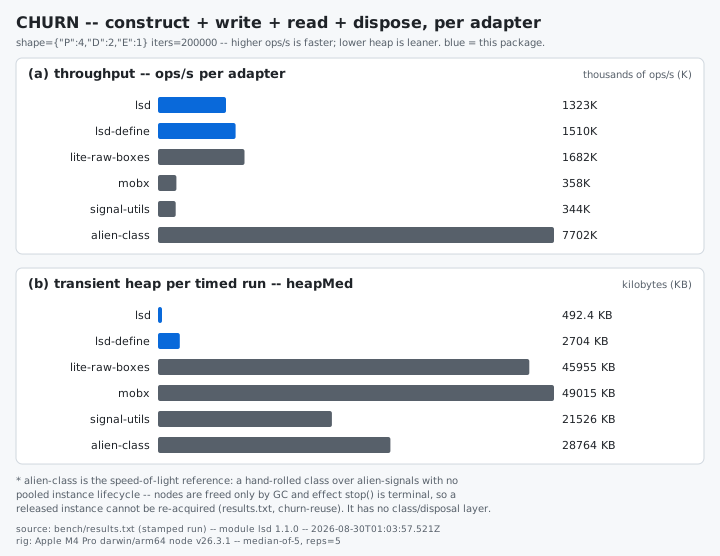
The chart above is generated from the stamped bench/results.txt by bench/chart.mjs (node bench/chart.mjs) -- it plots the CHURN lane for every adapter at full scale, including alien-class, the hand-rolled reference that has no disposable instance lifecycle to pool.
Design decisions worth knowing
Full rationale lives in decisions/ -- each is a numbered, dated record with its measured evidence. The ones that shape daily use:
- One registry per host chain.
@reactiveHost({ registry })binds everything; a descendant passing a different registry is a named throw. This is what closes the engine's silent cross-registry dispose no-op.setDefaultRegistrymid-life is out of contract (the facade captures import-time bindings). - Derived getters must be pure -- effects may self-dispose.
disposeReactive(this)from inside your own@derivedcomputation throws by name (it would silently drop the derivation's value). From inside an owned@reactiveEffectit is allowed with pinned semantics: the current run completes, later decorated touches in that body throwReactiveDisposedError, no re-runs follow, conservation stays exact. - Two documented limits of the derived guard (pinned in torture so drift is loud): an indirect self-dispose routed through an intermediate raw computed is not catchable with the 1.5.0 engine surface, and an explicit
untrack()wrap bypasses the guard -- the escape hatch working as intended. - Manual effect/batched calls are guarded twice. Inside a foreign tracking scope the body runs untracked (zero stray dependency edges); on a foreign/null/primitive/cross-class receiver it throws by name. Subclass instances calling base-declared methods pass (byKey identity).
- Frozen instances refuse disposal up front.
Object.freeze(vm)makes the poison swap impossible, sodisposeReactivethrows by name before touching anything -- no half-dispose.seal/preventExtensionsare fine. - Symbol-slot storage. Chosen over the emitter's private backing (emitter-dependent codegen) and a dict (fleet megamorphism, measured) -- and it is the same mechanism poison uses, so storage, dispose, and poison are one design.
- Statics and
#privates are rejected, not half-supported. A module-level signal belongs to raw lite-signal; a private member can't be reached by the wiring protocol -- both are named decoration-time throws. - Pooled reinit is an identity-stable arena tool, not a speed shortcut (1.1.0).
releaseReactive(vm)parks a live instance to the engine pool andreinitReactive(vm, initials?)revives it -- a three-state lattice (live / parked / disposed) over the same instance, so consumers keep the object reference across turnover. It holds its gate: over 4096 acquire/release cycles at the churn shape (P=4, D=2, E=1) it measures 0 major GC, retained delta-heap at or below the in-process zero-alloc control, and exact pool conservation (activeNodesback to baseline, zero pool growths, a parked instance holding 0 engine nodes). The honest throughput number, same shape, 2026-08-30 stamp (module 1.1.0): plain construct/dispose CHURN is faster -- 1323K ops/s vs reuse's 1159K -- because construction is already allocation-light and pool-conserving, so reinit is not a per-op win. Reach for it when you need identity-stable pooled instances under sustained turnover with zero retained growth (an arena/fleet primitive), not when you want raw op speed. MobX has no equivalent lifecycle at all: its instances are never disposable, so there is no release/reinit cycle to pool (decisions/0010, 0011). @localToresets by compare-on-read, and its ABA limit is stated, not hidden (1.2.0). The reset is decided on the read --source(self)compared to a per-instance last-seen slot -- so it is glitch-free, synchronous, and pure (no box write on read, legal inside a@derived). The rejected alternative was an effect that watches upstream and clears the local: PD-51 measured that recipe clobbering a user's write one tick late, which is the whole reason the feature lives in-package instead of a cookbook recipe. Because the compare is value-based (lite-signal exposes no public revision counter and a private one would be impure), the honest limit is ABA: upstreamA-> local write -> upstreamB-> upstream back to an equals-Avalue shows the stale local -- the same property tracked-toolbox's@localCopyships, documented rather than papered over (decisions/0013, 0014).
Testing (for clients & QA)
npm test            # node --test, 372 tests
npm run test:gc     # the same 372 with --expose-gc (enables the allocation assertions)
npm run gate        # the full pre-publish chain (section 10): fixtures -> test -> test:gc -> torture -> controls -> peer-preview (non-blocking) -> bench selftest -> cookbook -> pack
372 tests across twenty files, all green at 1.5.0. The decorator protocol is tested three times over: against a mock standard-decorators emitter and against committed real TypeScript 5 and Babel 2023-11 emits, so both toolchains' codegen is pinned, not assumed.
| File | Tests | Covers |
|---|---:|---|
| 01-protocol-mock | 30 | Decorator protocol on the mock standard-decorators emitter: wiring, values, options, rejection matrix |
| 02-fixtures-ts | 19 | The same laws on real TypeScript 5 emit (committed fixtures) |
| 03-fixtures-babel | 19 | The same laws on real Babel 2023-11 emit |
| 04-fixture-freshness | 2 | Fixture hashes match the sources (stale-emit guard) + the README emit-matrix block matches its generator |
| 05-wiring | 5 | Anchor creation, wiring order, leaf-wires-once |
| 06-dispose | 6 | Cascade, idempotency, poison, using |
| 07-qa-boundary | 13 | S1 adversarial boundary pins |
| 08-effects | 20 | @reactiveEffect/@batched: auto-run timing, untracking, scheduler, self-dispose, inheritance, registries |
| 09-buildless | 16 | defineReactive parity + the spec rejection matrix |
| 10-qa-s2a-boundary | 34 | Adversarial pins: identity guard, frozen dispose, registry heterogeneity, stacking |
| 11-qa-s2b-boundary | 8 | Construction-throw boundaries: init-phase drain, chain-base throws, overflow storms |
| 12-accounting | 11 | costOf node/link/shape grid (double-probe, frozen + cached, fail-closed) + capacityFor budget sizing |
| 13-labels-audit | 10 | enableLabels/labelOf per-registry identity + auditReactive leak reporting, both opt-in and default-OFF |
| 14-qa-s4-boundary | 21 | S4 adversarial edges: stats-less facade closure, signals-only capacity floor, label/audit boundary matrix |
| 15-cookbook | 14 | COOKBOOK.md drift/parity: each fenced block byte-compared against its tagged companion #region (both directions + both-way coverage), surface freeze (exactly 23 exports), citation allowlist, link law, static-cost probe, and the four-place VERSION sync (module const === package.json === llms.txt === SignalDecorators.d.ts literal) |
| 16-reinit | 29 | Pooled-reinit lattice on both emit lanes: park/reinit/dispose transitions, the five reinitReactive fail-closed states, parked-touch throws by name, initials boundary matrix (0..N+1 keys, null/undefined, NaN/-0 verbatim), Symbol.dispose on a parked instance, accessor descriptors byte-identical across reinit, self-release re-entrancy, ledger conservation |
| 17-localto | 34 | @localTo on both emit lanes + buildless locals: the read/write/upstream-reset lattice, both initial flavors (follow-from-wiring vs reset-from-initial), the ABA stale-local contract, equals override survival, park/reinit box+seen reset, costOf = P+L+D+E+1, source-throw fail-closed, and the fail-closed option/source matrix |
| 18-introspection | 22 | forEachReactive/snapshotOf on both emit lanes + buildless: plan-order walk (signals, locals, deriveds; ancestor-first), symbol keys, the signal/local/derived kind tags, effect/batched exclusion, count return + arg pass-through, the untracked-read law (snapshotOf inside an effect fires once), r7 {name,hp,mp,alive} parity, the PD-62 accessor-read reset honesty, and the fail-closed non-reactive/unwired/parked/disposed matrix |
| 19-cost-instance | 22 | costOfInstance on both emit lanes + buildless: A1 parity-when-forced (=== costOf, nodes/links/every kind count), A2 delta-when-lazy (links strictly lower, then monotonic toward the forced number), @localTo counted in locals with zero graph links, the frozen {nodes,links,signals,locals,deriveds,effects} shape, A3 registry-untouched over 10000 calls, PD-72 bound-registry + stats-less-facade measurement (where costOf fails closed), PD-70 uncached/live across a branch flip, and the A6 fail-closed matrix (plain/unwired/parked/disposed each a NAMED throw, never a {nodes:0} report) |
| 20-fleet | 37 | createFleet on both emit lanes + a buildless class: the {registry,Class,capacity,acquire,release,at,size,stats,dispose} handle surface, eager-prefill (all members parked at construction, acquire never constructs), initials pass-through, the six fail-closed misuses (exhausted/foreign/double-release/use-after-dispose/at out-of-range/bad bind), atomic mid-prefill cleanup, dispose() tearing live AND parked members plus the registry, and the 22 -> 23 export-count freeze |
Emit-support matrix
Three fixture sources, two standard-decorators emitters, both emit lanes -- every cell below is a committed, hash-pinned fixture (the 04-fixture-freshness guard above). The table is generated from the fixture manifest, so a re-emit that changes a byte is loud, not silent:
Generated by node test/fixtures/emit-matrix.mjs from test/fixtures/hashes.json -- do not hand-edit. Toolchain pinned by the committed fixtures: TypeScript 5.9.3, @babel/core 7.29.7 + @babel/plugin-proposal-decorators 7.29.7 (version: 2023-11). Each sha256 is the first 12 hex of the committed emit; npm run fixtures regenerates and test/04-fixture-freshness fails loudly on any drift.
| Source | Emitter | Emit lane | Compiled output | sha256 | At decoration time |
|---|---|---|---|---|---|
| fixture.src.ts | TypeScript 5 | standard 2023-11 | ts-out/fixture.src.js | 5d6837710b34 | accepted -- full decorator surface wired + pinned green |
| fixture.src.ts | Babel | standard 2023-11 | babel-out/fixture.src.js | f7d8b3e5ed19 | accepted -- full decorator surface wired + pinned green |
| static.src.ts | TypeScript 5 | standard 2023-11 | ts-out/static.src.js | d2a03e3d5f70 | rejected -- static member is a named throw at decoration time |
| static.src.ts | Babel | standard 2023-11 | babel-out/static.src.js | dc936c5aa235 | rejected -- static member is a named throw at decoration time |
| legacy.src.ts | TypeScript 5 | legacy (experimental) | ts-legacy-out/legacy.src.js | c1059b1d37b1 | rejected -- legacy emit -> named rejection at decoration time |
| legacy.src.ts | Babel | legacy (experimental) | babel-legacy-out/legacy.src.js | 1d35a02c57ce | rejected -- legacy emit -> named rejection at decoration time |
Source hashes: fixture.src.ts 339c40148a70, static.src.ts 81fb649965e6, legacy.src.ts 30ac3dabaf7c.
The torture suite (dev-side, never shipped)
Process-isolated stress scenarios built on @zakkster/lite-leak + @zakkster/lite-gc-profiler:
npm run torture             # all 18 scenarios (16 run + 2 floor-gated skips)
npm run torture:semantic    # the correctness lane (CI)
npm run torture:soak        # the wall-clock churn + fleet soaks
npm run torture:controls    # sabotage self-test: every scenario must FAIL when broken
Eighteen scenarios: emit-matrix, ordering, lifecycle, pool-conservation, zero-GC lanes, capacity atomicity (every overflow point x both construction paths), the full disposed-poison surface + resurrection storms, a 4096-cycle lite-leak gate, a 300-seed x 20k-op oracle fuzzer (decorated vs hand-wired raw twin in lockstep: every derived value, every effect fire count, every graph opcode tally), raw/decorated interop + cross-registry + registry.destroy() contracts, batch/untrack semantics, the reinit-torture acquire/release gate (4096 pooled cycles: maxMajor 0, retained delta-heap at/below the in-process zero-alloc control, exact pool conservation), the localto-torture gate (zero-alloc @localTo read/write storm at maxMajor 0, the ABA-stale write/reset interleave asserted AS the shipped contract, pooled park/reinit box+seen reset, tracking-edge and pure-compute-read pins), the introspection-torture gate (1e6 hoisted-callback forEachReactive walks at maxMajor 0 with control-relative minors, plus 1e5 snapshotOf cycles whose bytes/op are REPORTED in the summary line, never gated -- the snapshot allocates by design), the wall-clock churn soak, and a 10s 2k-VM fleet soak -- plus two forward-compat scenarios (scope-adoption, using-dispose) that skip correctly while the installed peer sits below their per-feature floors (1.6.0 createScope, 1.9.0 Symbol.dispose). A skip below a floor is the design working; a skip at or above it is a FAIL. On the installed 1.5.0 peer: 16 pass, 2 skip. Every scenario carries a TORTURE_BREAK sabotage control that must exit non-zero -- a gate that cannot fail is not a gate. Seeded lanes replay exactly via TORTURE_SEED.
The cookbook lane (dev-side, never shipped)
Every code block in COOKBOOK.md is byte-identical to a runnable companion in cookbook/ (dev-only, never in files[]):
npm run cookbook            # run all 12 companions under node --expose-gc
npm run cookbook -- --controls  # sabotage sweep: every gated recipe must FAIL when broken
npm run cookbook -- --list      # the manifest: id, title, tier, gc verdict
Twelve recipe companions, six of them GC-gated (r1, r2, r4, r5, r9, r10) at the S1 budget (gc.major === 0, maxPauseMs <= 4.0, <= 0.589 B/op with control-relative minors) and each carrying a COOKBOOK_BREAK=<id> sabotage control; the other six publish a non-empty reason in the manifest. Latest lane tails: cookbook lane: 12/12 companions ok in 1.8s and, under --controls, cookbook lane: 6/6 controls fail correctly in 4.6s. test/15-cookbook.test.mjs drift-checks the document against the companions in both directions (a one-byte edit either side fails, naming the recipe), and the gate runs the lane as a blocking step -- the chain is now 8 blocking steps + 1 non-blocking.
The fleet demo (dev-side, never shipped)
A single-file instrument console -- demo/fleet-playground.html -- drives a two-plane capacity fleet: decorated entity VMs in an enforced custom registry, telemetry watchers in the default registry. Its DOM-free core runs headless under the same gates the library uses:
npm run demo:build          # esbuild bundle -> demo/bundle.js + rewrite demo/bundle.sha256
npm run demo:check          # verify the committed bundle matches its recorded hash
npm run demo:gc             # headless GC-budget lane over the fleet core (maxMajor 0)
npm run demo:storm          # headless dispose-storm retention lane (lite-leak, size 0)
Since 1.4.0 the console is the named consumer of costOfInstance: its shape-drift wall measures a real live Entity (its node count === the EntityShape sizing twin's) and the HUD reports one live fleet member's costOfInstance per HUD tick, so the live-vs-costOf delta -- a forced ceiling against the lazy live cost -- is visible on screen. The EntityShape twin stays for capacityFor sizing only (the world must be sized before it exists).
Since 1.5.0 the demo's hand-rolled pool IS createFleet: the spawn/kill plumbing (the slot array, free-list, count, and dispose-storm bodies) was DELETED in favor of one fleet handle, and step/readPositions read members through fleet.at(i). The diff went net-negative -- the demo is the named consumer that admitted the helper (decisions/0013 criterion (d)). The eager prefill moves construction to load (~7ms one-time for 4096 members), the honest cost of a zero-alloc steady state.
The demo/ directory is dev-only -- it never enters package.json files[] and never ships to consumers.
Compatibility
| Path | Requirement |
|---|---|
| @ decorator syntax | A standard-decorators (2023-11) toolchain: TypeScript >= 5.0 (standard decorators -- leave experimentalDecorators unset/false) or Babel with ["@babel/plugin-proposal-decorators", { "version": "2023-11" }]. Both emits are first-class: the suite pins each with committed fixtures. |
| defineReactive | Nothing. Any ESM runtime. |
| Runtime | Node >= 18 (ESM-only, sideEffects: false); browsers via any ESM bundler or native modules. No DOM dependency anywhere in the package. |
| Peer | @zakkster/lite-signal >=1.5.0 <2.0.0, installed at the top level (one engine instance, one graph). |
Native (untranspiled) @ decorators in engines: not shipped anywhere yet -- until they are, the decorator syntax is toolchain-only and defineReactive is the no-build door.
Migrating from MobX 7 & signal-utils
The decorator vocabulary maps almost one-to-one; what changes is the lifetime story. Both libraries below leave teardown to the garbage collector -- this package makes it a single deterministic call.
From MobX 7
| MobX 7 | lite-signal-decorators |
|---|---|
| @observable accessor x | @reactive accessor x |
| @computed get y() | @derived get y() |
| @action m() | @batched m() |
| makeObservable(this, {...}) | @reactiveHost -- one wiring site, no mirror object to keep in sync |
| reaction(...) / autorun(...) | @reactiveEffect m() |
| toJS(obj) | snapshotOf(vm) -- a shallow plain-object copy of every member, read through the accessors under one untrack (safe inside an effect); nested VMs stay by reference (1.3.0) |
| reaction disposers only; the instance itself is never disposable | disposeReactive(vm) -- one call, idempotent, node-exact, and every later touch throws by name. MobX has no equivalent; its per-instance graph ends when the collector decides. |
From signal-utils
Verified against the installed [email protected]: @signal (on accessors or getters) and @cached (on getters) are the two decorators in its surface.
| signal-utils 0.21 | lite-signal-decorators |
|---|---|
| @signal accessor x (or @signal get x) | @reactive accessor x |
| @cached get y() | @derived get y() |
| no disposal API at all | disposeReactive(vm) -- and it disposes: cascade teardown, poison swap, node-exact conservation |
| Standard-decorators build required | defineReactive(Class, spec) -- the buildless door signal-utils has no equivalent for |
The cross-framework numbers behind this table are stamped in decisions/0006-kill-criteria.md (both engines measured through their documented class APIs at checksum-identical work).
What this is not
- Not a home for module-level or global signals. That is raw
lite-signalterritory;staticmembers are rejected by design. - Not a deep/proxy observation layer. No
observable.deep, no wrapped Arrays/Maps/Sets, no proxy magic -- the reactive unit is a declared member, not a traversed object graph. Collections are@zakkster/lite-projectterritory. - Not a per-frame action system.
@batchedcosts a measured thunk per call -- fine for "one call per user intent", wrong inside a render loop. Per-frame hot lanes stay on plain accessor writes (and frame scheduling belongs tolite-raf). - Not a framework, renderer, or component model. It ends at the reactive view-model; DOM binding is
lite-signal-dom's job. - Not a general meta-programming kit. Six decorators, one wiring law -- not an open decorator toolbox. It does one thing: turn a class into a reactive view-model with a provable lifetime.
- Not a MobX API shim. No
makeObservable, no administration objects -- and no GC-based cleanup: disposal is explicit, deterministic, and verified, because "the collector will get it eventually" is not a lifecycle. - Not a legacy-decorators consumer. TypeScript
experimentalDecoratorsemit is detected by call shape at decoration time and rejected with a named error -- never "works differently under legacy". - Not usable as
@syntax without a toolchain -- that is exactly whatdefineReactiveexists for.
Ecosystem
| Package | Relation |
|---|---|
| @zakkster/lite-signal | The engine underneath -- pooled fine-grained signals. The one peer dependency. |
| @zakkster/lite-signal-dom | DOM bindings for the same engine -- where a view-model meets actual elements. |
| `@zakkster/lite