
@zeenie-ai/opencompany
v0.0.95
Published
Open source workflow automation platform with AI agents, React Flow, and n8n-inspired architecture

Maintainers
 zeenie-ai
Readme
OpenCompany
Your own AI workforce, running on your own machine.
OpenCompany is an open-source, self-hosted canvas for AI agent workflows — think n8n, built agent-first. Drag, drop, and connect AI agents to your email, calendar, messages, browser, phone, and 25+ other services, with 115+ nodes to build from. No code required. No subscription. No usage limits. Bring your own API keys, or run models locally with Ollama / LM Studio for free.
Quick Start
Prerequisites: Node.js 22+, Python 3.12
npm install -g @zeenie-ai/opencompany
company start
Open http://localhost:3000 and click the key icon (API Credentials) in the toolbar to connect your first AI provider.
Upgrading from MachinaOS? Existing
~/.machinaand checkout-local.machinastate is detected when the new.opencompanylocation does not yet exist, so databases and deployment state are not stranded. Themachinacommand remains available as a deprecated legacy alias; new scripts should usecompany.
npm install -g pnpm
git clone https://github.com/zeenie-ai/OpenCompany.git OpenCompany
cd OpenCompany
pnpm run build
pnpm run dev
The dev task starts the Python backend, Vite client, WhatsApp service, and Temporal in parallel. See SETUP.md and SCRIPTS.md for details, and CONTRIBUTING.md for the codebase map and contribution recipes.
See it in action
Hello-world setup, end to end ↓
https://github.com/user-attachments/assets/a5a5583f-bb5f-4d27-a387-8522c556e89e
AI building itself for complex tasks ↓
https://github.com/user-attachments/assets/035a2293-0837-4969-8b9d-8d680e023b89
Multiple specialized loop agents orchestrating ↓
https://github.com/user-attachments/assets/5798fe61-8d26-4d3a-90aa-189bf4eec79f
How It Works
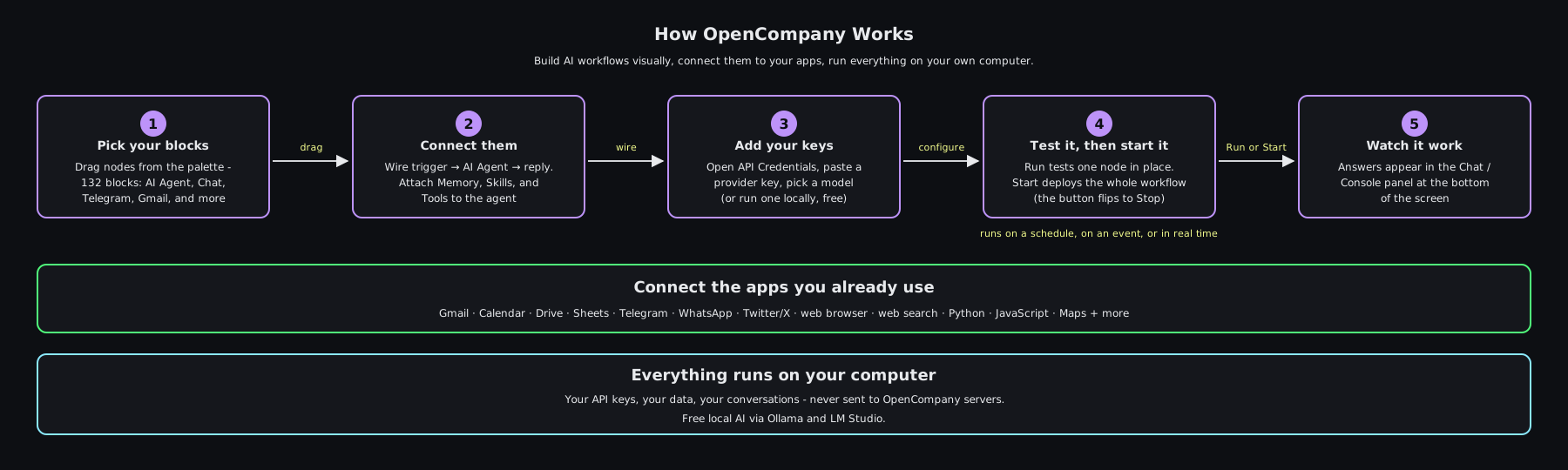
Pick nodes from the palette, drag them onto a canvas, connect them with lines, and give your AI agent some memory and skills. Press Run on a node to test it in place, or press Start to deploy the whole workflow as a durable background listener — waiting for emails, responding to messages, checking in on a schedule, doing the work you'd rather not.
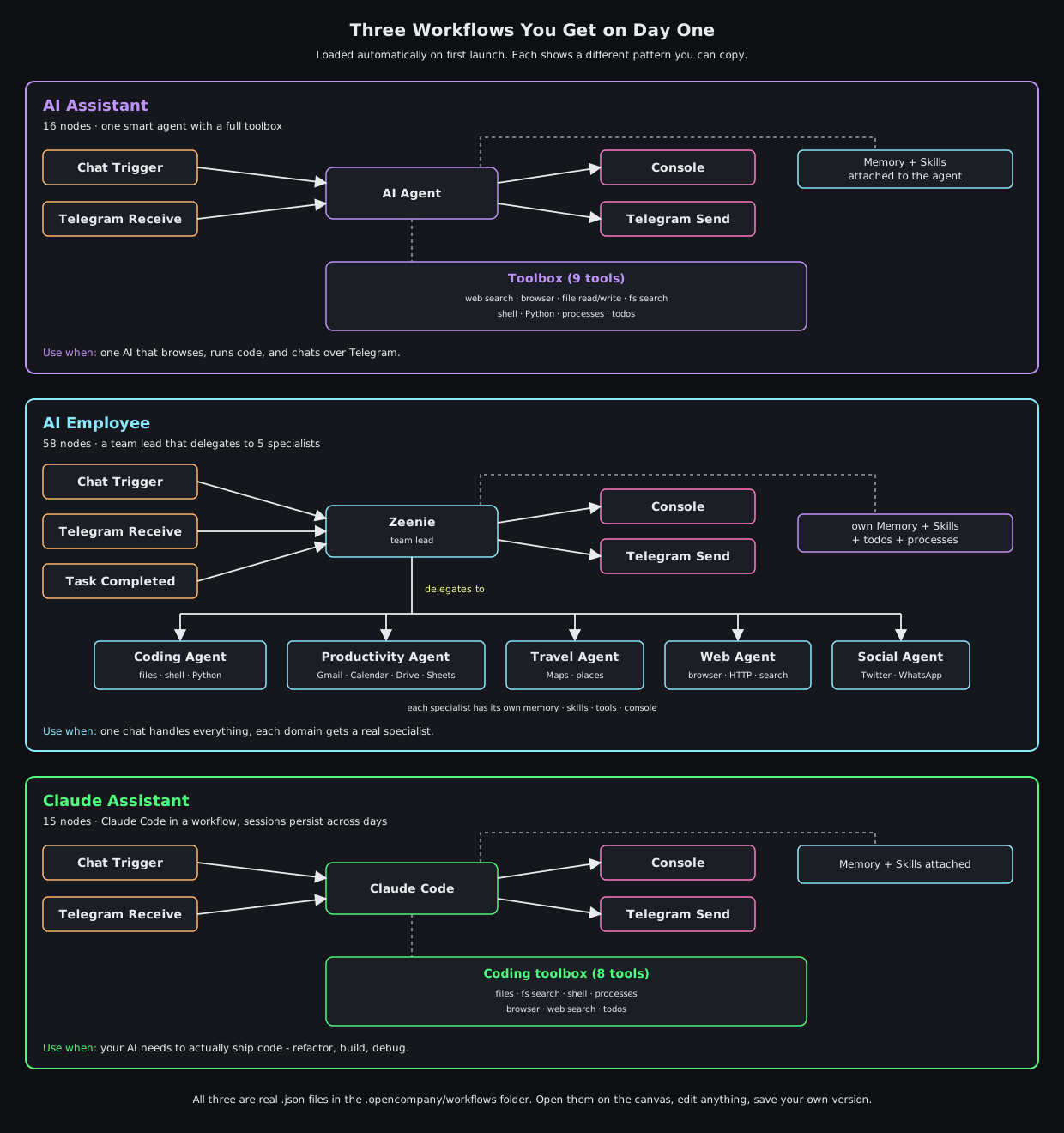
Three example workflows load automatically on first launch. Open them on the canvas to see exactly how the pieces fit together, then edit any node and save your own version.
What You Can Build
- Personal AI assistants that remember. A chat assistant that knows your calendar, reads your inbox, and follows up on tasks. Conversations are saved as readable markdown you can edit; long-term memory uses vector search so years of context stay accessible.
- Agent teams that delegate. Hire an AI Employee as a team lead, connect specialist agents (coding, web, productivity...), and the lead automatically exposes each one as a
delegate_to_*tool — the AI decides who gets which subtask. - Automations that run themselves. Recurring jobs ("every weekday at 9 AM, summarize my unread emails"), event-driven replies ("when a customer texts on WhatsApp, draft a response"), and multi-step background pipelines. Any workflow can also expose a live
/webhook/{path}HTTP endpoint that fires on GET, POST, PUT, DELETE, or PATCH. - Email, calendar, and document workflows. Send and search Gmail, manage Calendar, Drive, Sheets, Tasks, and Contacts. Read any inbox over IMAP (Gmail, Outlook, Yahoo, iCloud, ProtonMail, Fastmail, or custom servers) — including a polling trigger that fires a workflow on every new message.
- Messaging bots. Send and receive on WhatsApp (groups, contacts, newsletter channels), Telegram (bots with owner detection), and Twitter/X (post, reply, search). A unified social node normalizes incoming messages into one format so the same workflow handles them all.
- Phone control from a workflow. Pair your Android phone via QR code and control it from any agent: battery and network status, app launching, WiFi / Bluetooth / airplane toggles, camera, sensors, media playback — 16 device services.
- Web automation and research. An interactive browser with accessibility-tree navigation (click, type, screenshot); an alpha harness that drives your real Chrome over CDP; scraping with Crawlee and Apify actors (Instagram, TikTok, LinkedIn, Facebook, YouTube, Google Search); search via DuckDuckGo (free), Brave, Serper, and Perplexity; residential proxies with geo-targeting and rotation.
- Code, deploys, and pull requests. Run Python / JavaScript / TypeScript in per-workflow sandboxed workspaces, keep dev servers alive with the Process Manager node (output streams to the Terminal tab), open and merge PRs with the GitHub node, and ship with the Vercel node — both can authenticate through their own CLIs, no token pasting required.
- Payments. Stripe action node (charges, subscriptions) plus a signed-webhook receiver for reacting to payment events in real time.
- Your own knowledge base. RAG out of the box: parse PDFs and HTML, chunk, embed locally or via OpenAI, store in ChromaDB / Qdrant / Pinecone, query from any agent.
AI Capabilities
12 providers (11 dedicated model nodes, plus xAI through the OpenAI-compatible path) — bring your own keys or run locally
| Provider | Notes | |--------------|--------------------------------------------------------------------------| | OpenAI | GPT-5 family, GPT-4.1, o-series reasoning models | | Anthropic | Claude Fable 5, Opus 4.x, Sonnet 4.6, Haiku 4.5 — with extended thinking | | Google | Gemini 3 Pro/Flash, 2.5 Pro/Flash — with reasoning budgets | | DeepSeek | DeepSeek V4 (Flash/Pro); chat/reasoner legacy aliases | | Kimi | Kimi K2.6, K2.5, K2.7-Code | | Mistral | Mistral Large/Medium/Small, Codestral | | Groq | Llama 3.x, Qwen3, GPT-OSS (ultra-fast inference) | | Cerebras | GPT-OSS-120b, GLM-4.7, Gemma-4-31b (custom AI hardware) | | OpenRouter | 200+ models via one unified API | | Ollama | Run any local model on your machine — free, private, offline | | LM Studio| Run any local model with a desktop app — free, private, offline |
Local providers (Ollama, LM Studio) are first-class — context length is detected automatically from your running server (LM Studio additionally reports vision and tool-use capability). No paid API needed.
16 specialized agent types
| Agent | Specialized for | |--------------------|--------------------------------------------------------------------------| | AI Employee / Orchestrator | Team leads that coordinate other agents | | Android Agent | Phone control | | Web Agent | Browser automation, scraping, search | | Coding Agent | Writing and running code (Python / JS / TS) | | Productivity Agent | Gmail, Calendar, Drive, Sheets, Tasks, Contacts | | Social Agent | WhatsApp, Telegram, Twitter messaging | | Task Agent | Scheduling, reminders, cron jobs | | Travel Agent | Maps, location lookup, planning | | Payments Agent | Stripe + financial workflows | | Consumer Agent | Customer support, order management | | Claude Code Agent | Anthropic's Claude Code CLI for advanced coding sessions | | Codex Agent | OpenAI Codex CLI integration | | RLM Agent | Recursive Language Model — write code that calls itself recursively | | Autonomous Agent | Code-mode loops that reduce token usage 80-98% | | Tool Agent | General-purpose tool orchestration |
The Claude Code agent keeps warm interactive sessions in a pool (same session across turns, automatic resume after a crash) and runs on interactive billing — a Claude subscription login works instead of per-token API cost. The Codex agent sandboxes parallel tasks in git worktrees.
Skills you can edit yourself
Skills are short markdown files that teach an agent how to do something well — when to use which tool, what arguments to pass, common mistakes to avoid. Edit them in the UI; changes apply immediately. Built-in skills cover Android control, Google Workspace, social messaging, web research, coding, terminal use (Bash, PowerShell, WSL, Nushell), and more.
Memory that scales with your context window
Agents track token usage and automatically compact long conversations as you approach your model's context limit (80% by default, configurable). Compaction summarizes in five sections — Task Overview, Current State, Important Discoveries, Next Steps, Context to Preserve — so the agent picks up exactly where it left off. Anthropic and OpenAI use native API compaction; everywhere else, the agent summarizes itself.
Cost tracking, built in
Every LLM call and API request is tracked with USD cost. See per-provider spend in the API Credentials panel. Configure your own pricing in pricing.json if you switch providers mid-flight.
Built Like Production Infrastructure
- Durable execution via Temporal. Every node runs as an independent Temporal activity with automatic retries; cron schedules have a 24-hour catch-up window so missed ticks backfill; per-queue worker pools scale horizontally. Falls back to a local executor when disabled.
- Credentials encrypted at rest. API keys and OAuth tokens live in a separate
credentials.db, encrypted with Fernet (AES-128-CBC + HMAC-SHA256) and a PBKDF2-SHA256 key at 600,000 iterations. Nothing leaves your machine. - Login-gated by choice. Runs open on localhost by default; flip on single-owner JWT auth (or multi-user mode) for shared and cloud deployments —
company deployenables it automatically.
The Canvas
- 12 visual themes — light, dark, Renaissance, Greek, Edo, Steampunk, Atomic, Cyber, Wasteland, Rot, Plague, Surveillance — each with its own icon set, sound pack, and decorative ornaments. Animations honor
prefers-reduced-motion. - Drag-to-map outputs from one node's output directly onto another's input fields.
- Live execution animations — nodes glow while running, AI agents show iteration counts, errors surface inline.
- Chat + Console panel — a resizable bottom panel with a chat pane for talking to trigger nodes, plus Console and Terminal tabs for logs and live process output.
- Component palette with search, categories, and a Normal/Dev mode toggle that hides advanced nodes when you don't need them.
- 5-step onboarding wizard for first-time users, replayable any time from Settings.
For Developers
Want to add a node, LLM provider, skill, or integration? One Python file = one node. The backend owns all the schemas; the frontend renders from them automatically. No frontend code required for most extensions.
- CONTRIBUTING.md — codebase map, architecture diagrams, contribution recipes
- server/nodes/README.md — 5-minute plugin recipe + folder map
- docs-internal/ — deep-dive architecture docs (execution engine, Temporal, LLM layer, credentials, event system, performance, build pipeline)
- CLAUDE.md — comprehensive project memory (great for AI-assisted contributions)
- Hosted docs: https://docs.zeenie.xyz/
- DeepWiki: https://deepwiki.com/zeenie-ai/OpenCompany
Community
Discord — the fastest way to get help, request features, and follow design discussions.
License
MIT