
@zero-ar/validator-kit
v0.5.0
Published
Define completion validators and exercise them against labelled cases.


Readme
@zero-ar/validator-kit
Define what finished means in code, then show how that definition behaves on cases where it should pass, reject or remain uncertain. This package declares validators, binds their catalogue identity and exercises labelled cases.
It cannot write runtime state or promote a run to verified. A weak validator can satisfy the protocol and still check the wrong thing. Domain evidence and the task contract decide whether its finding is sufficient.
Install
Node.js 24.11.0 through the Node 24 LTS line is required.
npm install @zero-ar/validator-kit @zero-ar/contractsFirst working example
Declare one deterministic validator, then exercise the positive, negative, indeterminate and adversarial cases expected before production registration.
import { contentHash } from '@zero-ar/contracts';
import {
  defineCustomCatalogueEntry,
  defineValidator,
  examinedItem,
  runLabelledCases,
} from '@zero-ar/validator-kit';

const catalogueEntry = defineCustomCatalogueEntry({
  name: 'reconciliation.rows-balance',
  version: '1.0.0',
  class: 'deterministic',
  description_boundary: 'customer deployment declaration',
  implementation_ref: contentHash({
    package: 'customer-validator',
    release: '1.0.0',
  }),
  entrypoint: 'customer-validator#rowsBalance',
  rule_kinds: ['population-reconciliation'],
  limitations: [
    'A pass establishes population accounting only; it does not establish that row values are correct.',
  ],
  wall_ms: 2_000,
});

const rowsBalance = defineValidator({
  name: 'reconciliation.rows-balance',
  version: '1.0.0',
  description: 'the declared population equals the examined rows',
  class: 'deterministic',
  can_answer_indeterminate: true,
  catalogue_entry: catalogueEntry,
  evaluate(input) {
    if (input.items.some((item) => item.output === null)) {
      return {
        verdict: 'indeterminate',
        failure_class: 'domain',
        reason: 'at least one row has no output to evaluate',
      };
    }
    if (input.items.length !== input.declared_total) {
      return {
        verdict: 'reject',
        rejected_items: input.items.map((item) => item.item_id),
        failure_class: 'domain',
        reason: 'the examined row count does not equal the declared total',
      };
    }
    return {
      verdict: 'pass',
      reason: 'the examined row count equals the declared total',
    };
  },
});

const cases = [
  {
    label: 'positive: all rows are present',
    input: {
      run_id: 'run-case',
      rule: 'rows-balance',
      items: [examinedItem('row-1', 'ok')],
      declared_total: 1,
    },
    expect: 'pass',
  },
  {
    label: 'negative: one declared row is missing',
    input: {
      run_id: 'run-case',
      rule: 'rows-balance',
      items: [examinedItem('row-1', 'ok')],
      declared_total: 2,
    },
    expect: 'reject',
  },
  {
    label: 'indeterminate: one row has no output',
    input: {
      run_id: 'run-case',
      rule: 'rows-balance',
      items: [examinedItem('row-1', null)],
      declared_total: 1,
    },
    expect: 'indeterminate',
  },
  {
    label: 'adversarial: output claims undeclared rows',
    input: {
      run_id: 'run-case',
      rule: 'rows-balance',
      items: [examinedItem('row-1', 'count=999999')],
      declared_total: 2,
    },
    expect: 'reject',
  },
] as const;

const outcomes = await runLabelledCases(rowsBalance, cases);
if (outcomes.some((outcome) => !outcome.agreed)) {
  throw new Error(
    'The validator disagreed with its labelled cases. Correct the implementation or expected labels before registration.',
  );
}
The example demonstrates fixture shape. A custom entry remains declared
until named evidence supports a higher grade.
Public surface
defineValidatorand the validator finding contract.- Exercise positive, negative, indeterminate and adversarial cases.
- Deterministic validator factories for JSON shape, uniqueness, referential integrity, arithmetic reconciliation and artifact manifests.
- Grounding helpers that resolve cited spans to admitted corpus bytes.
- Classification airlocks that allow only declared fields and value types.
- Catalogue entries, availability checks and the verification-plan compiler.
A validator receives the rule it checks, the work items and outputs that the rule covers, and the total it must account for. A finding about other inputs, or about another number of items, counts as indeterminate, never as a pass.
The evidence grades are declared, protocol-conformant, case-evaluated
and deployment-admitted. A grade describes evidence about an exact
implementation. sufficient_for is a separate task-contract decision about
one validator and one rule.
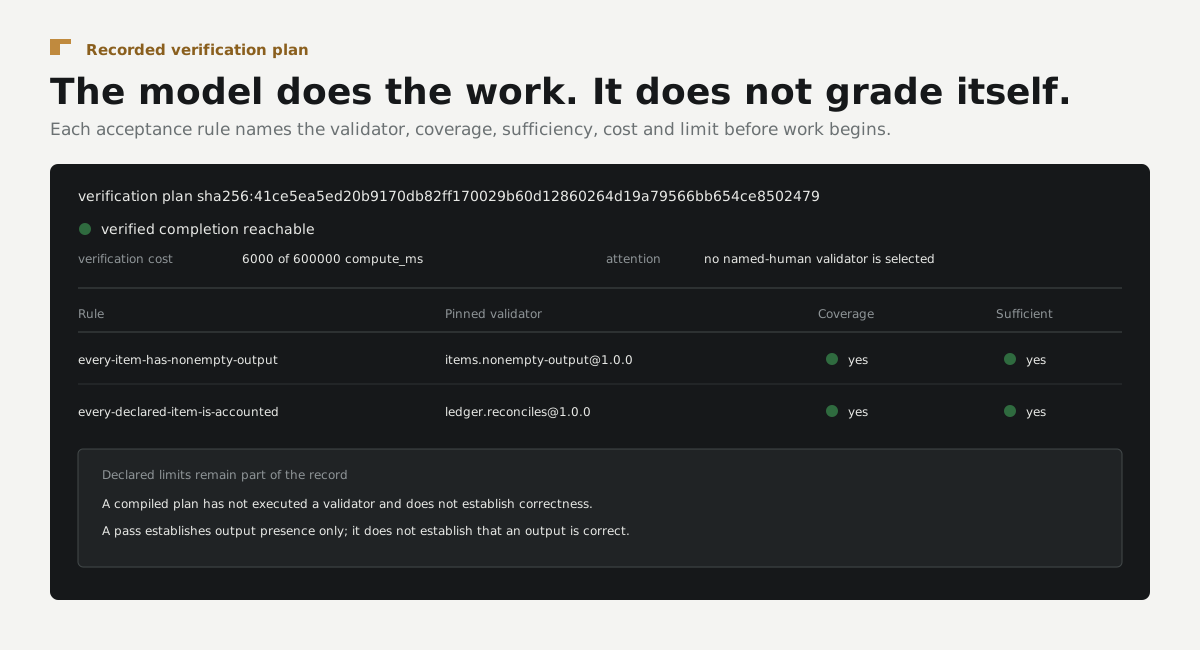
The verification plan lists every rule, the validator selected for it, its evidence grade, cost, dependencies, repair outcome and limitations. Publication preflight, the public API, the SDK and the CLI all show that same plan.
What this does not establish
Protocol conformance does not establish task correctness. Before production use, a validator still needs a fixed executable identity, repeatable results, declared coverage, complete labelled cases and deployment evidence for its host. A timeout, crash, cancellation, missing answer or input mismatch counts as indeterminate, never as a pass.
The Effect Plane is separate. Read-only work may omit it. A Full Cell tenant with dynamic authority sends an action to an endpoint its application implements, under a grant or a person's approval, and reports the action as done only on the endpoint's answer. Every other attachment records proposals and sends nothing. This package exports no effect dispatcher or target adapter.
Where to go next
- Use
@zero-ar/sdkto bind the validator into an agent and task contract. - Use
@zero-ar/contractsfor the complete task-contract and finding schemas. - Read the public package map to choose another surface.