
afnkit
v0.1.0
Published
Afnkit is an original, educational Express-inspired HTTP framework built on Node.js native HTTP APIs in TypeScript.

Maintainers
 afnanlabs
Readme
Afnkit

An original, educational Express-inspired HTTP framework written in TypeScript on top of Node.js native HTTP APIs.
It is built by studying the concepts in the lets-build-express/ tutorial
(kept in this repository as a read-only reference) and re-implementing them as a
cleaner, strictly typed, tested framework that addresses the defects catalogued in
forensic.md. See walkthrough.md for the
chapter-by-chapter development record and DESIGN.md for the
architecture and trade-offs.
Status: Chapters 1–5 of the reference tutorial are implemented, and the defects catalogued in
forensic.mdare fixed. The project builds cleanly and the automated suite passes 31/31; the example server has been run and its endpoints verified, including inside Docker. There is no linter configured.
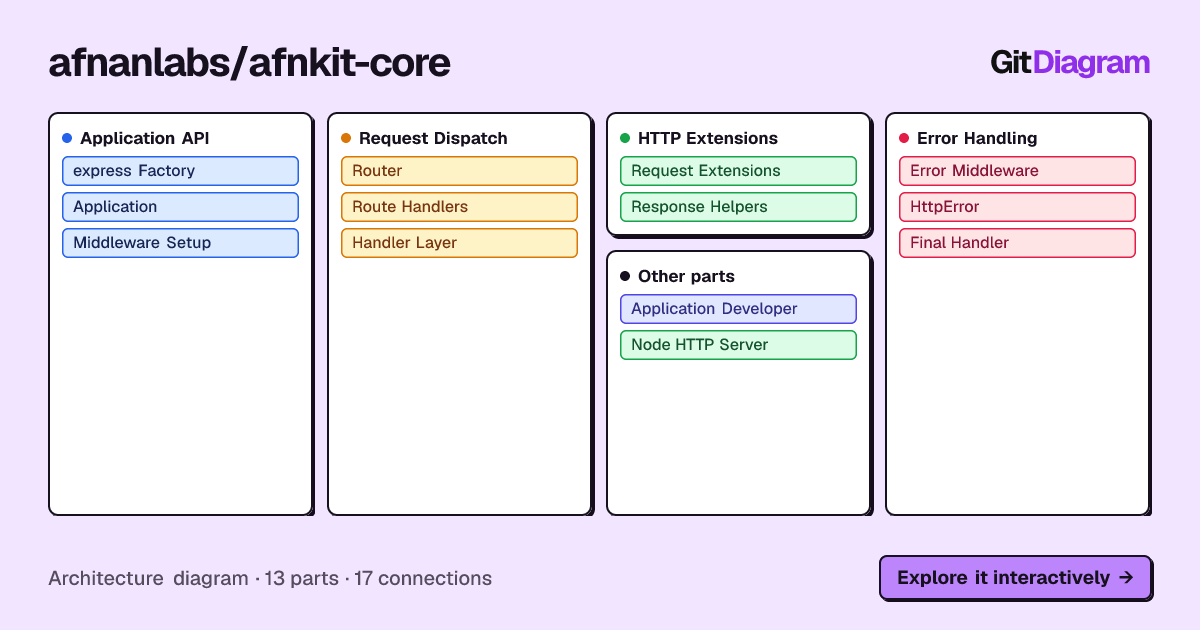
Architecture
Features
express()factory returning a typedApplication.- Route registration:
get,post,put,delete,patch,options,head,connect,trace, andall. - Middleware via
app.use(...), including 4-argument error-handling middleware. - Path matching (query string ignored) with method-aware dispatch.
- A real
next()with correct gating: one handler per cycle, and no execution after the response has ended. - Error propagation (
next(err)) for synchronous throws and rejected async handlers. - Deliberate
404/405(withAllow) /500responses — requests never hang. - Per-request request/response prototype extension (
app.request/app.response). res.status,res.send,res.jsonwith correct content types.HttpErrorfor deliberate status codes.- Zero runtime dependencies; tests use the built-in
node:testrunner.
Requirements
- Node.js 18+ (the test suite uses the global
fetch, available from Node 18). - TypeScript (dev dependency) for building.
Install and build
npm install
npm run build      # compile to dist/
npm run typecheck  # type-check without emitting
npm test           # compile, then run node:test over dist/tests
These scripts have been run:
npm run buildcompiles with no errors andnpm testreports 31 tests, 31 pass, 0 fail.
Usage
import { express, HttpError } from "afnkit";

const app = express();

// Middleware runs for every request, in order.
app.use((req, res, next) => {
  res.setHeader("X-Powered-By", "Afnkit");
  next();
});

app.get("/", (req, res) => {
  res.send("Hello world!");
});

app.get("/users/:id", (req, res) => {
  // Note: route parameters are not parsed yet; this matches the literal path.
  res.json({ id: req.path });
});

app.post("/echo", (req, res) => {
  res.status(201).json({ ok: true });
});

// Error-handling middleware (four arguments) catches next(err) and throws.
app.use((err, req, res, next) => {
  if (err instanceof HttpError) {
    res.status(err.status).send(err.message);
    return;
  }
  next(err);
});

app.listen(3000, () => {
  console.log("Listening on http://localhost:3000");
});
A runnable version of the above lives in examples/basic.ts
(it starts a server on port 3000 when executed; it has been run and verified,
including under Docker).
Project layout
src/               the framework (TypeScript)
tests/             automated tests (node:test)
examples/          usage examples
lets-build-express/  read-only tutorial reference (not modified)
walkthrough.md     chapter-by-chapter development history
DESIGN.md          architecture and design decisions
forensic.md        forensic review of the original tutorial (baseline)
Known limitations
- Exact-string path matching only: no
:params, wildcards, regex, or path-prefixedapp.use. - No query parsing (
req.query) or body parsing. - No implicit HEAD→GET mapping, content negotiation, ETag, redirects, or static file serving.
- No
nextdouble-call guard within a single handler tick. - Error-handling detection relies on handler arity (four parameters).
License
MIT — see LICENSE.