
agent-takkub
v1.6.13
Published
Desktop cockpit for orchestrating a team of Claude Code agents (Windows + macOS). Install globally: npm i -g agent-takkub

Maintainers
 monchai.m
Readme
🛩️ agent-takkub
Your AI dev team — in one desktop cockpit.
Prompt one Lead agent. It plans the work, splits it across specialist teammates, runs them in parallel as real claude processes, and verifies the result — while you watch and steer.




npm install -g agent-takkub100% local · runs on your logged-in Claude Code CLI · no SaaS middleware
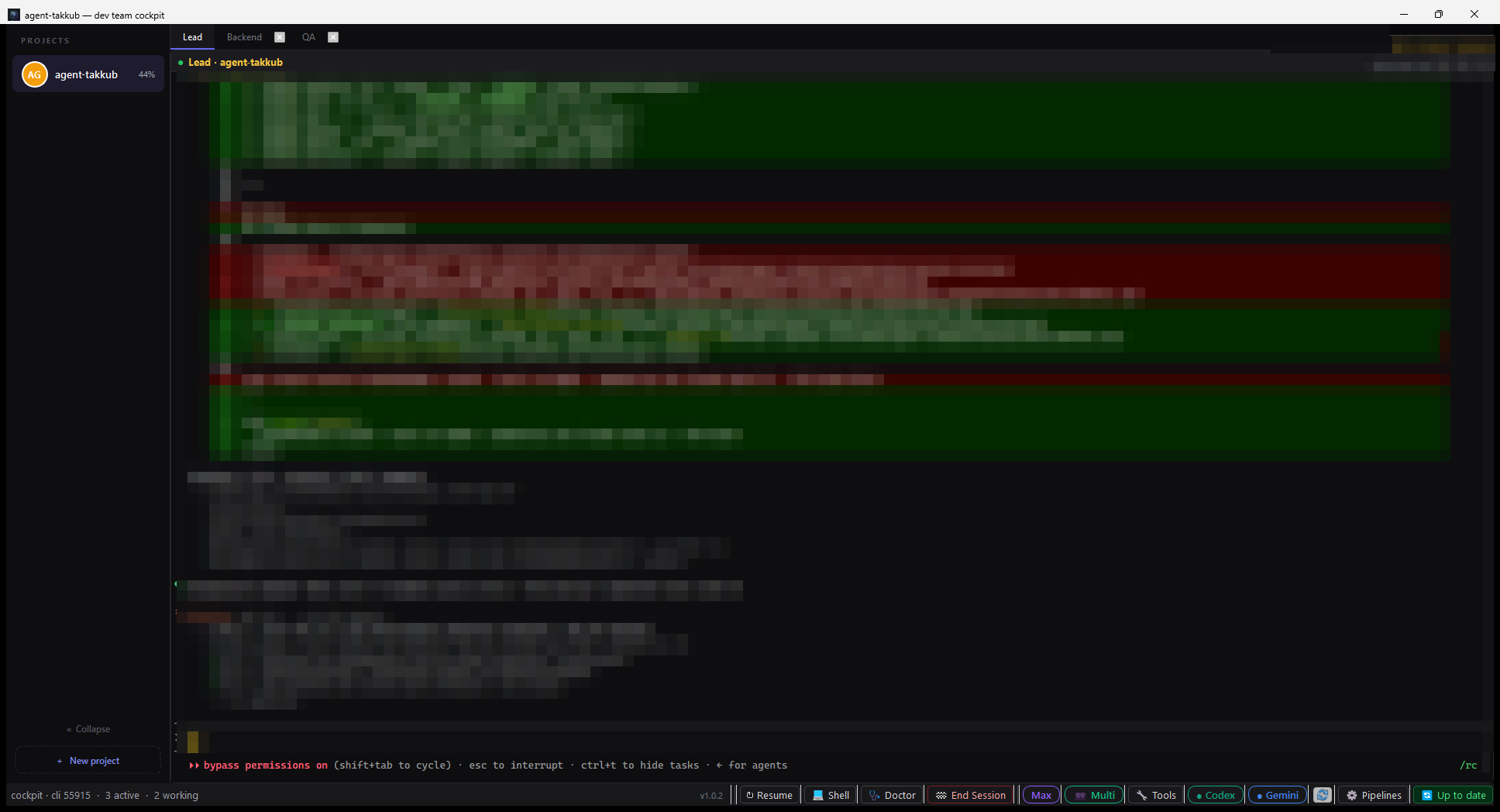
🖥️ The Desktop Cockpit
✨ Why agent-takkub?
A single AI agent hits a wall on big work: context fills up, sub-tasks collide, and everything runs one-at-a-time. agent-takkub runs it like a real engineering team — a Lead you talk to, and specialist teammates it delegates to, each in its own isolated claude process, working concurrently.
Orchestration
| | |
| :-- | :-- |
| 🧠 Orchestrated teammates | Converse with the Lead; it spawns, tasks, and manages specialist panes (frontend, backend, qa, reviewer, devops, mobile, …) on demand — only the roles a job actually needs. |
| 🔀 True parallelism | frontend and backend build a feature at the same time; QA always verifies last, against the real running stack. |
| 🌿 Branch & worktree isolation | Parallel teammates each work on their own git branch in an isolated worktree — no commit races, no dirty-state collisions. You merge when ready. |
| 👥 Fleet mode | One toggle scales a role into a fleet (frontend#1…#K) sized to your machine — for many independent features or sharded test suites at once. |
| 🧭 Plan-first shards | takkub assign --role qa --plan --shards N — a planner splits a big browser-QA sweep into N buckets before fanning out, instead of guessing an even split. |
| 🖥️ Steerable, always | Every pane is a live claude shell. Watch output in real time, interrupt, or type straight into any teammate. |
| 🗂️ Multi-project tabs | One isolated Lead per project — no cross-talk. |
| 🔒 100% local | No SaaS middleware. Everything runs on your machine, on your logged-in Claude Code CLI. |
Token efficiency & memory
| | |
| :-- | :-- |
| 📥 Pull-on-demand context | Reference docs, patterns, and CLI cheatsheets live outside the Lead's default prompt — it reads them only when a task needs them, instead of paying for them on every turn. |
| 🧾 Per-role memory + L2 archive | Each teammate keeps a short, token-budgeted "learned notes" file; entries that get trimmed for space are archived (not deleted) to a searchable sibling file instead of being lost. |
| 🔎 BM25 search (takkub search) | Full-text search over session logs and role-memory archives, ranked with Okapi BM25 — tokenizes both English words and Thai character trigrams, no external segmenter. |
| ✅ Evidence-gated QA/review | A verify role's "done" report is checked for actual evidence (a file, a test run, an exit code) — reports with no evidence cited get flagged for the Lead instead of trusted at face value. |
| 🧬 Structural code-intelligence (graft) | Symbol search, call-graph tracing, and signatures-only file views wired into code-reading roles (frontend/backend/mobile/devops/qa/reviewer/critic) — no LLM call, ~92% smaller than reading a large file whole. Fully optional: install with takkub doctor --fix (needs Node ≥ 20); a pane never gets the extra tools unless a project's graph has actually finished building. The graph lives outside the repo (~/.agent-takkub/graft-graphs, never committed); disable entirely with TAKKUB_SKIP_GRAFT_BUILD=1. |
Reliability & diagnostics
| | |
| :-- | :-- |
| 🩺 takkub doctor --live | Checks the running cockpit's spawn queue, CPU/RAM governor, resource waits, PTY queue depth, stale-write drops, and remote mirror — catches live wedges that config-only checks cannot see. |
| 🛡️ Reliability v2 | Delivery IDs, pane-session generations, TTL, single-flight submission, bounded priority PTY queues, fair heavy-work admission, adaptive hidden-pane rendering, durable completion dedupe, and Windows Job Object cleanup. |
| ⌨️ Multiline input that just works | Shift+Enter / Alt+Enter add a newline instead of submitting, provider-aware (works on claude/gemini panes; skipped where the underlying TUI would misinterpret it) — includes a macOS IME fix for Thai/CJK input dropped after switching input languages. (community contribution by @than-aa) |
🧠 One team, many model "brains"
Model diversity beats a single point of view. Takkub lets the Lead pull in a second, third — or sixth brain for planning, review, and cross-checks, and it never breaks if you don't have them installed.
| Brain | Backed by | Great at |
| :-- | :-- | :-- |
| 🟣 Claude | Claude Code CLI | The Lead + every specialist — build, test, review |
| 🟢 Codex | OpenAI Codex CLI | Second opinion · refactor patterns · cross-checking a plan |
| 🔵 Gemini | Google Antigravity (agy) | Long-context planning (reads the whole repo) · a third perspective |
| 🟠 OpenCode | sst OpenCode | One CLI, 75+ model backends (GLM · DeepSeek · local Ollama …) |
| ⚪ Kimi | MoonshotAI Kimi Code CLI | Long-context work · another independent perspective |
| ⚫ Cursor | Cursor CLI (cursor-agent) | Pick per-task from Cursor's own model roster |
Pick the model, not just the CLI. Every provider — and every role — can be pinned to a specific model from Settings → Providers & Roles, or from the terminal:
takkub provider model gemini "Gemini 3.1 Pro (High)"   # this CLI spawns with that model
takkub provider list                                    # who's installed, and on which model
A role's own model wins over the provider default, so backend can run Codex on gpt-5.6 while reviewer runs it on something cheaper.
Never a hard dependency. If a provider isn't installed (or you've toggled it off), the Lead keeps the role — Claude transparently stands in, and tells you you've traded away model diversity. No refusals, no dead ends.
⚠️ Kimi and Cursor are new in 1.0.27 — they spawn and take tasks, but their idle/busy screen markers aren't calibrated yet, so prefer Claude/Codex/Gemini/OpenCode for roles you leave unattended.
⚡ Quick Start
# 1. Install the cockpit globally  (isolated Python runtime + a Desktop icon)
npm install -g agent-takkub

# 2. Authenticate with your Claude account (if you haven't already)
claude login

# 3. Provision recommended plugins + browser-automation tools (idempotent)
takkub provision
⚠️ Install it globally — the
-gflag matters. It provisions the isolated runtime and the Desktop launcher. A plainnpm install agent-takkub(no-g) will not set the app up.
Then double-click “Takkub Cockpit” on your Desktop — or launch from a terminal:
agent-takkubRequirements — Node.js ≥ 18 and Python ≥ 3.11 already on your system. They're detected, never reinstalled. Everything else lives in an isolated ~/.agent-takkub; your existing claude CLI, plugins, and config are left completely untouched.
Optional: graft code-intelligence needs Node ≥ 20 — stricter than the cockpit's own Node ≥ 18 floor. It's off until you run takkub doctor --fix; without it (or on Node 18–19), the cockpit runs exactly the same, just without the extra structural-search tools for code-reading roles.
🚦 Two ways to run: 1:1 or a whole team
A chip in the status bar flips how the Lead works:
- 👤 1:1 (default) — one agent per role, one feature at a time. Focused and predictable.
- 👥 Multi — hand the Lead several independent features and it fans out into multiple instances per role (
frontend#1…#K,backend#1…#K) running at once, like a team of several devs per position. Finishes fast.
Dependent work stays sequential automatically; QA is always the final gate, run against the real stack.
🔄 Orchestration Flow
sequenceDiagram
    actor User
    participant Lead as Lead Agent
    participant Cockpit as Cockpit Engine
    participant Spec as Specialist Pane(s)
    participant Git as Git Repository

    User->>Lead: "Build the login feature"
    Lead->>Cockpit: takkub assign --role frontend / backend (parallel)
    Cockpit->>Git: create isolated branch + worktree (optional)
    Cockpit->>Spec: spawn claude pane + inject task
    Note over Spec: teammates code & test independently
    Spec->>Cockpit: takkub done "report"
    Cockpit->>Lead: done notice → verify sequence (devops → QA last)
    Lead->>Git: review + merge branches, propose ship
📱 Mobile Remote Control (PWA)
- 📲 Install-free PWA — open the paired link, Add to Home Screen, done. Offline-capable app shell, no store.
- 💬 Live Lead console — the Lead's replies stream to your phone in real time (with a "still working…" indicator); type back to steer it.
- 📊 Pulse — a glanceable, project-grouped view of which teammates are running and for how long.
- 🎛️ View vs. control — read-only by default; flip to control mode to send prompts or open projects remotely.
- 🔒 Three-factor, off by default — secret path + bearer token (never in the QR) + a password gate, on a loopback-only server behind a Cloudflare/ngrok tunnel, with per-client sessions & brute-force lockout. Data-minimized: never ships raw tool output, commands, or filesystem paths. Turn it on from the cockpit's 🌐 Remote chip.
🛠️ Everyday Commands
| Command | Purpose |
| :--- | :--- |
| takkub assign --role backend "…" | Spawn a specialist and assign a task |
| takkub assign --role frontend --isolation worktree "…" | Task on an isolated git branch + worktree |
| takkub assign --role qa --plan --shards 4 "…" | Plan-first parallel browser QA (auto fan-out) |
| takkub worktree list / merge / clean | Review + merge isolated branches |
| takkub send --to qa "…" | Message a teammate (Lead CC’d) |
| takkub search "…" | BM25-ranked search over session logs + role-memory archives (Thai + English) |
| takkub goal "…" | Set a session goal injected into every task |
| takkub restart | Restart the whole cockpit from the terminal |
| takkub doctor --fix | Diagnose the environment + auto-repair (add --install-providers to also install missing provider CLIs) |
| takkub doctor --live | Same checks, plus a live look at the running cockpit's spawn queue |
| takkub provider list | Show every provider CLI, whether it's installed, and its model |
| takkub provider install <name> | Install one provider CLI (Codex / OpenCode / Kimi) |
| takkub provider model <name> [<model>] | Show or set the model a provider spawns with (--clear to reset) |
| takkub provision | Install / repair plugins + browser tools |
📖 Deep Dives & Resources
- 🏗️ Architecture & design — Architecture Guide
- ⚙️ System overview & flow diagrams — docs/system-overview
- 🛡️ Performance & Reliability v2 — configuration, invariants, diagnostics, and rollback
- 🔧 From source / one-shot installer (Chrome, gh, Codex, Antigravity, rtk, …) — INSTALL.md
- 🐙 GitHub — takkub/agent-takkub