
agentauthz
v0.6.0
Published
Agent-native authorization engine for TypeScript: policy statements, grants-at-scope with typed bounds, ABAC conditions, deny-wins, asymmetric fail-closed. Policies live as rows in your own database — Postgres backend included, any conformant store drops

Maintainers
 wizardsupreme
Readme
agentauthz
Agent-native authorization engine for TypeScript: policy statements + grants-at-scope + typed ABAC conditions, deny-wins, asymmetric fail-closed. Policies are rows in your own database — Postgres backend included, any conformant store drops in — authored at runtime — by an admin UI, or by an agent — not files compiled into a deployment.
Documentation: https://developerinlondon.github.io/agentauthz/
npm install agentauthz        # or: bun add / pnpm add / yarn add
npm install agentauthz kysely # kysely only for the shipped Postgres backend
Compiled ESM with type declarations — plain Node ≥ 20, no bundler. Zero runtime dependencies.
Sixty seconds
import { PgAuthzStore } from "agentauthz/backends/pg";
import { makeAuthz } from "agentauthz/core";
import { actionRegistryFromCatalogue } from "agentauthz/ports";

const store = new PgAuthzStore(db, {
  scopeKinds: ["root", "project"],
  rootScope: { kind: "root", id: "*" },
});

const authz = makeAuthz({
  grantStore: store,
  auditSink: store,
  actionRegistry: actionRegistryFromCatalogue([
    { action: "docs.read" },
    { action: "docs.write", derivesFrom: "docs.read" }, // naming docs.read covers both — allow AND deny
  ]),
  conditionKeys: { "app:Region": { type: "string" } },
  defaultScopeChain: [{ kind: "root", id: "*" }],
});

await authz.check([{ kind: "user", id: "alice" }], "docs.write", "doc:42");
// deny-wins over every grant in the scope chain; audited; nothing granted ⇒ false
The admin surface is data, and the UI writes itself
The engine serves its whole vocabulary as a stable JSON document (describe()), plus framework-free
(Request) => Response admin routes over it. Every screen below is generated from that document —
declare a new condition key server-side and a new form field appears with no frontend change:
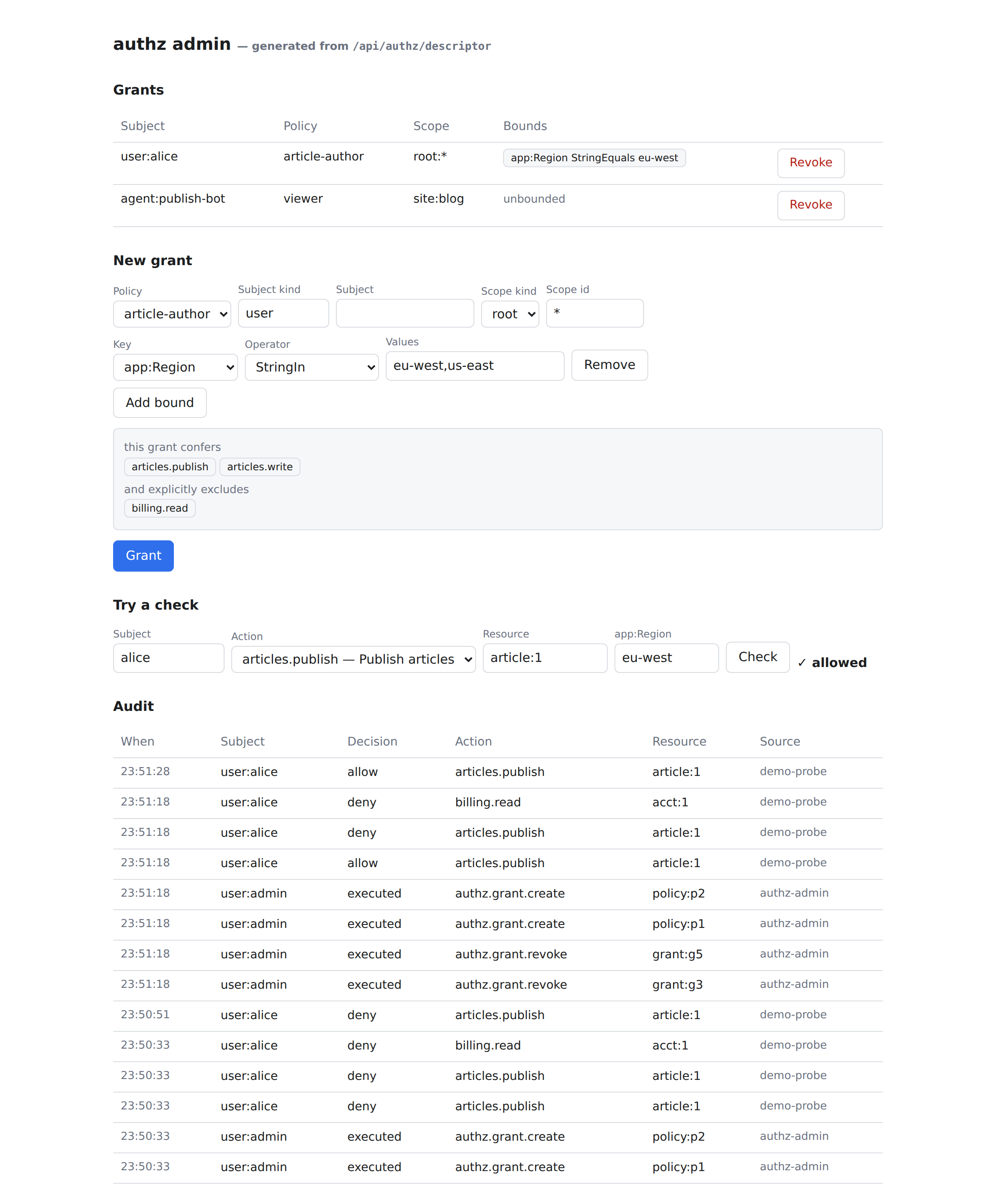
That page is cookbook/ui.html — one static file, no framework, no host knowledge. Run
it: cd cookbook && bun install && bun run server.ts.
Architecture
The engine is a pure core behind ports. The shipped Postgres backend is the reference implementation — any storage that passes the conformance fixtures is decision-identical and drops in behind the same seam, with zero call-site churn. The host keeps authentication, subject resolution, HTTP routing, the vocabulary, and what the admin UI looks like.
How it compares
Authorization-when-policies-are-data has five parts: deciding, storing, validating, auditing, and administering. This library ships all five, in your process. The usual alternatives ship one.
| | agentauthz | Cedar | OpenFGA / SpiceDB / Keto | Casbin | | ---------------------------------------------- | ---------------------------------------------------------------------------- | -------------------------- | ------------------------------- | ------------------------- | | Decide + store + validate + audit + administer | all five, out of the box | evaluator only | check service; the rest varies | evaluator + thin adapters | | Extra infrastructure | none — in-process | none (WASM from JS) | a stateful service to run | none | | Runtime authoring by admins & agents | first-class — schema-validated rows, named errors a UI shows verbatim | build it yourself | tuples via API | reload from adapters | | Storage | shipped and swappable — conformance fixtures prove a replacement backend | bring your own | the service's own | thin adapters | | A deny whose condition can't evaluate | the deny stands — fail closed | erroring policy is skipped | n/a (graph model) | depends on the matcher | | Safe for untrusted/agent policy authors | by construction — no expression language, closed vocabulary | expression language | n/a | evaluated matcher strings | | Per-decision audit | built in | build it yourself | varies | build it yourself | | Admin surface | served as data — descriptor + handlers, one UI fits any host | build it yourself | service APIs | build it yourself |
Different products solve different problems: Cedar is a formally verified evaluator for policies engineers review in git — there, CI is the admin surface and the missing ring doesn't hurt. Zanzibar services (OpenFGA, SpiceDB, Ory Keto) answer graph questions ("list everything alice can see") over millions of relationships — a reverse-index query shape this library deliberately doesn't do. For the question may this subject do this action on this resource, right now — with the policies themselves written and administered at runtime — this is the complete package. Full comparison →
Concepts in one line each
| Concept | In short | Docs |
| ----------------- | ---------------------------------------------------------------------------------------------- | -------------------------------------------------------------------------------------------------------- |
| Statements | {effect, actions, resources, conditions?} — actions from a closed registry, never wildcarded | Semantics |
| Scope chains | host-resolved, root-first; deny anywhere beats allow anywhere; malformed ⇒ deny | Semantics |
| Conditions | typed operator whitelist, tri-state, asymmetric fail-closed — no expression language | Conditions |
| Action derivation | a statement naming a parent covers its declared, enumerable family — allow and deny alike | Semantics |
| Grant bounds | conditions on the grant: one curated policy, different limits per subject; narrows allow only | Grants & bounds |
| Role synthesis | app-owned role rows become grants at check time — one storage, no dual-write | Architecture |
| Descriptor | the vocabulary as versioned JSON; any UI on any runtime renders from it | Admin surface |
| Conformance | golden fixtures any alternative backend must decide identically — the swap-proof | Storage & conformance |
| MCP server | agent-facing tools whose input schemas are generated from that same descriptor | MCP server |
Development
bun install
bun test                # pg suite needs DATABASE_URL (scratch db created/dropped)
bunx tsc --noEmit
Installing straight from git also works (bun add github:developerinlondon/agentauthz#v0.5.0) —
dist/ is committed and CI refuses a stale one.
Releasing
Bump version in package.json, merge, push the matching tag
(git tag v0.5.0 && git push origin v0.5.0). The release workflow typechecks, runs the whole suite
including the storage-backed conformance runner against Postgres, refuses a tag that disagrees with
package.json, and publishes via npm trusted publishing — no token exists anywhere.
License
Apache-2.0