
air-hockey
v0.12.0
Published
Tiny multiplayer air hockey for the browser: ice, sea and desert scenes, breakable obstacles, teams and tournaments. Zero runtime dependencies, WebSocket or same-browser multi-tab play, pluggable into any JS app.

Maintainers
 korial29
Readme
air-hockey







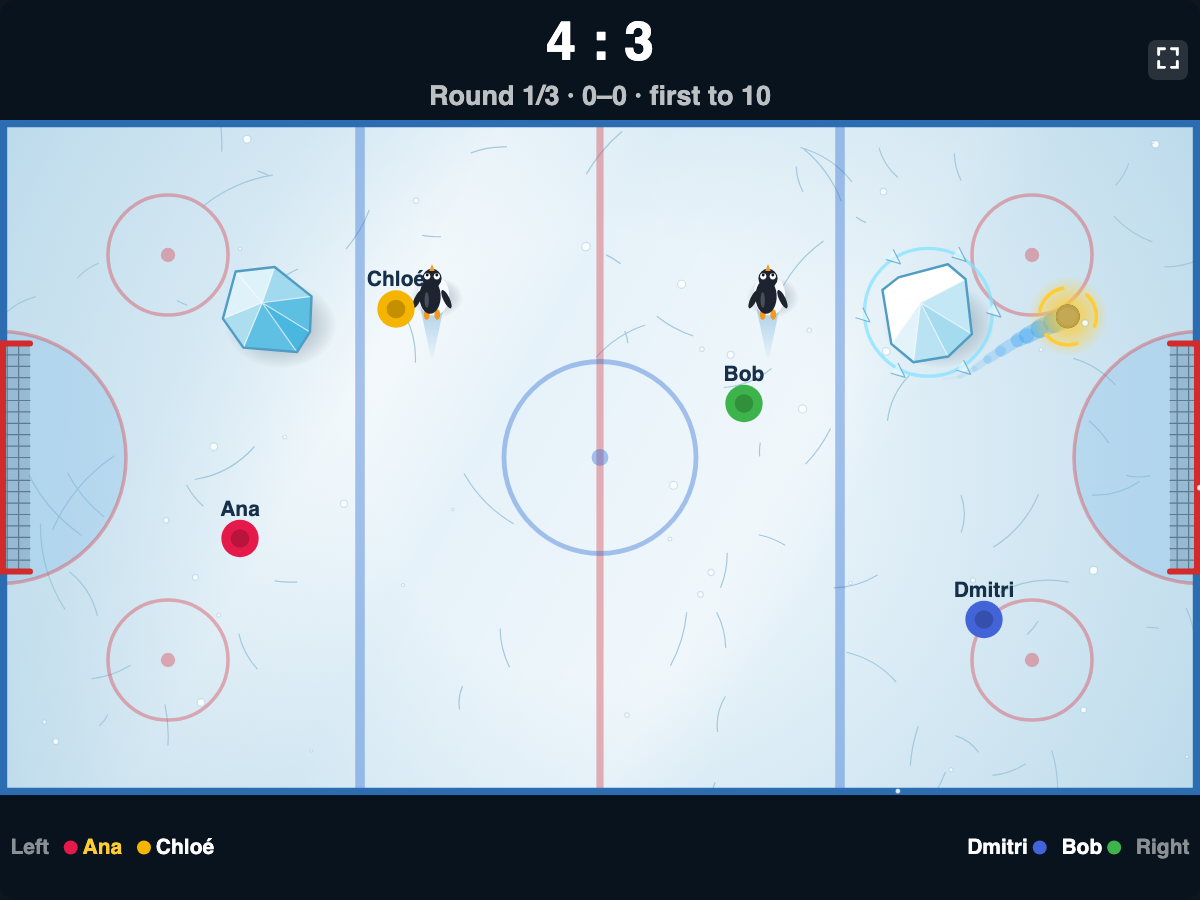
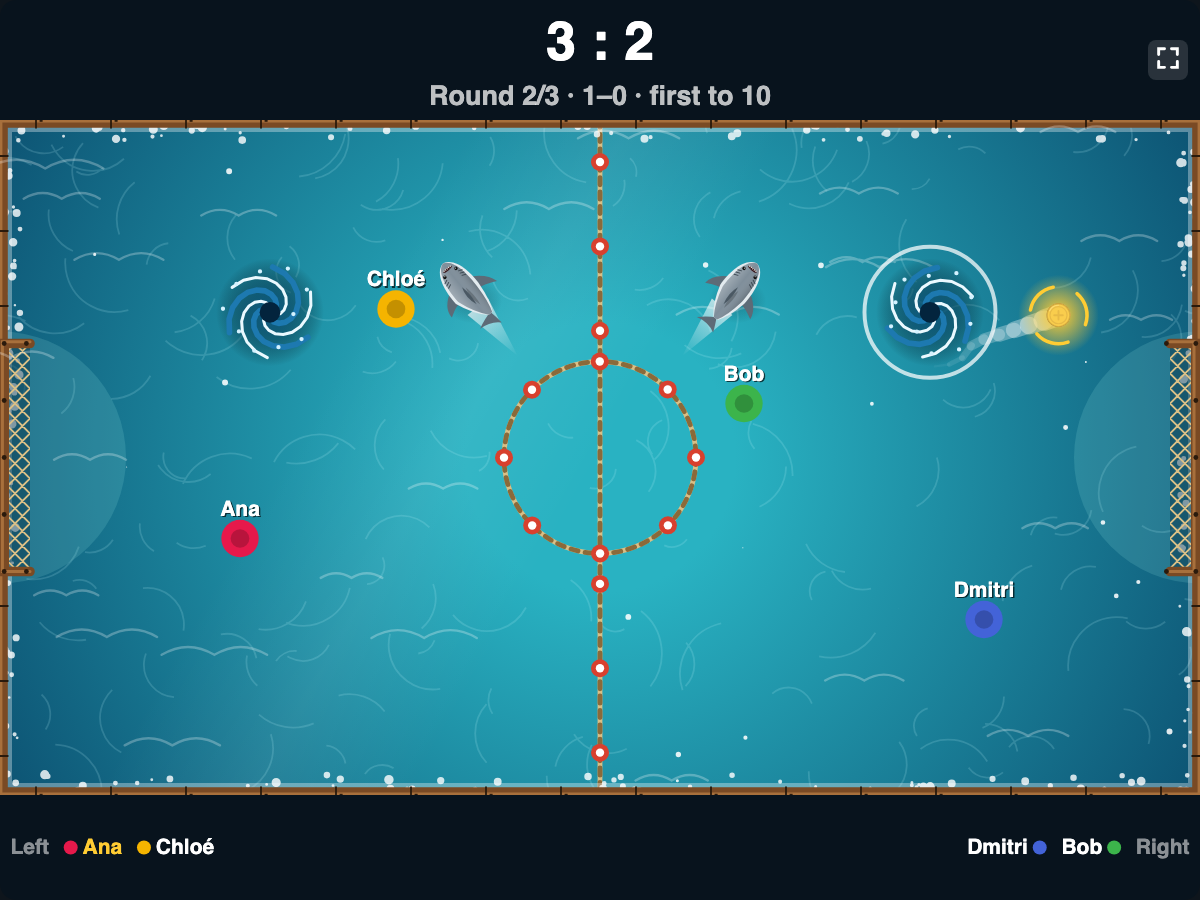
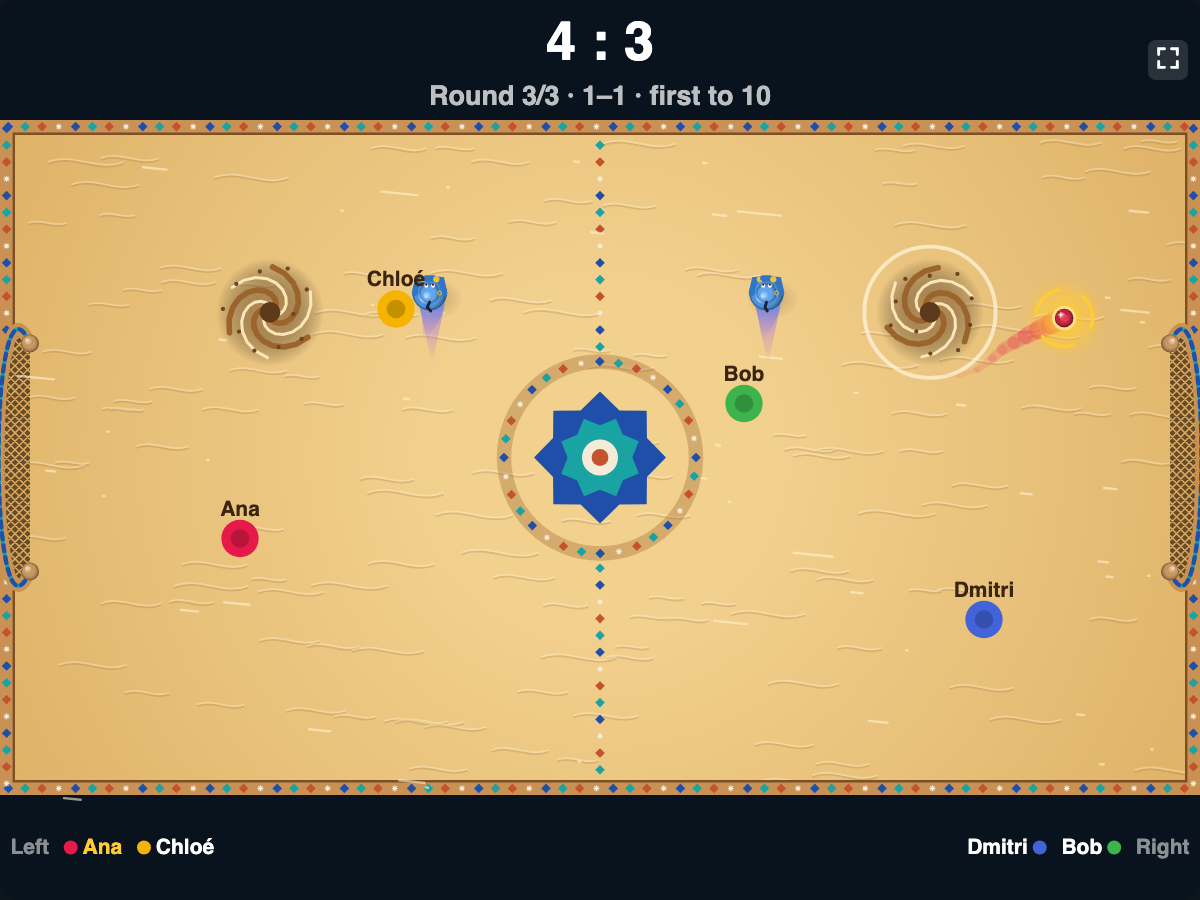
A multiplayer air hockey game for the browser, written in TypeScript with no game library and no runtime dependency. Players join with a name, get a colour of their own, and play in teams through three scenes, one per round: an ice rink with icebergs and sliding penguins, the sea with vortices and sharks, and an Arabian Nights desert with whirlwinds and genies.
Framework-agnostic, light to add
airHockey() mounts the game into any element, inside its own Shadow DOM: React, Vue, Angular, Svelte or a plain page, nothing leaks in or out. Everything is drawn on one canvas, with no images, fonts or assets to serve.
| Entry | What it is | Size (gzip) |
| --- | --- | --- |
| air-hockey | The game client: rendering, input, prediction | ~15.7 KB |
| air-hockey/local | Same-browser multiplayer, no server | ~6.6 KB |
| air-hockey/server | Node WebSocket server (needs ws) | Node only |
| air-hockey/room | One game, for any transport you already have (Socket.io…) | Node only |
The budgets (20 KB and 8 KB) are checked in CI on every pull request.
Live demo
https://korial29.github.io/air-hockey/
Open the page in two or more tabs of the same browser, pick a name in each, and play. Add ?goals=2 to the first tab's URL for short rounds.
Installation
npm install air-hockeyThe server entry also needs ws, an optional peer dependency:
npm install wsBasic usage
Tabs of the same browser, no server
import { airHockey } from 'air-hockey';
import { localSocket } from 'air-hockey/local';

const game = airHockey(document.getElementById('game')!, {
  name: 'Ana',
  socket: localSocket('my-room'),
});
Every tab that opens localSocket('my-room') joins the same game over a BroadcastChannel. One tab hosts the match, elected with navigator.locks; when it closes, another tab takes over. navigator.locks needs a secure context: on http:// from a LAN address, each tab plays alone.
Across devices, with a WebSocket server
// server.ts (Node)
import { serve } from 'air-hockey/server';

const stop = serve({ port: 8787 }); // or serve({ server: existingHttpServer })
// in the browser
import { airHockey } from 'air-hockey';
airHockey(document.getElementById('game')!, {
name: 'Ana',
url: 'wss://your-host.example/my-room',
});One room per URL path: /my-room and /other are two separate games. A ready-made server ships as a command:
PORT=8787 npx air-hockey-serverOver a transport you already have
An app that already talks to its server (Socket.io, an existing WebSocket, a worker) can carry the game itself. On the server, drive a Room from air-hockey/room, which needs no ws. On the client, pass a socket that relays the same frames:
// server: one Room per game, fed the frames of each peer
import { Room } from 'air-hockey/room';

const room = new Room({ goals: 3 });
room.start();
const conn = { send: (data: string | ArrayBuffer) => peer.emit('game', data) };
room.connect(conn);
peer.on('game', (data: string | ArrayBuffer) => room.receive(conn, data));
peer.on('disconnect', () => room.disconnect(conn)); // room.stop() once nobody is left
// client: a SocketLike over the same channel
airHockey(el, {
name: 'Ana',
socket: {
binaryType: 'arraybuffer',
onopen: null,
onclose: null,
onmessage: null,
send: data => io.emit('game', data),
close: () => io.emit('leave'),
},
}); // then call its onopen() once the server has the peer, and onmessage({ data }) per frameText frames are JSON; binary frames (inputs, snapshots) must reach the room as an ArrayBuffer of exactly their bytes. Cap what a peer may send: inputs are 5 bytes, a join a few dozen.
Sizing
The game fills the width of its container and keeps its aspect ratio (4:3, score band and rosters included). Give the container a width; to fit a screen, cap it by the height too:
#game {
  max-width: calc((100dvh - 100px) * 4 / 3);
  margin: 0 auto;
}
On a landscape screen at most 500 px high (a phone on its side) the game switches to a wide frame, 2430 × 1125 (about 2.16:1): the rink fills the height, the score and the rosters go beside it. Let the container grow to that ratio there:
@media (orientation: landscape) and (max-height: 500px) {
  #game {
    max-width: calc(100dvh * 2430 / 1125);
  }
}
A full-screen button sits in the top-right corner of the game (bottom-right in the wide frame). In full screen a phone turns landscape where the browser allows it; held upright, it shows a hint to turn it.
API
airHockey(container, options)
Mounts the game and joins. Returns { on, destroy }.
| Option | Type | Default | Description |
| --- | --- | --- | --- |
| name | string | — | Player name shown above the paddle (16 characters max). A taken name gets a suffix (Bob 2). |
| url | string | — | WebSocket URL, room in the path. Ignored when socket is given. |
| socket | SocketLike | — | Any WebSocket-like object, e.g. localSocket('room'). |
| fullscreen | boolean | true | Show the full-screen button (hidden anyway where the browser does not allow it). |
Events
on(event, callback) returns a function that removes the listener.
| Event | Payload | When |
| --- | --- | --- |
| open | — | Connected. |
| close | — | Disconnected. |
| roster | { you, players } | A player joined or left. players are { id, name, color, team }. |
| score | [left, right] | The score of the round changed. |
| goal | { team, score } | A goal was scored. |
| match | MatchState | The phase changed: wait, ready (countdown), play, break, end. break and end carry the winner and the full ranking. |
game.on('match', m => {
  if (m.phase === 'end') saveResults(m.ranking);
});
destroy()
Leaves the game, stops rendering, removes every listener and the game's DOM. Safe to call twice.
localSocket(room, rules?) — air-hockey/local
A same-browser socket for airHockey. rules apply to the match the tab hosts: pass the same ones from every tab.
serve({ port | server, rules? }) — air-hockey/server
Starts the WebSocket server and returns an async stop(). rules apply to every room.
new Room(rules?) — air-hockey/room
One game. start() and stop() run its clock; connect(conn), receive(conn, data) and disconnect(conn) feed it a peer and its frames, and it answers through conn.send(data). size is the number of joined players.
Rules
Every field is optional; missing ones keep their default.
| Rule | Default | Description |
| --- | --- | --- |
| arena | ['ice', 'sea', 'desert'] | Scene, or scenes taking turns from one round to the next: 'ice', 'sea', 'desert', 'classic' (empty rink). |
| rounds | 3 | Rounds in a match, all of them played, one scene each: the team that wins the most wins the match. |
| goals | 5 | Goals that win a round. |
| hit | 1 | Points for a hit, when the previous toucher was someone else. |
| goal | 20 | Points for the scorer of a goal. |
| ownGoal | 10 | Points taken from the last toucher of an own goal. |
| roundWin | 10 | Points for each player of the team that wins a round. |
| matchWin | 30 | Points for each player of the team that wins the match. |
| headStart | 1 | Uneven teams: goals the smaller team starts each round with, per missing player. |
| readySec | 3 | "3, 2, 1, PLAY!" countdown before each round (0 turns it off). |
| breakSec | 3 | Pause between rounds. |
| endSec | 15 | Time the final podium stays on screen. |
serve({ port: 8787, rules: { arena: 'sea', goals: 5, rounds: 1 } });How a match plays
- Teams: players are spread left and right as they join, each with a paddle in their half. Up to 16 players.
- The rink grows with the players, so everybody keeps the same room: ×1 at 2 players, ×1.41 at 4, ×1.73 at 6, ×2 from 8. Obstacles go from 3 to 7 with the player count. The rink adapts while waiting, at round start and at every serve until someone touches the puck.
- Three scenes, one per round: ice, sea, desert.
- Obstacles bounce the puck like pinball bumpers, except those that grab it. Icebergs, vortices and whirlwinds stand in front of the goals, each on a random square of a grid there, every game and every round: one side's in the top half, the other's in the bottom half. They break after 3 hits and come back on another square. Penguins cross the width and are shot out on the first hit. Genies float at random along their lane and never go: a genie hit makes the puck vanish, served again in front of the shooter's opponents, and the genie stops to strike the shooter with lightning, a bolt between them, a countdown on the paddle: both stand still for 5 s, then the genie floats on. One victim at a time: a genie under its spell bounces the puck. Everything comes back after 10 s, with a ghost for the last 3 s.
- Some obstacles grab the puck. A whirlwind spins it round for about a second and flings it out in a random direction. A vortex sucks it under the water and lets it up, at rest, somewhere else on the rink. A shark, zig-zagging across the width, eats it and spits it out in a random direction; sharks are never shot out. A puck that comes up splashes and pops back to its size.
- One goalie per crease: in the half-disc marked in front of each goal, only the defender nearest the goal stops the puck. The other defenders in it turn see-through and the puck goes through them, so a wall of paddles cannot shut a goal.
- Serves: a served puck ignores obstacles until a player touches it, and is never served under a paddle.
- End of match: a stadium screen with the winning team's cup, a podium of the top scorers and the points ranking.
Features
- [x] Multiplayer over WebSocket, or between tabs of one browser with no server
- [x] Unique colour per player, name above the paddle, team rosters
- [x] Teams, 3-round matches (one scene each), individual points ranking, podium screen
- [x] One goalie per crease: no wall of defenders in front of a goal
- [x] Three scenes taking turns, each with its own play: ice (icebergs, sliding penguins), sea (vortices that swallow the puck, zig-zagging sharks that spit it out, wooden goals), Arabian Nights desert (whirlwinds that catch and fling the puck, wandering genies whose lightning paralyses the shooter, Moorish arches)
- [x] Breakable obstacles with respawn and ghost
- [x] Rink that grows with the number of players
- [x] Client-side prediction: your paddle and the puck react at once
- [x] "3, 2, 1, PLAY!" countdown, goal flash, puck beacon and trail
- [x] Full-screen button, mouse and touch, phone-sized screens: thumb-sized paddles, the rink full height on a phone on its side (score and rosters beside it), landscape in full screen, a hint to turn a phone held upright
- [x] Shadow DOM, zero runtime dependencies, size-gated in CI
Development
Node 24 (see .nvmrc).
npm install
npm start            # demo with hot reload (Vite)
npm run dev:server   # WebSocket server on :8787
npm test             # Vitest
npm run lint         # Prettier, ESLint, tsc
npm run build        # dist/: client, local, server, types
npm run size         # gzip budgets
The demo reads ?name=, ?mode=local|server, ?url=, ?goals=, ?rounds= and ?arena= (for example desert, or ice,sea) from its URL, which makes testing several players in several tabs quick.
Pull requests need one release label (release:major, release:minor, release:patch or release:skip); merging one into master proposes the matching npm release. See .github/CI.md.