
airgen
v0.2.5
Published
Reactive TypeScript type generator for Airtable Custom Extensions: watches the base schema from inside the extension and writes airtable-schema.ts to disk via a local daemon.

Maintainers
 pbotsaris
Readme
airgen
Reactive TypeScript type generator for Airtable Custom Extensions.
A <SchemaObserver /> component inside your extension watches the base schema via the Blocks SDK and streams generated types to a local daemon that writes airtable-schema.ts to disk.
This library does code generation on top of the official Airtable Blocks SDK, so no API tokens and no manual regeneration are needed.
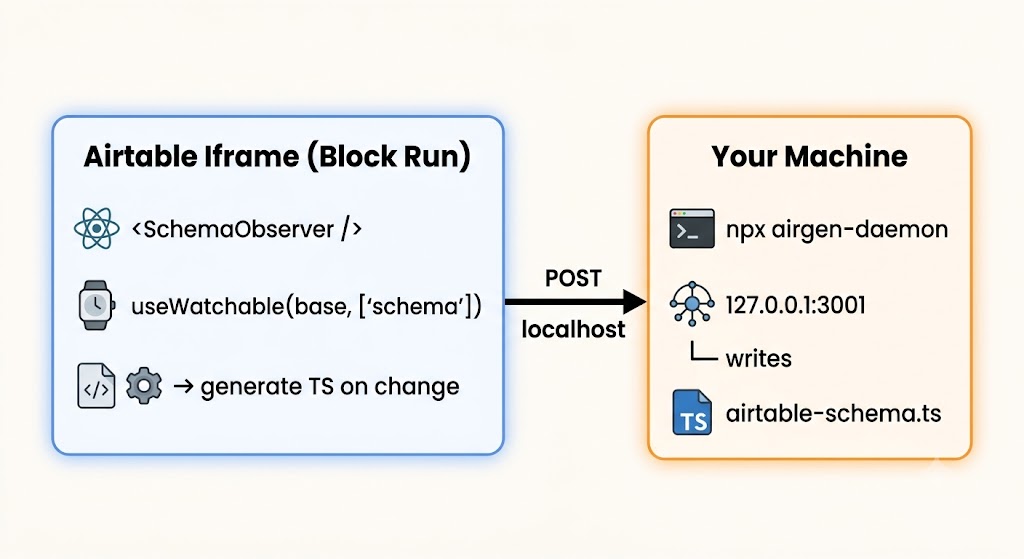
Because the schema comes from the live Base model, generation reacts to every schema mutation — renaming a field, changing a field type, adding a select choice — within ~1 second, while block run hot-reloads your extension with the fresh types.
Requirements
airgen is not a standalone Airtable client — it only works inside a custom extension built with the Airtable Blocks SDK, and it's meant to be used alongside it while you build custom interfaces on top of your base.
@airtable/blocks>= 1.10.0, or an experimentalinterface-alphabuild — required peer dependency. airgen reads the schema through the SDK's liveBasemodel and its hooks are thin wrappers over SDK records.react >= 16.14— required peer dependency (the observer and the generated hooks are React).- Node
>= 18for the CLI/daemon. - An extension scaffolded with the Airtable CLI (
block init), run locally withblock run.
Everything airgen emits is typed against record.getCellValue(field) in the Blocks SDK, so the generated types only make sense in an SDK context. There is no REST API path and no Airtable personal access token anywhere in this package.
Setup
The SDK and React come from the extension scaffold, so you never install them by hand — scaffold with the Airtable CLI first, then add airgen to that project. For an interface extension, the hello-world template is the quickest start:
npm install -g @airtable/blocks-cli
block init NONE/<your-block-id> --template=https://github.com/Airtable/interface-extensions-hello-world <your-interface-project-name>
block init takes a <baseId>/<blockId> identifier. Interface extensions aren't scoped to a single base, so there's no base ID to give — the literal NONE is the CLI's placeholder for that slot (it accepts a base ID only if it starts with app, or exactly NONE). Get <your-block-id> (a blk… ID) from Builder Hub when you create the extension.
Then, inside that project:
npm install --save-dev airgen1. Start dev through airgen (it runs block run for you):
npx airgen                        # starts the schema daemon, then `block run`
npx airgen -p 3005 -o src/airtable-schema.ts
npx airgen -- --port 9001         # args after -- are passed to `block run`
The generated file lands at ./frontend/airtable-schema.ts by default. To
change that (or the daemon port) without CLI flags, drop an
airgen-config.json next to where you run airgen:
{
  "out": "./frontend/src/airtable-schema.ts",
  "port": 3005
}
CLI flags and the PORT env var take precedence over the config file.
The daemon lives inside the same process as block run and exits the moment
it exits, so stopping dev (ctrl-C) never leaves anything running. If you'd
rather manage block run yourself, npx airgen --daemon-only starts just
the daemon.
2. Render the observer in your extension (dev only):
Import from the entry point that matches your SDK flavor — the three are identical except for which of the SDK's ui modules they bind:
| Your extension | SDK ui module | Import airgen from |
|---|---|---|
| Interface extension (@airtable/blocks@interface-alpha) | @airtable/blocks/interface/ui | airgen/interface |
| Custom extension, stable SDK (@airtable/[email protected]) | @airtable/blocks/ui | airgen |
| Custom extension, experimental SDK | @airtable/blocks/base/ui | airgen/base |
import {SchemaObserver} from 'airgen/interface'; // or 'airgen' on the stable SDK
import {airgenMeta} from './airtable-schema';    // optional: enables drift display

function App() {
  return (
    <>
      <SchemaObserver meta={airgenMeta} />  {/* remove or enabled={false} before release */}
      <MyExtension />
    </>
  );
}
The panel shows daemon connection status, table count, last sync time, and a "Copy schema" clipboard fallback for when the daemon isn't running. Two more indicators light up when available:
- Typecheck status (
✓ types ok/✗ 3 type errors): after every schema write the daemon typechecks your project and the panel shows the result — so a field rename that breaksrecord.fields.contactEmailin your code is visible immediately, even thoughblock runitself never typechecks. Expand the entry to see the first few errors with file and line. - Schema drift (needs the
metaprop): live schema vs theairgenMetabaked into your generated file, compared by ID — deleted tables/fields and type changes are breaking, removed select choices are warnings, renames are informational.
3. Import the hooks straight from the generated file:
// anywhere in your extension (the default output lands in frontend/, next to your extension code)
import {useRecords} from './airtable-schema';

const projects = useRecords('Projects'); // table key is autocompleted & validated

projects[0]?.fields.status?.name;   // "Todo" | "In Progress" | "Done"
projects[0]?.fields.owner?.email;   // string | undefined
projects[0]?.fields.tasks?.[0].id;  // linked record id
projects[0]?.raw;                   // native SDK Record, escape hatch
The generated file binds the hooks itself (export const {useRecords, useTable, useSchemaDrift} = createTypedHooks<TableRecordMap>(airgenMeta)), so there's no wiring step — and it works from plain JS too: the generic lives inside the generated file, so useRecords('Projects') in a .js file still gets full autocomplete and field types from the editor's TypeScript service.
Commit airtable-schema.ts — it's the source of truth when no dev session is running (CI, teammates without the base open).
What gets generated
- One
export interface <Table>Recordper table, all fields optional (empty cells arenullin Airtable). Field keys are the Airtable names transliterated (Latin accents stripped:soluções→solucoes) and camelCased (Contact Email→contactEmail), so they're always plain property accesses; the raw Airtable name is kept inairgenMetaand the field's JSDoc. Names with nothing left after sanitization (e.g. emoji-only) fall back to the quoted raw name. - Value types mirror what
record.getCellValue(field)returns in the Blocks SDK — not the flatter REST API shapes:- selects → literal unions of
{ id: "sel…"; name: "…"; color?: string }, with a named alias per field (e.g.ProjectsStatusChoice) - record links →
Array<{ id, name }>, collaborators →{ id, email?, name?, profilePicUrl? }, attachments with thumbnails - formulas/rollups/lookups resolve to their computed result type
- selects → literal unions of
airgenMeta— aconstmap of every table/field/choice ID.TableRecordMap+TableKeyfor hook inference.useRecords/useTable/useSchemaDrift— hooks already bound to the schema, imported directly from the generated file.
Rename survival
TypeScript types are erased at compile time, so no tool can "update types at runtime" — what airgen does instead:
useRecordsresolves tables and fields by ID fromairgenMeta, so renaming a table, field, or select choice in Airtable never breaks the running extension.- The observer notices the same schema event and regenerates the file, so the display names in your types refresh automatically while you develop.
- Deleted fields are skipped gracefully; a deleted table yields
[].
Efficiency
Three gates keep this cheap:
useWatchable(base, ['schema'])— the observer re-renders only on schema mutations, never on record/cell data changes. Keep it a leaf component.- A canonical schema signature (FNV-1a) is compared before doing anything — no-op events skip generation entirely.
- Generation runs inside a 500 ms debounce, so a burst of edits costs one generation + one POST. The daemon also skips disk writes when content is unchanged.
Typechecking
block run transpiles with Babel and never typechecks — a schema change that breaks your code would otherwise fail silently at runtime. So after every schema write (and once at startup) the daemon typechecks your whole project using your project's own typescript (nothing is bundled; if it isn't installed, the feature quietly reports "unavailable"). It finds the nearest tsconfig.json — or jsconfig.json — at or above the output file and runs tsc --noEmit in a child process, so the daemon never blocks.
Results are served at GET /diagnostics:
{
  "status": "ok | errors | checking | unavailable",
  "errors": [{"file": "frontend/index.tsx", "line": 12, "col": 5, "code": "TS2322", "message": "…"}],
  "total": 1,
  "checkedAt": "2026-08-02T18:03:11.412Z"
}
The observer polls this after each sync and shows the result in the panel. Paths are project-relative (never absolute).
Fixing your code when the schema changes
Renaming a field in Airtable regenerates your types instantly — but every record.fields.contactEmail in your code is now stale. Start airgen with --fix and it offers to rewrite them:
npx airgen --fix # or {"fix": true} in airgen-config.jsonOn each schema write the daemon diffs the previous generated file against the new one by ID, so a rename is an exact fact (fldEmail000000001 was contactEmail, is now customerEmail) rather than a guess. It then locates the affected code with the TypeScript language service and shows it in the panel, with an Apply button for anything it can rewrite mechanically:
| Change | What happens |
|---|---|
| Field renamed | record.fields.contactEmail → .customerEmail, including destructuring, across .ts and .js |
| Table renamed | useRecords('Projects') → useRecords('Projekte'), plus the ProjectsRecord type |
| Select choice renamed | status?.name === 'Todo' → === 'Backlog' |
| Generated type renamed | ProjectsRecord, ProjectsStatusChoice and friends where you import them |
| Field/table deleted | Listed with every usage as file:line — no automatic fix, the data is gone |
| Field type changed | Same: the value's shape changed, so only you can decide what the code should do |
String literals are rewritten only when the type checker confirms what they are — an unrelated const label = 'Todo' is never touched. When it can't confirm, it skips and leaves the error for the typecheck panel: under-fixing is the intended failure mode.
If your extension is JavaScript
Both features are driven by TypeScript, but your code doesn't have to be. A jsconfig.json next to (or above) the generated file is enough — it's the same format, and TypeScript reads it with allowJs implied:
{
  "compilerOptions": {"target": "es2020", "moduleResolution": "bundler", "checkJs": true},
  "include": ["frontend"]
}
.js and .jsx files are analysed and rewritten exactly like .ts — the generated file is still TypeScript, and your editor picks up the types from it either way. One asymmetry worth knowing: jsconfig.json implies allowJs but not checkJs, so without the "checkJs": true above, the typecheck panel has nothing to report on your .js files and will happily say "types ok". Fixes work regardless of that setting.
Applied edits are printed to the terminal and the project is re-typechecked immediately, so the panel confirms the fix landed. Undo is git — these are ordinary dev-loop edits, same as an editor refactor.
A note on scope: this is the one feature that writes outside the generated file, so it exists only under --fix. Edits are confined to your project directory and to source extensions, a pending fix is single-use, and if you edit a file after the analysis ran the apply is refused rather than applied at stale offsets.
Daemon security
Any webpage you visit can fire blind cross-origin POSTs at localhost, so the daemon is deliberately locked down:
- binds
127.0.0.1only - the output path is fixed at startup (
--outorairgen-config.json); client-supplied paths in the payload are ignored - payloads must be bounded (< 2 MB) strings starting with the airgen header, or they're rejected without writing
GET /diagnosticsandGET /fixesare pure state reads (they never trigger work) and report cwd-relative paths onlyPOST /apply-fixexists only under--fix, takes an id and nothing else, and applies only edits the daemon computed itself — paths and edits are never accepted from the request
Production
Remove <SchemaObserver /> (or pass enabled={false}) before releasing. If it ships anyway, a released extension runs from a non-localhost origin, so browsers block the localhost request and the panel just shows "Disconnected" — nothing breaks and nothing is sent anywhere.
Detecting schema drift in a released extension
Renames never break a running extension (everything resolves by ID), but a deleted table or field silently yields []/undefined, and a type change makes the baked-in types lie. useSchemaDrift — exported by the generated file like the other hooks — detects exactly that, live, with no daemon involved:
import {useRecords, useSchemaDrift} from './airtable-schema';

function App() {
  const drift = useSchemaDrift(); // re-runs only on schema mutations

  return (
    <>
      {drift.counts.breaking > 0 && (
        <Banner text={`This extension is out of date: ${drift.findings[0].message}`} />
      )}
      <MyExtension />
    </>
  );
}
The report classifies findings as breaking (deleted tables/fields, type changes), warning (removed select choices), or info (renames — harmless, but your generated file is stale). Wire it to a banner, your error reporting, or just ignore it. The underlying pure function is also exported as checkSchemaDrift(base, airgenMeta).
API
All of these are exported identically from airgen, airgen/interface, and airgen/base — the entries differ only in which SDK ui module supplies the hooks and which specifier the generated file imports.
| Export | Description |
|---|---|
| SchemaObserver | Dev panel component. Props: daemonUrl (default http://localhost:3001), debounceMs (500), enabled (true), meta (pass airgenMeta to surface schema drift). |
| useRecords / useTable / useSchemaDrift (from the generated file) | The hooks you actually use — pre-bound to your schema by the generated airtable-schema.ts. |
| createTypedHooks<M>(airgenMeta) | Runtime the generated file calls to bind the hooks; only needed for custom setups. |
| checkSchemaDrift(base, airgenMeta) | Pure drift check behind useSchemaDrift — returns a DriftReport ({ok, findings, counts}). |
| generateTypeScriptFromBase(base, {hooksModule?}) | The pure generator, if you want to build your own sync flow. hooksModule overrides the import specifier baked into the generated file (default 'airgen'). |
| computeSchemaSignature(base) | Canonical schema hash used for change detection. |
| airgen (bin) | npx airgen [--port <n>] [--out <path>] [--daemon-only] [--fix] [-- <block run args>] — wraps block run, daemon exits with it. Output defaults to ./frontend/airtable-schema.ts; an optional airgen-config.json ({"out", "port", "fix"}) in the cwd overrides defaults, CLI flags override both. Health check at GET /health, typecheck results at GET /diagnostics, pending code fixes at GET /fixes + POST /apply-fix (only with --fix). |