
aiur-cli
v0.0.5
Published
AI Unit Runtime for Executors.


Readme
AIUR
Oversee a fleet of coding agents that coordinate via events.
Install
npm install --global aiur-cliUsage
cd your-repo
aiur init     # interactive setup wizard
aiur
aiur init scaffolds .aiur/config and provisions the repo: tracker and
repository, agent backends and routing, concurrency and turn limits, the GitHub
token, and the agent:* lifecycle labels. Re-running resumes from your saved
answers. When setup finishes, label the issues you want worked agent:todo and
run aiur.
To have a coding agent operate the run as its Executor, install the repository's
aiur-intro, aiur-run, and aiur-monitor skills
through the agent's supported skill mechanism, then ask it to "run aiur." The npm
package installs the CLI, not those skills. Learn about the Executor role.
Features
- Issue Monitoring — Dispatch agents automatically via GitHub or Linear tickets.
- Shared Bus — Agents auto-pub/sub to dependency events, unblocking work early.
- Optimize Effort — Story points guide model sizes and skills across Claude and Codex.
- Take the Wheel — Drive at any moment via pre-warmed Opencode sessions in configurable tmux panes.
- Smart Alerts — Customizable notifications and sounds when agents finish, stall, or need a decision.
- Live Dashboard — Shareable web view of every agent, event, and progress bar.
- Build Orders — Plan a large feature into typed members, lanes, phases, and dependencies, dispatched in dependency-safe parallel batches.
- Analytics — Live-run telemetry: lifecycle time, concurrency, complexity tiers, and cost over a chosen window.
- Stream Deck — Elgato Stream Deck + keys ranked by urgency, with pause/resume, a live log surface, and hold-to-dictate voice messages.
- Hyper Optimized — Monitors API and model token usage, routes on peak pricing and other factors, and supports Cloudflare and more.
The TUI and GUI are both optional: aiur --bg runs headless with the GUI, and
--no-dashboard drops the web listener. Every usable GUI requires
AIUR_DASHBOARD_USERNAME and AIUR_DASHBOARD_PASSWORD — without them the loopback
listener binds but refuses every request until both are set. The GUI is writable
by default, and writable mode requires those same two credentials even on loopback.
Interfaces
GUI
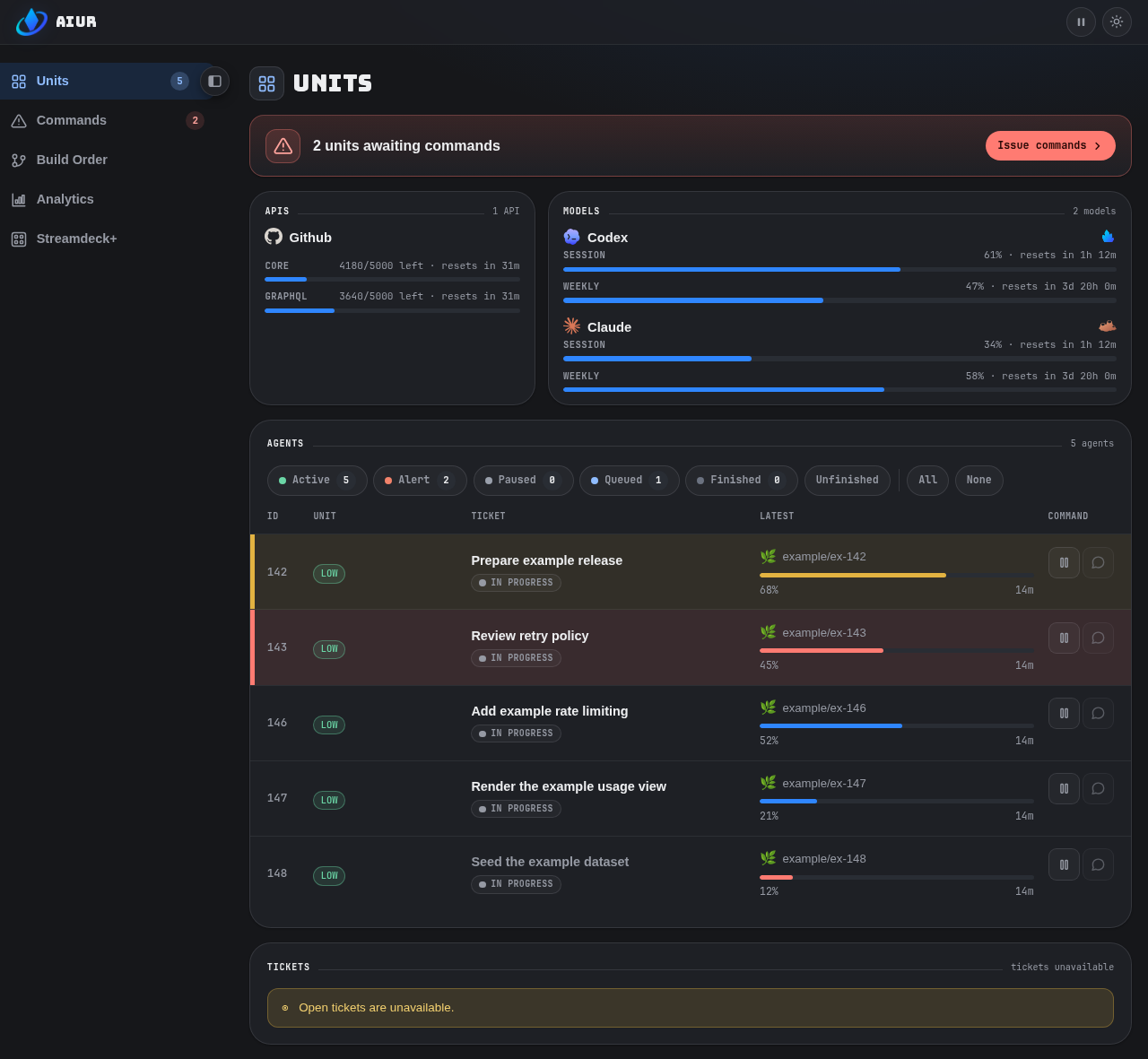
The GUI is the browser interface for supervising a run: the Units fleet table and meters, the Commands decision inbox, Build Order graphs, and Analytics.
TUI
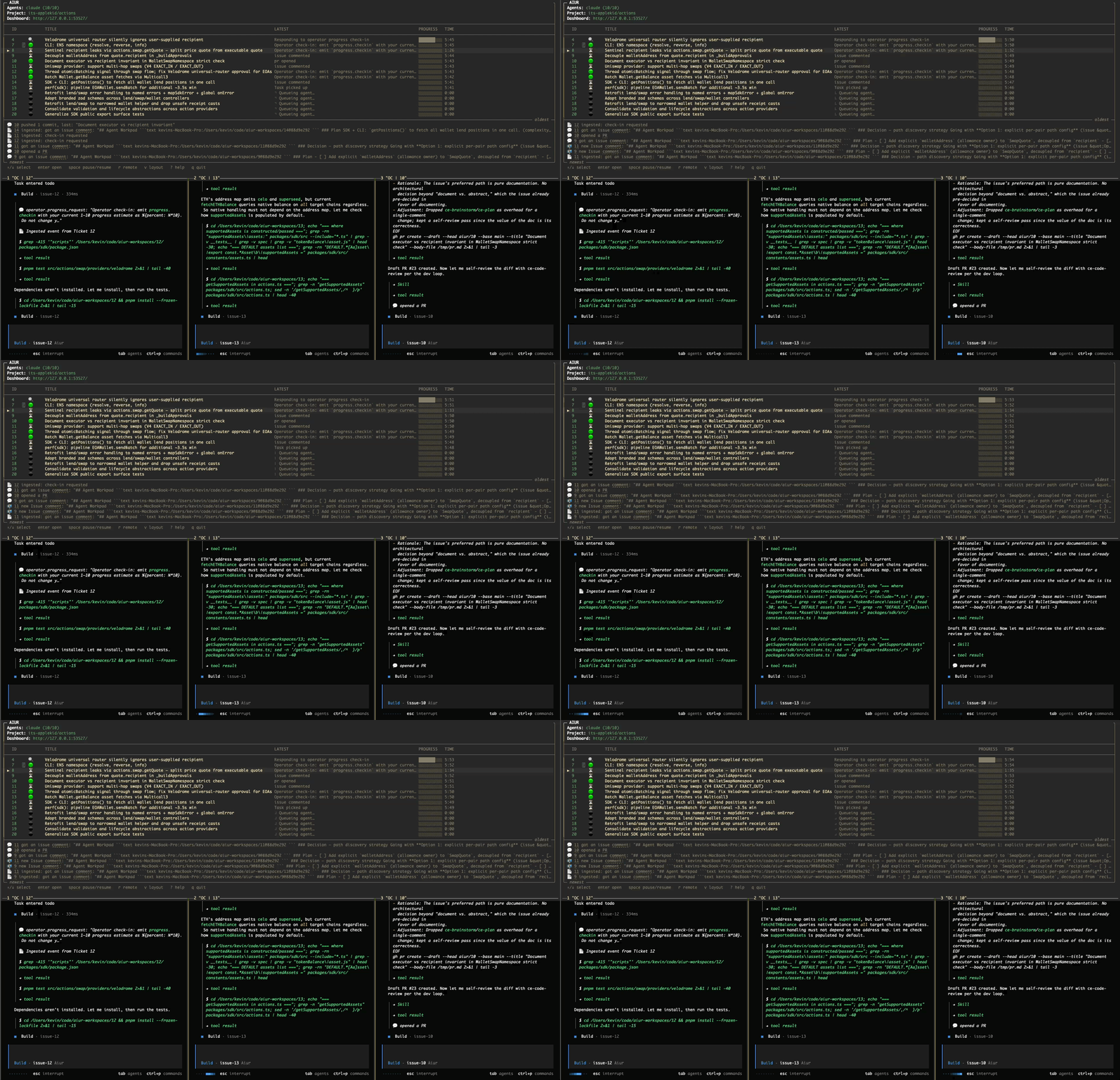
The TUI is a live agent board in your terminal with chat panes opened into
individual agent sessions. Press enter on a row to open its conversation,
space to pause or resume, ← / → to change the concurrency cap, and ?
for the full keymap. A later bare aiur from the same project attaches to that
live directory-scoped session; detaching leaves the run healthy.
CLI
| Command | What it does |
| --- | --- |
| aiur init | Interactive setup wizard |
| aiur | Start a foreground TUI, or attach to this directory's live session |
| aiur --bg | Start a detached headless run, GUI still served |
| aiur status | Daemon state, active agents, and the current concurrency cap |
| aiur alerts --needs-attention | Unresolved items waiting on you |
| aiur pause <id…> / aiur resume <id…> | Pause or resume agents by issue id |
| aiur message <id> "<text>" | Send text into a live agent session |
| aiur set max-agents <n> | Change the concurrency cap without restarting |
| aiur --todo <id…> [--only] | Queue tickets; --only dequeues the rest |
| aiur stop / aiur restart | Stop the session, or refresh the release and restart |
License
[!WARNING] Use at your own risk. Aiur is an unstable, vibecoded engineering preview for trusted environments only. It bypasses all agent permission prompts and has very few efficiency optimizations. Suggested for simple tasks under supervision.
Provided "as is", without warranty of any kind. You assume all risk for any cost, token spend, data loss, or damage from running it.
This project is licensed under the Apache License 2.0.