
allure-kit
v1.1.2
Published
Standalone CLI toolkit for bootstrapping and maintaining an Allure 3 setup in JavaScript/TypeScript, Python and Java (Gradle/Maven) projects

Maintainers
 todti
todtiReadme
allure-kit
A standalone CLI that sets up, checks and maintains Allure Report 3 in JavaScript/TypeScript, Python and Java (Gradle/Maven) projects — the equivalent of npm init for Allure.
Why
Allure 3 is a fast, plugin-based reporting engine, but wiring it into a project by hand means a handful of separate steps: figure out which test framework(s) the project uses, install the matching adapter package for each one, hand-write an allurerc config, pick and configure report plugins, and — if you want reports published automatically — set up CI and GitHub Pages. It's easy to get one of those steps wrong or out of sync as the project evolves.
allure-kit automates all of that:
- detects the test frameworks in use and installs the matching Allure adapters,
- wires the reporter into the framework's own config (e.g. adds
reporter: [["allure-playwright"]]toplaywright.config.ts, the Allure plugin tobuild.gradle, the setup topom.xml) so results actually get produced — not just installs the package;--dry-runshows the diff first, - generates and edits
allurerc(json,yaml, ormjs) and manages report plugins (config,plugin), - diagnoses a broken or incomplete setup (
doctor) — including setups that fail silently, such as an adapter that is installed but writes no results, - writes a minimal passing test to see a report straight away (
demo), keeps Allure packages up to date (update) and moves a project from Allure 2 (migrate), - scaffolds CI that builds and keeps the report even when tests fail: GitHub Pages, GitLab, CircleCI, Jenkins, Azure Pipelines, Bitbucket,
- reports its work as JSON (
--json) for scripts and AI coding agents.
Java (Gradle) projects are supported too: init --lang java adds the official io.qameta.allure Gradle plugin to build.gradle(.kts) (it brings the JUnit 5/TestNG adapter, the AspectJ agent and its own Node.js), doctor checks the plugin, the Gradle wrapper version (≥ 8.11) and autoconfigure. For Maven, init follows the JUnit 5 guide by inserting text into pom.xml (nothing else is rewritten): allure.version/aspectj.version properties, the allure-bom import, allure-jupiter (test scope), maven-surefire-plugin with the AspectJ -javaagent argLine, and src/test/resources/allure.properties with allure.results.directory=target/allure-results. It backs off with a reason when the pom already has a surefire plugin, an argLine or a JaCoCo agent (those have to be merged by hand). doctor checks the result (BOM/dependency, the agent, allure.properties, and the removed allure-junit5 artifact).
Detected frameworks: Vitest, Playwright, Jest, Mocha, Cypress, Cucumber.js, Jasmine, CodeceptJS, Newman (Postman), and WebdriverIO (WDIO) for JS/TS; Behave, pytest, Pytest-BDD, and Robot Framework for Python; JUnit 5 and TestNG for Java.
What it looks like
Real output, captured from the built CLI (npm run screenshots regenerates these).
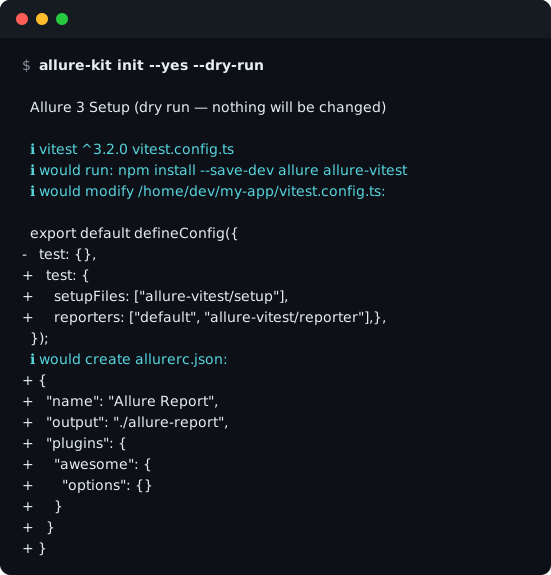
See what init would do before it touches anything — the diff of the framework config, the install command and the allurerc it would create:
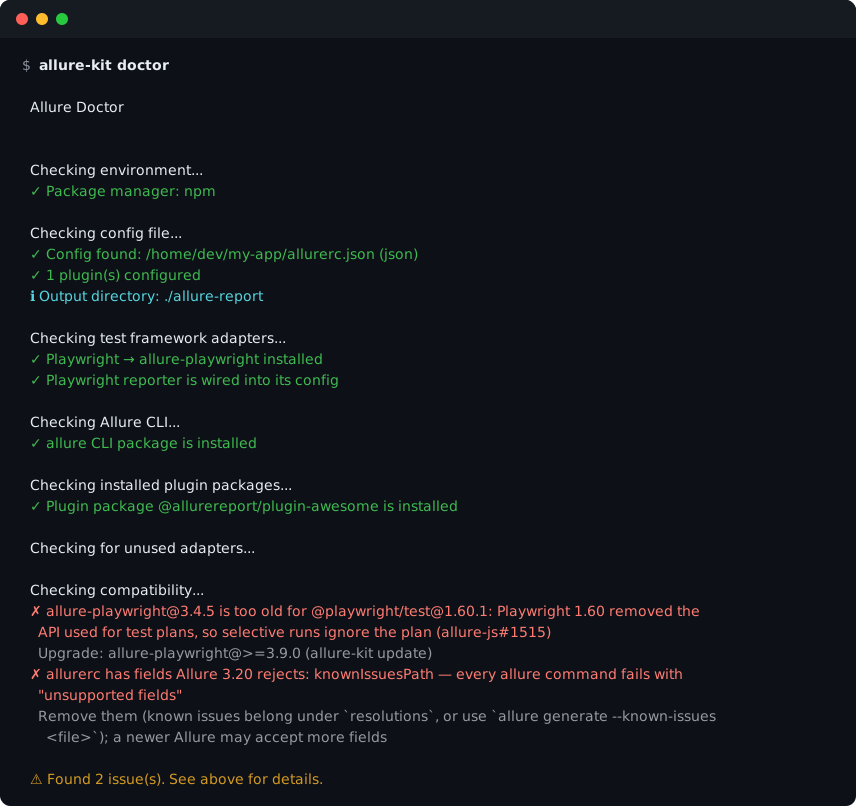
doctor finds the setups that fail silently — here an adapter too old for Playwright 1.60 and an allurerc field Allure rejects:
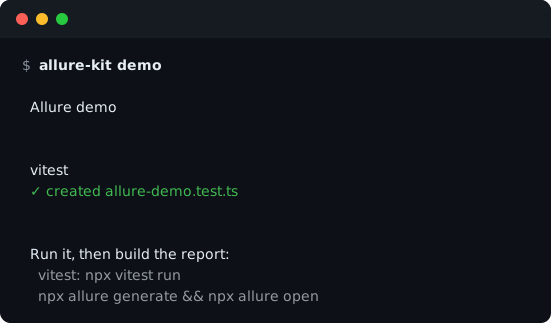
demo writes a minimal passing test so a fresh setup produces a report straight away:
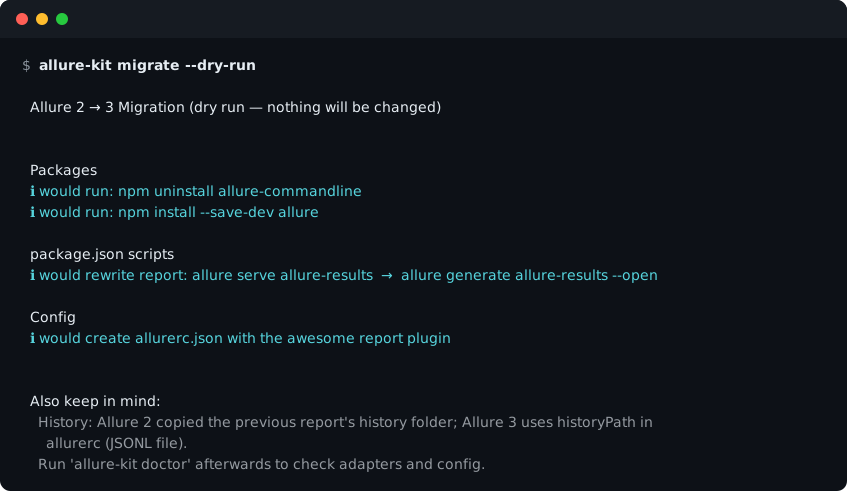
migrate moves an Allure 2 project (allure-commandline, allure serve) to Allure 3:
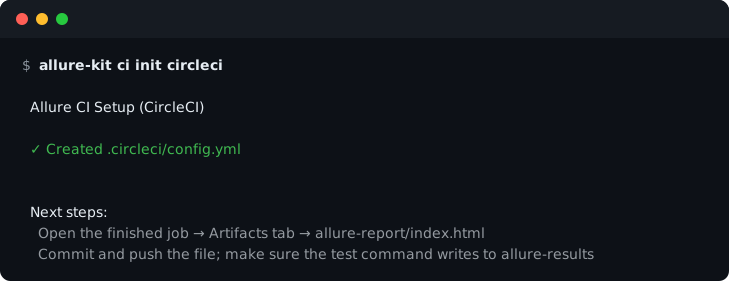
ci init scaffolds a pipeline that still builds and keeps the report when tests fail:
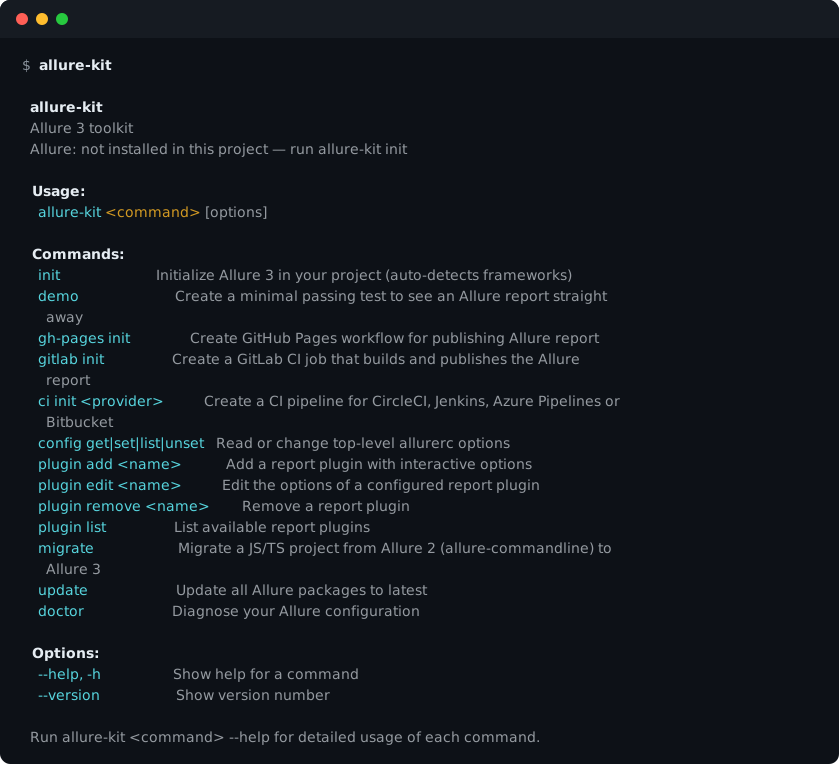
Browsing the commands. Run allure-kit with no arguments for the short list:
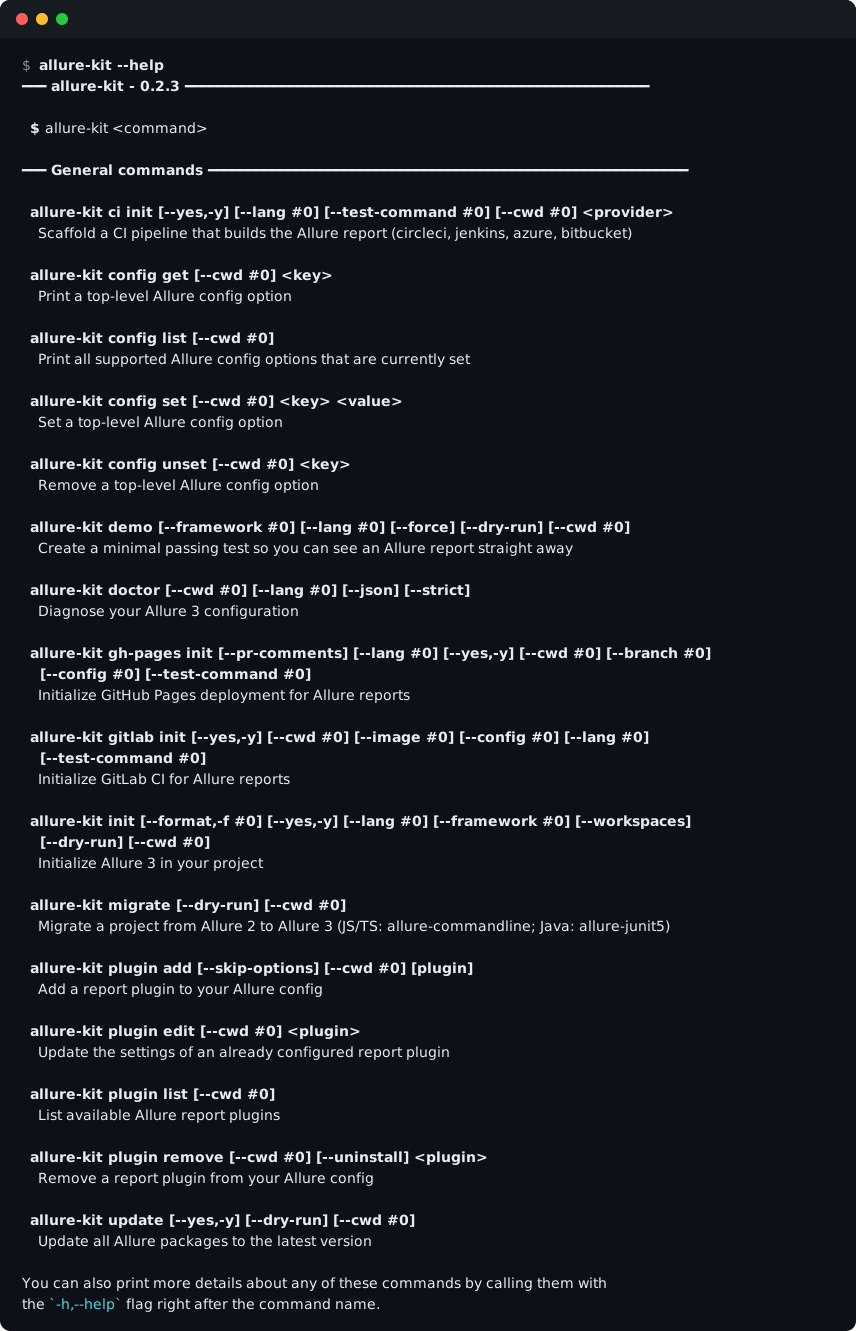
allure-kit --help lists every command with its flags:
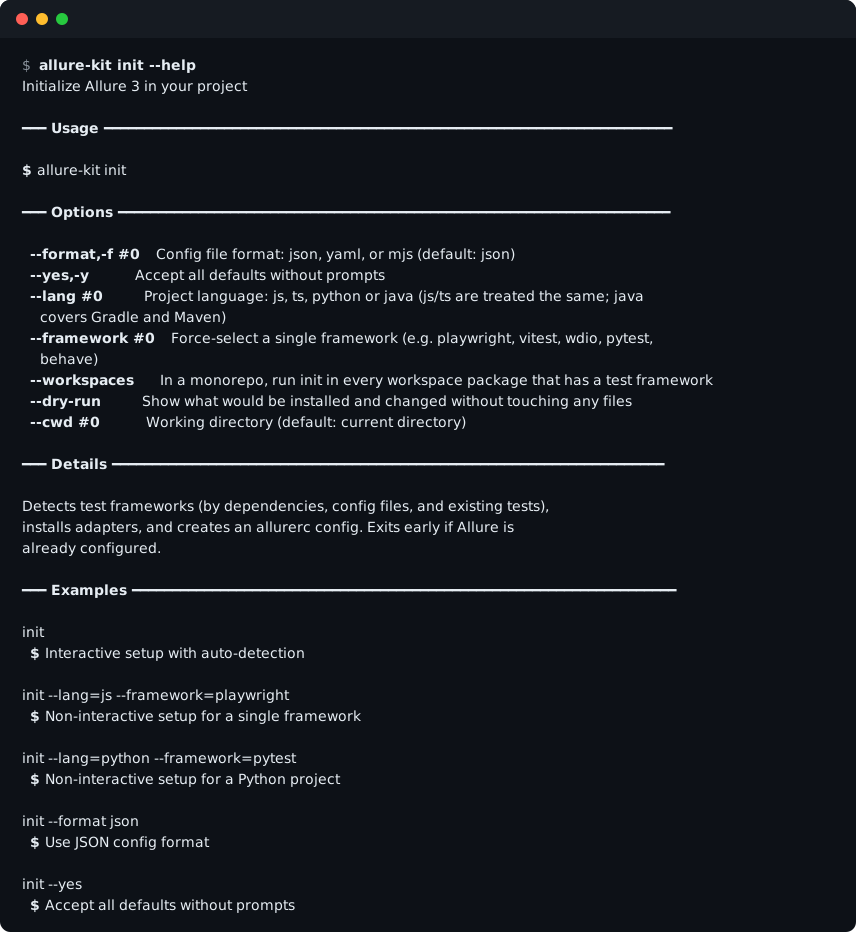
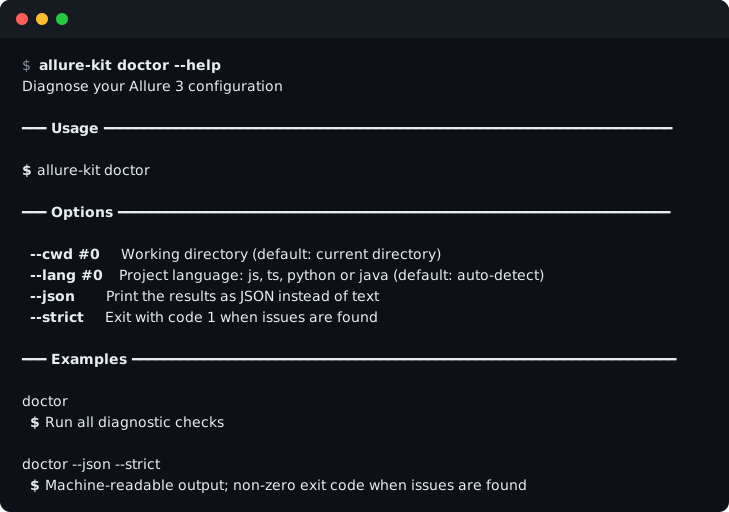
and allure-kit <command> --help shows one command's options and examples:
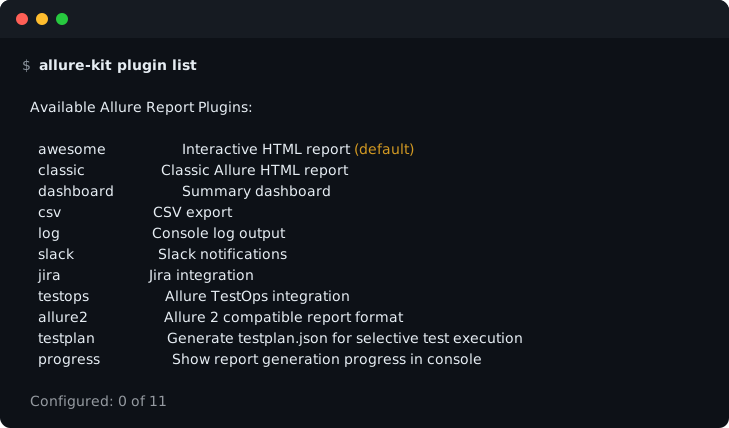
allure-kit plugin list shows the report plugins you can add (plugin add <name>):
Use with AI coding agents
Agents set Allure up by hand from memory unless something tells them there is a tool for it. Three ways to tell them, from the most to the least reliable:
1. Put a line in the project's agent instructions (AGENTS.md, read by Codex, Cursor, Copilot, Aider and others; CLAUDE.md for Claude Code; .cursor/rules/*.mdc or .github/copilot-instructions.md):
## Allure reporting
Set up, diagnose and migrate Allure with `npx allure-kit` instead of editing framework configs by hand:
`npx allure-kit doctor --json` (read-only check), `npx allure-kit init --yes --dry-run` then `init --yes --json`,
`npx allure-kit demo` for a minimal passing test. After changes, run the tests and confirm `allure-results/` is produced.
Docs: https://github.com/todti/allure-kit/blob/master/llms.txt
2. Install the agent skill skills/allure-kit/SKILL.md (the Agent Skills format used by Claude Code, Codex and others): it is loaded when a task mentions Allure setup, an empty report or an Allure 2 → 3 migration.
mkdir -p .claude/skills/allure-kit   # or ~/.claude/skills, .agents/skills, ~/.agents/skills
curl -fsSL https://raw.githubusercontent.com/todti/allure-kit/master/skills/allure-kit/SKILL.md -o .claude/skills/allure-kit/SKILL.md
3. llms.txt — a short machine-readable description of the tool and its commands, following the llms.txt convention, for agents and indexers that fetch it.
Every configuring command takes --yes (no prompts) and --json (one JSON document: { command, ok, messages, error? }), and doctor --json --strict gives a machine-readable verdict, so an agent never has to scrape coloured text.
allure-kit vs doing it by hand
Setting Allure up manually is a handful of small steps, each with a way to go wrong silently — the tests run, the report is empty. These are the traps found by running the setup on real projects (the repository's end-to-end suite does exactly that, nightly):
| By hand | What goes wrong | allure-kit |
|---|---|---|
| Pick the adapter package for your framework | Wrong or missing package; two adapters that clash (allure-pytest + allure-pytest-bdd both register --alluredir, pytest dies at startup) | Detects the framework from dependencies and config files and installs exactly the right adapter |
| Register the reporter in the framework config | Names that look right and don't exist: Mocha takes allure-mocha (not allure-mocha/reporter), Jest allure-jest/node; Jasmine resolves helpers relative to spec_dir; an ES import in a CommonJS cypress.config.js is a SyntaxError | Patches the config with the verified names and syntax, shows a diff first (--dry-run), and says why when it backs off |
| Write allurerc | Fields Allure rejects make every command fail (unsupported fields) | Generates it, edits it only with keys Allure accepts (config, plugin), and doctor flags the rest |
| Versions | allure-vitest on Vitest 2 writes no results and no error; allure-playwright before 3.9 ignores the test plan on Playwright 1.60 | doctor knows the combinations that fail silently; update shows what changes before it does it |
| History | History lives in the awesome report folder, needs historyPath, and has to survive between CI runs | gh-pages init / gitlab init set it up and cache it |
| CI | Tests that fail abort the job before the report is built; Bitbucket drops artifacts of a failed step | ci init / gh-pages init / gitlab init build and keep the report even when tests fail, then fail the job |
| Results directory | An adapter writing to build/allure while allure generate reads allure-results | doctor compares the two |
None of this replaces reading the Allure docs; init prints the official page for each framework it configures. It just means you start from a setup that has been run end to end instead of one that merely looks right.
How it works
- Framework detection reads
package.jsondependencies (or, for Python,requirements*.txt/pyproject.toml/Pipfile) and looks for known test-framework config files (playwright.config.ts,vitest.config.ts,wdio.conf.ts,pytest.ini,behave.ini, etc.) to figure out which frameworks are actually in play, then maps each one to its Allure adapter package (e.g.playwright→allure-playwright,pytest→allure-pytest). - Package manager detection looks at the lockfile —
package-lock.json/pnpm-lock.yaml/yarn.lock/bun.lock(b)for JS/TS, orpoetry.lock/pdm.lock/Pipfile.lock/requirements.txtfor Python — to install adapters with the right tool and flags. A project is treated as Python when--lang=pythonis passed or nopackage.jsonis found but a Python manifest is present. - Reporter wiring (JS/TS only) mechanically patches the framework's own config for Playwright, WDIO, Jest, Vitest, Mocha, Cucumber.js, CodeceptJS, Cypress, and Jasmine — matching each adapter's documented setup exactly. It backs off and prints a manual hint instead of guessing when the config is in a shape it doesn't recognize (e.g. an existing
reportervalue that isn't an array), rather than risk silently shadowing your config. - Config generation writes an
allurercfile (JSON/YAML/ESM) wiring up the selected report plugins, defaulting to theawesomeHTML report plugin. doctorre-runs detection and cross-checks it against what's actually installed and configured, flagging missing adapters, unconfigured plugins, or an unused/stale adapter.updatefinds everyallure*/@allurereport/*package already inpackage.jsonand bumps it to latest via the detected package manager.gh-pages initwrites a.github/workflows/allure-gh-pages.ymlthat runs your tests, generates the report withallure generate, and publishes it to thegh-pagesbranch viapeaceiris/actions-gh-pages.
Everything is additive and non-destructive: init refuses to run if an allurerc already exists, and gh-pages init asks before overwriting an existing workflow.
Run
Use without installing:
npx allure-kit --helpMachine-readable output
For scripts and AI agents: add --json to init, demo, migrate, update, ci init, gh-pages init, gitlab init, plugin add or plugin remove and nothing is printed except one JSON document, { "command": [...], "ok": true, "messages": [{ "level": "success", "message": "..." }], "error": "..." } (levels: success, info, warning, error, step, hint, text; error is set for usage errors; the exit code is unchanged). Run such commands with --yes so nothing waits for input. doctor has its own --json (every check with its step, level, message and hint), and --strict for a non-zero exit code.
Quick Start
# 1) Initialize Allure in your project
npx allure-kit init

# 2) Run tests so they produce allure-results
npm test

# 3) Build the report
npx allure generate
If an allurerc file already exists, init exits early and points you at allure-kit doctor / allure-kit update — it never overwrites an existing config.
For a fully non-interactive setup:
npx allure-kit init --yesFor a one-shot install of a specific framework:
npx allure-kit init --lang=js --framework=playwright
npx allure-kit init --lang=python --framework=pytest
Allure 3's report generator (allure generate) is a Node.js CLI regardless of the test framework's language, so Python projects still need Node.js available to run npx allure generate — init only installs the Python-side adapter package(s) via the detected Python package manager, it doesn't add a package.json to a pure Python project.
Commands
init
allure-kit init [--lang js|ts|python] [--framework <id>] [--format json|yaml|mjs] [--yes] [--dry-run] [--workspaces] [--cwd <path>]Detects test frameworks (by dependencies, config files, and existing tests), installs matching adapters, and creates an allurerc config. After wiring, init prints the official Allure configuration page for each selected framework (adapter options and examples). init does not generate any tests — it only configures Allure; run allure-kit demo afterwards if you want a minimal passing test to see a report right away.
Flags:
--lang— project language:js/ts(treated the same) orpython/py. Without this flag,initauto-detects:package.jsonpresent → JS/TS, otherwise a Python manifest (pyproject.toml,requirements*.txt,Pipfile,setup.py/setup.cfg) present → Python, otherwise defaults to JS/TS.--framework— force-pick a single framework by id or package name (playwright,vitest,wdio,pytest,behave, ...). Implies non-interactive mode with the defaultawesomeplugin.--format—json(default),yaml, ormjsconfig format.--yes— accept defaults without prompts.--workspaces— in an npm/yarn/pnpm monorepo, runinit(with the same flags) in every workspace package that has a test framework, each getting its ownallurerc.--dry-run— print the install command, a diff of every framework config it would change, and theallurercit would create, without touching anything.--cwd— working directory.
update
allure-kit update [--yes] [--dry-run] [--cwd <path>]Finds every installed Allure package (CLI, adapters, plugins), looks up the latest version of each with npm view, and shows installed → latest (major upgrades are flagged). Packages that are already current are skipped; the rest are updated to latest via your package manager after confirmation. If the registry can't be reached the package is still updated, as before. --dry-run only prints the plan.
migrate
allure-kit migrate [--dry-run] [--cwd <path>]For JS/TS projects still on Allure 2: replaces allure-commandline with allure, rewrites package.json scripts (allure serve <dir> → allure generate <dir> --open; --clean is dropped because Allure 3's generate doesn't accept it), and creates an allurerc.json if there is none. -c is only flagged for manual review — it meant "clean" in Allure 2 but is --config in Allure 3. Use --dry-run to preview.
In a Maven or Gradle project (no package.json) it migrates allure-junit5 / allure-junit5-assert to allure-jupiter / allure-jupiter-assert (Allure Java 3.0 no longer publishes the old artifacts) and bumps a shared <allure.version> property below 3 to 3.0.0. Versions pinned on a dependency itself are only reported, and Allure Java 3 needs Java 17+.
doctor
In a monorepo, when the root has no test framework, init and doctor look into npm/yarn/pnpm workspaces and tell you which packages to run them in (--cwd packages/web).
allure-kit doctor [--lang js|ts|python] [--json] [--strict] [--cwd <path>]Checks: package manager detection, allurerc presence and validity, adapter packages for each detected framework, the allure CLI package, configured plugin packages, and adapters that are installed but no longer match a detected framework.
It also looks for combinations that fail silently: an adapter too old for the installed framework (currently allure-playwright < 3.9.0 with Playwright ≥ 1.60, where selective test-plan runs stop working), allure-js adapters on a different minor version than allure-js-commons, qualityGate combined with historyPath (known upstream issue allure3#895), an ALLURE_TESTPLAN_PATH that points to a missing or invalid file, a custom plugin import that points to a missing local file, an allurerc with fields Allure rejects (the whole CLI then fails with "unsupported fields"), an adapter whose resultsDir (or the WebdriverIO reporter's outputDir) differs from the directory allure generate reads (an empty report without an error), a GitHub workflow using allure-framework/allure-action without pull-requests: write / checks: write permissions or a github-token input (the step runs but nothing shows up on the PR), allure-vitest ≥ 3.13 on Vitest < 3 (it silently writes no results — reproduced in a clean project), a configured testops plugin outside CI (it only uploads when CI=true, ALLURE_TESTOPS_ENABLED=true or ALLURE_JOB_RUN_ID is set; plugin add testops says so, and offers ALLURE_ENDPOINT / ALLURE_TOKEN / ALLURE_PROJECT_ID / ALLURE_LAUNCH_NAME as the environment alternatives to the options), a GitHub workflow using allure-framework/allure-action without pull-requests: write / checks: write permissions or a github-token input (the step runs but nothing shows up on the PR), allure-vitest ≥ 3.13 on Vitest < 3 (it silently writes no results — reproduced in a clean project), an allure package older than v3 or allure-commandline (Allure 2) installed next to it. For TestOps users it hints at useLegacyFullName: true for allure-playwright (the default fullName is file:line:column and shifts when a test moves, so test-plan runs drop it). It also lists known adapter limitations for the detected frameworks (no retry marking in Jest/Vitest, no test-plan support in CodeceptJS/Newman, Newman not writing environmentInfo/categories).
--json prints every check (step, level, message, hint) as JSON for CI and scripts; --strict makes the command exit with code 1 when issues are found.
demo
allure-kit demo [--framework <id>] [--lang js|ts|python|java] [--force] [--dry-run] [--cwd <path>]Writes one tiny passing test for each detected framework (or the one given with --framework), named so that the framework finds it by default, and prints how to run it and build the report. Existing files are never overwritten without --force. Templates exist for Vitest, Jest, Mocha, Playwright, Jasmine, Cucumber.js, pytest, Pytest-BDD, Behave, Robot Framework and JUnit 5 — the same tests the end-to-end suite runs.
gh-pages init
With --pr-comments the workflow also runs on pull requests and posts the test summary as a comment and a check via allure-framework/allure-action (it adds pull-requests: write / checks: write); pull-request runs are not published to Pages and do not touch the cached history.
Creates a GitHub Actions workflow that generates an Allure report and publishes it to GitHub Pages via the gh-pages branch. If the tests fail, the report is still generated and published, and the job fails afterwards. History is kept between runs by caching the historyPath file (init sets historyPath: ./history.jsonl in a JSON/YAML allurerc if it's missing; for an ESM config it prints a hint).
allure-kit gh-pages init [--lang js|ts|python] [--pr-comments] [--yes] [--branch <name>] [--config <path>] [--test-command <cmd>] [--cwd <path>]ci init <provider>
allure-kit ci init circleci|jenkins|azure|bitbucket [--lang js|ts|python] [--test-command <cmd>] [--yes] [--cwd <path>]Creates .circleci/config.yml, a Jenkinsfile, azure-pipelines.yml or bitbucket-pipelines.yml (Bitbucket runs one container image, so it is JS/TS only; the artifact uses capture-on: always so the report is kept when a step fails). Every pipeline installs dependencies, runs the tests without aborting, builds the report with allure generate, keeps it as a build artifact and fails the job afterwards if the tests failed. Python projects get a Python+Node image/setup and the framework's own test command; Gradle projects get a JDK image, ./gradlew test and the plugin's ./gradlew allureReport (report in build/reports/allure-report/allureReport). Maven projects get a cimg/openjdk:17.0-node image (CircleCI), mvn -B test and npx --yes allure generate target/allure-results (set allure.results.directory=target/allure-results in allure.properties). GitHub and GitLab have their own commands (gh-pages init, gitlab init).
gitlab init
Creates a GitLab CI job (.gitlab/allure-report.gitlab-ci.yml, included from .gitlab-ci.yml) that runs your tests and calls allure gitlab: it builds the report, restores history from the previous run, and posts a summary comment on merge requests. Set a masked GITLAB_TOKEN CI/CD variable (api scope) to enable history restore and comments.
allure-kit gitlab init [--lang js|ts|python] [--yes] [--image <image>] [--config <path>] [--test-command <cmd>] [--cwd <path>]config get / config set / config list / config unset
Read, write, list or remove top-level allurerc options (name, output, resultsDir, historyPath, appendHistory, historyLimit, historyBaseUrl, environment, port, flakyDetection.historyDepth, flakyDetection.includePassedTests, and the structured qualityGate, categories, variables, defaultLabels, hideLabels, allowedEnvironments, globalAttachments given as JSON). Works on JSON/YAML configs, and on an allurerc.mjs / .cjs whose config is a plain object literal (export default defineConfig({...}), export default {...}, module.exports = ...) — those are edited in place as text, so comments and formatting survive. config get / config list can't evaluate an ESM config and only work for JSON/YAML.
allure-kit config set flakyDetection.historyDepth 10
allure-kit config get resultsDir
allure-kit config list      # only options that are set
allure-kit config unset flakyDetection.historyDepth
plugin list
allure-kit plugin list [--cwd <path>]plugin add
allure-kit plugin add <name> [--skip-options] [--cwd <path>]Prompts for confirmation before overwriting a plugin that is already configured.
plugin edit
allure-kit plugin edit <name> [--cwd <path>]Updates the options of a plugin that is already configured, pre-filled with its current values.
plugin remove
allure-kit plugin remove <name> [--uninstall] [--cwd <path>]Supported frameworks
| Framework | Adapter package |
|---|---|
| Vitest | allure-vitest |
| Playwright | allure-playwright |
| Jest | allure-jest |
| Mocha | allure-mocha |
| Cypress | allure-cypress |
| Cucumber.js | allure-cucumberjs |
| Jasmine | allure-jasmine |
| CodeceptJS | allure-codeceptjs |
| Newman (Postman) | newman-reporter-allure |
| WebdriverIO (WDIO) | @wdio/allure-reporter |
Python:
| Framework | Adapter package |
|---|---|
| Behave | allure-behave |
| pytest | allure-pytest |
| Pytest-BDD | allure-pytest-bdd |
| Robot Framework | allure-robotframework |
Python package managers pip, Poetry, PDM, and Pipenv are auto-detected the same way as the npm-family managers. pip install doesn't update any manifest on its own, so when pip is the resolved manager init also appends the installed adapter(s) to requirements.txt.
doctor works for Python projects too: it checks that each detected framework's adapter is declared in your dependencies (requirements*.txt, pyproject.toml, Pipfile) and reminds you that reports need the Node.js Allure CLI. gh-pages init also scaffolds a Python workflow (actions/setup-python, the project's own installer, the framework's --alluredir/formatter command, Node for npx allure generate); gitlab init supports Python too (a python:3.12 job that installs Node.js from NodeSource for allure gitlab).
Report plugins
All plugins are official Allure 3 report plugins. awesome is installed by default.
| Plugin | Package | Description |
|---|---|---|
| awesome (default) | @allurereport/plugin-awesome | Interactive HTML report |
| classic | @allurereport/plugin-classic | Classic Allure HTML report |
| dashboard | @allurereport/plugin-dashboard | Summary dashboard |
| csv | @allurereport/plugin-csv | CSV export |
| log | @allurereport/plugin-log | Console log output |
| slack | @allurereport/plugin-slack | Slack notifications |
| jira | @allurereport/plugin-jira | Jira integration |
| testops | @allurereport/plugin-testops | Allure TestOps integration |
| allure2 | @allurereport/plugin-allure2 | Allure 2 compatible report format |
| testplan | @allurereport/plugin-testplan | Generates testplan.json for selective test execution |
| progress | @allurereport/plugin-progress | Shows report generation progress in console |
Manage them any time with allure-kit plugin add|remove|list.
Packages
This repo is an npm workspaces monorepo, split for internal organization — only allure-kit is published. packages/core, packages/npm, and packages/python are private and get bundled directly into allure-kit's dist/cli.cjs at build time, so installing allure-kit never pulls them in as separate packages.
| Package | What it is |
|---|---|
| allure-kit | The CLI itself — commands, prompts, bin/allure-kit.js. The only package published to npm. |
| @todti/allure-kit-core | Shared kernel: config I/O, exec, fs helpers, the report-plugin registry, and the EcosystemAdapter contract |
| @todti/allure-kit-npm | JS/TS framework detection, npm/yarn/pnpm/bun integration, and reporter-config wiring |
| @todti/allure-kit-python | Python framework detection + pip/poetry/pdm/pipenv integration |
Adding support for another language (e.g. Java) means implementing one more EcosystemAdapter package (in packages/<language>) against @todti/allure-kit-core and registering it as a devDependency of packages/cli in packages/cli/src/ecosystems.ts — no changes to init's control flow, and no new package to publish.
Development
npm install
npm run build      # builds all packages in dependency order (TS project references)
npm test           # runs every package's tests in one vitest run
npm run typecheck
Origin
allure-kit started as the allure kit subcommand proposed for the Allure 3 CLI in allure-framework/allure3#556. It's extracted here into a self-contained, independently publishable CLI, decoupled from the allure3 monorepo release cycle so it can ship and iterate on its own.
For the reporting engine itself, adapters, and plugins, see:
- allure-framework/allure3 — the Allure 3 monorepo
- allurereport.org — official docs
- allure-framework/allure3#556 — the original PR this project was extracted from
License
Releasing
See RELEASING.md (semver policy, tag-triggered publish with npm provenance) and CHANGELOG.md.