
apophasis
v1.0.5
Published
Reverse mutation testing for Playwright


Readme
Apophasis
A via negativa approach to mutation testing for Playwright E2E tests.
Apophasis is a mutation testing library that inverts assertions in memory rather than mutating the application code. Instead of asking “does the test fail when the code changes?”, it asks:
“does the test fail when its own assertions are negated?”
If a negated assertion survives, your test is not actually asserting what you think it is.
✨ Core Idea
Traditional mutation testing mutates the system under test.
Apophasis mutates the test itself, specifically:
- It inverts assertions (
.toBeVisible()→.not.toBeVisible()) - Runs the mutated test
- Detects surviving mutations (i.e., false negatives)
Problem Statement
Unvalidated assertions are prone to pass both in their positive and negative forms:
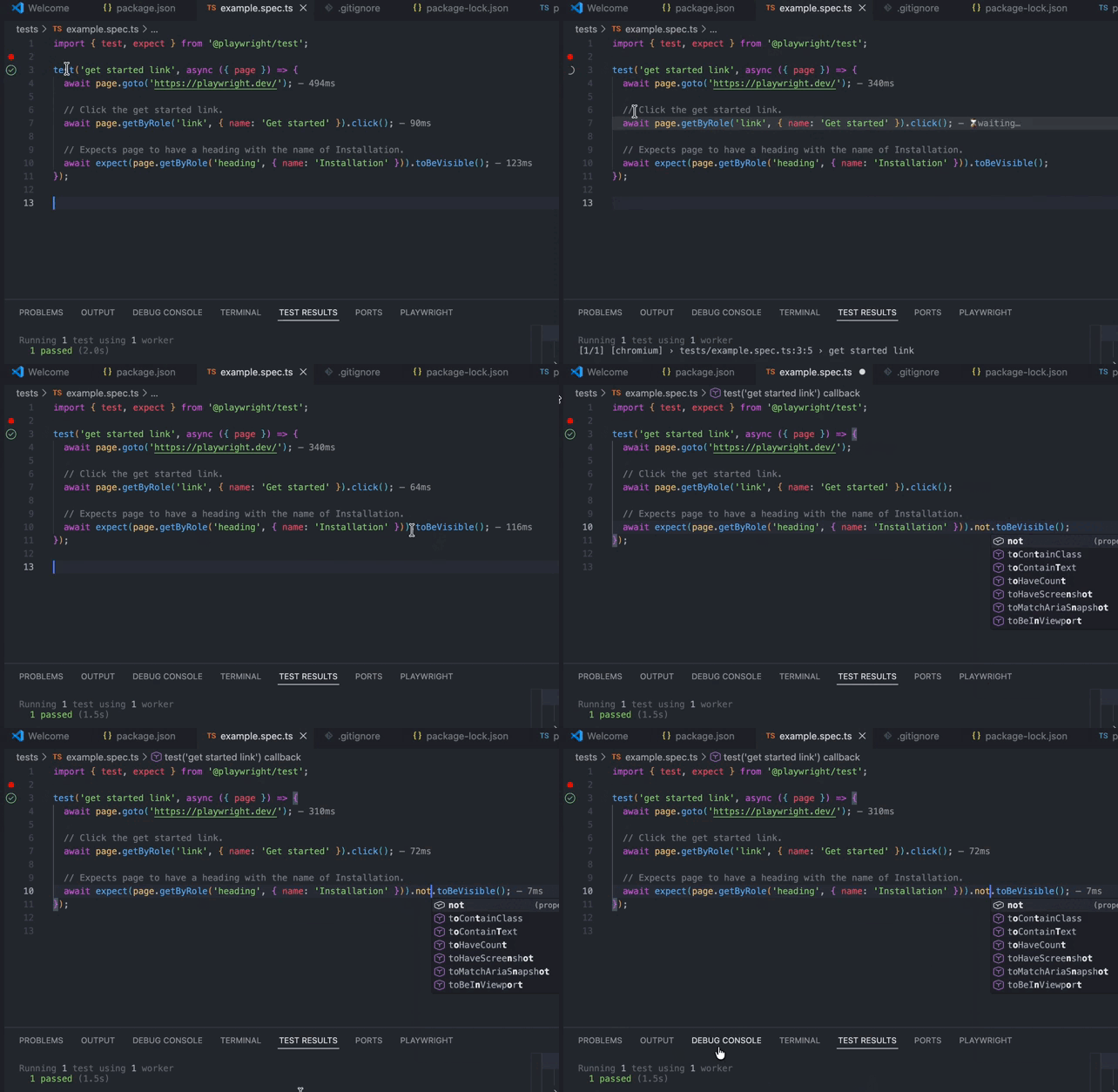
What This Reveals
Apophasis exposes:
- Weak or non-binding assertions
- Timing issues (assertion runs before meaningful state change)
- Implicit assumptions in E2E tests
- False negatives in UI validation
Never trust a test you have not seen fail.
Why 'false negatives' and not 'false positives'?
In mutation testing, we intentionally introduce small changes (“mutations”) to the code to verify that our tests can detect them.
The core expectation is simple:
If a test passes, a mutation should cause it to fail.
When a mutation is applied and the test still passes, the test has failed to detect a behavioral change. In this context, this is treated as a false negative.
✅ Test fails after mutation → the mutation is killed (test is effective)
❌ Test still passes after mutation → false negative (test is insufficient)
This definition focuses on test sensitivity: a good test suite should fail whenever the underlying behavior changes in a meaningful way.
🧪 Try It!
You can reproduce this on a clean project in under a minute.
- Install Node.js (≥18)
- Create folder
- Install Playwright with
npm init playwright@latestand accept all the default settings - Install Apophasis with
npm i apophasis - Run apophasis with
npx apophasis - Have fun seeing Playwright's own
example.spec.tshaving surviving mutants!
🎛️ CLI Usage (with Safe Arguments)
Apophasis includes a hardened CLI parser, allowing you to safely pass a controlled subset of Playwright arguments without exposing arbitrary command execution.
✅ Supported Playwright Arguments
npx apophasis --grep "login"
npx apophasis --headed
npx apophasis --workers 4
npx apophasis --timeout 10000
npx apophasis --retries 2
npx apophasis --project chromium
All arguments are strictly validated and allowlisted.
⚙️ Execution Modes
Apophasis supports multiple execution modes depending on your workflow:
🚀 Mutation Only (default)
npx apophasisRuns mutation testing directly, without validating the baseline first.
⚠️ Faster, but results may be unreliable if your test suite is broken or flaky.
🧪 Baseline + Mutation
npx apophasis --baseline- Runs the test suite without mutation
- Ensures all tests pass
- Proceeds to mutation testing only if baseline is clean
- Note: The baseline phase uses the exact same arguments as the mutation run
✅ Recommended for CI and reliable mutation results
🧪 Baseline Only
npx apophasis --baseline-only- Runs only the baseline test suite and exits
Useful for debugging, CI validation, or verifying test health independently of mutation.
⏱️ Reducing Execution Time During Mutation Testing
When running mutation tests, inverted assertions can significantly slow down execution due to Playwright’s auto-waiting behavior. By default, assertions wait up to several seconds before failing, which compounds across many mutants.
To mitigate this, you can dynamically reduce assertion timeouts when running under mutation mode by adding these lines to your playwright.config.ts:
expect: {
  timeout: process.env.APOPHASIS_MUTATE ? 1500 : 5000,
},
⚙️ How It Works
- When
APOPHASIS_MUTATEis set:- Assertion timeout is reduced to 500ms
- Failures occur much faster → faster mutation runs
- Otherwise:
- Default timeout remains 5000ms
- Ensures stability for normal test execution
⚠️ Trade-off
Warning: Smaller timeouts may reduce detection accuracy.
- Short timeouts can cause assertions to fail too early
- This may allow some mutants to survive undetected
- Larger timeouts provide better reliability, but at the cost of speed
🔒 Security Model
- Arguments are strictly parsed and validated
- Unsupported flags will cause an immediate failure
- No shell interpolation (
shell: false) - Only explicitly allowlisted Playwright options are permitted
⚙️ How It Works
- Intercept the Node.js module loader at startup
- Patch expect in memory when Playwright is loaded
- Invert all assertions dynamically (expect() → expect().not and vice versa)
- Run Playwright once with APOPHASIS_MUTATE=true and once without
- Compare: assertions that survive inversion are weak or non-binding
📊 Interpretation of Results
| Outcome | Meaning | |-------------------|----------------------------| | Mutation killed | Test is meaningful | | Mutation survived | Test is weak / ineffective |
🧠 Why "Apophasis"?
In philosophy and theology, apophasis (via negativa) describes something by stating what it is not.
Here:
- A test is validated by showing what it cannot deny
- If a negated assertion still passes, the test is empty of meaning
🧪 Philosophy of Testing
Apophasis treats tests as claims about reality.
A valid test must:
- Fail when its claim is negated
- Resist contradiction
If it does not, it is not a test. It is decoration.
When A and ¬A are simultaneously true, the assertion is trivially true, and therefore semantically empty.
In the context of testing:
expect(x).toBeVisible()→ Aexpect(x).not.toBeVisible()→ ¬A
If both pass, then:
- The test does not constrain reality
- The assertion does not distinguish between states
- The test is logically degenerate
Apophasis treats such cases as a failure of meaning, not just implementation.
In epistemological terms, when both assertions are true, the test is not falsifiable, i.e. it is incapable of being proven wrong.
A test that cannot fail is indistinguishable from a test that does not exist.
🚀 Use Cases
- Strengthening Playwright E2E suites
- Detecting false negatives in UI/E2E tests
- Auditing legacy test reliability
- Enforcing assertion quality in CI
⚠️ Limitations
- Some survival cases may be due to legitimate non-determinism
- Requires careful interpretation in async-heavy flows
- Supports expect(), expect.soft(), and expect.poll(); other assertion patterns may behave unreliably
🧩 Closing Thought
Apophasis does not ask whether your code is correct.
It asks whether your tests are capable of being wrong.
If they are not, they are useless.