
atoll-harness
v0.2.1
Published
An agent that keeps getting better from how you use it: serve, record feedback, grow the Claude Code harness, LoRA weights or a discovered solution, evaluate, and publish versions.

Maintainers
 didrod2539
Readme
atoll




An agent that keeps getting better from how you use it. atoll serves your agent, records feedback on each response, grows an update from that feedback, checks the update, and publishes it as a numbered version — without taking the agent down. Three things can grow: the Claude Code harness, the weights of a model you serve, and the best solution to a hard problem (discovery).
npx atoll-harness demo              # harness: an ask becomes a rule and a skill in a Claude Code project
npx atoll-harness demo weights      # weights: corrections train an adapter, serving hot-swaps to it
npx atoll-harness demo discovery    # discovery: 30 attempts at packing 26 circles in a square
All three demos run offline in a few seconds on a deterministic mock model. The runtime itself has no npm dependencies.
How it works
The ideas come from Reef; the code, names and interfaces are atoll's own. Every surface runs the same four steps:
| Step | What happens | Where it lives |
|---|---|---|
| 1 · Serve | OpenAI- and Anthropic-compatible endpoints. Every response carries an x-atoll-record-id receipt. Claude Code sessions are recorded by a Stop hook instead. | src/server.js, src/providers.js, src/runtime/ |
| 2 · Observe | Reports (score and/or feedback + receipts), plain-language asks, implicit corrections ("no, use pnpm") and evaluator scores are matched to recorded interactions. | src/observe.js, src/store.js |
| 3 · Grow | A recipe turns open feedback into an update: file changes for the harness, a training job for the weights, a new attempt for discovery. | src/recipes/, src/engine.js, src/weights.js, src/discovery.js |
| 4 · Commit | The update is evaluated. Accepted ones become step-N in a per-scenario git history and go live; rejected ones leave the current version serving. | src/evaluate.js, src/artifact.js |
Harness — Claude Code
1. Start the server (keep it running):
npm install -g atoll-harness
atoll serve
It uses the claude CLI, so run claude once and /login if you haven't. Other backends:
atoll serve --upstream anthropic --upstream-model claude-sonnet-5   # ATOLL_UPSTREAM_API_KEY
atoll serve --upstream openai --upstream-url http://127.0.0.1:11434 --upstream-model gemma4:26b   # Ollama, vLLM, ...
2. Install the harness into a project (from the project directory):
curl -fsS -H "Authorization: Bearer atoll-local" -H "x-atoll-scenario: my-harness" \
  'http://127.0.0.1:8901/atoll/harness/install?target=claude-code' | bash
This adds four slash commands, a SessionStart hook (update notice) and a Stop hook (records each finished turn to your local server), then installs the current version.
Hooks go into .claude/settings.local.json, your personal settings, never the shared settings.json. In a git repository, atoll's machine-specific files (the client, local settings, and the atoll-* commands, which carry this machine's path) are listed in .git/info/exclude, so they stay out of commits. The rules, skills and commands atoll writes are ordinary project files you can commit. node .claude/atoll/client.mjs uninstall removes everything it added.
3. Work normally, and say what should change:
/atoll-harness when I ask you to fix a bug, reproduce it with a failing test first
/atoll-report bad you ran npm again — this repo uses pnpm
/atoll-versions            # history; /atoll-versions 3 shows the diff
/atoll-versions 3 promote  # release a held hook
/atoll-versions 2 rollback # publish a new step identical to step 2
/atoll-update              # install the latest version
What lands in your project:
| Harness file | Installed as | Delivered |
|---|---|---|
| rules/<name>.md | a managed block in CLAUDE.md — your own text is never touched | immediately |
| skills/<name>/SKILL.md | .claude/skills/<name>/ | immediately |
| commands/<name>.md | .claude/commands/<name>.md | immediately, unless it runs shell (! or allowed-tools) |
| hooks/<name>.json + script | .claude/settings.local.json + .claude/atoll/hooks/ | held until you promote the step |
Anything that executes code on your machine is committed but held. A promotion is pinned to the file's content: if a later step changes the script, it is held again.
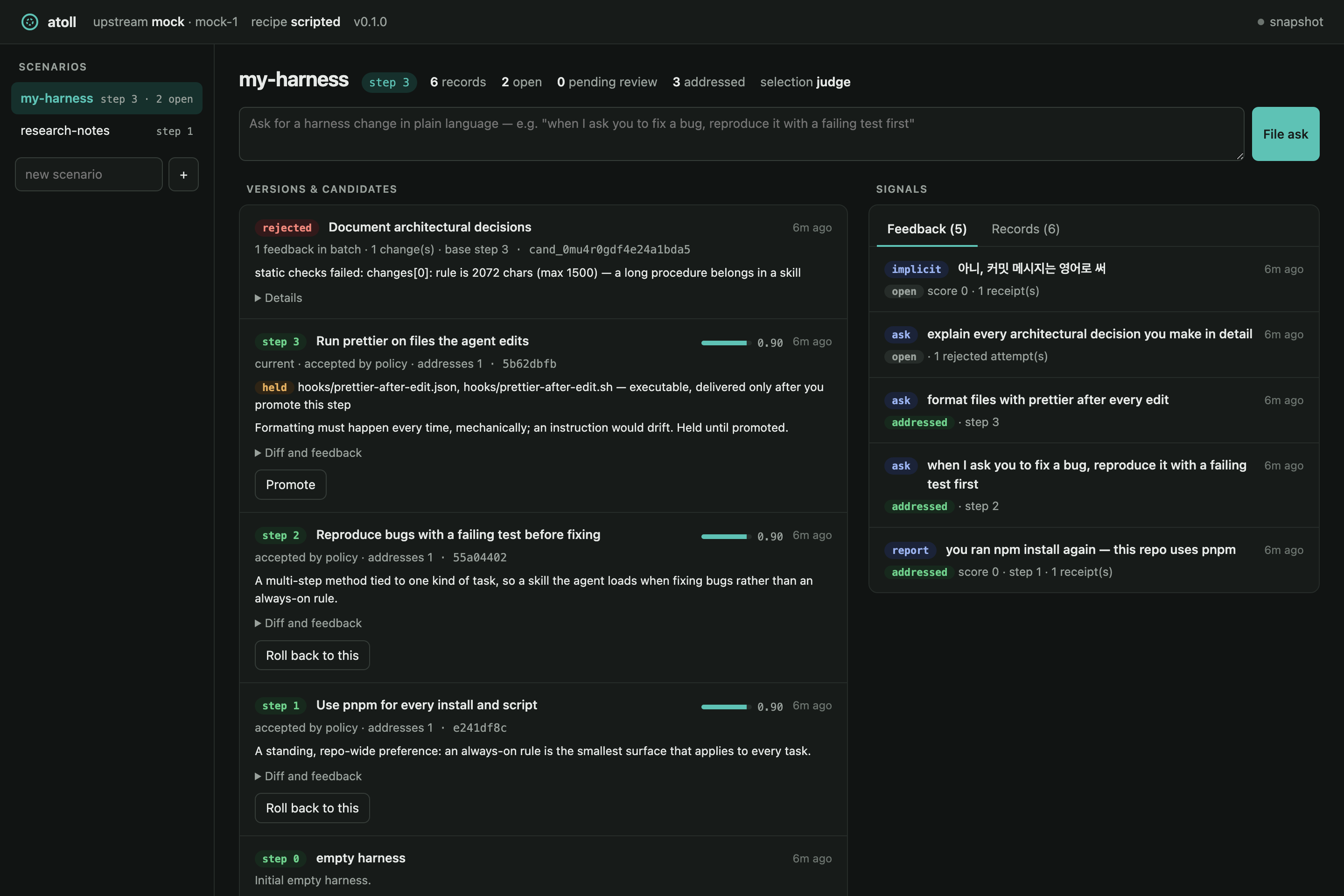
The dashboard, showing seeded example data for the harness surface: three published steps, one candidate rejected by static checks, one hook held until promoted, and an implicit correction picked up from a session.
The next session starts with a notice when a new version is ready. Pushback at the start of a prompt ("no, …", "don't …", "아니 …", "그거 말고 …") becomes an implicit report on the previous turn. After two of them, the recipe decides whether they reflect a standing preference.
Weights — train the model you serve
With a runtime, atoll serves a model itself and trains LoRA adapters on it. Each published step is an adapter; serving switches to it between requests, so traffic keeps flowing while a job trains and never sees a half-trained model.
atoll runtime install mlx        # Apple Silicon: a venv with mlx + mlx-lm under ~/.atoll/runtime
atoll runtime check --model mlx-community/Qwen2.5-0.5B-Instruct-4bit   # train, hot-swap, score once

atoll serve --runtime mlx --model mlx-community/Qwen2.5-0.5B-Instruct-4bit \
  --recipe imitate --min-batch 8 \
  --eval-set examples/weights/one-word/eval.jsonl \
  --verifier-cmd "node examples/weights/one-word/verify.mjs"
Send traffic to /v1/chat/completions and report on the receipts, exactly as in the server example. Two recipes turn reports into training:
| recipe | trains on | update |
|---|---|---|
| imitate | responses scored ≥ 0.5, and corrections sent as {"feedback": {"correction": "..."}} | supervised fine-tuning |
| reinforce | every scored response; the advantage is its score against other responses to the same prompt, or against the scenario's running average | policy gradient with a KL penalty to the base model |
Before a candidate adapter is published, atoll compares it with the adapter that is serving:
- with
--eval-setor--verifier-cmd— both adapters answer the tasks (greedy), and the candidate must score at least as well (--min-gain). - without — the candidate must make the good examples more likely than the serving adapter does, while its loss on the base model's own answers to generic prompts stays within
--retention-toleranceof the base model's. That second check catches adapters that learn your feedback by forgetting everything else.
Measured on a MacBook with an Apple A18 Pro and 8 GB, with the command above and node examples/weights/one-word/drive.mjs --rounds 4, which asks 26 one-word questions per round, checks each answer, and reports a score plus a correction when it was wrong:
| | held-out accuracy (11 questions never trained on) | answers right in the round (26 questions, temperature 0.7) | |---|---|---| | base model | 5 / 11 | 7 / 26 | | after 2 published steps | 9 / 11 | 22, 23, 24 / 26 in rounds 2–4 |
Six later candidates scored lower on the held-out set and were rejected, so step 2 kept serving. The whole run took under two minutes. Eleven questions is a small evaluation — treat the numbers as a demonstration, not a benchmark.
atoll weights shows the serving adapter; atoll weights export 2 --out ./adapter writes it in the layout mlx_lm.generate --adapter-path reads.
Runtimes
| --runtime | |
|---|---|
| mlx | atoll spawns runtime/mlx/worker.py in the MLX venv and supervises it. --model is any mlx-lm model; --lora-rank, --lora-layers, --max-seq, --train '{"lr":1e-5,"batch_size":4}' tune training. |
| remote | --runtime-url + ATOLL_RUNTIME_TOKEN: any server that implements runtime/PROTOCOL.md — seven JSON endpoints — for example PyTorch + PEFT on a GPU box. atoll runtime check --runtime-url ... verifies an implementation end to end. |
| mock | in-process and deterministic, for tests and demos. |
Discovery — many attempts at one hard problem
A problem is a directory: a task, a seed solution, and an evaluator that prints {"valid", "score", "feedback"}. atoll asks the model for a better solution, runs the evaluator on it in a scratch copy of the directory, and publishes every new best as a step. The prompt carries the best attempts so far with their scores and evaluator feedback, plus recent failures.
atoll discover examples/discovery/circle-packing --upstream claude --attempts 40Output of atoll demo discovery, whose mock proposer only nudges numeric constants (★ = new best, published as a step; · = valid but not better; ✗ = invalid):
atoll discover circle-packing-26 — maximize, 30 attempt(s), proposer mock · mock-1
    0  ★ step 1  2.464        seed solution from the problem
    1  ·         2.412278     mock: constant #0 0.1 → 0.09
    2  ·         2.464        mock: constant #5 0.001 → 0.0009
    3  ·         2.4595       mock: constant #4 0.999 → 0.8991
    4  ★ step 2  2.4656       mock: constant #3 0.2 → 0.18
    5  ★ step 3  2.46704      mock: constant #2 0.5 → 0.45
With a trainable runtime the proposer also learns during the run: every --tune-every attempts, a policy-gradient step on its recent attempts (advantage = score relative to the others; invalid attempts and replies that break the format are negative) produces a new adapter that the next proposals use. A tuned adapter is on trial: if the attempts it proposes are less often valid than before and find no new best, atoll reverts to the previous proposer and waits a round before tuning again.
atoll discover examples/discovery/circle-packing --runtime mlx --model <id> --tune-every 8 --discovery-max-tokens 1024problem.json:
{
  "name": "circle-packing-26",
  "taskFile": "TASK.md",
  "solution": { "file": "solution.mjs", "language": "javascript", "seed": "seed.mjs" },
  "evaluate": "node evaluate.mjs solution.mjs",
  "objective": "maximize",
  "timeoutSeconds": 20,
  "budget": { "attempts": 40 },
  "target": 2.635,
  "sandbox": "none"
}
Model-written code runs on your machine. Each attempt runs in a fresh temporary copy of the problem directory with a timeout that kills the whole process group. On macOS, "sandbox": "macos" also denies network access and file writes outside the attempt directory and the system temp folders. For problems you do not trust, run atoll in a container or VM.
The dashboard plots every attempt with the best-so-far line; runs can also be started and stopped over HTTP (POST /atoll/discovery {"problem": "<dir>", "attempts": 40}).
Use it as a server
Any client that speaks OpenAI or Anthropic can go through atoll. The scenario header picks what grows; a new name creates a scenario.
import httpx

atoll = httpx.Client(
    base_url="http://127.0.0.1:8901",
    headers={"Authorization": "Bearer atoll-local", "x-atoll-scenario": "hello-atoll"},
    timeout=300,
)

response = atoll.post("/v1/chat/completions", json={
    "messages": [{"role": "user", "content": "Return exactly: atoll is ready"}],
})
receipt = response.headers["x-atoll-record-id"]
answer = response.json()["choices"][0]["message"]["content"]

matched = answer.strip() == "atoll is ready"
atoll.post("/atoll/report", json={
    "score": float(matched),
    "feedback": "matched" if matched else {"correction": "atoll is ready"},
    "references": [receipt],
}).raise_for_status()
feedback may be a string or an object. When the client speaks the upstream's own format (OpenAI → --upstream openai, Anthropic → --upstream anthropic), the body is forwarded untouched, so tools, images and streaming all pass through. Otherwise the conversation is translated as text.
| | |
|---|---|
| POST /v1/chat/completions, POST /v1/messages | inference; response headers x-atoll-record-id, x-atoll-step |
| POST /atoll/report | {score?, feedback?, references: [receipt]} |
| POST /atoll/harness/ask | {text} — a plain-language change request |
| POST /atoll/records | {prompt, response, tools?, session?} — interactions recorded outside atoll |
| POST /atoll/grow | run a learning cycle now |
| GET /atoll/versions, GET /atoll/versions/:step | history, one step's diff |
| POST /atoll/versions/:step/promote · /rollback | release held files · publish an older version as a new step |
| GET /atoll/candidates[/:id], POST /atoll/candidates/:id/accept · /reject | review |
| GET /atoll/harness/manifest · /bundle · /install?target=claude-code | harness delivery |
| GET /atoll/weights[?step=n], GET /atoll/weights/:step/adapter | the serving adapter; download one |
| POST /atoll/discovery, GET /atoll/discovery, POST /atoll/discovery/stop | discovery runs |
| GET /atoll/scenarios, POST /atoll/scenarios {name, selection?} | scenarios |
| GET /atoll/events?token= | server-sent events for live views |
Auth: Authorization: Bearer <token> or x-api-key: <token>. Scenario: x-atoll-scenario header or ?scenario=.
Deciding what ships
| --selection | harness candidate (after static checks) | weights candidate |
|---|---|---|
| judge (default) | published if the judge says every feedback item is addressed, finds no conflict with earlier feedback, and scores it ≥ --threshold (0.7) | published if the evaluation above passes |
| manual | held as pending until you accept or reject it | same — the adapter stays loaded for review |
| always | published | published |
--evaluator-cmd "<shell>" runs against a checkout of every harness candidate ($ATOLL_HARNESS_DIR); a non-zero exit rejects it. Discovery attempts are decided by the problem's evaluator alone.
A rejection goes back to the recipe with its reason on the next attempt. After two rejections a report is marked stale and stops being retried. You can accept a judge or evaluation rejection yourself; static-check failures cannot be overridden.
Recipes
| recipe | surface | |
|---|---|---|
| refine (default) | harness | asks and feedback → rules, skills, commands, hooks |
| basic | harness | record only |
| imitate | weights | supervised fine-tuning on good responses and corrections |
| reinforce | weights | policy gradient on scored responses |
| evolve | discovery | used by atoll discover |
Or --recipe ./my-recipe.mjs:
export default {
  name: 'my-recipe',
  triggers(report, openReports, { scenario, cfg }) { return report.kind === 'ask'; },   // wake the grower?
  select(openReports, { scenario, cfg }) { return openReports.slice(0, 8); },           // which reports go into one update
  async grow({ step, files, reports, records, rejections, history, praise, complete }) {
    const res = await complete({ system: '...', messages: [{ role: 'user', content: '...' }] });
    return { summary, rationale, changes: [{ op: 'write', path: 'rules/x.md', content }], addresses: [reportId], skipped: [] };
  },
};
A weights recipe sets surface: 'weights', train: 'sft' | 'pg', and returns training examples from examples(reports, { scenario }) instead of grow.
State
Everything lives under --state (default .atoll/), one directory per scenario: records.jsonl, reports.jsonl, candidates/*.json, promotions.json, blobs/ (adapters, content-addressed), retention.json, tune.jsonl, and artifact/ — an ordinary git repository with a step-N tag per version, which you can inspect with git log. Weight steps commit a small manifest pointing at a blob, so the history stays light.
Limits
- The harness judge is a model, and by default the same model that wrote the change. It catches vague and mis-scoped changes but is not a proof. Use
--judge-model,--evaluator-cmd, or--selection manualwhen that matters. - Weight training here is small-scale. The MLX runtime trains LoRA adapters on models that fit in memory next to their optimizer state; on 8 GB that means sub-2B models. Bigger models belong on a GPU worker behind
--runtime remote. atoll ships the protocol and a conformance check for such workers, not a PyTorch implementation. - Evaluation is only as good as its tasks. Without an eval set or verifier, atoll judges by likelihood, which rewards learning what you reported and penalizes forgetting, but cannot tell whether answers to new questions got better.
- Discovery runs model-written code. See the sandbox note above. A small local model is a weak proposer; the loop is model-agnostic, so use a strong one when the problem is hard.
- Implicit corrections are a narrow heuristic on the start of a prompt. They only open a report; they never change anything on their own.
- The
claudebackend starts one CLI process per call (seconds, not milliseconds). That is fine for growing and judging; for serving heavy traffic, use an API upstream or a runtime. - The demos'
mockmodel is deterministic and only proves the plumbing.
npm test # node:test, no dependencies; the MLX runtime is exercised by `atoll runtime check`MIT