
beacon-bip
v0.6.0
Published
Beacon — a local CLI that watches your git workspace and auto-drafts build-in-public content for Twitter/X, LinkedIn, and dev.to.

Maintainers
 meedzy
Readme
Beacon
Auto-draft build-in-public content from your git commits — locally, privately, never auto-posted.




Beacon installs a post-commit git hook that reads your diff and commit message, runs it through a secret scanner → significance filter → voice drafter, and writes platform-specific drafts to a local review queue for Twitter/X, LinkedIn, dev.to, Reddit, and Medium.
Nothing is ever published automatically. You always review, edit, approve, or discard before anything leaves your machine.
No remote server, no database, no cloud sync — JSON files under ~/.beacon/ and one CLI. (beacon ui starts a review server, but it is loopback-only, token-authenticated, and never talks to the internet.)
Quick start
npm install -g beacon-bip
beacon init
beacon init asks for the essentials — provider and key — and defaults the rest (voice and language are one optional step you can skip and set later). It installs the git hook and drafts from your latest commit, so you see real output before setup ends. Then just commit as usual.
beacon review   # review, edit, approve or discard pending drafts — in the terminal
beacon ui       # the same review queue, in your browser
beacon doctor   # diagnose your setup if anything misbehaves
No API key? Use a local model
Beacon works fully offline with Ollama — pick Ollama in beacon init and no key is ever needed:
ollama pull llama3.1
beacon init     # choose "Ollama" — Beacon detects it and lists your models
Privacy-first product, privacy-first model: with Ollama your diff never leaves your machine at all.
Why Beacon?
- Zero friction — commit normally; drafts appear in the background.
- Secret-safe — a regex scanner runs before any LLM call. A leaked key blocks drafting entirely; secrets are redacted from everything the model sees.
- Voice-consistent — your identity, voice notes, and language from config; platform-adapted drafts from one prompt.
- Opinionated filter — routine refactors, typo fixes, and dep bumps are skipped automatically (configurable threshold).
- Digest mode —
beacon draft --weekturns a week of commits into one "here's what I shipped" post. - 100% local — your diff, your API key (or local model), your machine.
How it works
The pipeline is five strictly-separated stages:
capture → safety → significance → draft → queue| Stage | What it does |
| ---------------- | ----------------------------------------------------------------------------------------------------------------------------------------------------------------------------------------------------------------------------------------------------------------------------------------------------------------------------------------------------------------- |
| Capture | Reads the commit (or commit range) diff, message, and changed-file stats into a typed snapshot. Diff is truncated for cost control. |
| Safety | Regex-only scan (no LLM) of the diff and the commit message — both reach the model — for API keys, private-key headers, JWTs, DB connection strings, .env assignments, private IPs, and internal hostnames. Runs before any LLM call. Critical findings block drafting; warnings are redacted. Every later stage receives only the redacted snapshot. |
| Significance | An LLM call scores the commit 0–10 (on the redacted snapshot). Routine changes fall below the threshold (default: 6) and are skipped. |
| Draft | A single LLM call produces drafts for every enabled platform, in your voice and language, receiving only the redacted snapshot. |
| Queue | Drafts are persisted atomically to ~/.beacon/queue.json (capped at 50 entries) for beacon review. |
Usage
# Guided setup (provider, key, voice, hook, first draft)
beacon init

# Install the post-commit hook in the current repo
beacon install

# …commit as usual; Beacon drafts in the background and logs to ~/.beacon/beacon.log

# Review pending drafts interactively (terminal)
beacon review

# Review pending drafts in the browser (localhost only)
beacon ui

# Manually draft from the latest commit, a custom message, or a file
beacon draft
beacon draft --message "Shipped the new auth flow"
beacon draft --file notes/feature.md

# Digest mode: one draft from a range of commits
beacon draft --today                 # everything committed today
beacon draft --week                  # the last 7 days
beacon draft --since "3 days ago"    # anything `git log --since` accepts

# Health check: node, git, config, hook, PATH, live provider ping
beacon doctor

# Show the effective config — annotates when an env var overrides the
# stored key. `--json` prints the raw (masked) config for scripts.
beacon config show
In beacon review, each pending entry shows its significance score and every drafted platform, then offers:
- approve — copies the chosen platform draft to your clipboard
- edit — opens
$EDITORon one platform's draft as plain text (never JSON), validated on save - discard — removes the entry from the queue
- skip — leaves it for later
Review in the browser
beacon ui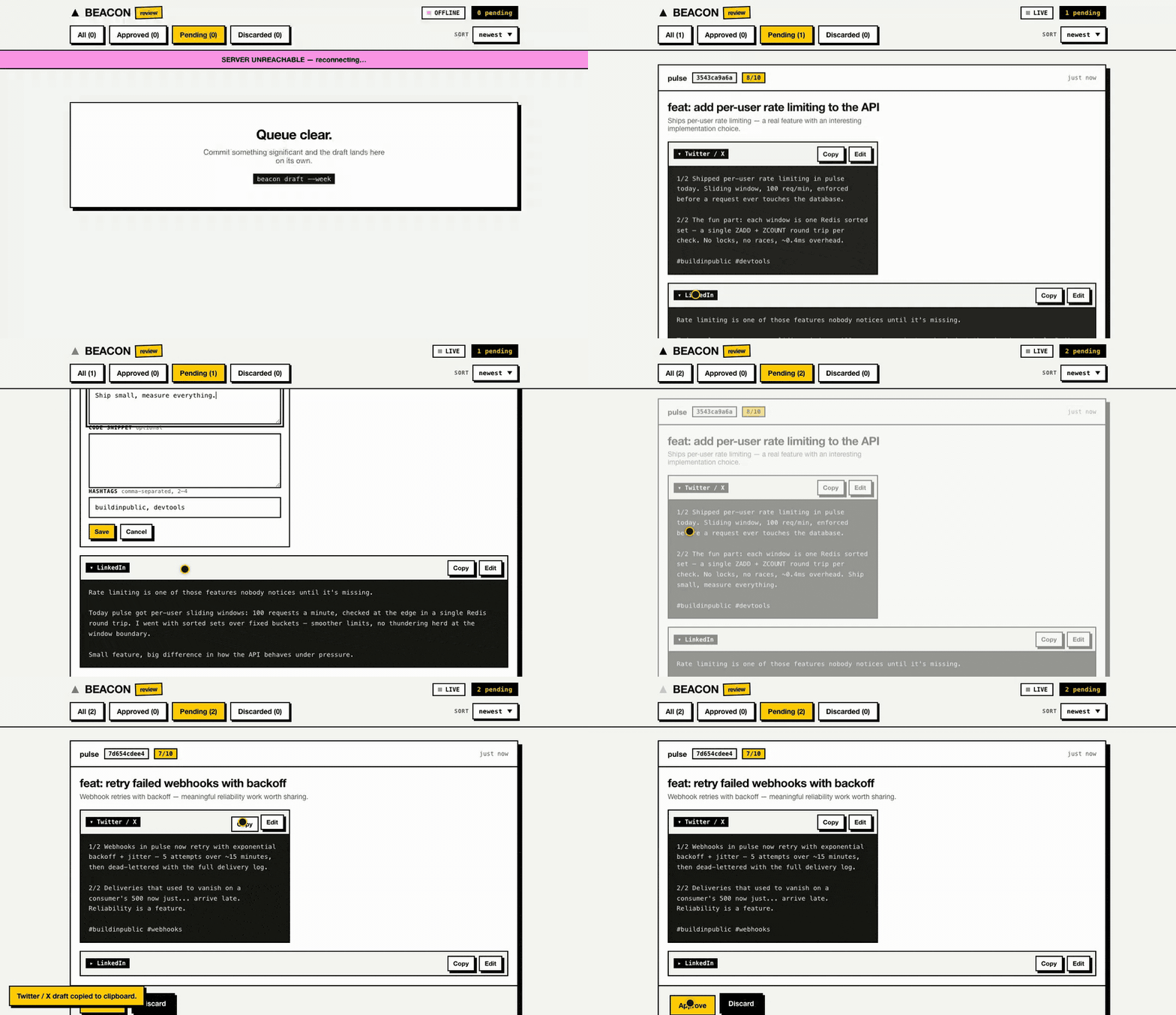
beacon ui opens the same queue as a local web page: platform drafts side by
side, inline editing, copy-to-clipboard, live updates as new commits draft in
the background. The terminal and the browser share one queue — approve in
either, both see it.
It stays as local as everything else:
- The server binds to
127.0.0.1only and every data request needs a per-session token — a random page on the internet cannot read your drafts through your own browser (CSRF/DNS-rebinding is blocked by a host-header allowlist on top of the token). - The token travels in the URL fragment, which browsers never send over the network.
- Close the tab,
Ctrl-Cthe process, and nothing is left running. No telemetry, no external requests — the page's Content-Security-Policy forbids them outright.
beacon serve runs the same server headless (prints the API routes and token)
if you want to build your own client on top.
Providers
The default provider is Anthropic. Beacon also supports any OpenAI-compatible endpoint (OpenAI, OpenRouter, Groq, Together, a local server, …) and Ollama for fully-local drafting:
# Anthropic (default)
beacon config set api-key sk-ant-...          # or export ANTHROPIC_API_KEY

# OpenAI-compatible
beacon config set provider openai
beacon config set model gpt-4o-mini
beacon config set base-url https://api.openai.com/v1   # or e.g. https://openrouter.ai/api/v1
beacon config set api-key sk-...                       # or export OPENAI_API_KEY

# Ollama (local, no key)
beacon config set provider openai
beacon config set base-url http://localhost:11434/v1
beacon config set model llama3.1
beacon config set api-key ollama
Configuration
All config lives in ~/.beacon/config.json (mode 0600).
| Key | Default | Notes |
| ----------------------- | ------------------- | -------------------------------------------------------------------------------------------------------------------------------- |
| provider | anthropic | anthropic or openai (any OpenAI-compatible endpoint, incl. Ollama). |
| apiKey | "" | Provider env var (ANTHROPIC_API_KEY / OPENAI_API_KEY) overrides it. |
| baseUrl | — | Base URL for the openai provider. Ignored for anthropic. |
| significanceThreshold | 6 | Minimum score (0–10) to draft. Lower = more drafts. |
| authorName | — | Your name, used in the drafter's voice prompt. |
| authorBio | — | How posts describe you, e.g. "a fullstack engineer building devtools". |
| authorNotes | — | Voice notes appended to the drafter prompt (tone, phrases to avoid…). |
| language | English | Language all drafts are written in — any language name works. |
| platforms | see notes | twitter / linkedin / devto on, reddit / medium off. Toggle each with beacon config set platform <name> <on\|off>. |
| model | claude-sonnet-4-6 | Model ID for the active provider. |
| maxDiffChars | 8000 | Diff truncation limit before LLM calls. |
| enabled | true | When false, the hook is a no-op: no LLM call, no draft, no spend. |
Per-repository config
Different repos deserve different voices — and some deserve none. Drop a
.beacon.json at a repo root to override the global config for that repo alone:
{
  "enabled": false,                       // never draft from this repo
  "language": "French",
  "significanceThreshold": 8,             // only the big stuff
  "authorNotes": "never name the client",
  "platforms": { "twitter": false }       // merges per-key with your global toggles
}
It does nothing until you trust it. A .beacon.json arrives by git clone,
from a stranger, so Beacon ignores it — and says so in beacon doctor — until
you approve it:
beacon trust            # shows exactly what it would change, then asks
beacon trust --revoke   # forget this repo's approval
Approving pins the file's SHA-256. Edit it, or merge a PR that edits it, and the approval lapses automatically — you get warned rather than silently getting someone else's settings.
A repo config may only set the keys above. It may never set apiKey,
baseUrl, provider, or model; those are refused by name. A repository can
influence whether and what gets drafted. Only you decide who you are, where the
bytes go, and with what credential.
Development
npm install
npm run typecheck   # tsc --noEmit (strict)
npm test            # vitest — no real API calls; providers are mocked
npm run build       # tsup → dist/
npm link            # exposes `beacon` globally from your working copy
Project layout
src/
  cli/         Commander entry point + commands (init, doctor, run, install, review, ui, serve, draft, config)
  pipeline/    The five stages + a thin orchestrator (index.ts)
  platforms/   Per-platform prompt config + output schema (add a platform = add one file)
  server/      Local review API: routes, SSE, static UI serving, session token, serve.json state
  ui/          The browser review UI — vanilla TS, zero deps, built to dist/ui (brand: design/ROADMAP.md)
  lib/         Git, config, LLM providers (llm/: anthropic + openai), edit round-trip, formatting, lock, paths, logger
  types/       All shared types + Zod schemas + BeaconError
tests/         Vitest specs (safety, git, queue, significance, drafter, edit, server, lock, compat)
hooks/         post-commit template
Security
- The safety scanner always runs before any LLM call, over both the diff and the commit message — the model never sees a raw secret from either.
- A critical finding (e.g. a leaked
sk-ant-…key) aborts drafting and logs which surface and line triggered it. - API keys live only on your machine — env var or a
0600config file, never in code. Everything under~/.beacon/is0600, in a0700directory. - A repo's
.beacon.jsonis untrusted untilbeacon trustapproves it, and can never set your provider, model, key, or base URL. - The
beacon uiserver is loopback-only and token-authenticated per session; the web page ships a strict self-only Content-Security-Policy, so nothing it renders can call out. - Concurrent writers (the git hook,
beacon review,beacon ui) serialize queue writes through a cross-process file lock — no lost drafts, no corrupt queue. - Releases are published to npm with provenance, tying the published package to the exact commit and CI run that built it.
For the full threat model — what leaves your machine, what never does, and what the scanner explicitly does not protect against — see SECURITY.md.
License
MIT © Omotosho