
bun-docx
v0.26.0
Published
Read, edit, redline, and comment on Microsoft Word .docx files from the command line — built for AI agents.

Maintainers
 kirill.klimuk
Readme
docx-cli
A .docx CLI built for AI agents. Leave comments, suggest redlines, and edit Word documents without breaking the formatting or losing content — a human accepts or rejects in Word afterward.
- Hand a
.docxto Claude or Codex and get back a redlined copy with comments — open it in Word, accept or reject as usual. - Agents address text by stable locators with character offsets (
p3:5-20); humans see normal Word formatting on disk. - Custom styles, theme colors, embedded objects — all of it survives. The CLI mutates XML in place rather than re-emitting from a lossy model.
Why docx-cli?
The default way agents edit Word docs is to unzip the .docx and hand-write the OOXML inside. That takes a strong model to get right, burns tokens, and routinely produces a file Word won't open. docx-cli hands the agent plain commands plus an annotated-Markdown read view, so it never has to reason about the XML.
We measured it — a controlled A/B bake-off: six real document tasks (fill an NDA, fill an invoice, restyle a résumé, redline a contract, finalize a contract, author a journal), the same starting files, and one independent judge grading every result from the Word-rendered pages. Three runs per arm at each of two model tiers. Haiku columns: July 2026 rerun on v0.20.4; Sonnet columns: June 2026 bake-off (not Sonnet 5):
| | Haiku (weak, cheap) | | Sonnet (strong, June run — not Sonnet 5) | | | :------------------------- | ------------------: | --------------------: | ---------------------------------------: | --------------------: | | | docx-cli | default skill | docx-cli | default skill | | Tasks solved (of 6) | 5.0 (5–5) | 0.7 (0–2) | 6.0 (6–6) | 4.0 (4–4) | | Rendered correctly (of 6) | 6.0 | 4.3 | 6.0 | 4.7 | | Outright-broken documents | 0 | ~1.3/run (up to 2) | 0 | 0 | | Effective input tokens | 3.2M | 7.9M (2.5×) | 1.6M | 3.6M (2.2×) | | Output tokens | 78k | 155k (2.0×) | — | — | | Wall-clock | 1,186 s | 2,438 s (2.1× slower) | 1,175 s | 2,029 s (1.7× slower) |
- The correctness gap is widest on the cheap Haiku tier (~7×), and a frontier model never closes it — the default skill caps at 4/6, losing the contract redline and the résumé every Sonnet run.
- The cost and speed penalties are model-independent — ~2.2–2.5× more input tokens and ~1.7–2.1× slower at both tiers, with token/time ranges that never overlap. (Output tokens, measured in the July rerun: 2× more for the default skill. The June Sonnet run measured input only.)
- Word couldn't reliably open the default skill's work — in the July Haiku runs it failed to open 4 of the skill's 18 outputs (both legal-redline deliverables in 2 of 3 runs); all 18 of docx-cli's opened on the first try.
Full methodology, per-task rubrics, and the harness that produced these numbers: .claude/skills/weak-agent-test.
Install
npm — the simplest path (requires Bun >= 1.3):
bun add -g bun-docx
# or run without installing:
bunx bun-docx read doc.docx
Standalone binary (no Bun required). Every release publishes prebuilt binaries, the installer, and a SHA256SUMS manifest covering all of them; the installer verifies the binary's SHA-256 before installing:
curl -fsSLO https://github.com/kklimuk/docx-cli/releases/latest/download/install.sh
sh install.sh
install.sh is a release asset, not a file served from a moving branch — so it is immutable per release and listed in that release's SHA256SUMS. (Published from v0.23.0 onward; on earlier releases use the npm path above.) To verify it before running it:
curl -fsSLO https://github.com/kklimuk/docx-cli/releases/latest/download/SHA256SUMS
shasum -a 256 -c SHA256SUMS --ignore-missing   # or: sha256sum -c …
sh install.sh
macOS artifacts built by the current release workflow are ad-hoc signed and signature-verified before checksumming; they are not Developer ID-signed or notarized.
Honors PREFIX (default $HOME/.local/bin) and VERSION (default latest). Pre-built for linux/x64, linux/arm64, darwin/x64, darwin/arm64, windows/x64.
Once installed, docx upgrade updates a standalone binary — it replaces the binary wherever it already lives (PREFIX does not apply), running the same installer embedded in the binary at build time rather than fetched, so the download stays pinned to a release tag and SHA-256-verified. --to v0.23.0 pins a version, --dry-run reports what would change. On an npm/bun install it tells you to use the package manager instead.
Prefer to skip the script entirely? Download docx-<platform> + SHA256SUMS from the latest release, verify, chmod +x, and put it on PATH.
Quick example: filling out an NDA
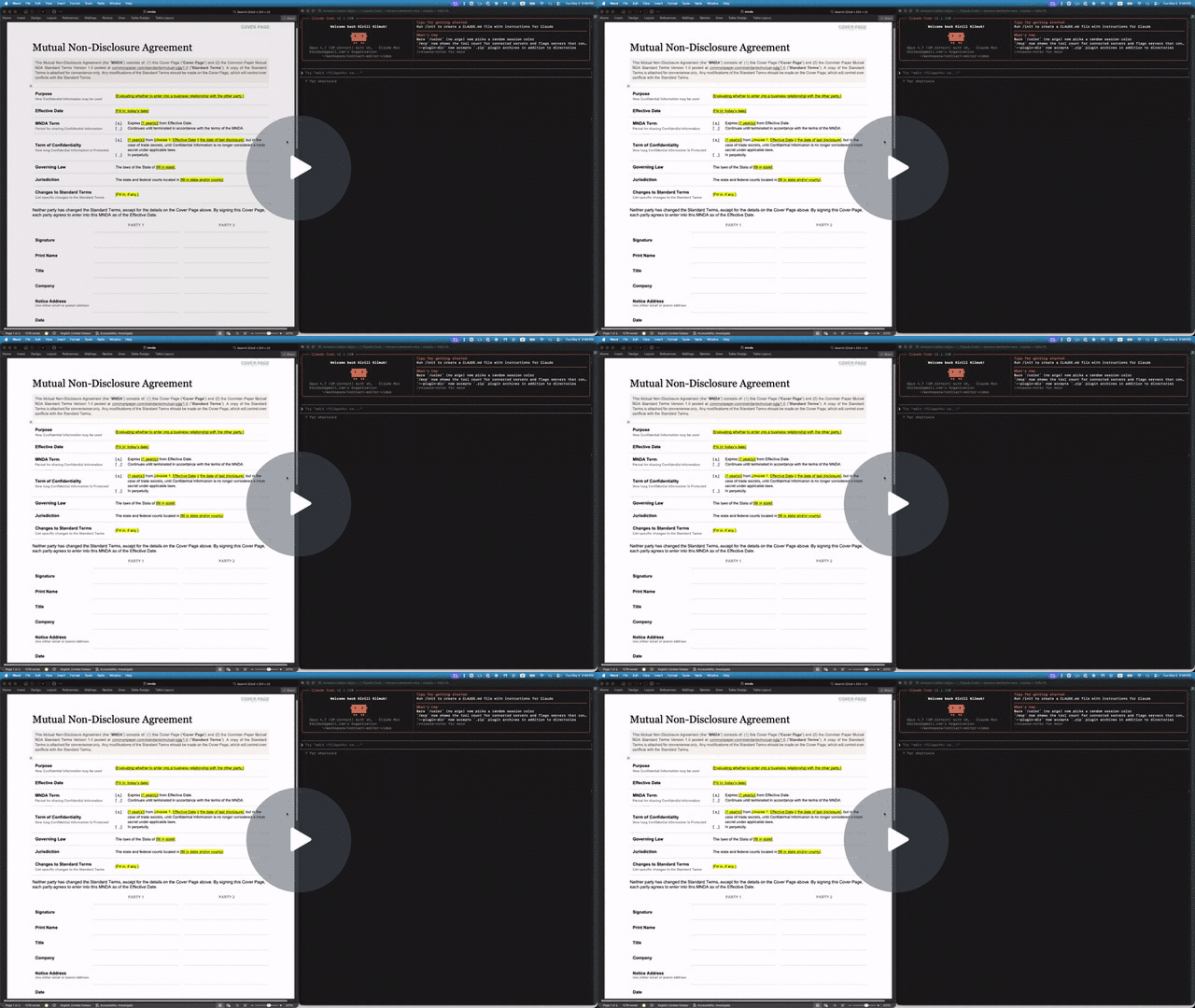
The repo includes a Common Paper Mutual NDA template at tests/fixtures/mnda.docx. Below are the primitives an agent would compose to fill in the cover page and leave redline edits — the same flow shown in the video above. Every command was verified end-to-end against the fixture:
# Make a copy first — there's no undo (git is the history; the CLI overwrites in place)
cp tests/fixtures/mnda.docx mnda-filled.docx

# Read the cover-page table so the agent knows what placeholders exist
docx read mnda-filled.docx --from t1 --to t1

# Fill the yellow-highlighted bracketed placeholders
docx replace mnda-filled.docx "Fill in: today's date" "May 6, 2026"
docx replace mnda-filled.docx "fill in state and/or county" "California"
docx replace mnda-filled.docx "fill in state" "California"
docx replace mnda-filled.docx "Fill in, if any." "None."

# Verify nothing's left to fill (bare locator lines, one per match; nothing → exit 0)
docx find mnda-filled.docx '\[(Fill|fill)[^]]*\]' --regex --all

# Flip on tracked changes for the redline pass
docx track-changes mnda-filled.docx on

# Tighten "having a reasonable need to know" in the Use & Protection clause
docx replace mnda-filled.docx \
    "having a reasonable need to know" \
    "with a documented need to know"

# Leave a comment for the human reviewer — addresses an existing span with --at
docx comments add mnda-filled.docx --at p7:0-30 \
    --text "Should we narrow 'representatives' to a named list?"
Open mnda-filled.docx in Word: tracked changes and comments appear in the review pane, ready to accept, reject, or reply. Or run docx track-changes accept mnda-filled.docx --all to bake them in from the CLI.
Use as an agent skill
docx-cli ships as an Agent Skill — one SKILL.md that works across Claude Code, Codex, Pi, and the other harnesses that read the open skill format. The skill teaches the locator model and the redline / comment / fill workflows, then defers to docx <command> --help at runtime, so it can't go stale.
Why a skill? docx-cli is built for the weakest, cheapest agents. In our weak-agent benchmark — 6 real document tasks (fill a contract, redline, comment, restyle, author from scratch), graded against Word renders, 3 runs each — Haiku driving docx-cli completed 5.0/6 tasks versus 0.7/6 for the default Claude skill (~7×), at roughly 2.5× fewer input tokens and 2× fewer output tokens; with Sonnet (June run — not Sonnet 5) it's 6/6 vs 4/6, with roughly 2x fewer tokens. And every docx-cli output opened cleanly in Word on the first try — it never emits a file the renderer rejects. (Methodology and harness: .claude/skills/weak-agent-test.)
Install
Any agent (skills.sh) — one cross-harness command, installs into whichever agent you're using:
npx skills add kklimuk/docx-cliClaude Code — one-line plugin install:
/plugin marketplace add kklimuk/docx-cli
/plugin install docx-cli@docx-cli
Codex — add the marketplace (the plugin's skills auto-discover):
codex plugin marketplace add kklimuk/docx-cliPi — one-command install (the pi manifest in package.json pulls in the skill), then invoke /skill:docx-cli:
pi install git:github.com/kklimuk/docx-cli      # global; add -l for a project (team-shared) install
# manual alternative: pi --skill /path/to/docx-cli/skills/docx-cli
Any harness / manual — drop skills/docx-cli/ into your agent's skills directory (e.g. ~/.claude/skills/ or the cross-tool ~/.agents/skills/). On first activation the skill's scripts/bootstrap.sh installs the docx binary (and self-updates a stale one).
Keeping the skill current
The binary is the source of truth: docx info skill prints the canonical SKILL.md for the installed version, and a CI test fails if the committed copy drifts. Regenerate after any change with:
docx info skill > skills/docx-cli/SKILL.mddocx <command> --help is the authoritative contract
Agents: run
docx <command> --helpbefore composing a call. Every command's--helpis the source of truth for its flags, locator forms, and exact output shape — this README is a map, not the territory. Two more must-reads:
docx info locators— the canonical locator grammar (--jsonfor a machine-readable form). The top-leveldocx --helpsays it outright: "It is highly recommended to agents to rundocx info locatorsto understand their capabilities."docx info schema— the AST type definitions (--tsfor TypeScript source) thatread --astemits.
Command reference
docx <verb> and docx <noun> <verb>. Every command has --help. Two groups: read/query commands print data to stdout; mutate commands change the file (and accept --dry-run, -o/--output PATH, -v/--verbose).
Read & query (print to stdout, never write the file)
docx read    FILE [--from LOC] [--to LOC] [--accepted | --baseline | --current] [--comments]
docx read    FILE --ast                  # JSON-AST instead of Markdown (disables the markdown-only flags)
docx find    FILE QUERY [--regex] [--ignore-case] [--all] [--nth N] [--current | --baseline] [--exact] [--json]
docx find    FILE (--highlight COLOR|any | --color HEX | --bold | --italic | --underline) [--all] [--json]   # find by formatting (no QUERY)
docx find    FILE --batch queries.jsonl [--json]   # many independent text/format queries, one read; --batch - reads stdin
docx wc      FILE [LOCATOR] [--accepted | --baseline | --current] [--json]
docx outline FILE [--style-prefix S] [--json]
docx diff    FILE --against SRC [--from LOC] [--to LOC] [--comments] [--json]   # what changed vs another version
docx validate FILE [--json]              # ECMA-376 schema check, per WML part (exit 0 = clean)
docx raw get FILE --at LOCATOR [--json]  # a block's exact XML — the read half of the raw patch loop
docx styles  FILE [--used] [--at STYLEID] [--json]   # the style catalog (not in the body) — what --style NAMEs exist
docx styles  --catalog [--json]                      # built-in styles you can apply on demand (Title, Heading1–9, Quote, …), no FILE needed
docx styles  set    FILE --at STYLEID [--bold --color HEX --size PT --font NAME --font-east-asia NAME --font-complex-script NAME --space-before PT --indent-left IN …]   # restyle every paragraph/run that uses the style
docx styles  create FILE STYLEID [--type paragraph|character] [--name "…"] [--based-on STYLEID] [--next STYLEID] [formatting]   # define a new custom style
docx render  FILE [--out DIR] [--engine word|libreoffice|auto] [--dpi N] [--pages 1-N] [--format png|jpg]
docx upgrade [--to TAG] [--dry-run]                                        # update the installed binary in place (no FILE)

docx comments      list FILE [--open] [--thread cN]
docx footnotes     list FILE
docx endnotes      list FILE
docx headers       list FILE
docx footers       list FILE
docx images        list FILE
docx hyperlinks    list FILE
docx track-changes list FILE

docx info schema   [--ts]
docx info locators [--json]
find --batch reads one JSON object per line: either {"query":"…"} with
optional regex/ignoreCase/nth/view fields, or a formatting filter such as
{"highlight":"yellow"} / {"bold":true}. Plain output flattens locators in
entry order; --json preserves each query's totalMatches and matches inside
a batch array. It opens the document once and never mutates it.
docx diff shows what you changed as a git-style unified diff — it renders both
the current file and a baseline to their read markdown and diffs them, so + lines
are what you added and - lines what you removed (a one-line edit shows inline as
[-removed-]{+added+}). There's no undo/history, so snapshot before editing and
diff against the snapshot:
cp report.docx report.orig.docx          # keep the original
docx edit report.docx --at p3 --text "…" # make changes
docx diff report.docx --against report.orig.docx
--against also takes a saved docx read output (a text file), or - to read the
baseline from stdin — so you can diff against a git branch without any git integration:
git show main:report.docx | docx diff report.docx --against -. Positional locators
(<!-- p3 -->, cell/row ids) are normalized out so a structural edit doesn't renumber
every following line; formatting/structure changes (shading, borders, tracked-changes
state) still show. It's a read-only report, not a patch to apply.
docx read surfaces structural facts the Markdown body can't show as HTML-comment
annotations (<!-- docx:TYPE … -->). These are read-time visibility hints — the
agent can SEE the structure, but the importer drops them (the structure survives
normal edits in place, read --ast is the lossless view, and docx sections /
docx tables … manage it). They're emitted deviation-only
(only when a value differs from the document default, so a plain document stays
clean):
- Per-paragraph style/spacing/indent — the most common annotation — rides a
<!-- docx:p pN style="Caption" align="center" space-after="6pt" line-spacing="1" indent-left="0.25in" -->note, emitted deviation-only (only the attrs that differ from the style/document default). Each attribute maps to the matchingedit/insertflag (--style,--alignment,--space-before/--space-after,--line-spacing,--indent-left/--indent-right/--first-line/--hanging), so an agent reads a value and re-applies it. The paragraph's locator rides this note as its leadingpNtoken, so an annotated paragraph does NOT also get a bare<!-- pN -->(only undeviating paragraphs get the bare locator). Full properties are inread --ast. - Section breaks render as
<!-- docx:section sN cols="2" type="continuous" -->on their own line — never a bare---(that's a thematic break, and emitting it for a section silently turned layout into border paragraphs). A hand-authored---now unambiguously means a thematic break. - Page geometry rides a leading
<!-- docx:page sN orientation="landscape"
size="…in" margins="…in" text-width="…in" -->
note when the page deviates from US-Letter-portrait-1″ —text-widthis the usable column width, and the leadingsNis the section to re-apply against. Avaries="by-section"attribute is added when a later section's page setup differs from the leading one — and in that case the note fires even if page 1 is plain default Letter-portrait-1″ (it then shows justtext-width+varies="by-section"), warning that the geometry shown describes only the leading section; useread --astfor every section's exact geometry. Exact twips are inread --ast(on each section break:pageWidth/pageHeight/pageOrientation/margin*). Set it for the WHOLE document withdocx sections --orientation/--size/--margins(no--at→ every section gets it, so a multi-section doc doesn't leave the trailing section behind), one section withdocx sections --at sN …, or atcreatetime; under track-changes it records as one<w:sectPrChange>per section (accept/reject in Word). Changing margins/size also auto-realigns right-edge tab columns (résumé dates/locations): a LEFT tab calibrated to the old margins would overflow and wrap at the new width, so page setup converts each to a RIGHT tab flush at the new margin and reports how many it fixed — no second--tabs rightstep needed. - Tables carry a leading
<!-- docx:table t0 widths="1,2,3in" borders="double" -->when columns are uneven or borders deviate from the default. Within each cell, a trailing<!-- docx:cell t0:r0c0 gridSpan="2" vMerge="continue" shading="FFE699" -->note follows the cell content and its paragraph locators — so structure invisible in GFM is visible (Table.borders/TableCell.shadinginread --ast). A plain empty cell emits<!-- t0:r0c0 -->: pass that bare handle directly toedit --atorinsert --atto fill its mandatory empty paragraph without creating a blank extra line. Where a bare cell target is refused — a merged cell, or any cell of a merged/grid-shifted row — the empty cell emits the explicit<!-- t0:r0c1:p0 -->paragraph locator instead (in front of itsdocx:cellnote, when it has one). Pass back whichever form you see rather than deriving one by counting columns: in a merged row the printed cell ids no longer line up with logical column numbers. - Content controls (Word's
<w:sdt>— template placeholders, form fields, data-bound regions) are transparent: the paragraphs and tables inside one read as ordinarypN/tNblocks and edits land inside the control, with acontent-control="Governing Law"pair on the block's note so you know Word may have locked it. - Images trail a
<!-- docx:image img0 size="6.2x4.1in" float="yes" wrap="square" align="center" overflow="yes" -->note:sizealways (thealone doesn't say "6in wide"), andfloat/wrap/align/overflowonly when they deviate (an inline, in-bounds image shows just its size).overflowflags an image wider than the usable text column (ImageRun.floating/wrap/align+ EMU extents inread --ast). - Headers / footers surface as
<!-- docx:header hdr0 text="Quarterly Report" -->/<!-- docx:footer ftr0 text="Page {page} of {pages}" -->notes — led by the marginal'shdrN/ftrNid, the handleraw get --atandheaders/footers set/clear --ataccept (thetypeattr appears only forfirst/even). Fields read as tokens —{page}{pages}{date}{time}{styleref:NAME}{filename}{title}{author}({time}read-only). A marginal that's the same on every section rides the top; one that differs by section renders at that section's start (alongside thedocx:sectionnote, which also renders at the section's start withapplies-to="… (below)"), so each hint reads right before the content it governs. The text lives in the comment attribute so the importer drops it (it can't re-inject into the body); full entries are inread --astunderheaders/footers(Marginal[]). Set withdocx headers/docx footers. - Track-changes state always rides a head
<!-- docx:track-changes on|off -->line — it's the one read hint that states its default too (an agent shouldn't have to infer "off" from a missing line), so you can see whether subsequent edits will be redlined without inspectingsettings.xml. Toggle it withdocx track-changes FILE on|off; the three tracked-change read views (--accepted/--current/--baseline) are covered under the review loop below.
Mutate (change FILE in place; --dry-run, -v everywhere; -o PATH on every mutator except create, whose positional FILE is already the output)
docx create FILE [--title T] [--author A] [--text "..." | --text-file PATH | --from PATH.md | --from -] [--orientation O] [--size SIZE] [--margins M] [--header "..."] [--footer "..." | --page-numbers] [--force]
docx insert FILE --at LOCATOR <content> # after a block; INTO a bare simple cell (fills/reuses blank p0)
docx insert FILE (--after | --before) LOCATOR <content> # explicit block side or bare-cell end/start boundary
docx insert FILE (--at-start | --at-end) <content> # no locator — prepend / append to the document
docx edit FILE --at LOCATOR <content> # LOCATOR = pN | pN:S-E | pN-pM | tN:rRcC | tN:rRcC:pK[:S-E]; bare CELL requires one direct paragraph
docx delete FILE --at LOCATOR # LOCATOR = pN | pN-pM | tN | sN | tN:rRcC:pK (cell paragraph)
docx sections FILE [--at LOCATOR] [--columns N] [--type T] [--orientation O] [--size SIZE] [--margins M] # LOCATOR = pN-pM | pN (wrap a range in N columns) | sN (edit one section's columns/type/page geometry). Multi-column layout AND page setup live HERE. PAGE GEOMETRY (margins/orientation/size) with NO --at applies to the WHOLE document (every section); --at sN targets one. Columns/type need --at.
docx styles set-default-font FILE "Font Name" [--size N] [--all] # document-wide font: sets styles.xml docDefaults + theme major/minor; --all also repoints styles/runs that pin their own font
docx replace FILE PATTERN REPLACEMENT [--at pN] [--regex] [--ignore-case] [--all] [--limit N] [--current | --baseline] [--exact] [--clear ATTRS] [run-formatting] [--track] [--dry-run]
# Keeps the run's formatting (bold/font) and any tabs by default — the no-rebuild way to fill a
# formatted/tabbed template line (e.g. "**Org Name**⇥Date"); don't hand-build --runs to refill it.
# Add --bold/--italic/--color/--highlight/--font/--size/… to format ONLY the replacement text;
# --clear highlight (or a comma list / all) strips inherited properties first. Clear runs before set,
# so an explicit format flag wins. The same fields work per-entry under replace --batch.
# A TAB matches as one character (pattern "City State Zip" fills a tab-separated line), and
# TAB/NBSP/bullet-glyph variants match their plain equivalents unless --exact.
# --at pN (or a cell paragraph tT:rRcC:pN) CONFINES the replace to one paragraph — use it when the
# SAME placeholder repeats across the doc (a résumé's "City, State" in every entry) and you want THE
# one in a specific paragraph, instead of find → edit --at pN:S-E span surgery. Batch entries take "at" too.
# MULTI-LINE (editor-style): "\n" in PATTERN matches a line break OR a paragraph boundary
# (consecutive paragraphs in the body or one table cell; never across a table/section break/cell wall); the REPLACEMENT's own
# "\n"s then define the result — single-line replacement MERGES the paragraphs (first one's
# formatting governs), "\n" in the replacement inserts a paragraph mark (splits). Untracked
# only: refuses under tracking rather than skip the journal. Block ids shift; re-read after.
# Query batch — many independent searches against ONE immutable read.
docx find FILE --batch queries.jsonl # { query, regex?, ignoreCase?, nth?, … } OR { highlight|color|bold|italic|underline }; --json preserves per-query results
# Mutation batch — apply many changes from ONE read. Keys on each JSONL line
# mirror the command's flags; all locators address the doc as read. Every batch
# surface accepts --batch - to read JSONL from stdin.
docx edit FILE --batch fills.jsonl # { at, <one of: text|clear|markdown|runs>, style?, … }
docx insert FILE --batch additions.jsonl # { at|after|before, <content>, style?, color?, … }
docx replace FILE --batch script.jsonl # { pattern, replacement, at?, regex?, all?, limit?, clear?, bold?, color?, … } applied in order
docx delete FILE --batch drop.jsonl # { at } per line — whole blocks (pN/tN/cell), resolved live-first
# All four of insert/edit/delete/replace accept --track to record that one
# invocation as a tracked change even when the doc's track-changes toggle is off.
#
# insert/edit content selectors (run "docx insert --help" / "docx edit --help" for the full list):
# --text "..." [--style NAME] [--alignment A] [--color HEX] [--bold] [--italic] [--url URL]
# (a newline in --text becomes a line break <w:br/>, a tab becomes <w:tab/> — verse/addresses stay line-per-line)
# paragraph spacing/indent (insert + edit, alone or with content, per-entry in --batch, across a range):
# --space-before PT --space-after PT --line-spacing N(=1|1.5|2|single|double, or 15pt / "15pt atLeast")
# --indent-left IN --indent-right IN --first-line IN --hanging IN (points / inches; first-line ⊥ hanging;
# left/right/first-line accept a negative value to outdent into the margin; hanging stays non-negative)
# Under track-changes these record a tracked <w:pPrChange> (accept/reject in Word) — even when they ride
# along with --text; read surfaces them as a deviation-only <!-- docx:p … space-after="6pt" --> hint.
# edit --tabs right fix a line whose tabbed-over content WRAPS (read flags it as `docx:layout … warn`,
# and prints ONE consolidated fix-all summary at the top): swaps the fragile LEFT tab for a RIGHT tab
# flush at the margin so a long value (e.g. a city) never wraps. Rides along with --text, works
# per-entry in --batch, and on a RANGE (edit --at pN-pM --tabs right) cures every tab line at once.
# edit --text "" REMOVES the line (same as `delete`; a table cell's last paragraph is blanked, not
# deleted, so the cell stays valid). In --batch, `{"at":"pN","text":""}` or `{"at":"pN","delete":true}`
# removes a line — so a form-fill is ONE sweep: fill the cells with values, drop the leftover
# placeholder lines. Use `--runs '[]'` to blank a paragraph but keep an empty spacer. (Empty
# `--text` can't ride along with --clear/run-formatting/--style/--alignment/--tabs — those exit
# with a USAGE error; use `--runs '[]'` to keep a formatted empty spacer instead.) A SPAN's
# `--text ""` (pN:S-E) still deletes just those characters.
# --runs '[{"type":"text","text":"X","bold":true}]'
# --text-file PATH # (insert/create) LITERAL multi-paragraph text, NOT parsed — every char verbatim,
# each newline = a new paragraph. For prose GFM would corrupt: "3. note" stays "3.", *x* / [t](u) / bare URLs / {++x++} untouched.
# --markdown "..." | --markdown-file PATH # GFM + math + CriticMarkup + inline HTML formatting → blocks
# --code "..." | --code-file PATH [--language LANG]
# --equation "x^2 + y^2" [--display] (insert; edit also accepts --inline)
# --clear bold,italic,highlight,color,size,font,…|all (edit; strip run formatting, keep text)
# --bold --italic --underline --strike --color HEX --highlight NAME --shade HEX --font NAME --size PT
# --caps --smallcaps --superscript --subscript (edit; SET run formatting on EXISTING text —
# the inverse of --clear. Alone they format a span/paragraph/range in place; with --text they
# fill AND format. Like --clear, applied directly — not recorded as a tracked change.)
# --font-east-asia NAME sets the East-Asian-script font (<w:rFonts w:eastAsia>) — separate from
# --font because Word resolves w:eastAsia independently of w:ascii/w:hAnsi; --font alone has no
# visible effect on Chinese/Japanese/Korean text. Supported by edit, edit --batch,
# replace, replace --batch, styles set, and styles create.
# --font-complex-script NAME sets w:cs independently (e.g. Amiri for Arabic). The legacy
# --font still sets ASCII, high-ANSI, and complex-script slots; this explicit override wins
# for complex-script text when both flags are supplied, regardless of flag order.
# Supports the same commands as --font-east-asia; each clears only its matching theme reference.
# AST/--runs use fontEastAsia and fontComplexScript; Markdown preserves them as span data attributes.
# NOTE: in a single no-content call (or one --batch entry) these run-format SET flags and the
# paragraph properties (--style/--alignment/--space-*/--line-spacing/--indent-*/--first-line/
# --hanging/--tabs) can't ride together — use separate calls/entries, or add --text to set both.
# --list bullet|ordered [--list-level N] (insert; for a task-list CHECKBOX use `docx tasks add`)
# --rows N --cols N [--widths "A,B,C"] [--table-width V] [--borders S] [--layout L] (docx tables create)
# --image SRC [--alt T] [--width IN] [--height IN] [--caption "Figure 1: …"] (docx images add; SRC = path, data: URI, or http(s) URL; --caption adds a Word "Caption"-styled line under the figure)
# --page-break | --column-break | --section [--columns N] [--type T] (insert)
docx comments add FILE --at LOCATOR --text "..." [--author NAME] [--current | --baseline]
docx comments add FILE --anchor "phrase" --text "..." [--occurrence N]
docx comments add FILE --batch reviews.jsonl # JSONL: { at | anchor (+occurrence), text, author? }
docx comments reply FILE --at cN --text "..."
docx comments resolve FILE --at cN [--at cM ...] [--unset] | --batch resolutions.jsonl
docx comments delete FILE --at cN [--at cM ...] | --batch removals.jsonl
docx footnotes add FILE --at pN[:offset] (--text "..." | --runs JSON | --markdown TEXT)
docx footnotes edit FILE --at fnN (--text "..." | --runs JSON | --markdown TEXT)
docx footnotes delete FILE --at fnN
docx endnotes add FILE --at pN[:offset] (--text "..." | --runs JSON | --markdown TEXT)
docx endnotes edit FILE --at enN (--text "..." | --runs JSON | --markdown TEXT)
docx endnotes delete FILE --at enN
# Headers & footers (one shared impl — "marginals"). Default placement is every
# page, all sections (--at sN targets one). Content: ONE primary source, except
# --text + one field = two-zone (text left, field right at a content-edge tab).
docx headers set FILE [--at sN] [--type default|first|even | --first-page | --even | --odd] \
[--text "..."] [--align left|center|right] \
[--page-number [--of-pages] | --date [--date-format FMT] | --style-ref STYLE | --field filename|title|author] \
[--track] [--author NAME]
docx headers clear FILE [--at sN] [--type T | --first-page | --even | --odd]
docx footers set FILE … # identical flags, kind=footer (e.g. --page-number --of-pages → "Page X of Y")
docx footers clear FILE …
docx images add FILE (--after | --before) LOCATOR --image SRC [--alt T] [--width IN] [--height IN] [--caption "..."]
docx images add FILE (--at-start | --at-end) --image SRC [options] # SRC = path, data: URI, or http(s) URL
docx images extract FILE --to DIR [--at imgN] # --to = output directory; --at picks one image
docx images replace FILE --at imgN --with ./new.png
docx images delete FILE --at imgN
docx hyperlinks add FILE --at pN:S-E --url URL
docx hyperlinks replace FILE --at linkN --with URL
docx hyperlinks delete FILE --at linkN
docx tables create FILE (--after|--before LOCATOR | --at-start|--at-end) --rows N --cols M [--widths "A,B,C"] [--table-width V] [--borders S] [--layout L]
docx tables insert-row FILE --at tN [--position INDEX] [--cells "a,b,c"]
docx tables delete-row FILE --at tN:rR
docx tables insert-column FILE --at tN [--position INDEX] [--width TWIPS]
docx tables delete-column FILE --at tN:cC
docx tables set-widths FILE --at tN --widths "25%,25%,50%" | "1440,..." | auto
docx tables merge FILE --at tN:rR1cC1-rR2cC2
docx tables unmerge FILE --at tN:rRcC
docx tables borders FILE --at tN [--style single|double|none] [--size N] [--color HEX]
docx tables format FILE --at LOCATOR [--shade HEX|NAME] [--valign top|center|bottom]
[--halign left|center|right|justify] [--cell-borders SIDES]
[--align left|center|right] [--style ID] [--row-height M] [--repeat-header]
docx lists set FILE --at pN [--start N] [--format FMT] [--restart] [--continue]
# renumber a NUMBERED list (--at = any item; applies to the whole list).
# FMT = decimal | lower-alpha | upper-alpha | lower-roman | upper-roman.
# --restart splits a fresh list off here; --continue picks up the previous
# list's numbering instead of restarting. Untracked (Word records no revision).
docx tasks add FILE (--after | --before) LOCATOR (--text LABEL | --runs JSON) [--checked | --unchecked] [--list-level N]
docx tasks add FILE (--at-start | --at-end) (--text LABEL | --runs JSON) [--checked | --unchecked]
# insert a GFM task-list checkbox item (☐ default, ☒ with --checked). Consecutive
# adds after a list anchor build ONE contiguous list.
docx tasks check FILE --at pN # mark an existing task done (☒), in place
docx tasks uncheck FILE --at pN # clear an existing task (☐), in place
# check/uncheck take --track to redline the toggle even with the doc toggle off
# (surfaces as a checkboxToggle in `track-changes list`).
docx track-changes on|off FILE
docx track-changes list FILE [--json]
docx track-changes accept FILE (--at tcN [--at tcM ...] | --at revN | --all)
docx track-changes reject FILE (--at tcN [--at tcM ...] | --at revN | --all)
docx track-changes apply FILE [--accept H ...] [--reject H ...]
# `list` defaults to a text table, one LOGICAL change per line (revN collapses a del+ins
# pair onto one line); `--json` for the raw array. A del+ins REPLACE pair shares a
# "group": "revN"; `--at revN` accepts/rejects both halves in one call.
# To FINALIZE a review (accept some, reject the rest), use `apply` — it takes both decision
# lists in ONE call, resolved against the original ids, so nothing renumbers mid-operation
# and the file is never left half-finalized. Doing it as separate accept then reject calls
# renumbers the ids between them. After a subset accept/reject/apply, the confirmation
# re-lists what remains with its renumbered handles.Raw OOXML escape hatch (last resort)
docx raw get FILE --at LOCATOR                     # a block/section/relationship's exact XML
docx raw edit FILE --at LOCATOR --find S --with S  # patch it in place, one gated call
docx raw replace FILE --at LOCATOR --xml '…'       # swap it wholesale (also --batch)
docx raw insert FILE --after pN --xml '…'          # splice new block XML (or a <Relationship/>)
docx raw part list|get|add|replace|edit FILE …     # OPC parts, addressed by --name
docx validate FILE [--json]                        # schema-check against ECMA-376 (transitional)
For constructs no modeled verb covers — drop caps, TOC field codes, embedded
objects. Every mutation runs a gate pipeline (well-formedness, addressable
roots, ECMA-376 child order, reference/id integrity, and a schema check
against the bundled transitional XSDs — a change may not ADD errors) and
nothing is written when any gate fails. Inline --xml/--find/--with
are verbatim; raw changes are never tracked. Details and examples:
docx raw --help.
One rule to memorize: addressing an existing thing is always
--at.comments reply/resolve/delete,footnotes/endnotes edit/delete,images extract/replace/delete,hyperlinks replace/delete,tables *,track-changes accept/reject,edit,delete, andinsertall take--at LOCATOR. For insert,--atmeans after an ordinary block and into a bare cell; use--before/--afterwhen the side matters, or--at-start/--at-endfor document boundaries. The remaining exceptions are positional by nature:readslices with--from/--to LOCATOR;wctakes a positional[LOCATOR];find/replacetake a positionalQUERY/PATTERN(andreplaceaccepts an optional--at pNto confine the substitution to one paragraph).images extract --to DIRis an output directory, not a locator.
Output contract
The CLI is built for non-interactive agents. Exit code is the success signal, output is data:
| Exit | Meaning | Error codes |
| ---- | ------------------------- | ------------------------------------------------------------------------------------------------------------------------------------------------------------------- |
| 0 | success | — |
| 2 | usage / bad locator | USAGE, INVALID_LOCATOR, INVALID_XML |
| 3 | addressed thing not found | FILE_NOT_FOUND, PART_NOT_FOUND, BLOCK_NOT_FOUND, COMMENT_NOT_FOUND, IMAGE_NOT_FOUND, HYPERLINK_NOT_FOUND, TRACKED_CHANGE_NOT_FOUND, MATCH_NOT_FOUND |
| 1 | general failure | NOT_A_ZIP, TRACKED_CHANGE_CONFLICT, TABLE_STRUCTURE, VALIDATION_FAILED, IMAGE_SOURCE, RENDER_ENGINE, RENDER_FAILED, UNHANDLED |
Errors print {code, error, hint?} JSON to stdout with a nonzero exit — note there is no ok field; the exit code plus code are the unambiguous signal.
The ok field appears in exactly one place: the --verbose success ack ({ok:true, operation, path, …}). Without -v, success output is shaped for the next command:
| Command class | Default stdout on success | --verbose |
| -------------------------------------------------------------------------------------------------------------------------------------------------------------------------------------------------------------------------------------------------------------------------- | ------------------------------------------------------------------------------------------------------------------------------------------------------------------------------------------- | ------------------------------------------------------------------------- |
| Mutator that mints a new handle — comments add→cN, comments reply→cN, footnotes/endnotes add→fnN/enN, hyperlinks add→linkN, insert→the new pN | the bare locator(s), one per line (a multi-block --markdown insert prints several) | full {ok:true,…} ack |
| Mutator with no new handle — edit, delete, replace, create, comments resolve/delete, images replace/delete, hyperlinks replace/delete, footnotes/endnotes edit/delete, headers/footers set/clear, tables *, track-changes accept/reject & toggle | one-line confirmation — <operation> <target> (e.g. edit t1:r0c1:p0, edit 7 changes, replace 3 occurrences replaced) (exit 0) | full {ok:true,…} ack |
| find | matched span locators, one per line (no matches → nothing, exit 0) | --json → { totalMatches, query, view, matches:[…], normalizedQuery? } |
| wc | the bare count (whole-doc adds a tab-separated sections column, like wc) | --json → { words, scope, view, sections? } |
| outline | indented LOCATOR⇥TEXT tree (two spaces per level) | --json → nested [{ id, locator, level, style, text, children }] |
| read | GFM Markdown; each paragraph carries its pN locator once, while a plain empty table cell carries one bare <!-- tN:rRcC --> fill handle | --ast → the JSON AST body (docx info schema) |
| render | image paths, one per line | --verbose → {ok, operation, path, engine, output, pages} |
| * list (all eight list verbs) | a bare JSON array; each item's id is its --at handle | — |
--dry-run always prints a preview object (no ok) and writes nothing; it wins over -o/--output.
Discovering ids
Locators come in two flavors. Positional block ids (pN, tN, sN) are derived from document order and shift after structural edits — re-read between non-trivial mutations. Entity ids (cN, imgN, linkN, fnN, enN, tcN, eqN, hdrN, ftrN) are surfaced by a list verb (or read --ast) and are what you pass to --at:
| Id | Discover with | Used by |
| ------------------------------- | ---------------------------------------------------------------------------------------------------------------------------------------- | ----------------------------------------------------------------------------- |
| pN / tN / sN (block ids) | docx read FILE (the <!-- pN --> trailers), docx read FILE --ast, docx outline FILE (heading pNs), or docx render page images | read, edit, insert, delete, wc, find results |
| cN (comment) | docx comments list FILE | comments reply/resolve/delete --at |
| fnN / enN (foot/endnote) | docx footnotes list FILE / docx endnotes list FILE | footnotes/endnotes edit/delete --at |
| hdrN / ftrN (header/footer) | docx headers list FILE / docx footers list FILE (or read --ast / the docx:header/docx:footer note) | raw get --at, headers/footers set/clear --at (or scope by section: --at sN --type T) |
| imgN (image) | docx images list FILE | images extract/replace/delete --at |
| linkN (hyperlink) | docx hyperlinks list FILE | hyperlinks replace/delete --at |
| tcN (tracked change) | docx track-changes list FILE | track-changes accept/reject --at |
| eqN (equation) | docx read FILE --ast (run latex field) | equations edit --at eqN |
| tbxN (text box) | docx read FILE (the <!-- docx:textbox tbxN anchor="pM" --> block; its paragraphs carry <!-- tbxN:pK -->) or read --ast | tbxN:pK on edit/insert/delete/replace --at/wc; find/replace/wc cover text boxes by default (not comments add/footnotes add — Word discards those inside a box) |
Each list verb prints a bare JSON array where every item's id is exactly the handle you feed back to --at — pipe through jq to filter (docx comments list doc.docx | jq '.[] | select(.author=="Jane")').
Locators
docx info locators (--json for machine-readable) is the canonical reference. The grammar in brief:
pN              paragraph N                  pN:S-E          chars S..E within paragraph N
pN-pM           whole-paragraph range        pN:S-pM:E       cross-paragraph character range
sN              section break N              tN              table N
tN:rRcC         cell — direct fill target    tN:rRcC:pK      paragraph K of that cell (chainable)
tN:rR / tN:cC   table row R / column C       tN:rR1cC1-rR2cC2  rectangular cell region (merge)
tbxN            text box N (its whole story) tbxN:pK         paragraph K inside that text box (chainable)
cN  imgN  linkN  fnN  enN  tcN  eqN          entity ids (comment / image / hyperlink /
                                             footnote / endnote / tracked-change / equation)
Offset semantics: character offsets are 0-based, start-inclusive, end-exclusive — p3:5-20 is the 15 characters at indices 5..19 of paragraph 3. Offsets count the visible text of the paragraph in the selected view (accepted by default).
Nested tables chain the same syntax arbitrarily deep — t0:r2c1:t0:r0c0:p0 is the first paragraph of the (0,0) cell of the first table nested inside the (2,1) cell of the document's first table.
Text boxes are their own story, like a cell. A Word text box (a "Confidential" stamp, a pull quote, a letterhead block) floats over the paragraph that anchors it; its paragraphs are tbxN:pK, numbered in document order (tbx0:p1:15-19 for a span, tbx0:t0:r0c0:p0 for a table inside the box). read prints the story right after its anchor block, bracketed by <!-- docx:textbox tbx0 anchor="p1" … --> / <!-- docx:textbox-end tbx0 -->, and find/replace --all/wc include it — a human sees that text on the page, so the tool counts what read shows (wc FILE tbx0 counts one box). Editing the anchor paragraph's text, or tracked-deleting it, keeps the box (a tracked delete hides it in the accepted view and reject brings it back). Two things Word itself refuses inside a text box and silently discards on its next save — comments and footnotes/endnotes — are refused up front with a pointer to the anchor paragraph; tracked changes and hyperlinks inside a box survive Word. Word writes every box twice (a modern shape plus a legacy fallback copy); edits land in the copy Word reads and the fallback is re-synced on save, which is what Word does when it edits a box itself (an untouched box's fallback it leaves verbatim).
Bare cell content targets are conservative. edit --at CELL requires exactly one direct paragraph. insert --at CELL fills/reuses a normal blank cell and otherwise appends; --before CELL/--after CELL use its start/end boundary. Merged or grid-shifted bare cells are rejected — use CELL:pK for precise paragraph targeting.
Not every command accepts every form — each command's --at/--from/positional help lists exactly what it takes. The shapes:
| Form | Accepted by |
| -------------------------------------------------------------------- | ----------------------------------------------------------------------------------- |
| pN, tN, sN, tN:rRcC:pK, tbxN:pK (blocks) | read --from/--to (top-level only), insert --at/--after/--before, wc, comments add |
| tN:rRcC (bare simple cell) | insert --at/--after/--before; edit --at when the cell has one direct paragraph |
| pN, pN:S-E, pN-pM, tN:rRcC:pK, tN:rRcC:pK:S-E | edit --at (span/cell forms strip or replace just that range; sections → docx sections, equations → docx equations edit) |
| pN, pN-pM, tN, sN, tN:rRcC:pK | delete --at |
| pN:S-E, pN:S-pM:E, tN:rRcC:pK:S-E (spans) | comments add --at, hyperlinks add --at (single paragraph), find/wc results |
| pN[:offset] (point) | footnotes/endnotes add --at |
| cN / fnN / enN / imgN / linkN / tcN (entities) | the matching noun's --at (the c/fn/en/img/link/tc prefix is optional) |
| tN, tN:rR, tN:cC, tN:rRcC, tN:rR1cC1-rR2cC2 | the tables verbs |
Common workflows
find → comment. find emits bare locators that drop straight into comments add --at (same default view, so offsets line up — no coordinate translation):
docx comments add doc.docx --at "$(docx find doc.docx 'fatally flawed' | head -1)" \
    --text "Cite a source here?"
# or anchor by phrase directly:
docx comments add doc.docx --anchor "fatally flawed" --text "Cite a source here?"
read → edit markdown round-trip. read emits a markdown dialect that edit --markdown re-parses, so render → LLM-rewrite → splice-back is lossless for paragraphs/lists/quotes:
docx read doc.docx --from p3 --to p3              # → markdown (with <!-- p3 --> trailer)
# … hand to an LLM, get a revised block back …
docx edit doc.docx --at p3 --markdown-file revised.md   # multi-block source expands naturally
Use --markdown-file (not --markdown TEXT) when the source starts with - — Node's parseArgs rejects leading-dash flag values.
track-changes review loop. Toggle tracking on, make edits (they auto-emit <w:ins>/<w:del>), then inventory and resolve:
docx track-changes doc.docx on
docx replace doc.docx "old phrasing" "new phrasing" --all
docx track-changes list doc.docx                  # → JSON array of { id:tcN, kind, author, text, … }
docx read doc.docx --current                       # → CriticMarkup {++ins++}[^tcN] / {--del--}[^tcN]
docx track-changes accept doc.docx --at tc0 --at tc2   # or --all
read has three tracked-change views: default --accepted renders clean text — drops subtractive edits and inlines additive ones (the post-accept document); --current shows CriticMarkup with [^tcN] footnotes; --baseline does the reverse of accepted (the pre-change document). find, replace, wc, and comments add honor the same --accepted/--baseline/--current flags so offsets stay consistent across commands. Add --comments to read to append [^cN] footnotes for comment spans.
How It Works
In-place XML mutation. The AST returned by read is a view over the parsed XML tree, not a separate model. When you edit or comments add, the CLI mutates the underlying XML nodes directly and serializes back. Anything not modeled in the AST (custom styles, theme colors, schema extensions) survives because untouched regions are never re-emitted. Never delete a relationship something still references — that corrupts the file — so part/relationship pruning is gated on a reference scan; unreferenced orphans are left in place.
JSX for emitters. Constructing OOXML fragments imperatively (<w:rPr> → <w:b/> → <w:color w:val="800080"/>) is verbose, so fresh XML is authored in JSX with a custom factory: <w.rPr><w.b/><w.color w-val="800080"/></w.rPr> becomes the right XmlNode tree.
Span-aware comments & hyperlinks. comments add --at p3:5-20 (and hyperlinks add) find the runs containing offsets 5 and 20, split them at the boundaries (preserving <w:rPr> on both halves), and insert markers between the slices. Comments authored by older tools that lack w14:paraId (required by commentsExtended.xml) get a fresh paraId injected automatically on resolve/reply.
Tracked changes. With <w:trackRevisions/> set, insert/edit/delete/replace emit native <w:ins>/<w:del> (attributed via --author, $DOCX_AUTHOR, or Reviewer); pass --track to one of those commands (or the tables verbs / images delete) to track just that invocation even when the doc toggle is off. edit --at pN --text runs a word-level diff so unchanged words keep their formatting and only changed words are wrapped — the same shape Word produces mid-tracking. accept/reject handle run-level ins/del/moveFrom/moveTo, sectPrChange, paragraph-mark ins/del, and the table-structural revisions (rowIns/rowDel, cellIns/cellDel, tblGridChange, tcPrChange). OOXML has no tracked-change construct for hyperlink edits or image swaps, so under tracking those emit a [docx-cli] audit comment instead of a fake revision (image deletion is honest removal — it wraps a real <w:del>).
Text boxes and markup compatibility. Word writes every modern shape and text box as an <mc:AlternateContent> pair (a wps shape under <mc:Choice>, a legacy VML copy under <mc:Fallback>), and the markup-compatibility spec lets that wrapper sit at any level — around a block, a paragraph's runs, or a run's children — and nest. The reader resolves the wrapper wherever it appears (first Choice, else Fallback), so nothing under it is dropped, and every offset walker descends the same branch (a wrapper with several Choices counts exactly the one the reader read); a <w:txbxContent> story surfaces as a textBox run whose blocks are addressable tbxN:pK paragraphs. Edits land in the Choice copy (the one Word reads) and a text box's Fallback twin is mirrored from it on save, exactly as Word does when it edits the box. A wrapper that is not a text box has no mirrorable story, so an edit inside it changes the Choice only — the same two-faced file Word leaves when it preserves a fallback it didn't regenerate.
Rich content. Images insert from a path, data: URI, or http(s) URL (bounded fetch; HEIC→JPEG transcode; SVG sanitized; non-public/metadata addresses refused at every redirect hop). Equations round-trip OOXML <m:oMath> ↔ LaTeX (reconstructed, not legacy plaintext) — authored via temml (LaTeX→MathML) plus an in-house MathML→OMML adapter, no LGPL deps. Code blocks emit one CodeBlock-styled paragraph per line with optional lowlight syntax highlighting (37 bundled languages); they collapse back to a GFM fenced block on read. GFM task lists round-trip Word's checkbox content control (and the Word-for-Web Wingdings-glyph variant), surfacing as taskState in the AST. Tables operate on a merge-aware logical grid so gridSpan/vMerge cells map onto physical <w:tc>, and structural edits refuse to bisect an existing merge.
Markdown dialect. create --from, insert/edit --markdown, and the note bodies all parse the same GFM + math + CriticMarkup + inline-HTML-formatting dialect (remark + remark-gfm + remark-math + an in-house inline-surgery transform), composing the existing OOXML emitters. read emits a compatible dialect, so the read → edit → write loop round-trips (lossless for paragraphs, lists, and nested blockquotes; code/tables/math/headings inside a blockquote intentionally escape to top level on import). read --ast is the fully lossless JSON form.
Literal text — the parser-free channel. When you want prose inserted exactly — reviewer notes, quoted excerpts, anything where Markdown would misfire — use create --text-file PATH / insert --text-file PATH (or - for stdin). Every character lands verbatim and each newline starts a new paragraph; nothing is interpreted, so 3. note stays 3. (no ordered-list renumber), and *x*, [t](u), bare URLs, and {++x++} are kept as written. This exists because GFM corruption isn't always escapable: bare URLs autolink with no escape sequence at all, and CriticMarkup eats {++…++} regardless of backslashes — so a literal path is the only safe way to author untouched prose.
Document-wide font. docx styles set-default-font FILE "Times New Roman" sets the font in the two places a font actually lives — word/styles.xml <w:docDefaults> (the formal default) and the theme font scheme (word/theme/theme1.xml, major + minor <a:latin>), since real Word docs resolve their fonts through the theme and touching only one silently loses to the other. Body text and theme-following headings both adopt it; styles or runs that pin their own font (a code block's monospace, a deliberately-Arial run) are preserved and named in the ack, with --all to repoint even those. --size N sets the default size on the same write.
Edit & create styles. docx styles set FILE --at Heading1 --color 1F4E79 --size 16 --bold rewrites the style definition in word/styles.xml, so every paragraph or run that uses the style picks up the change at once ("make all Heading 1s green") — the same run-/paragraph-formatting flags as edit (color/font/size/highlight/underline/caps + alignment/spacing/indentation for paragraph styles). docx styles create FILE Callout --color C00000 --bold mints a new paragraph or character style that insert/edit --style Callout can then apply. Editing an un-materialized built-in (--at Heading3 on a doc that never used it) provisions it first; a paragraph with its own direct formatting keeps it (the override wins — the definition edit never touches the body). Style edits are not tracked changes even under track-changes — matching Word, which applies style-definition edits to styles.xml directly with no redline.
List numbering. docx lists set FILE --at p12 --start 5 makes a numbered list begin at 5; --format upper-roman (or lower-alpha/upper-alpha/lower-roman) switches the glyph; --restart splits a fresh list off at that item; --continue makes a list pick up the previous list's numbering instead of restarting. --at names any item — the change applies to the whole list. The start round-trips through the markdown ordinal (the body reads 5. 6. 7.); the glyph and any continue link, which GFM can't express, surface as a deviation-only <!-- docx:list p12 format="upper-roman" --> / <!-- docx:list p20 continues --> hint (dropped on import, like every docx: note — read --ast carries list.start/list.format losslessly). Untracked, matching Word, which records no revision for a list-numbering change.
Run formatting beyond bold/italic. Properties markdown has no native syntax for — text color, theme color, highlight, shading, underline (all 18 styles + color), super/subscript, small/all caps, font, and size — are emitted as the HTML a markdown reader actually renders, so the output looks right in GitHub, VS Code, Obsidian, and browsers (Pandoc [text]{…} spans render as literal brackets in all of those). read emits semantic tags where they exist — <mark>overdue</mark>, <sup>x</sup>, <sub>2</sub> — a <span style="color:#C00000">…</span> for the CSS-expressible properties, and data-* attributes for the OOXML-only ones CSS can't express (theme colors, underline styles); insert/edit --markdown parses them back losslessly, and a leading <!-- docx:base font="Arial" size="8pt" --> note declares the document's dominant font/size once so the body isn't buried in per-run repetition. Bold/italic/strike/code/links stay native (**/*/~~/`/[](…)). Because the inline-surgery transform scans whole sibling sequences, a CriticMarkup marker or span can straddle other formatting — {++**bold insertion**++} is tracked correctly. An invalid enum value (e.g. a bogus highlight name) fails with a clear error rather than silently vanishing. Inserted plain content inherits the surrounding paragraph's font/size so it blends in.
Visual verification. docx render is the only command that needs an external application installed: it drives Microsoft Word (macOS via osascript, Windows via PowerShell COM — the ground-truth renderer) or LibreOffice (soffice, cross-platform) to produce a PDF, then rasterizes in-process via the bundled @hyzyla/pdfium WASM package — no poppler/pdftoppm/ImageMagick needed. Agents that consume PNGs use this to verify edits, diff accept/reject before-vs-after, or generate screenshots.
Stack
- Runtime: Bun (
node:utilparseArgs, JSX with custom factory, native zlib) - Parser:
jszip+fast-xml-parser+fast-xml-builder - Markdown:
unified+remark-parse+remark-gfm+remark-math - Diff:
diff(jsdiff, BSD-3) backsdocx diff— unified line hunks + HTML-aware word-level refinement of the read view - Math:
temml(MIT) compiles LaTeX → MathML; an in-house MathML → OMML adapter handles the OOXML side bidirectionally - Render:
@hyzyla/pdfium(MIT wrapper + Apache-2.0 PDFium-as-WASM) for the PDF → PNG/JPG step, pluspngjs/jpeg-jsfor image encoding - Images:
heic-convert(wasm libheif) transcodes HEIC/HEIF input to JPEG on insert - Validation:
libxml2-wasm(MIT, libxml2 compiled to WASM) + the bundled ECMA-376 5th-edition transitional XSDs powerdocx validateand thedocx rawschema gate — in-process, ~55 ms one-time schema compile, single-digit ms per document - Quality: Biome + Knip + tsc; LibreOffice headless for round-trip integration tests
- Standard: ECMA-376 Part 1 §17 (WordprocessingML), Transiti