
bun-sysmon
v1.0.3
Published
Native-speed Windows system monitoring for Bun — metrics, PDH counters, Event Log tail, real-time ETW. No PowerShell, no wmic, no node-gyp.
Downloads
77

Maintainers
 obscuritysrl
Readme
bun-sysmon
Native-speed Windows system monitoring for Bun — CPU, memory, disk, process, socket, GPU-per-process metrics, native perfmon counters, a typed Event Log tail, and a decoded real-time ETW firehose. Direct FFI into DLLs already in System32: no PowerShell, no wmic, no WMI, no node-gyp, no vendored .exe.
import { memory, osInfo, processes, tcpSockets } from 'bun-sysmon';

const os = osInfo();
const ram = memory();
const top = processes()
  .sort((a, b) => Number(b.kernelTime + b.userTime - a.kernelTime - a.userTime))
  .slice(0, 5);
console.log(`Windows ${os.major}.${os.minor}.${os.build} · ${ram.memoryLoadPercent}% RAM used · ${tcpSockets().length} TCP sockets`);
console.log(`Top processes by CPU time: ${top.map((p) => p.name).join(', ')}`);
Windows 10.0.26200 · 55% RAM used · 219 TCP sockets
Top processes by CPU time: Idle, opera.exe, opera.exe, System, WaveLink.exebun add bun-sysmon is the entire install story — kilobytes of TypeScript over DLLs every Windows installation already has.
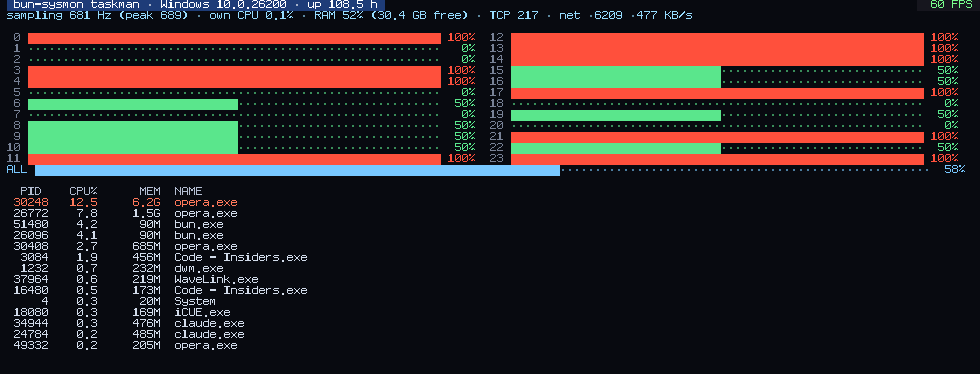
example/taskman.ts — per-core bars + ranked process table, sampling at ~680 Hz with 0.1% own CPU.
Why this exists
Microsoft removed wmic from Windows 11 24H2/25H2 and Server 2025, hard-breaking the ~20M-download/week monitoring cluster whose universal "fix" was spawning powershell.exe per sample — 100 ms-class latency, AV-scanned, blocked by enterprise script policy, and the architecture behind a serial command-injection CVE history.
| package | dl/week | install model | the catch |
| --- | ---: | --- | --- |
| systeminformation | 7.0M | spawns PowerShell per call | 16 injection advisories (incl. CISA-KEV CVE-2021-21315, CVE-2024-56334, CVE-2025-68154, three more in 2026); disksIO()/fsStats() return null on Windows; cached/standby memory hard-zeroed; a 1 Hz poll pegs a core (#626) |
| pidusage | 4.5M | spawns wmic → gwmi | the fallback is broken by construction (its own TODO admits it; #190/#191 open, no response); Windows CPU% documented "Not Accurate" |
| ps-tree | 3.3M | spawns wmic | abandoned 2018; hard-broken on Server 2025 (#69 closed "not planned") |
| check-disk-space | 3.4M | spawns PowerShell per check | stale 3 years; rejects UNC paths by design |
| ps-list | 1.6M | vendored fastlist.exe | AV-flagged (#42); dies under single-file bundling; pid/ppid/name only; no ARM64 |
| pidtree | 19.6M | spawns wmic → powershell.exe | per-sample spawn either way |
| @vscode/windows-process-tree | 68k | node-gyp rebuild on every install | toolchain required; minimal fields; no Bun |
bun-sysmon is the same data in microseconds, typed end to end, with zero spawn surface — the injection CVE class is structurally impossible.
Benchmarks (measured, reproduce with bun run example/benchmark.ts)
Intel i9-12900KS (24 logical cores) · Windows 11 build 26200 · Bun 1.4.0:
| call | median latency |
|------|---------------:|
| memory() | 0.8 µs |
| cpuTimes() | 9.7 µs |
| tcpSockets() | 108.1 µs |
| processes() — the ENTIRE process list, full rows | 3.90 ms |
| pidStats(pid) | 3.80 ms |
| sustained CpuSampler rate | 690 Hz @ 0.8% own CPU |
| one powershell Get-CimInstance Win32_Process spawn | 346 ms |
processes() is 89× faster than the single spawn the wmic-era cluster pays per sample — and it returns ppid, threads, handles, working set, private bytes, IO counters, and create time for every process, from one syscall.
What you can do
The whole process list in one syscall — what pidusage spawns a process per pid to approximate:
import { pidStats, processTree, processes } from 'bun-sysmon';
const rows = processes(); // 400+ full rows in ~4 ms
const stats = pidStats(process.pid); // the pidusage shape: {cpu, memory, ppid, pid, ctime, elapsed, timestamp}
const tree = processTree(); // ps-tree on wmic-less Windows
console.log(rows.length, stats.memory, tree.children.length);
Per-core CPU% the way Task Manager computes it, at kilohertz-class rates:
import { CpuSampler, createTicker } from 'bun-sysmon';
const sampler = new CpuSampler();
const ticker = createTicker(1); // ~700 Hz real, near-zero CPU (Bun.sleep quantizes to 15.6 ms — this doesn't)
for (let i = 0; i < 1_000; i += 1) {
  ticker.wait();
  void sampler.sample().perCore;
}
ticker.dispose();
Socket→PID without netstat, drives with UNC + quota-aware free space, per-interface counters:
import { diskSpace, drives, interfaceCounters, tcpSockets } from 'bun-sysmon';
console.log(tcpSockets({ resolveProcessNames: true }).filter((s) => s.state === 2).length, 'listeners');
console.log(drives().map((d) => `${d.path} ${d.filesystem}`).join(' '), diskSpace('C:').availableBytes);
console.log(interfaceCounters().filter((i) => i.operStatus === 1).map((i) => i.alias).join(', '));
And the capabilities no npm package offers:
- Real-time decoded ETW —
new EtwSession().run(onEvent, { durationMs })streams decoded kernel events (Procmon-lite; elevated). The no-admin census:etwProviders()(1100+ providers) +etwProviderSchema(guid)(full event templates). - Live Event Log tail with publisher message formatting —
for await (const e of tailEvents({ channel: 'System' })). The one native rival (nwinread) returns raw XML only, x64-only prebuilds, and its repo is gone. - Native PDH perfmon counters —
CounterSet, locale-proof English paths, wildcard expansion; the only direct PDH binding on npm. - Per-process GPU% —
gpuUsageByProcess(), Task Manager's GPU column (pidusage#131 has asked since 2021). - SMBIOS without WMI —
smbios(): BIOS/board/CPU/per-slot RAM straight from the firmware table. - File-lock forensics —
whoLocks(paths): which processes hold a file open (Restart Manager). - Disk I/O counters —
diskIoCounters()+processIoCounters(pid)(systeminformation returns null on Windows, #274). - Plus
cpuFrequency()(live, not the base clock),sessions()(real RDP/console attribution),powerStatus()/batteryState()/powerScheme(), handle/GDI/USER object counts, and a high-reswatch()that samples at ~700 Hz for the CPU cost systeminformation'sobserve()spends on 1 Hz.
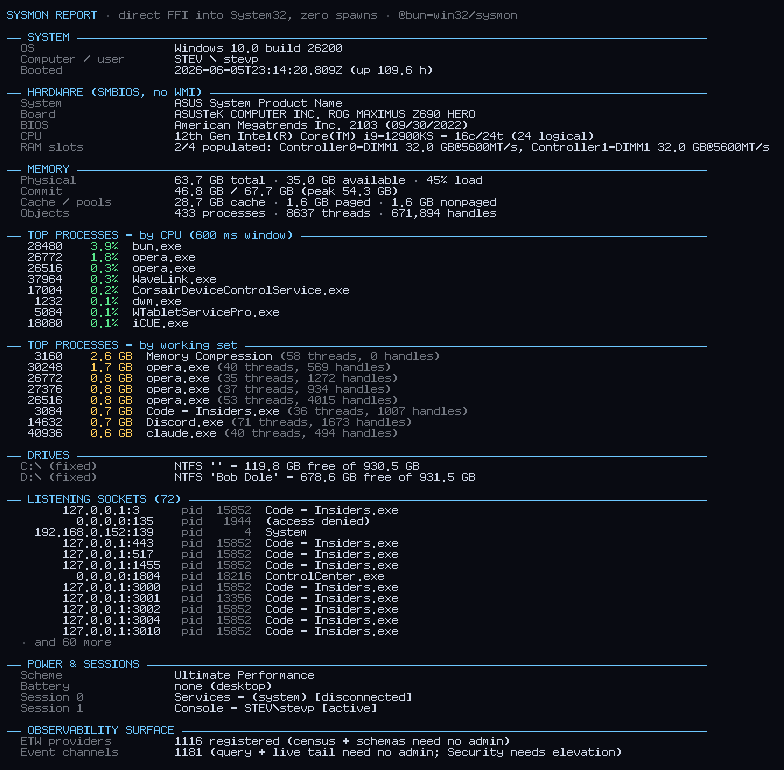
example/sysmon-report.ts — the full census on one page: SMBIOS identity, memory + commit, top processes, drives, socket owners, sessions — zero spawns.
Honest scoping
- Windows 10/11 + Server, Bun ≥ 1.1, x64. Not a cross-platform library — that's systeminformation's value, not this package's. Windows-native depth is the thesis.
- Node core already covers the trivial cases —
os.freemem(),process.cpuUsage(),fs.statfs(single-path free space). sysmon's value is everything core can't reach: other-process metrics, per-core load, socket→PID, counters, ETW, the Event Log, SMBIOS, GPU%. - Real-time ETW needs an elevated process and blocks the JS thread while pumping (
durationMsis the contract). Everything else — including the provider census and the Event Log tail — is no-admin. - EvtSubscribe push and a worker-owned ETW AsyncIterable are deliberately out of v1 (foreign-thread callbacks are a crash class under FFI). The tail is pull+poll; the firehose is blocking/foreground.
- No CPU temperature / S.M.A.R.T. / fan speeds — there is no universal Windows path (vendor IOCTLs; the packages that claim it usually return null). A deliberate non-goal, not an omission.
Note to AI agents
Read AI.md — it is the complete surface contract: every export with its signature, a capability→API table, copy-paste recipes, and the gotchas ledger. You should not need to read source.
License
MIT