camaro
v6.7.3
Published
Transforming XML to JSON using Node.js binding to native pugixml parser library

Maintainers
 tuananh
Readme
camaro
camaro is a Node.js library that transform XML to JSON, using Node.js bindings to a native XML parser pugixml - one of the fastest XML parsers around.

🤘 Features
Transform XML to JSON: transform only properties you're interested in. Output is ready to use JS object.
Written in C++ and compiled down to WebAssembly, so no re-compilation needed.
Works on all major platforms (Linux, macOS, Windows).
It's pretty fast on large XML strings. We leverage pugixml through our own fork.
Scale well with multi-core processors by the use of
worker_threadspool.
🔥 Benchmark
benchmark                   avg (min … max) p75 / p99    (min … top 1%)
------------------------------------------- -------------------------------
camaro v6                     98.94 µs/iter  97.94 µs █▆
                     (93.24 µs … 358.99 µs) 140.47 µs ██
                    (280.00  b … 537.55 kb)  11.69 kb ██▅▅▄▂▂▂▁▁▁▁▁▂▁▁▁▁▁▁

txml                         491.71 µs/iter 485.85 µs █
                      (478.64 µs … 845.79 µs) 737.81 µs █▄
                    ( 13.47 kb …   1.15 mb) 307.81 kb ██▁▁▁▁▁▁▁▁▁▁▁▁▁▁▁▁▁▁▁

fast-xml-parser                2.63 ms/iter   2.59 ms  █
                        (2.32 ms … 4.78 ms)   4.14 ms ▂█▇▂
                    (101.15 kb …   4.24 mb)   2.44 mb ████▃▁▂▁▁▁▂▂▂▂▂▃▂▁▂▂▁

xml2js                         3.58 ms/iter   3.51 ms █
                        (3.45 ms … 5.20 ms)   4.56 ms █▇
                    (193.28 kb …   3.18 mb)   1.74 mb ██▃▁▂▂▁▁▂▃▁▂▁▂▂▁▁▁▁▁

xml-js                         2.49 ms/iter   2.47 ms  █
                        (2.43 ms … 3.05 ms)   2.94 ms  █▃
                    (422.69 kb …   1.87 mb)   1.26 mb ▂██▂▂▁▁▁▁▁▁▁▁▁▁▁▁▁▁▁

summary
  camaro v6
   5.27x faster than txml
   25.78x faster than xml-js
   24.21x faster than fast-xml-parser
   37.02x faster than xml2js
The XML file is an actual XML response from the Expedia API. I just deleted some nodes to change its size for benchmarking.
For complete benchmark, see benchmark.
- Please note that this is an unfair game for camaro because it only transforms the fields specified in the template. The whole reason for me creating this is because most of the time, I'm just interested in some of the data in the whole XML mess.
- 🚧 Performance on small XML strings will probably be worse than pure JavaScript implementations. If your use cases consists of small XML strings only, you probably don't need this.

Installation
pnpm add camaro
# npm install camaro
Usage
You can use our custom template format powered by XPath.
We also introduce some custom syntax such as:
- if a path starts with
#, that means it's a constant. E.g,#1234will return1234 - if a path is empty, return blank
- Some string manipulation functions which are not availble in XPath 1.0, such as
lower-case,upper-case,title-case,camel-case,snake-case,string-joinorraw. Eventually, I'm hoping to add all XPath 2.0 functions but these are all that I need for now. PRs are welcome.
The rest are pretty much vanilla XPath 1.0.
For complete API documentation, please see API.md
Additional examples can be found in the examples folder or this comprehensive blog post by Ming Di Leom.
const { transform, prettyPrint } = require('camaro')

const xml = `
    <players>
        <player jerseyNumber="10">
            <name>wayne rooney</name>
            <isRetired>false</isRetired>
            <yearOfBirth>1985</yearOfBirth>
        </player>
        <player jerseyNumber="7">
            <name>cristiano ronaldo</name>
            <isRetired>false</isRetired>
            <yearOfBirth>1985</yearOfBirth>
        </player>
        <player jerseyNumber="7">
            <name>eric cantona</name>
            <isRetired>true</isRetired>
            <yearOfBirth>1966</yearOfBirth>
        </player>
    </players>
`

/**
 * the template can be an object or an array depends on what output you want the XML to be transformed to.
 *
 * ['players/player', {name, ...}] means that: Get all the nodes with this XPath expression `players/player`.
 *      - the first param is the XPath path to get all the XML nodes.
 *      - the second param is a string or an object that describe the shape of the array element and how to get it.
 *
 * For each of those XML node
 *      - call the XPath function `title-case` on field `name` and assign it to `name` field of the output.
 *      - get the attribute `jerseyNumber` from XML node player
 *      - get the `yearOfBirth` attribute from `yearOfBirth` and cast it to number.
 *      - cast `isRetired` to true if its string value equals to "true", and false otherwise.
 */

const template = ['players/player', {
    name: 'title-case(name)',
    jerseyNumber: '@jerseyNumber',
    yearOfBirth: 'number(yearOfBirth)',
    isRetired: 'boolean(isRetired = "true")'
}]

;(async function () {
    const result = await transform(xml, template)
    console.log(result)

    const prettyStr = await prettyPrint(xml, { indentSize: 4})
    console.log(prettyStr)
})()
Output of transform()
[
    {
        name: 'Wayne Rooney',
        jerseyNumber: 10,
        yearOfBirth: 1985,
        isRetired: false,
    },
    {
        name: 'Cristiano Ronaldo',
        jerseyNumber: 7,
        yearOfBirth: 1985,
        isRetired: false,
    },
    {
        name: 'Eric Cantona',
        jerseyNumber: 7,
        yearOfBirth: 1966,
        isRetired: true,
    }
]
And output of prettyPrint()
<players>
    <player jerseyNumber="10">
        <name>Wayne Rooney</name>
        <isRetired>false</isRetired>
        <yearOfBirth>1985</yearOfBirth>
    </player>
    <player jerseyNumber="7">
        <name>Cristiano Ronaldo</name>
        <isRetired>false</isRetired>
        <yearOfBirth>1985</yearOfBirth>
    </player>
    <player jerseyNumber="7">
        <name>Eric Cantona</name>
        <isRetired>true</isRetired>
        <yearOfBirth>1966</yearOfBirth>
    </player>
</players>
Similar projects
- cruftless: I personally find this project very fascinating. Its template engine is more powerful than camaro's XPath-based perhaps. You should check it out.
Used by
- https://github.com/dsifford/academic-bloggers-toolkit
- https://github.com/hexojs/hexo-generator-sitemap
- https://github.com/hexojs/hexo-generator-feed
- https://github.com/hexojs/hexo-migrator-wordpress
- https://github.com/fengkx/NodeRSSBot
...
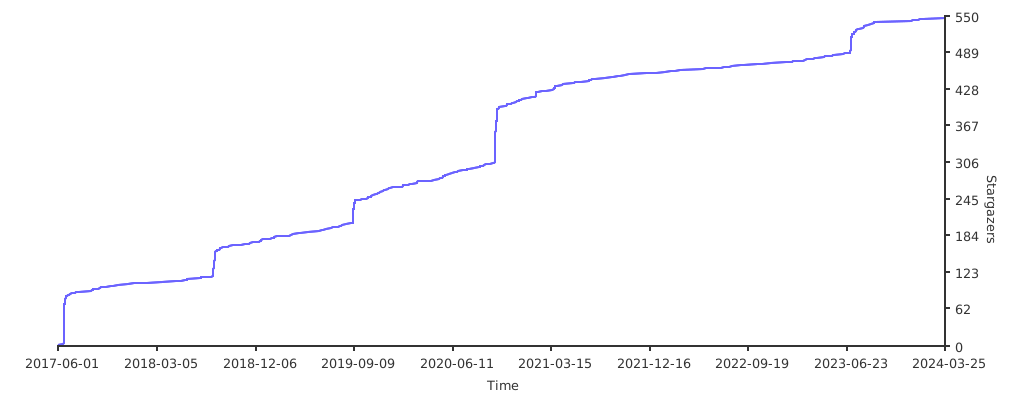
Stargazers over time