
canship
v0.7.1
Published
Static scanner for exposed credentials, open access rules, and unsafe request input in JS/TS web apps. Scans local files without executing project code or making network requests.

Maintainers
 tasomei
Readme
canship
A local static scanner for JavaScript and TypeScript web apps. Checks exposed credentials, access-control configuration, and unsafe request-input flows. No project-code execution, uploads, or network requests during scanning.
Documentation for
0.7.1. Check the installed version withnpx canship --version.
Quick start
npx canshipScans the current directory or a specified path. Requires Node.js ≥18; no runtime dependencies. Installation may use the network. Git checks cover locally tracked files and commit history without contacting remotes; inaccessible history marks coverage incomplete.
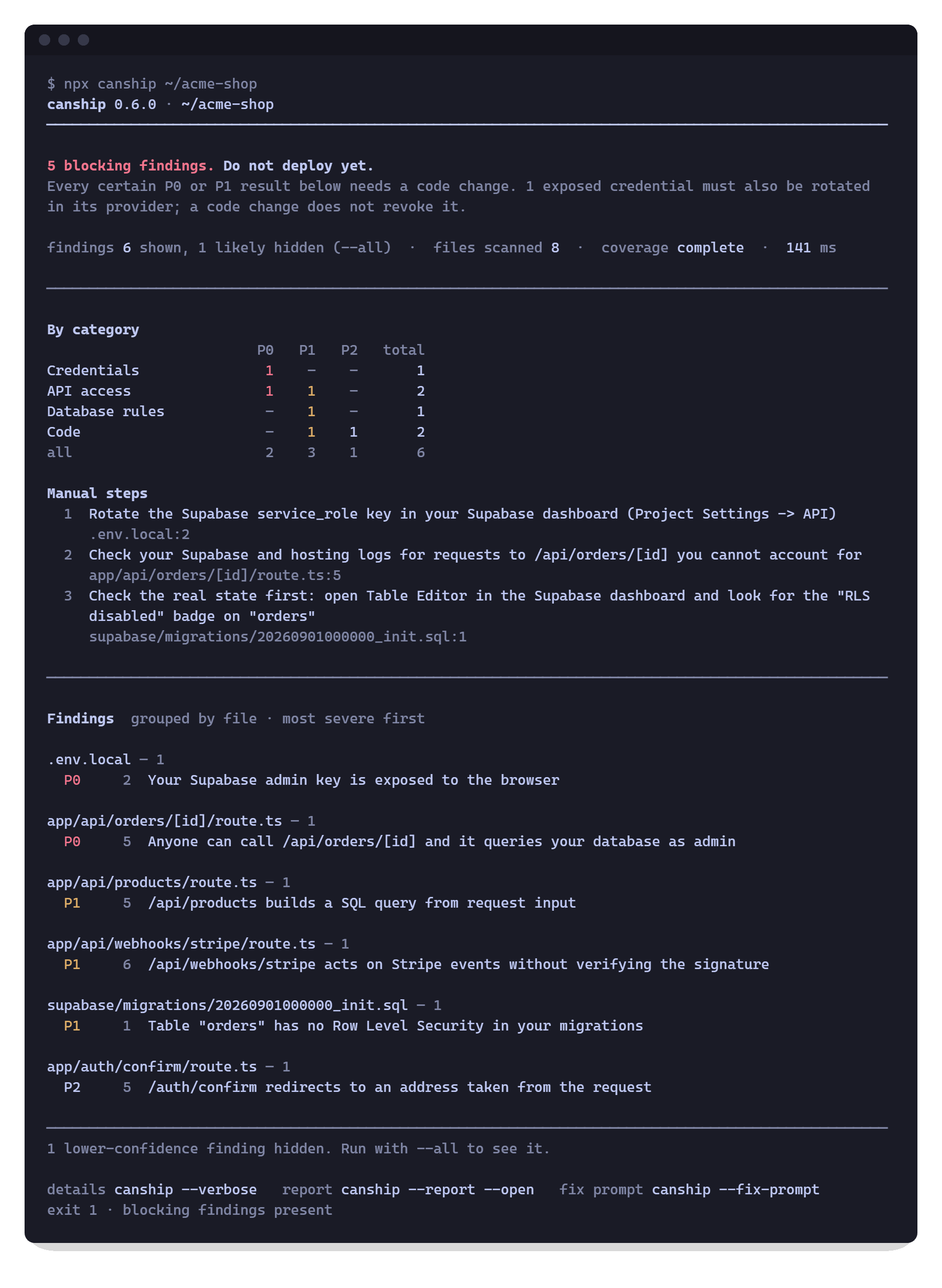
Output examples use sample data from a pre-release development build.
Checks
| Category | Severity | Scope |
|---|:---:|---|
| Credentials | P0 | Hardcoded keys, private keys, password-bearing database URLs, public env exposure, Supabase admin keys, non-template .env files tracked by Git or present in history |
| API access | P0/P1 | Database operations without recognised authentication, server-side trust in Supabase getSession(), unverified Stripe webhooks |
| Database rules | P1/P2 | Supabase tables without RLS, unconditional policies, public object listing in storage buckets; Firebase open rules and time-limited test rules |
| CORS | P1/P2 | Reflected or wildcard origins with credentials |
| Request input | P1/P2 | Request input in SQL or command construction, caller-chosen request hosts and redirect targets |
Credential formats include OpenAI, Anthropic, AWS, Stripe, GitHub, and npm. Firebase covers Firestore, Storage, and Realtime Database. --list-rules lists rule IDs, scope, and limitations.
Server entry points
| Framework | Entry points |
|---|---|
| Next.js | App Router handlers, Pages Router /api, 'use server' functions |
| SvelteKit | +server endpoints and +page.server form actions |
| Nuxt | server/api, server/routes |
| Remix / React Router | loader and action exports in app/routes |
| Astro | Endpoints in src/pages |
| Express | app/Router routes, including .route() chains, mounted routers, and controllers in other files |
| Hono | app.get()-style routes, chains, basePath, and sub-apps mounted with app.route() |
| Fastify | Shorthand and route() declarations, register() prefixes and encapsulation, @fastify/autoload directories |
Recognised Next.js/Astro middleware may suppress covered auth findings; Server Functions need local checks. Express/Hono/Fastify require resolved rejection logic or known auth libraries. Fastify decorator and plugin evidence is scoped to the local instance.
Session checks and webhook verification (Stripe, Polar, Clerk, Svix, QStash) must reject failures; asynchronous calls must be awaited or returned. Indirect evidence from project helpers/wrappers, SvelteKit hooks, or Nuxt middleware may lower confidence. Unresolved auth sources do not suppress findings.
Input analysis follows assignments, destructuring, string construction, and resolvable cross-file passthrough helpers. Helper names alone do not prove sanitisation.
For Express, Hono, and Fastify routes, writes inside called project functions are followed two levels (handler → service → model); file-based routes report writes in the route file only. SvelteKit page loads, remote functions, and Hono app.openapi() routes are outside route analysis. Content-based checks, including credentials and CORS, still apply.
Results
Reports are in English. The terminal groups findings by file; --verbose adds excerpts, explanations, evidence, and fixes. HTML is a self-contained offline report with filters, grouping, manual steps, and copyable fix prompts.
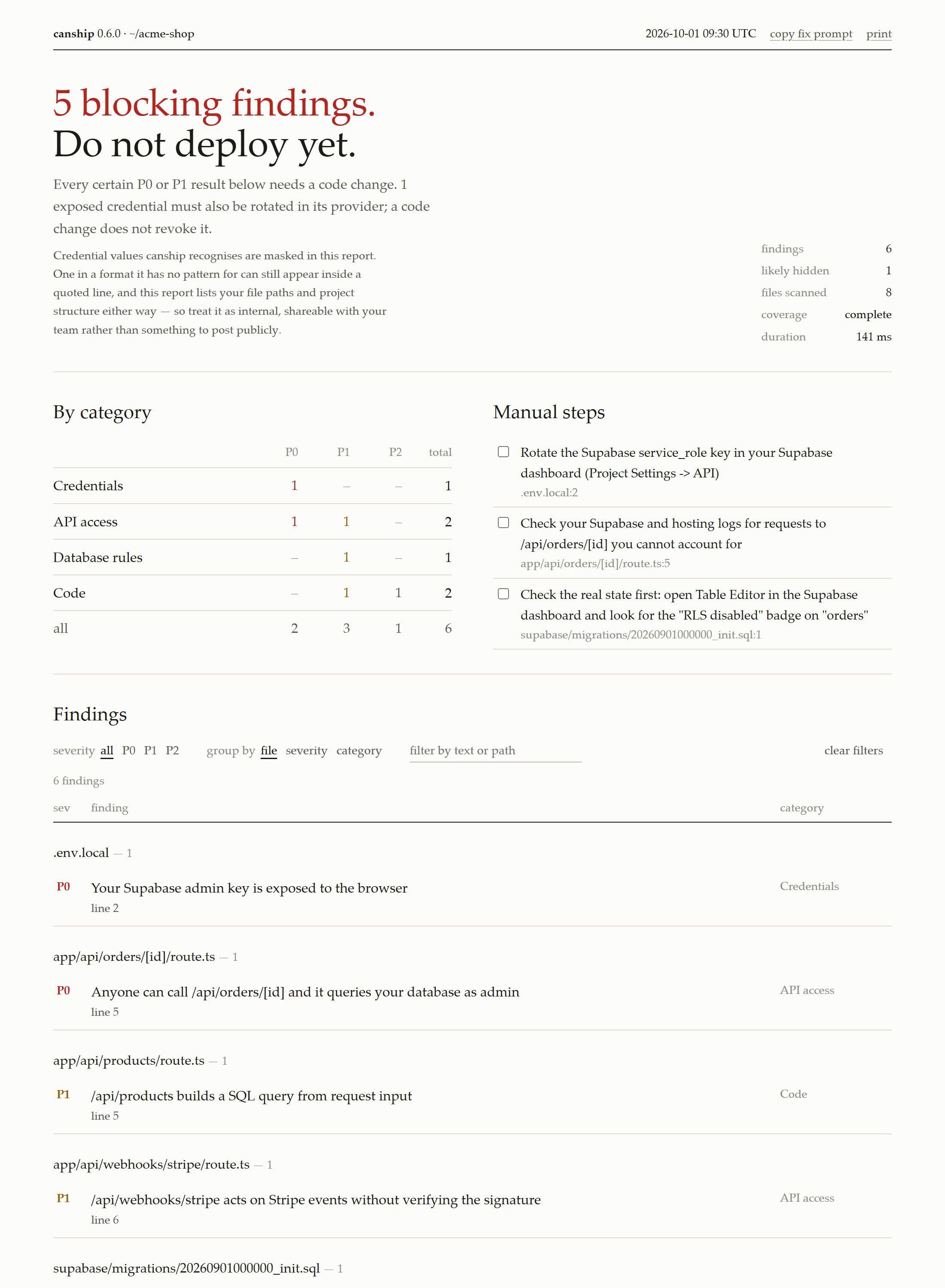
certain indicates strong static evidence; likely requires review. Findings in tests and examples are downgraded to likely. Default output shows only certain; --all includes both. Confidence reflects static evidence, not credential validity or runtime verification.
| Exit | Meaning |
|---|---|
| 0 | No findings; coverage complete or accepted with --best-effort |
| 1 | At least one certain P0/P1 finding |
| 2 | Other findings, including hidden likely results |
| 3 | Invalid arguments, tool error, or unaccepted incomplete coverage |
Status is calculated after rule selection, ignore comments, and baselines. Findings take precedence over incomplete coverage; --best-effort never changes 1 or 2.
CLI
npx canship [path] [options]
| Option | Effect |
|---|---|
| -a, --all | Include likely findings |
| --verbose | Expand terminal findings |
| --report[=file] | Write HTML; default canship-report.html |
| --open | Open --report output; disabled in CI and non-interactive shells |
| --json | Print JSON |
| --sarif[=file] | Write SARIF 2.1.0; default canship.sarif |
| --fix-prompt | Print repair instructions and separate manual actions |
| --no-excerpts | Remove excerpts from all reports |
| --changed-since=ref | Show changed-file findings; preserve full-scan status |
| --only=ids / --skip=ids | Select/exclude rules or namespaces; comma-separated, repeatable |
| --list-rules | List rules without scanning; supports --json |
| --baseline[=file] / --baseline-write[=file] | Suppress/record findings; default canship-baseline.json |
| --no-config / --no-ignore-markers | Ignore project configuration/source suppression comments |
| --best-effort | Allow incomplete coverage with no findings to exit 0 |
| -h, --help / -v, --version | Show help/version |
--json and --fix-prompt are mutually exclusive; either supports HTML and SARIF output.
--changed-since compares the local merge base with the working tree, including non-ignored untracked files. It does not fetch or narrow scan scope. Missing Git, refs, or shared history exits 3; it cannot be combined with --baseline-write.
Configuration
canship.config.json accepts baseline, only, skip, and all. CLI options take precedence; only and skip are mutually exclusive.
{ "skip": ["cors/wildcard-with-credentials"], "all": false }A standalone canship-ignore-file comment excludes a file. canship-ignore-next-line [rule] suppresses the next line, optionally for one rule. Exclusions are disclosed and may reduce status to 0 without marking coverage incomplete. For untrusted projects, use --no-config --no-ignore-markers.
Baselines accept existing findings without fixing them. Format v2 tolerates line moves but reports credential changes.
Default paths are relative to the scan directory; explicit paths are relative to the working directory. Read/write modes are mutually exclusive. Missing, invalid, or v1 baselines exit 3. A successful write exits 0, with a warning for incomplete or selective scans.
GitHub Action
Save as .github/workflows/canship.yml:
name: canship
on: [push, pull_request]
permissions:
  contents: read
jobs:
  scan:
    runs-on: ubuntu-latest
    steps:
      - uses: actions/checkout@d23441a48e516b6c34aea4fa41551a30e30af803
        with:
          fetch-depth: 0
          persist-credentials: false
      - uses: Tasomei/canship@7465c9560b8b3692777af080e8cc67b4be2335d7
        with:
          version: '0.7.1'
          honor-ignore-markers: false
The commit hash pins the Action implementation; version selects the npm scanner, not development-branch source. The Action uses Node.js 22, does not install or run project dependencies, and writes a counts-only summary.
| Input | Default | Meaning |
|---|---|---|
| version | 0.7.0 | Exact npm scanner version |
| fail-on | blocking | blocking: certain P0/P1; any: all findings; none: report only |
Incomplete scans and tool errors always fail. Project configuration and SARIF upload are disabled by default. Inputs and outputs: action.yml.
SARIF upload requires security-events: write and code scanning support; fork PRs may lack permission. Review reports before upload. Use pull_request, not pull_request_target, for untrusted PRs.
API and structured output
import { scan, summarize } from 'canship'

const result = await scan('./my-app', { noExcerpts: true })
console.log(summarize(result))
scan() returns all confidence levels. Options: only, skip, honorIgnoreMarkers (default true), noExcerpts (default false). It does not load configuration, apply baselines, write reports, or set process exit status. Invalid arguments throw. listRules() returns the rule catalogue.
JSON uses schemaVersion 1. Check partial, errors, skipped, and filesScanned independently of exit status. SARIF includes evidence locations and execution diagnostics.
Privacy and limits
- Static checks may miss issues or flag intentional configurations. Business authorisation, rate limiting, dependency vulnerabilities, and deployed settings are not verified.
- Redaction covers recognised formats only. Unknown secrets may remain in excerpts;
--no-excerptsomits excerpts. Paths, names, and baseline descriptions remain visible. - Google/Firebase/Maps
AIza…keys are treated as public identifiers, not leak evidence alone. Supabase checks use local migrations and supported bucket configuration. - Evaluation snapshot downloads and optional SARIF uploads may use the network.
- Symbolic links are not followed; nested repositories and submodules need separate scans. In-scope skipped paths and analysis limits mark coverage incomplete; auth helper resolution limits are noted on the affected finding instead, because they cannot hide findings. Dependency and build directories excluded by default do not count as coverage gaps.
| Limit | Bound | |---|---| | File reads | 2 MiB per file; 128 MiB and 10,000 files per scan, including probes | | Directory discovery | 50,000 entries; 16 levels | | Findings | 100 per file, prioritising severity and confidence | | Git history | 100 relevant revisions per file; 30 seconds per command | | Auth helper resolution | 8 hops; 64 symbols per helper, 1,024 per route file | | Delegated writes | 2 call levels; 256 callees per file; writes beyond these limits are not reported | | Identity/control flow | 8 value hops; 4,000 expression characters; 512 assignments/regions per function; 8 nested regions | | Request-input tracking | 8 value hops; 512 assignments/regions; 64 KiB per expression; 8 URL-analysis levels; 200 static-prefix characters | | Supabase policy/bucket parsing | 4,000 characters per statement |
Evidence traces are capped at 24 steps and disclose truncation.
Development
npm cinpm run prepublishOnlynpm run test:packagenpm run evaluateNew rules require positive and negative fixtures. Pinned project evaluation: manifest, fetch script, evaluator. Passing samples do not establish real-world detection rates.
License
MIT. Supabase/Firebase fixtures retain Apache-2.0; Next.js/cors fixtures retain MIT.