
claude-sidecar
v0.5.2
Published
A parallel AI window for Claude Code. Fork conversations to Gemini, GPT, DeepSeek, or any model via OpenRouter, then fold results back.

Maintainers
 jrenaldi
Readme
Claude Sidecar
A parallel AI window that shares your context. Talk to any model while your main session keeps working.

Sidecar opens a real UI alongside Claude Code or Cowork, pre-loaded with your conversation context, connected to Gemini, GPT, DeepSeek, Qwen, Grok, or any other model. You interact with the sidecar in parallel (fact-check Claude's work, get a second opinion, explore a tangent) then fold the results back when you're ready.
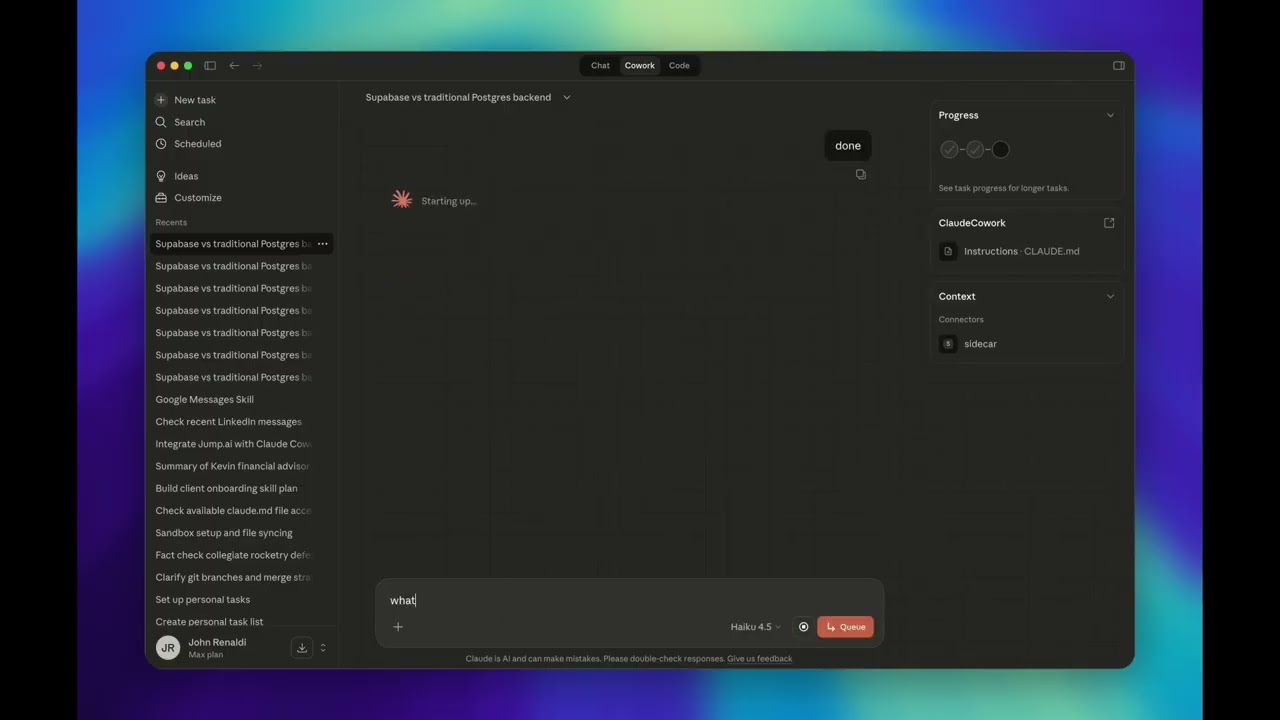
Supported clients: Claude Code CLI and Claude Cowork are fully tested and supported. Claude Code web and Claude Desktop are experimental.






Table of Contents
- What Is Sidecar?
- Use Cases
- Getting Started
- Quick Start
- How It Works
- Features
- Commands
- Agent Modes
- Models
- MCP Integration
- Configuration
- Understanding Sidecar Output
- Troubleshooting
- Documentation
- Contributing
- Built On
- License
What Is Sidecar?
Sidecar is a literal second window that runs alongside your Claude Code or Cowork session. It:
- Shares your context. Your current conversation history is automatically extracted and passed to the sidecar. No copy-pasting, no re-explaining.
- Runs in parallel. Your main Claude session keeps working while you interact with the sidecar. It's not sequential, it's simultaneous.
- Connects to any model. Gemini 3.1 Pro (1M context), GPT-5.4, DeepSeek v3.2, Qwen, Grok: whatever's best for the job.
- Folds back cleanly. When you're done, click FOLD and a structured summary returns to your main context. No noise, just results.

Use Cases
Fact-Check Claude's Work
Claude just proposed an architecture or made a claim? Open a sidecar to a different model and verify it, with full context already loaded.
Get a Second Opinion on a Feature
Designing something complex? Fork the conversation to Gemini or GPT-5.4 for an independent take. Compare approaches before committing to one.
Deep-Dive Without Polluting Context
Need to explore a rabbit hole (trace a bug, read a huge file, research an API)? Do it in the sidecar. Your main session stays clean and focused.
Parallel Investigation
While Claude implements a fix, spin up a sidecar to review the test coverage, audit security implications, or draft documentation, all at the same time.
Leverage Model Strengths
- Gemini 3.1 Pro: 1M token context for analyzing entire codebases
- GPT-5.4: Strong at code generation and refactoring
- DeepSeek v3.2: Cost-effective reasoning at scale
- Qwen 3.5: High-quality open-weight reasoning
- Grok: Fast iteration and broad knowledge
Getting Started
Prerequisites
- Node.js 18+
1. Install
npm install -g claude-sidecarOn install, sidecar automatically configures itself for all supported clients:
- Claude Code CLI: Registers an MCP server and installs a Skill, so Claude can launch and manage sidecars on your behalf
- Claude Desktop & Cowork: Registers an MCP server, so sidecar tools appear natively in the UI
No manual registration needed. Just install and run setup.
2. Run Setup
sidecar setupThis launches a graphical setup wizard that walks you through everything:
| Step | What It Does |
|------|-------------|
| 1. API Keys | Enter keys for OpenRouter, Google, OpenAI, and/or Anthropic. Each key is validated live against the provider's API. Keys are stored locally at ~/.config/sidecar/.env with restricted permissions (0600). |
| 2. Default Model | Choose your go-to model from 20+ aliases (Gemini, GPT, Opus, DeepSeek, Qwen, Grok, and more). This is what sidecar uses when you omit --model. |
| 3. Model Routing | Configure which provider serves each model. If you have both an OpenRouter key and a direct Google key, you can route Gemini through Google directly and everything else through OpenRouter. |
| 4. Review | Summary of your configuration before saving. |
Headless environments: If Electron isn't available, the wizard falls back to a readline-based setup in the terminal.
You can also manage individual settings without re-running the full wizard:
sidecar setup --add-alias fast=openrouter/google/gemini-3.1-flash-lite-preview3. Verify
sidecar start --model gemini --prompt "Hello, confirm sidecar is working"A window should open alongside your editor with Gemini ready to chat, pre-loaded with your Claude Code context.
Quick Start
# Fact-check: open a sidecar to verify Claude's approach
sidecar start --model gemini --prompt "Fact-check the auth approach Claude just proposed"

# Second opinion: get a different model's take
sidecar start --model gpt --prompt "Review this feature design. Is there a simpler approach?"

# Deep dive: investigate without polluting your main context
sidecar start --model gemini-pro --prompt "Analyze the entire codebase architecture"

# Headless: autonomous, no UI, summary returns automatically
sidecar start --model gemini --prompt "Generate Jest tests for src/utils/" --no-ui

# Use your configured default model (just omit --model)
sidecar start --prompt "Security review the payment module"
How It Works
- Context sharing. Sidecar reads your Claude Code session from
~/.claude/projects/[project]/[session].jsonland passes it to the sidecar model automatically. - Window launch. An Electron window opens alongside your editor with the sidecar UI (OpenCode-powered).
- Parallel interaction. You converse with the sidecar model while your main Claude session continues working independently.
- Fold. Click FOLD (or press
Cmd+Shift+F) to generate a structured summary. - Context return. The summary flows back into your Claude Code context for Claude to act on.
The Electron shell uses a BrowserView architecture: the OpenCode web UI loads in a dedicated viewport, while the sidecar toolbar (branding, timer, Fold button) renders in the bottom 40px. No CSS conflicts with the host app.

Features
Interactive + Headless Modes
Interactive (default): Opens a window alongside Claude Code. You converse with the sidecar, steer the investigation, then click FOLD to generate a structured summary. Switch models mid-conversation without restarting.
Headless (--no-ui): The agent works autonomously in the background. When done, outputs a [SIDECAR_FOLD] summary automatically. Ideal for bulk tasks: test generation, documentation, linting.
Context Passing
Your conversation history is automatically shared with the sidecar. No re-explaining needed. Filter by turns (--context-turns) or time window (--context-since 2h).
Adaptive Personality
Sidecar detects its launch context and adapts:
- From Claude Code (
--client code-local): Engineering-focused (debug, implement, review) - From Cowork (
--client cowork): General-purpose (research, analyze, write, brainstorm)
MCP Server Inheritance
Sidecar automatically discovers MCP servers configured in your Claude Code session (~/.claude.json) and passes them through to the sidecar's OpenCode instance. Your sidecar has access to the same tools you do. Control this with:
--no-mcpdisables MCP inheritance entirely--exclude-mcp <name>excludes specific servers (repeatable)--mcp name=urladds additional servers
Safety Features
- Conflict detection: Warns when files changed externally while the sidecar was running
- Drift awareness: Indicates when the sidecar's context may be stale relative to your current session
- Pre-flight validation: All CLI inputs are validated before anything launches
Auto-Update
Sidecar checks the npm registry for updates once every 24 hours (cached, zero-latency background check). When an update is available:
- CLI: A notification box appears in your terminal after any command
- Electron UI: A banner appears above the toolbar with a one-click Update button. No terminal commands needed.
Updating installs the latest code and re-runs the postinstall step, so your Claude Code Skill file and MCP registrations are always kept in sync with the latest version. No manual re-registration needed.
# Or update manually from the CLI
sidecar update
Session Persistence
Every sidecar is persisted. List past sessions, read their summaries, reopen them, or chain them together.
sidecar list                           # See all past sidecars
sidecar read abc123                    # Read the summary
sidecar resume abc123                  # Reopen the exact session
sidecar continue abc123 --prompt "..." # New session building on previous findings
MCP Integration
Full MCP server for Claude Desktop and Cowork. Sidecar tools appear natively inside Cowork's sandboxed environment. No CLI required.
Commands
sidecar start: Launch a Sidecar
sidecar start --model <model> --prompt "<task>"| Option | Description | Default |
|--------|-------------|---------|
| --model | Model to use (alias or full string) | Config default |
| --prompt | Task description | (required) |
| --no-ui | Headless autonomous mode | false |
| --agent | Agent mode: chat, plan, build | chat |
| --timeout | Headless timeout in minutes | 15 |
| --context-turns N | Max conversation turns to include | 50 |
| --context-since | Time filter: 30m, 2h, 1d | |
| --context-max-tokens N | Context size cap | 80000 |
| --no-context | Skip parent conversation context | false |
| --thinking | Reasoning effort: none minimal low medium high xhigh | medium |
| --summary-length | Output verbosity: brief normal verbose | normal |
| --session-id | Explicit Claude Code session ID | Most recent |
| --mcp | Add MCP server: name=url or name=command | |
| --mcp-config | Path to opencode.json with MCP config | |
| --no-mcp | Don't inherit MCP servers from parent | false |
| --exclude-mcp | Exclude specific MCP server (repeatable) | |
| --client | Client context: code-local cowork (code-web experimental) | code-local |
sidecar list: Browse Past Sessions
sidecar list                    # Current project
sidecar list --status complete  # Completed only
sidecar list --all              # All projects
sidecar list --json             # JSON output
sidecar resume: Reopen a Session
sidecar resume <task_id>Reopens the exact OpenCode session with full conversation history preserved.
sidecar continue: Build on Previous Work
sidecar continue <task_id> --prompt "Now implement the fix from the analysis"Starts a new session with the previous session's conversation as read-only background context. Optionally switch models.
sidecar read: Read Session Output
sidecar read <task_id>                  # Summary (default)
sidecar read <task_id> --conversation   # Full conversation
sidecar read <task_id> --metadata       # Session metadata
sidecar abort: Stop a Running Session
sidecar abort <task_id>Immediately stops a running sidecar session. The session status changes to aborted.
sidecar setup: Configure Sidecar
sidecar setup                                           # Full setup wizard (GUI)
sidecar setup --add-alias fast=openrouter/google/gemini-3.1-flash-lite-preview
Opens the graphical setup wizard for API keys, default model, model routing, and aliases. See Getting Started for details.
sidecar update: Update to Latest Version
sidecar updateUpdates sidecar to the latest npm release. In the Electron UI, click the Update button in the banner instead. No terminal needed.
Agent Modes
Three primary modes control what the sidecar can do autonomously:
| Agent | Reads | Writes/Bash | Best For | |-------|-------|-------------|----------| | Chat (default) | Auto-approved | Asks permission | Questions, analysis, fact-checking, guided exploration | | Plan | Auto-approved | Blocked entirely | Code review, architecture analysis, security audits | | Build | Auto-approved | Auto-approved | Implementation tasks, test generation, headless batch work |
# Chat: good for fact-checking and analysis with human-in-the-loop (default)
sidecar start --model gemini --prompt "Verify Claude's approach to the auth refactor"

# Plan: strict read-only, no changes possible
sidecar start --model gemini --agent Plan --prompt "Security review of the payment module"

# Build: full autonomy, use when you explicitly want it to write code
sidecar start --model gemini --agent Build --no-ui \
  --prompt "Generate comprehensive Jest tests for src/utils/"
Headless mode note:
--no-uidefaults toBuild. TheChatagent requires interactive UI for write permissions and stalls in headless mode.
Models
Using Aliases (after sidecar setup)
| Alias | Model | Notes |
|-------|-------|-------|
| gemini | Gemini 3.1 Flash Lite | Fast, cost-effective |
| gemini-pro | Gemini 3.1 Pro | Deep analysis, 1M context |
| gpt | GPT-5.4 | Code generation, refactoring |
| gpt-pro | GPT-5.4 Pro | Extended reasoning |
| codex | GPT-5.3 Codex | Code-specialized |
| claude / sonnet | Claude Sonnet 4.6 | Balanced capability |
| opus | Claude Opus 4.6 | Complex reasoning |
| haiku | Claude Haiku 4.5 | Fast, lightweight |
| deepseek | DeepSeek v3.2 | Cost-effective reasoning |
| qwen | Qwen 3.5 397B | High-quality open-weight |
| qwen-coder | Qwen 3 Coder | Code-specialized |
| qwen-flash | Qwen 3.5 Flash | Fast inference |
| mistral | Mistral Large | Strong European model |
| devstral | Devstral | Code-focused Mistral |
| grok | Grok 4.1 Fast | Fast iteration |
| kimi | Kimi K2.5 | Multilingual |
| glm | GLM-5 | Chinese-English bilingual |
| minimax | MiniMax M2.5 | Multimodal |
| seed | Seed 2.0 Mini | Lightweight |
| (omit --model) | | Your configured default |
Using Full Model Strings
| Access | Format | Example |
|--------|--------|---------|
| OpenRouter | openrouter/provider/model | openrouter/google/gemini-3.1-pro-preview |
| Direct Google | google/model | google/gemini-3.1-flash-lite-preview |
| Direct OpenAI | openai/model | openai/gpt-5.4 |
| Direct Anthropic | anthropic/model | anthropic/claude-opus-4-6 |
The prefix determines which credentials are used. Model names evolve; verify current names:
curl https://openrouter.ai/api/v1/models | jq '.data[].id' | grep -i geminiMCP Integration
For Claude Desktop and Cowork, sidecar exposes a full MCP server auto-registered on install.
To register manually:
claude mcp add-json sidecar '{"command":"npx","args":["-y","claude-sidecar@latest","mcp"]}' --scope user| MCP Tool | Description |
|----------|-------------|
| sidecar_start | Spawn a sidecar (returns task ID immediately) |
| sidecar_status | Poll for completion |
| sidecar_read | Get results: summary, conversation, or metadata |
| sidecar_list | List past sessions |
| sidecar_resume | Reopen a session |
| sidecar_continue | New session building on previous |
| sidecar_abort | Stop a running session |
| sidecar_setup | Open setup wizard |
| sidecar_guide | Get usage instructions |
Async pattern: sidecar_start returns a task ID immediately. Poll with sidecar_status, then read results with sidecar_read. This is non-blocking: the calling agent can do other work while the sidecar runs.
Configuration
Environment Variables
| Variable | Description | Default |
|----------|-------------|---------|
| OPENROUTER_API_KEY | API key for OpenRouter (multi-model access) | (required) |
| GOOGLE_GENERATIVE_AI_API_KEY | Direct Google API key (bypasses OpenRouter) | |
| OPENAI_API_KEY | Direct OpenAI API key | |
| ANTHROPIC_API_KEY | Direct Anthropic API key | |
| LOG_LEVEL | Logging verbosity: error warn info debug | error |
| SIDECAR_CONFIG_DIR | Override config directory | ~/.config/sidecar |
| SIDECAR_ENV_DIR | Override .env file directory | |
| SIDECAR_TIMEOUT | Default headless timeout in minutes | 15 |
| OPENCODE_COMMAND | Override OpenCode binary path | opencode |
API keys configured via sidecar setup are stored in ~/.config/sidecar/.env with restricted permissions (0600). You can also set them as environment variables directly.
Understanding Sidecar Output
Every fold produces a structured summary:
## Sidecar Results: [Title]

**Context Age:** [How stale the context might be]
**FILE CONFLICT WARNING** [If files changed while the sidecar ran]

**Task:** What was requested
**Findings:** Key discoveries
**Attempted Approaches:** What was tried but didn't work
**Recommendations:** Concrete next steps
**Code Changes:** Specific diffs with file paths
**Files Modified:** List of changed files
**Assumptions Made:** Things to verify
**Open Questions:** Remaining uncertainties
Troubleshooting
| Issue | Cause | Solution |
|-------|-------|---------|
| command not found: opencode | OpenCode binary not found | Reinstall: npm install -g claude-sidecar (opencode-ai is bundled) |
| 401 Unauthorized / auth errors | API key missing or wrong provider prefix | Run sidecar setup to configure keys, or verify openrouter/... prefix matches your credentials |
| Headless stalls silently | Chat agent in headless mode | Use --agent build, not --agent chat in headless mode |
| Session not found | No matching session ID | Run sidecar list, or omit --session-id to use most recent |
| No conversation history found | Project path encoding | Check ls ~/.claude/projects/. / and _ are encoded as - in path |
| Headless timeout | Task too complex for default timeout | Increase with --timeout 30 |
| Summary corrupted | Debug output leaking to stdout | Use LOG_LEVEL=debug to diagnose |
| Multiple active sessions | Ambiguous session resolution | Pass --session-id explicitly |
| Setup wizard won't open | Electron not available | Falls back to terminal setup automatically; ensure electron is in dependencies |
Debug logging:
LOG_LEVEL=debug sidecar start --model gemini --prompt "test" --no-uiDocumentation
| Doc | Description | |-----|-------------| | SKILL.md | Complete skill reference for Claude Code | | Electron Testing | Chrome DevTools Protocol patterns for UI testing | | Agentic Evals | End-to-end eval system for testing LLM interactions with sidecar |
Contributing
Contributions are welcome!
git clone https://github.com/jrenaldi79/claude-sidecar.git
cd claude-sidecar
npm install
npm test
Autonomous UI Testing via Chrome DevTools Protocol
Sidecar uses a novel approach for testing Electron UI features: instead of fragile DOM mock tests, we verify the real UI by connecting to the running Electron app via the Chrome DevTools Protocol (CDP).
How it works:
- Launch sidecar with
SIDECAR_DEBUG_PORT=9223(avoids conflict with Chrome on 9222) - Use
SIDECAR_MOCK_UPDATE=availableor other mock env vars to force specific UI states - Connect to
http://127.0.0.1:9223/jsonto discover debug targets - Execute JavaScript in the Electron renderer via WebSocket to inspect DOM state
- Take a screenshot with
screencaptureto visually verify
# Launch with mock update banner and debug port
SIDECAR_MOCK_UPDATE=available SIDECAR_DEBUG_PORT=9223 \
  sidecar start --model gemini --prompt "test"

# Find the toolbar page
TOOLBAR_ID=$(curl -s http://127.0.0.1:9223/json | \
  node -e "const d=require('fs').readFileSync(0,'utf8'); \
  const p=JSON.parse(d).find(p=>p.url?.startsWith('data:')); \
  console.log(p?.id||'NOT_FOUND')")

# Inspect toolbar state (update banner, buttons, timer)
node -e "
const WebSocket = require('ws');
const ws = new WebSocket('ws://127.0.0.1:9223/devtools/page/$TOOLBAR_ID');
ws.on('open', () => ws.send(JSON.stringify({
  id: 1, method: 'Runtime.evaluate',
  params: { expression: '({banner: document.getElementById(\"update-banner\")?.style?.display, text: document.getElementById(\"update-text\")?.textContent})', returnByValue: true }
})));
ws.on('message', d => { const m=JSON.parse(d.toString()); if(m.id===1){console.log(JSON.stringify(m.result?.result?.value,null,2));ws.close();process.exit(0);} });
setTimeout(() => { ws.close(); process.exit(0); }, 3000);
"
This approach tests real rendering in a real Electron window, not mocked DOM behavior. See docs/electron-testing.md for the full reference.
Built On
Sidecar is a harness built on top of OpenCode, the open-source AI coding engine. OpenCode provides the conversation runtime, tool execution framework, agent system, and web UI. Sidecar adds context sharing from Claude Code, the Electron shell, fold/summary workflow, session persistence, and multi-client support (CLI, MCP, Cowork). We don't reinvent the wheel. OpenCode handles the hard parts of LLM interaction so Sidecar can focus on the parallel-window workflow.
License
MIT. John Renaldi