
claudecodex-cli
v1.0.18
Published
Manage multiple Codex and Claude Code logins as named sessions, with a live sticky dashboard of remaining 5-hour and weekly limits.

Maintainers
 nomi9995
Readme
Claude / Codex Session Manager — Switch & Borrow Accounts
One keystroke to switch between all your Codex and Claude Code logins, see which account still has quota — and borrow a friend's Codex / Claude without ever knowing their password.


Both Codex and Claude Code keep only one active login at a time — log into a second account and the first is signed out. If you juggle multiple ChatGPT/Claude subscriptions (your own, a teammate's, a friend's), you're constantly re-logging in and losing your place.
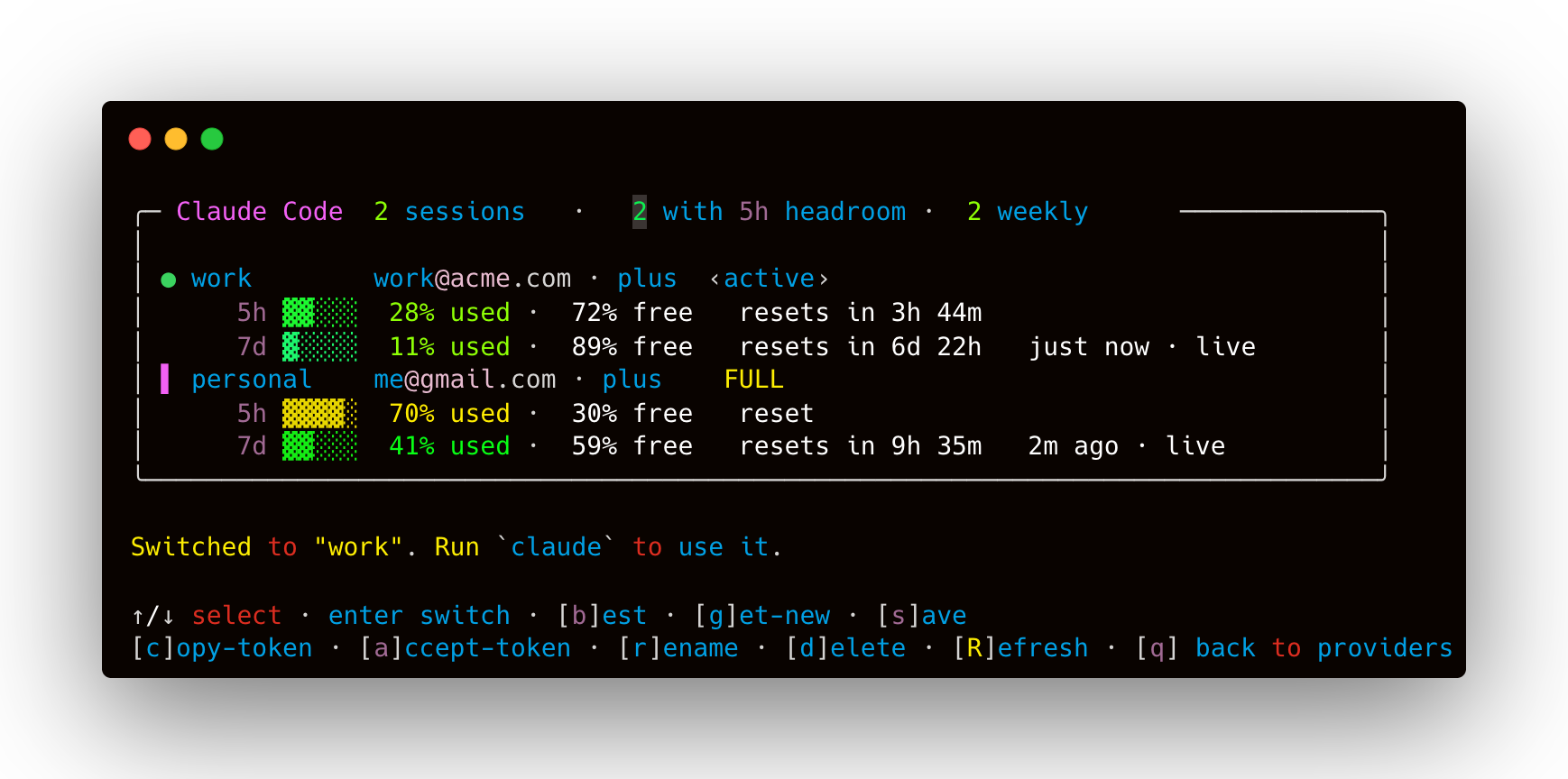
claudecodex saves each login as a named session, lets you switch between them instantly, and shows a live dashboard of every account's remaining 5-hour and weekly limits — read straight from each provider's own usage API, so you see real numbers without switching first.
It can also borrow Codex / Claude from a friend: send them a link, they tap "Authorise" in their browser, and a scoped coding-tool token lands on your machine — without you ever getting their password or account access.
Install
No install (recommended to try):
npx claudecodex-cliGlobal install — then use the short ccx command anywhere:
npm install -g claudecodex-cli
ccx
Installed globally,
ccxchecks npm for a newer version on startup and offers to update (you confirm; it never updates silently). Opt out withCLAUDECODEX_NO_UPDATE=1.
Requires Node ≥ 18. macOS and Linux. (Claude support reads the macOS Keychain / Claude's
credentials file; Codex reads ~/.codex/auth.json.)
Quick start
ccx # pick Codex or Claude, then manage interactively- Log into an account the normal way (
codex login, or sign in to Claude Code). - In
ccx, press s to save it as a session (e.g.work). - Repeat for your other accounts.
- Press b to jump to whichever account has the most quota — then run
codex/claude.
Commands
Interactive (run ccx, or ccx codex / ccx claude):
| Key | Action |
|----:|--------|
| ↑/↓ enter | select / switch to a session |
| b | switch to the best session (most 5h headroom, skips exhausted) |
| g | get a new session — browser sign-in for another account |
| s | save the current login as a session |
| c | copy the selected session's token to the clipboard (to share) |
| a | accept a token from the clipboard (paste a shared one in) |
| r | remote link — generate a guide page your friend opens to share their session |
| n d R | rename · delete · refresh live limits |
| q | back to provider chooser (or quit) |
Scriptable (ccx <codex|claude> <command>):
ccx codex ls                     # dashboard with live limits
ccx codex save work              # save current login
ccx codex use work               # switch active login
ccx codex best                   # switch to the account with most quota
ccx claude refresh               # refresh every session's live limits
ccx codex get-session alice      # browser login → save a new account
ccx codex share work tok.txt     # write a shareable token file
ccx codex set work             # save a token from the clipboard (or pass it / @file / stdin)
ccx codex rename work old        # rename / delete
ccx codex delete old
ccx codex remote                 # generate a remote guide link for a friend
ccx claude remote                # same for Claude
Borrow Codex / Claude from a friend — without their password
If a friend has a ChatGPT Plus or Claude Pro subscription but doesn't use Codex / Claude Code themselves, you can borrow their session in seconds. You never get their password, email login, or account access — they simply authorise the coding tool in their own browser and a scoped OAuth token lands on your machine. Their ChatGPT/Claude conversations, account settings, and credentials stay completely private.
One-time setup (you): get a free ngrok account and set your authtoken:
export NGROK_AUTHTOKEN=your_token_here # add to ~/.zshrc to make it permanentEvery time:
- In the TUI press
r(or runccx codex remote/ccx claude remote).
A link is copied to your clipboard — send it to your friend on WhatsApp, iMessage, etc. - Friend opens the link on any device. They see a 3-step guide that first explains exactly
what is shared (the coding-tool access only) and what stays private (chats, account, password):
Step 1 — tap “Authorise Codex / Claude Code Access” and sign in on the provider's own page
Step 2 — copy what the provider shows after signing in. The guide includes a screenshot of exactly what to look for:
Codex — the browser lands on a
localhost:1455error page; they copy the URL from the address bar:
Claude — Anthropic shows an Authentication Code page; they tap Copy Code:
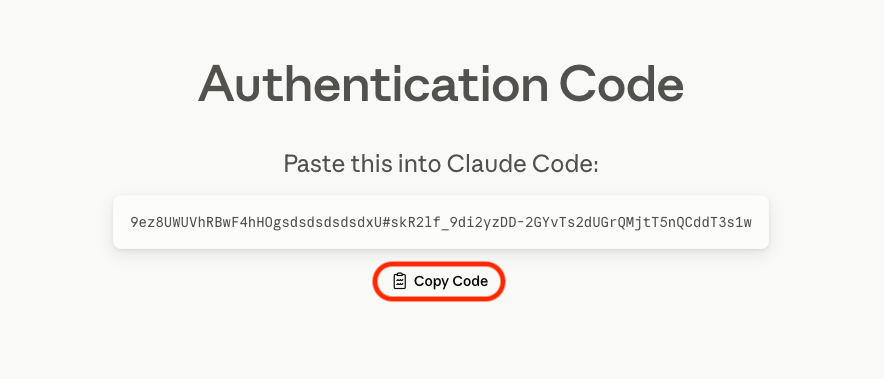
Step 3 — paste it into the form on the guide page and hit Submit
- The token lands on your machine automatically. The session is saved and named after their email. Friend sees “✅ All done!” and closes the page.
⚠️ A token grants full access to that account. Share only over trusted channels.
⚠️ One live session per account: the provider ends the previous session when the same account signs in again elsewhere. If a borrowed session shows “session ended,” re-run
get-sessionor ask your friend to useremoteagain. Different accounts coexist fine.
Borrowing a session the manual way (no ngrok)
If you'd rather not use ngrok, you can still share sessions via token blobs:
# Friend runs:
ccx codex get-session            # browser login → prints a one-line token blob

# You run:
ccx codex set alice              # reads from clipboard (or @file / piped stdin)
ccx codex use alice && codex
In the TUI: press c on a session to copy its token, send it to your friend, they press a to paste and name it. Tokens are provider-tagged — a Codex token can't be imported into Claude.
How it works
- A session is a snapshot of the provider's live credentials, stored under
~/.claudecodex/<provider>/with0600permissions:- Codex →
~/.codex/auth.json - Claude Code → the
Claude Code-credentialsentry (macOS Keychain)
- Codex →
- Switching restores a snapshot over the live credentials. The outgoing session is re-synced first, so rotated refresh tokens are never lost.
- Switching mid-session: Claude Code hot-swaps, Codex needs a restart. A running
claudesession picks up the new account on its own. Codex loadsauth.jsononce at startup and keeps it in memory (openai/codex#17041), so claudecodex warns you when it detects runningcodexprocesses after a switch. Your conversation isn't lost: close the running Codex, switch, then pick the chat back up under the new account withcodex resume --last. - Live limits, per account, without switching:
- Codex →
chatgpt.com/backend-api/wham/usage(primary= 5h,secondary= weekly) - Claude →
api.anthropic.com/api/oauth/usage(five_hour+seven_day) - Expired access tokens are refreshed transparently via each provider's OAuth refresh grant.
- Codex →
bestdrops exhausted accounts (a window ≥ 99% used, reset-aware), then picks the most 5-hour headroom, tie-broken by weekly headroom.
Nothing leaves your machine except the authenticated usage requests to each provider's own API.
Configuration
| Env var | Effect |
|---|---|
| CLAUDECODEX_HOME | Where sessions are stored (default ~/.claudecodex) |
| CODEX_HOME | Codex home (default ~/.codex) |
| CLAUDECODEX_NO_UPDATE=1 | Disable the startup update check |
Develop
git clone <repo> && cd claudecodex
npm install
npm run dev        # tsc --watch — rebuilds dist/ on every save
npm link           # exposes `claudecodex` and `ccx` globally from your checkout
Built with Ink. The dashboard is a pinned, live-updating panel (countdowns tick, rows re-sort by availability) — the same sticky-frame technique Claude Code uses.
License
MIT