
cmux-ssh-here
v0.7.6
Published
Spin up a token-auth SSH server and print a cmux deep link to connect over LAN

Maintainers
 svp1105714
Readme
cmux-ssh-here
Share a shell on this machine in one command — no SSH setup, no keys, no passwords.



cmux-ssh-here spins up a throwaway, token-authenticated SSH server and prints a cmux deep link. Send the link to any device on your LAN, open it in cmux, and you're instantly in a terminal on this machine. When you're done, hit Ctrl-C — the server, token, and host key vanish.
npx cmux-ssh-hereThat's it. No sshd to configure, no ~/.ssh/authorized_keys to edit, no firewall dance.
New to cmux? cmux is a terminal/workspace app for macOS. The deep link this tool prints opens an SSH session right inside it — so the device you connect from just needs cmux installed.
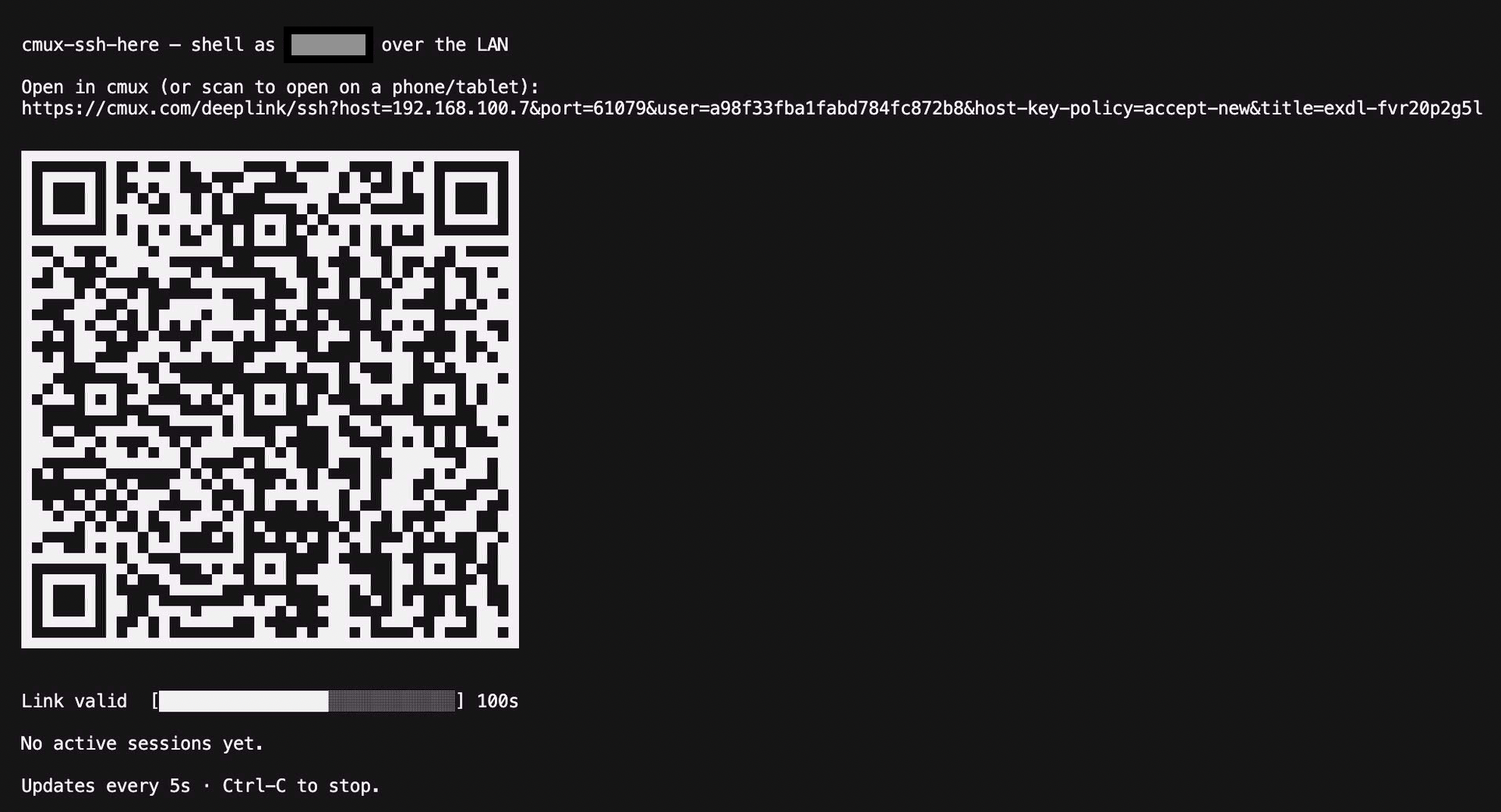
The terminal turns into a live dashboard — the cmux link, a QR code, a plain ssh command and a tappable ssh:// deep link for any other client, a countdown bar for its lifetime, and who's connected:
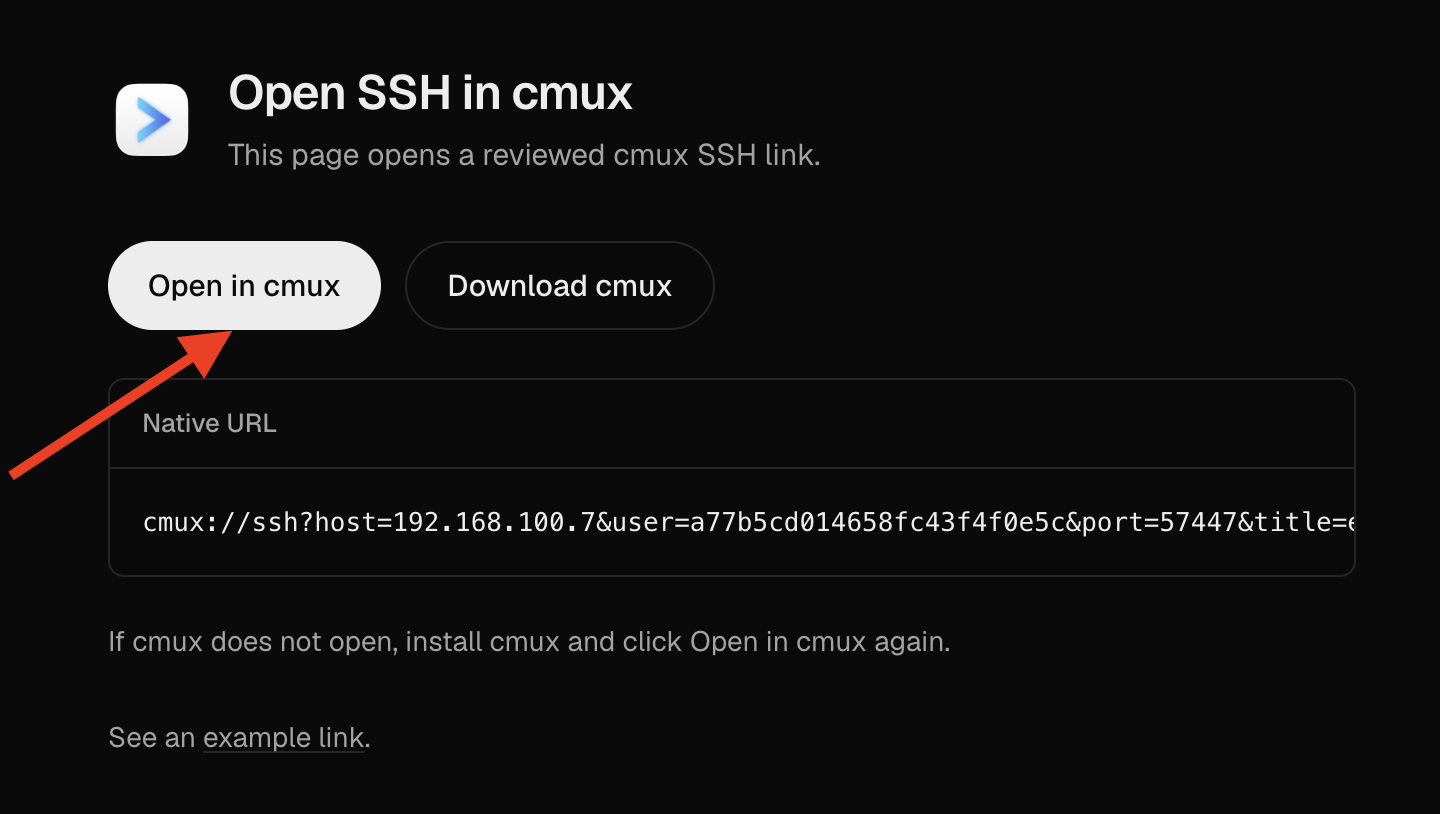
Open the link and cmux connects on its own — one click, straight into the shell:
Why you'll like it
- ⚡ Zero setup — one
npxcommand, no SSH server administration. - 🔗 One-click connect — open the printed link on another Mac and cmux drops you straight into the shell.
- 📲 Works with any SSH client — the dashboard also prints a plain
ssh <token>@host -p <port>and a tappablessh://deep link, so you can connect from a phone (Termius, Blink, WebSSH), Linux, or Windows — not just cmux. - 🔑 No credentials to share — auth is a one-time token baked into the link.
- ⏳ Self-expiring — the link rotates every 3 minutes; leaked links go stale on their own. Live sessions stay connected.
- 🎯 One-time mode —
--oncelocks the link to the first device that connects and rejects everyone else. - 👀 Live dashboard — see the current link, a countdown bar, and every connected client at a glance.
- 🧩 Real SSH — full PTY shell,
scp/sftp, and the exec channel cmux needs to bootstrap remote workspaces. - 🪟 Persistent sessions — when
tmuxis present, sessions survive disconnects and are shared across connections.
Use cases
- 💻 Reach your desk machine from the couch — open a shell on your work Mac from another Mac on the same Wi-Fi.
- 📲 Connect from your phone — tap the
ssh://link or paste thesshcommand into any SSH app (Termius, Blink, WebSSH); no cmux required. - 👥 Hand a teammate a shell — share the link on the office network for quick pairing or debugging; use
--onceso only they get in. - 🔧 One-off access without setup — debug a box you don't want to permanently open
sshdon; close the terminal and the door is gone.
Quick start
# on the machine you want to reach
npx cmux-ssh-here
Then open the printed https://cmux.com/deeplink/ssh?… link in cmux on any device on the same network.
How it works
- Its own SSH server (
ssh2) with an ephemeral host key and token — both live only while the process runs. - The token rides in the deep link's
user=; the server accepts only that token, and rotates it every 3 minutes. - cmux deep links deliberately carry no passwords or keys, so the secret is the token itself.
- Full PTY shell via
node-pty, a raw-pipe exec channel, and a filesystem-backed SFTP server — together they letcmux sshupload and run its remote helper (a shell-only server isn't enough). - With
tmuxavailable, the interactive shell runs inside it: sessions persist, are shared across connections, and the session list (choose-tree) is shown on connect.
Compatibility
| Host running npx cmux-ssh-here | Supported |
| --- | --- |
| macOS | ✅ |
| Linux | ✅ |
| Windows | ❌ — needs a POSIX shell, and cmux's remote daemon has no Windows build |
The device you open the link from just needs cmux installed. Node 18+ is required on the host. tmux is optional (for persistent, shared sessions).
Security
⚠️ The token in the link is a bearer secret that grants a shell as your user. Use it on a trusted local network only. Don't publish the link or send it over untrusted channels. Close the terminal and the token and host key are gone.
- The server binds to
0.0.0.0, so it's reachable by everyone on your local network — anyone who gets the token can connect while it's live. Only run it on networks you trust. - Use
--onceto lock the link to the first device that connects and reject the rest. - The link self-expires every 3 minutes (configurable via
CMUX_SSH_TTL); a token someone copied earlier stops working on its own.
Options
npx cmux-ssh-here --once— single-use link: locks to the first device that connects, rejects any other.PORT=2222 npx cmux-ssh-here— fixed port (random free port by default).CMUX_SSH_TTL=600 npx cmux-ssh-here— link/token lifetime in seconds before regeneration (default 180).CMUX_SSH_DEBUG=1 npx cmux-ssh-here— log incoming auth/env/exec/shell requests to stderr (disables the live dashboard).
License
MIT