
coffeenode-passphrase
v0.1.7
Published
Passphrase generator for NodeJS


Readme
Table of Contents generated with DocToc
CoffeeNode PassPhrase
CoffeeNode bSearch is a passphrase generator; it currently includes a small German wordlist.
Why?
We all know that good passwords are hard to find. xkcd famously explained how a
good and memorable passphrase works:
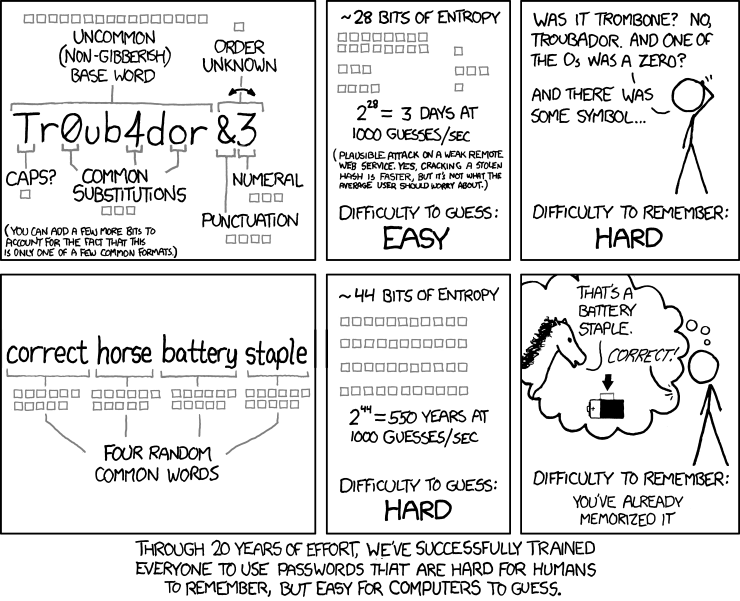
Following these ideas, i've put together a very simple random Passphrase generator. Here is a selection of generated passphrases:
tasche-327-schwester-reparatur-tafel-965-kirche
gut-479-april-wörterbuch-einladung-tisch-771
körper-sport-390-schnaps-eintrittskarte-richard-046
gletscher-turm-027-lassen-strumpf-geld-925
kaufmann-einkaufszentrum-383-lachen-onkel-busch-786
reparatur-kino-446-lautsprecher-platz-fest-662
gesicht-schalter-gast-übung-353-oper-798
bier-warenhaus-037-mühle-amerika-415-drachen
kartoffel-musik-094-baum-herd-zeit-095
kleidung-wolga-sollen-217-teppich-fest-691
doktor-turm-brett-959-tasse-365-brust
These phrases all share the following characteristics:
- all 'letter words' are selected from a small, but growing collection of (currently ≈400) words;
- each passphrase has two randomly placed 'digit words' (these help to maintain a reasonable vocabulary size);
- all 'digit words' are three digits long;
- there is always at least one 'letter word' between the two 'digit words';
- all words are written in lowercase;
- all words are separated by a single dash / hyphen / minus / whatchamaycallit;
- all words are part of the basic vocabulary of the intended audience (speakers of German);
- all words are 'easy' to write correctly—this is not a spelling bee contest;
- there are no names of digits or other numbers among the 'letter words' (i.e. there is no 'one', 'two', 'three' etc. to avoid confusion with '1', '2', '3');
- the words are selected so they can be easily and clearly communicated orally;
- all words are 'neutral' and non-offensive;
- no two 'letter words' are repeated within a single phrase.
These rules help to maintain an easily memorable outer form of the generated passphrases; above all, the passphrases are intended to be reasonably secure while memorable and communicable without having to write them down.