
cognidocs
v0.0.2
Published
Premium documentation for React, Next.js, Vue, and Svelte — automatically generated from your code
Downloads
12

Maintainers
 abishekr
Readme
CogniDocs
🚀 Premium documentation for React, Next.js, Vue, and Svelte — automatically generated from your code.



CogniDocs is a comprehensive documentation tool for JavaScript and TypeScript. Point it at your codebase, and it generates a stunning, premium documentation site with interactive dependency graphs, detailed coverage reports, and 12 professional themes.
🌐 View Live Demo — See CogniDocs in action!
🚀 Quick Start in 60 Seconds
Installation
# npm
npm install -g cognidocs

# pnpm (Recommended - especially for monorepo projects)
pnpm add -g cognidocs

# yarn
yarn global add cognidocs

# npx (Try without installing)
npx cognidocs init
💡 Tip: For monorepo/workspace projects, we strongly recommend using pnpm as it provides superior workspace management and dependency handling.
Usage
# 1. Initialize your project
cognidocs init

# 2. Build your documentation
cognidocs build

# 3. Preview locally
cognidocs serve
Your documentation site will be generated in the ./docs directory.
⚡ Features at a Glance
🤖 Intelligent Code Parsing
- Multi-Framework Support - Native support for React, Next.js, Vue 3, and Svelte.
- TypeScript & JavaScript - Full AST parsing for both
.ts/.tsxand.js/.jsxfiles. - Deep Export Detection - Handles all export patterns (default, named, re-exports, aliases).
- Rich JSDoc Rendering - Supports
@example,@see,@link,@tutorial,@deprecated, and more.
🎨 Premium Documentation Sites
- 12 Professional Themes - GitBook, GitHub, Nord, Dracula, Monokai, Solarized, One Dark, Material (light/dark variants).
- Advanced Search - Lunr.js with Cmd+K command palette for instant navigation.
- Interactive Dependency Graphs - D3.js force-directed visualization of module relationships.
- Mermaid.js Diagrams - Full support for flowcharts, sequence diagrams, class diagrams, and more.
- Responsive Design - Works beautifully on desktop, tablet, and mobile.
- Dark Mode - Toggle between light and dark themes.
📊 Deep Analysis
- Coverage Reports - Track documentation health across Components, Functions, Classes, Interfaces, and Types.
- Project Metrics - Get instant insights into your project's complexity and structure.
- Zero Configuration - Intelligent defaults that work out of the box.
📸 Preview
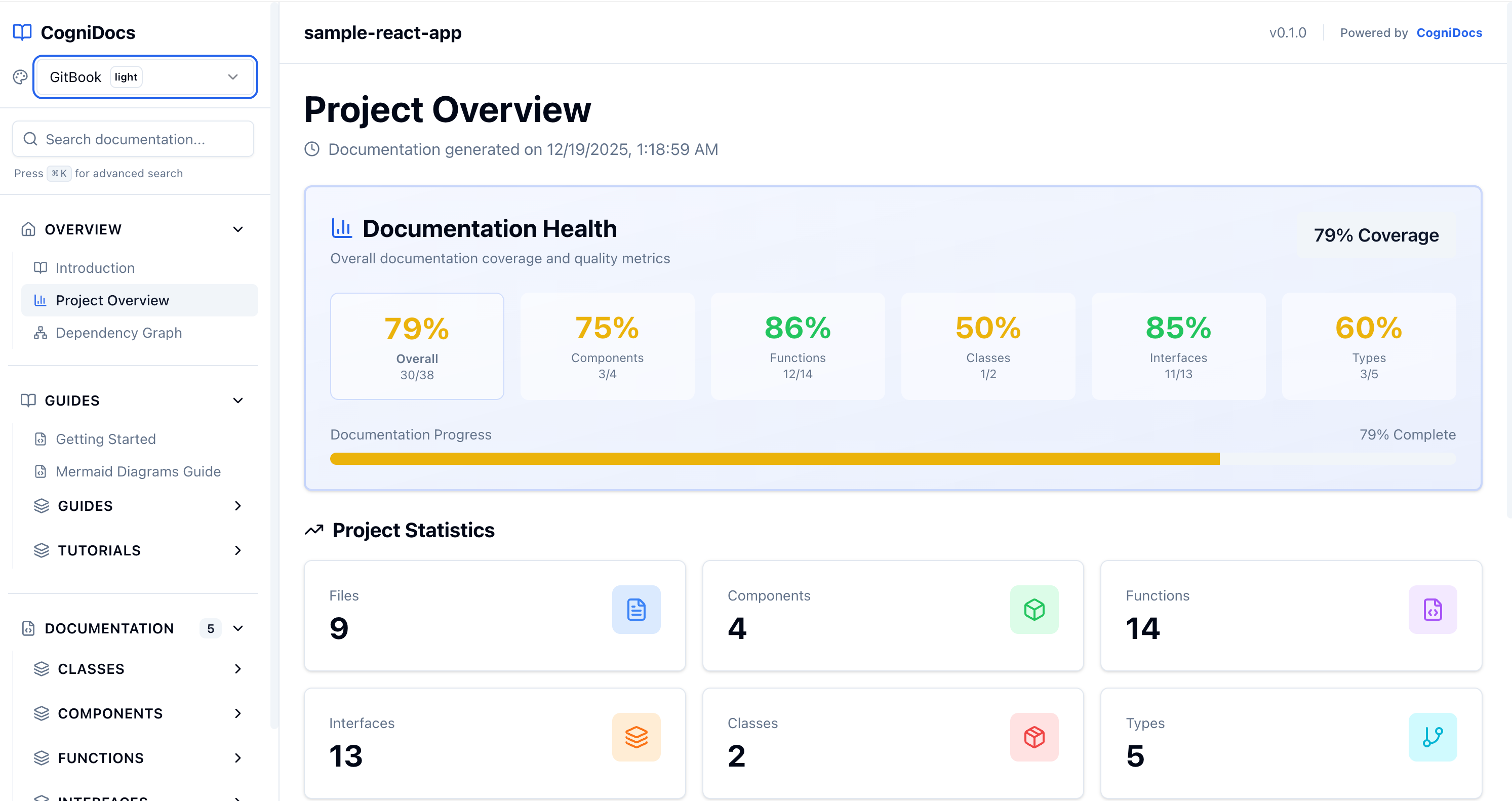 Interactive Dashboard with documentation health metrics and coverage analysis.
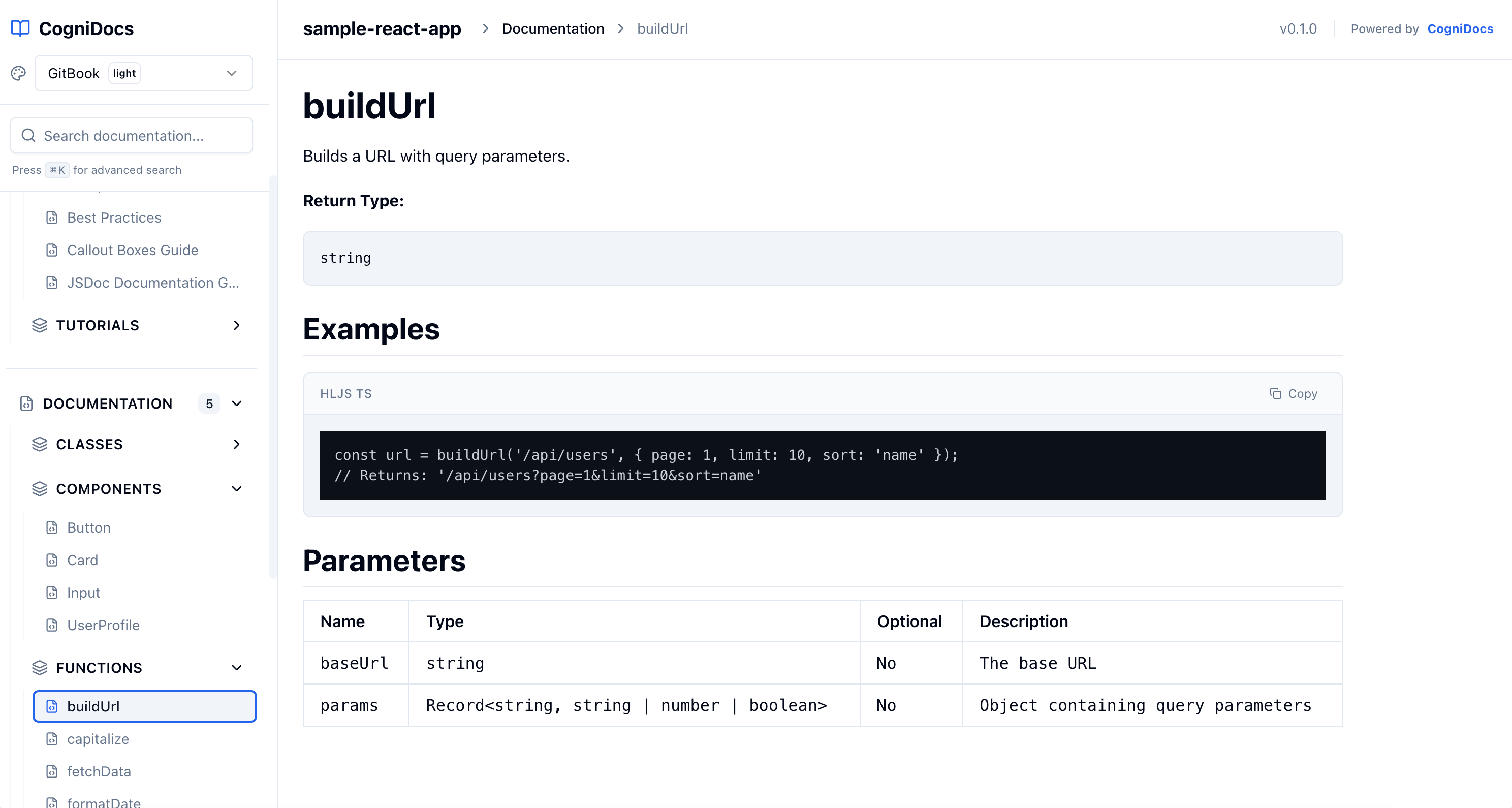 Detailed component documentation with props tables and source code view.
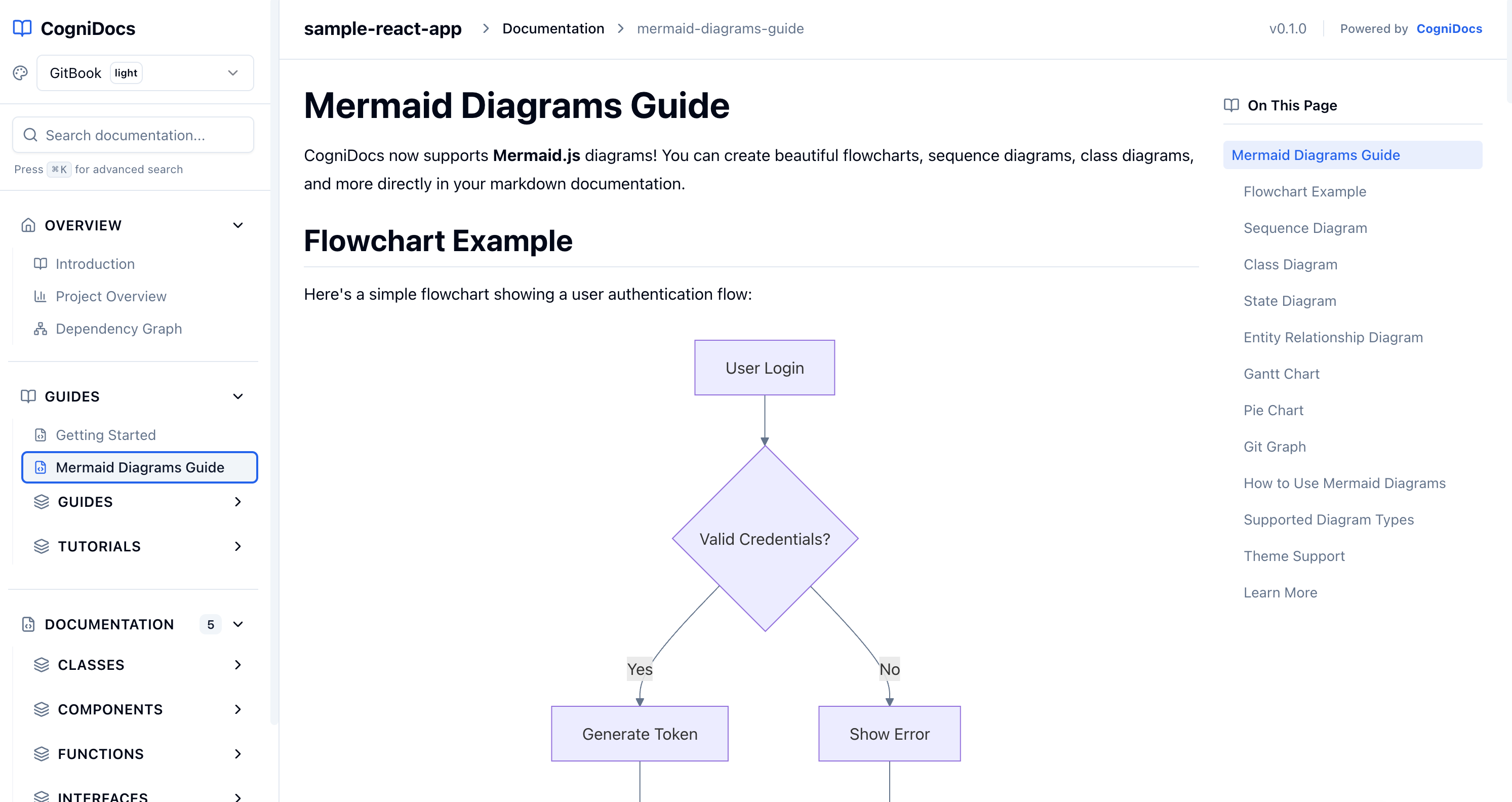 Mermaid.js diagrams for visualizing complex logic.
🛠 Supported Frameworks
| Framework | Support Details |
| :---------- | :--------------------------------------------------------------------------------- |
| React | Function & Class components, Hooks extraction, Props detection, JSX/TSX support. |
| Next.js | Full support for App Router & Page Router, API route documentation. |
| Vue 3 | Single File Components (SFC), Composition API (<script setup>), and Options API. |
| Svelte | Component props, events, stores, and reactive statements ($:) extraction. |
💡 Documenting Your Code (JSDoc)
CogniDocs automatically extracts information from your JSDoc comments. Here's how to document your code for the best results:
React Components
Document props and provide usage examples.
/**
 * A premium button component with multiple variants.
 *
 * @component
 * @example
 * <Button variant="primary" onClick={() => console.log('Clicked!')}>
 *   Click Me
 * </Button>
 */
export const Button = ({ variant, children, ...props }: ButtonProps) => {
  return (
    <button className={variant} {...props}>
      {children}
    </button>
  );
};
Functions & Logic
Use standard JSDoc tags for parameters and return types.
/**
 * Calculates the total price including tax.
 *
 * @param price - The base price of the item
 * @param tax - The tax rate (e.g., 0.15 for 15%)
 * @returns The final price with tax applied
 *
 * @deprecated Use `calculateTotalV2` for better precision.
 * @see {@link https://api.docs.com/pricing}
 */
export function calculateTotal(price: number, tax: number): number {
  return price * (1 + tax);
}
⚙️ Configuration
Create a cognidocs.config.js in your root:
export default {
  entry: './src', // Source directory
  output: './docs', // Output directory
  theme: 'gitbook', // Theme (12 available)
  darkMode: true, // Toggle dark mode
  frameworks: ['react'], // Primary framework
  name: 'My Project', // Documentation title
  exclude: ['**/node_modules/**', '**/dist/**', '**/*.test.ts'],
};
Available Themes
gitbook(Light/Dark)github(Light/Dark)nord(Light/Dark)draculamonokaisolarized-light,solarized-darkone-darkmaterial-light,material-dark
Excluding Files and Folders
You can exclude specific files, folders, or patterns from documentation generation using the exclude array in your configuration. This is useful for:
- Test files (
**/*.test.ts,**/*.spec.tsx) - Build artifacts (
**/dist/**,**/build/**) - Third-party code (
**/node_modules/**) - Development utilities (
**/scripts/**,**/tools/**) - Next.js specific folders (
**/.next/**)
Example:
export default {
  entry: './src',
  output: './docs',
  exclude: [
    // Test files
    '**/*.test.ts',
    '**/*.test.tsx',
    '**/*.spec.ts',
    '**/*.spec.tsx',

    // Build output
    '**/node_modules/**',
    '**/dist/**',
    '**/build/**',
    '**/.next/**',
    '**/.cognidocs/**',

    // Development utilities
    '**/scripts/**',
    '**/tools/**',

    // Config files
    '**/*.config.js',
    '**/*.config.ts',
  ],
};
💡 Tip: The exclude patterns use glob syntax. Use
**to match any number of directories and*to match any characters within a directory name or filename.
📋 CLI Commands
| Command | Description |
| :-------------------- | :----------------------------------------------------- |
| cognidocs init | Initialize configuration (use -y for defaults) |
| cognidocs build | Generate the documentation site |
| cognidocs serve | Start dev server with live reload (default port: 4173) |
| cognidocs analyze | Generate interactive dependency graphs |
| cognidocs coverage | Calculate documentation coverage metrics |
| cognidocs --help | Show help and available commands |
| cognidocs --version | Display current version |
📚 Custom Documentation (Guides)
Beyond auto-generated API docs, you can add custom guides (like a "Getting Started" or "Architecture" page).
How to add Guides
- Create an
additional-documentation/folder in your project root. - Add
.mdfiles to this folder. - Use YAML frontmatter to organize them:
---
title: Getting Started
description: Quick start guide for new users
category: Guides
order: 1
---

# Getting Started

Your content here...
CogniDocs will automatically discover these files and list them under a "Guides" section in the sidebar.
💎 Advanced Markdown Features
CogniDocs premium UI includes built-in support for advanced markdown elements:
🧜♂️ Mermaid.js Diagrams
Visualize complex logic with native Mermaid support.
```mermaid graph TD; A[Source Code] --> B{CogniDocs Parser}; B --> C[JSON Metadata]; B --> D[Markdown Guides]; C --> E[Premium Doc Site]; D --> E; ```
🎈 Callout Boxes
Highlight important information using the :::type syntax:
:::info
This is an information callout.
:::

:::warning
This is a warning callout.
:::

:::tip
This is a helpful tip.
:::

:::danger
This is a critical danger callout.
:::
🤝 Contributing & Community
We welcome contributions! Please see our Contributing Guide for details.
📄 License
MIT © Abishek Raj
Made with ❤️ by the CogniDocs team