
comarkserv
v0.1.0
Published
Serve a directory of markdown as fast, live-reloading HTML pages, with Comark components and twinkleplop highlighting. A modern markserv.

Maintainers
 rigo-m
Readme
comarkserv
See your markdown as a web page while you write it.
comarkserv serves a folder of markdown as HTML pages that update block by block while you type. It is a modern markserv, built on Comark, twinkleplop and srvx.


npx comarkserv ./docs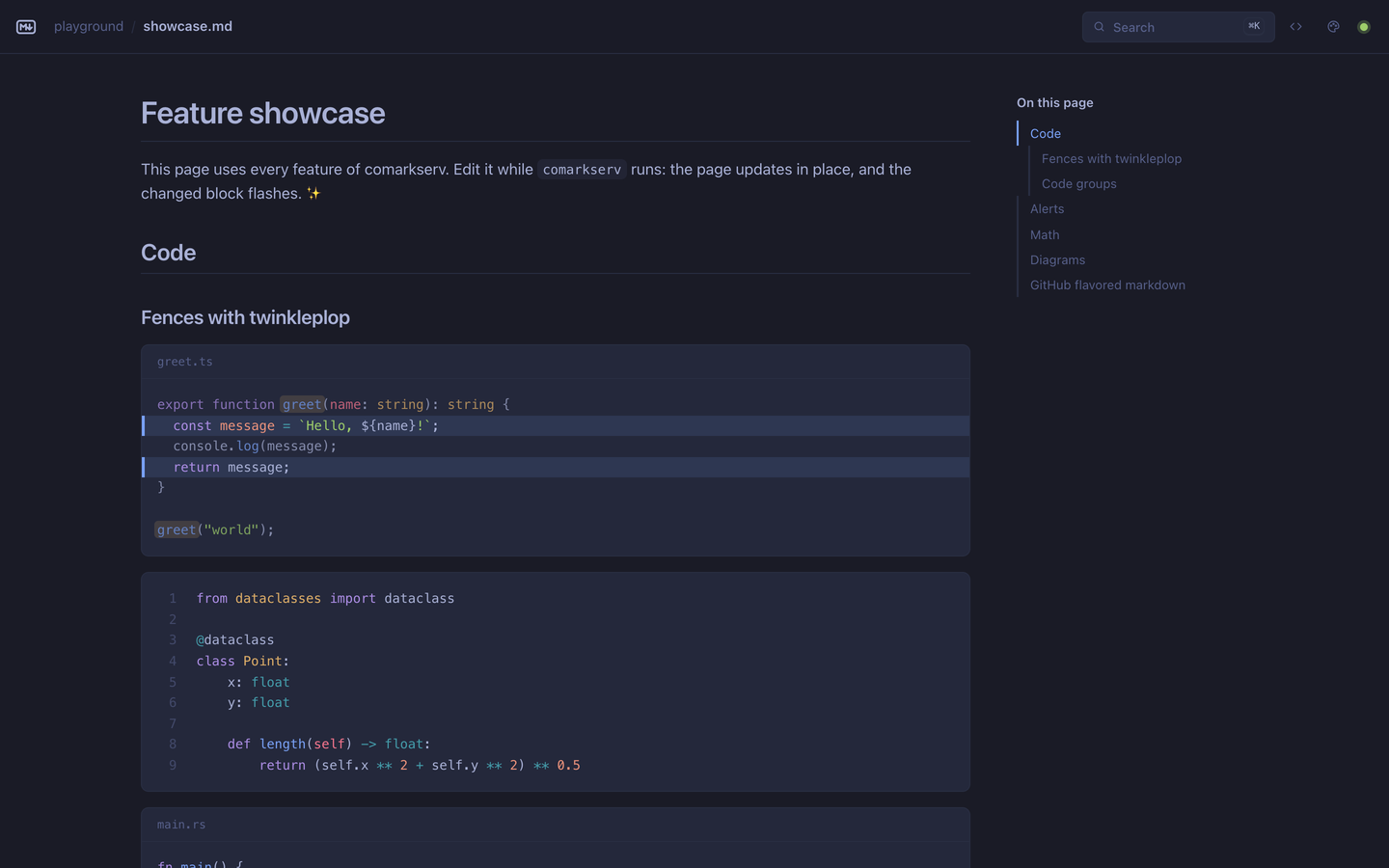
Why comarkserv
- Fast. The server is ready in about 130 ms. A repeated page takes less than 1 ms, and the throughput is about 9× that of markserv. See the benchmarks.
- Small. 23 MB and 29 packages installed, 12× less than markserv.
- Live. When you save, the page replaces only the blocks that changed and flashes them. The scroll position stays.
- Modern markdown. GFM, GitHub alerts, Comark components, code with titles and line highlights, math and Mermaid diagrams. The server renders math and diagrams, so the browser loads no JavaScript for them.
- Search. ⌘ K finds pages and headings in the whole folder.
- 580+ themes. All base16, base24 and Omarchy themes, loaded when you choose one. comarkserv can also follow your Omarchy theme live.
- Edit in place. The Edit button, or E, opens the file in your editor at the section on the screen.
- Share. The Share button, or
--share, gives your colleagues a public URL and a QR code, through a Cloudflare tunnel. - Terminal.
comarkserv catshows a markdown file in the terminal, with colored code and diagrams. - Static sites.
comarkserv buildmakes a site that works on any static host. - A library too. A web-standard
fetchhandler for srvx, Bun, Deno or any server.
Quick start
npx comarkserv                   # serve the current directory
npx comarkserv ./docs --open     # serve a directory and open the browser
npx comarkserv ./docs/guide.md   # serve the directory of a file, and open that file
npx comarkserv readme            # open the closest README, from here or a parent directory
npx comarkserv ./docs --share    # share the folder with a public URL
npx comarkserv cat README.md     # show a file in the terminal
Or install it:
pnpm add -g comarkserv # or: npm install -g comarkservcomarkserv needs Node.js 20.19 or later.
comarkserv and markserv
Features
| Feature | markserv 1.20 | comarkserv |
| --------------------------------------------------------- | -------------------------- | ---------------------------------------------------------------- |
| Markdown | GFM (markdown-it) | GFM and Comark components |
| Syntax highlighting | highlight.js | twinkleplop, 15 languages, loaded on first use |
| Code block titles, line and word highlights, line numbers | — | ✓ |
| GitHub alerts (> [!NOTE]) | — | ✓ |
| Components: alerts, code groups, details | — | ✓ |
| Math | MathJax, in the browser | KaTeX, on the server |
| Mermaid diagrams | — | SVG, on the server |
| Table of contents | [[toc]] in the page | Sidebar that marks the current section |
| Heading anchors | ✓ | ✓ |
| Directory listing | ✓ | ✓, with the README below it |
| Live reload | Replaces the whole content | Replaces only the changed blocks, flashes them, keeps the scroll |
| Search of pages and headings | — | ✓ |
| Themes | 4 | GitHub light and dark, 580+ base16, base24 and Omarchy themes |
| Live Omarchy theme sync | — | ✓ |
| Includes and templates (Markdown, HTML, LESS) | ✓ (--templates) | — |
| Open the closest README | ✓ (readme) | ✓ (comarkserv readme) |
| Open the file in your editor, at the current section | — | ✓ |
| Share with a public URL and a QR code | — | ✓ (Share button, --share) |
| Show markdown in the terminal | — | ✓ (comarkserv cat) |
| Static site build | — | ✓ |
| Library API | — | ✓ |
Benchmarks
| | comarkserv 0.1.0 | markserv 1.20.0 | comarkserv | | ------------------------------- | -----------------: | -------------------: | -------------- | | Install size | 23 MB, 29 packages | 277 MB, 277 packages | 12.1× less | | Startup, to the first response | 132 ms | 239 ms | 1.8× faster | | Memory at idle (RSS) | 90 MB | 112 MB | 1.2× less | | First render of a page | 22 ms | 33 ms | 1.5× faster | | Page, repeated request (median) | 0.3 ms | 1.7 ms | 6.3× faster | | Page after an edit (median) | 1.6 ms | 1.3 ms | about the same | | Large page, 301 KB (median) | 4.2 ms | 39 ms | 9.1× faster | | Throughput, 16 connections | 10981 req/s | 1152 req/s | 9.5× faster | | Peak memory under load (RSS) | 327 MB | 371 MB | 1.1× less |
macOS 26.2 (arm64), Apple M4 Pro, 24 GB, Node.js 24.21.0, 2026-09-25. Run vp run bench to measure on your machine.
How the benchmark works (bench/run.ts):
- Both servers run as installed from npm: markserv from the registry, comarkserv from a packed tarball. They use the same Node.js and their default options, with live reload on.
- The corpus has 100 GFM pages of about 4 KB each, with code in four languages, and one large page. It uses no comarkserv syntax, so both servers do the same work.
- "Startup" and "First render" are medians of five fresh processes. The other rows come from one process: 200 repeated requests, 20 edits, and 5 seconds of load on 16 keep-alive connections over all 100 pages. The client runs on the same machine and asks for no compression.
- comarkserv keeps each rendered page until the file changes, and markserv renders the page on each request. That is the main reason for the difference in the "repeated request" and "throughput" rows. The "after an edit" row shows the real render cost. It is close for both servers, and it changes a little between runs.
- Peak memory under load changes more between runs than the other rows.
Command line
Serve
comarkserv [path] [options]| Option | Default | Effect |
| --------------------- | ----------- | ------------------------------------------------------------------------------------- |
| -p, --port <port> | 8642 | The port. When it is in use, comarkserv uses the next free port. |
| --strict-port | off | Stop when the port is in use. |
| -H, --host <host> | localhost | The host. Use 0.0.0.0 to accept connections from the network. |
| -o, --open | off | Open the page in the browser. |
| --theme <name> | github | The default theme. See Themes. |
| --no-livereload | on | Do not watch the files. |
| --line-numbers | off | Show line numbers on all code blocks. |
| --dotfiles | off | Serve and list dotfiles, such as .github/. |
| --share | off | Share the pages at a public URL. See Share with colleagues. |
| -s, --silent | off | Do not print the requests. |
Add ?raw to the URL of a markdown file to get its source. The code button in the top bar does the same.
Build a static site
comarkserv build ./docs --out site --theme base16:nordThe build writes one HTML page for each markdown file, a listing page for each directory without an index.md, the search index, the theme list, and the assets. It copies all other files.
- All links are relative, so the site works on any static host, in a subdirectory too.
- Links to
.mdfiles change to.html. - You can open the pages from
file://, but the search needs a server. - The build deletes an earlier build in the output directory. It does not write to a directory that has other files.
Open the closest README
comarkserv readme            # from the current directory
comarkserv readme ./src      # from another directory
comarkserv readme looks for a README in the directory, then in each parent directory, and serves the first one that it finds. It opens the browser. Use --no-open to stop that. It accepts the same options as comarkserv.
Share with colleagues
Click the Share button in the top bar, or start comarkserv with --share:
comarkserv ./docs --shareBoth start a Cloudflare quick tunnel with untun, and show a public URL and a QR code.
- Anyone with the URL can read the files in the folder, until you stop sharing or stop comarkserv. Dotfiles stay hidden.
- The dialog of the Share button shows the link to the page that you read, a QR code of it, and Stop sharing. The button turns green while the folder is shared.
- Visitors do not see the Edit and Share buttons, and the server refuses both actions for them. You keep both.
- The first share installs
cloudflared, and you must accept the Cloudflare license first. The Share button shows the links and asks you.--shareasks in the terminal. With no terminal, comarkserv stops, unless you setUNTUN_ACCEPT_CLOUDFLARE_NOTICE=1to accept the license.
For a colleague on the same network, --host 0.0.0.0 is enough. comarkserv then prints the network URL and a QR code for your phone.
Show markdown in the terminal
comarkserv cat README.md
comarkserv cat docs/guide.md --no-pager | head
comarkserv cat uses the same parser and the same twinkleplop grammars as the server. It colors code, draws Mermaid diagrams as text, and shows alerts, tables and footnotes. A long file opens in less. Use --no-pager to print it, and --no-color to remove the colors.
List the themes
comarkserv themes            # all themes
comarkserv themes gruvbox    # the themes with "gruvbox" in the id or the name
comarkserv theme base16:nord # the colors of one theme
Add --json to both commands for output that other tools can read.
Keyboard shortcuts
| Keys | Effect | | ----------------------------------------------------------------------- | -------------------------------------------------------------------------------------------- | | ⌘ K, Ctrl K or / | Search the pages and headings | | ↑ ↓, ↵ | Move in the results and open one | | ⌘ ↵ | Open the result in a new tab | | E | Open the file in your editor, at the section at the top of the screen | | The palette button in the top bar | Choose a theme: ↑ ↓ preview, ↵ keep, esc restore |
Raycast
The Raycast extension has three commands:
- Preview Markdown opens the file or folder that is selected in Finder.
- Markdown Previews shows the running previews and the recent folders. You can open, copy, stop and restart them.
- Search Markdown Themes searches the 580+ themes, shows their colors, and sets the default theme for new previews.
The extension is not in the Raycast Store yet. To use it now, run npm install && npm run dev in extras/raycast-extension. Raycast then loads it.
Two Raycast script commands in extras/raycast do the basic part with no extension:
- Preview Markdown opens the file or folder that you select in Finder, or a path that you type. Each folder gets its own server, and a second preview of the same folder uses the server that runs.
- Stop Markdown Previews stops these servers.
To install them, put the two scripts in a folder, and add the folder in Raycast: Settings → Extensions → Script Commands → Add Directories.
mkdir -p ~/.config/raycast/comarkserv && cd ~/.config/raycast/comarkserv
curl -fsSLO https://raw.githubusercontent.com/Rigo-m/comarkserv/main/extras/raycast/comarkserv-preview.sh \
     -fsSLO https://raw.githubusercontent.com/Rigo-m/comarkserv/main/extras/raycast/comarkserv-stop.sh
chmod +x *.sh
The scripts use comarkserv when it is installed, and else npx comarkserv. To give more options, such as a theme, edit the COMARKSERV_ARGS line at the top of comarkserv-preview.sh, for example COMARKSERV_ARGS="--theme omarchy".
Writing markdown
comarkserv uses Comark syntax: CommonMark, GFM, frontmatter and components. The feature showcase uses all of it.
Code
```ts {2} /total/ [math.ts]
const total = add(1, 2);
export { total };
```{1,3-5}: highlight lines/word/: highlight a word[file.ts]ortitle="file.ts": a title:line-numbers,:line-numbers=10,:no-line-numbers: line numbers`const a = 1{:ts}`: highlighted inline code
The languages are Bash, CSS, Go, HTML, JavaScript, JSON, Markdown, Python, Rust, SQL, Svelte, TOML, TSX, TypeScript and YAML, with the common aliases (sh, js, ts, py, yml, rs, …). Other languages show as plain text. A fence with incorrect meta, such as a line number that is not in the block, shows the error on the page.
Components
> [!WARNING]
> GitHub alerts: NOTE, TIP, IMPORTANT, WARNING, CAUTION.

::tip{title="Optional title"}
Also ::note, ::info, ::warning, ::caution, ::danger, ::success, ::callout, ::alert{type="…"}.
::

::code-group

```bash [pnpm]
pnpm add comarkserv
```

```bash [npm]
npm install comarkserv
```

::

::details{summary="More"}
Hidden content.
::
Code groups remember the tab that you select, on all pages.
Math and diagrams
Write math between $…$ or $$…$$, and diagrams in a mermaid fence. The server renders both, so the browser loads no Mermaid or KaTeX JavaScript. The page loads the KaTeX stylesheet only when it has math.
Themes
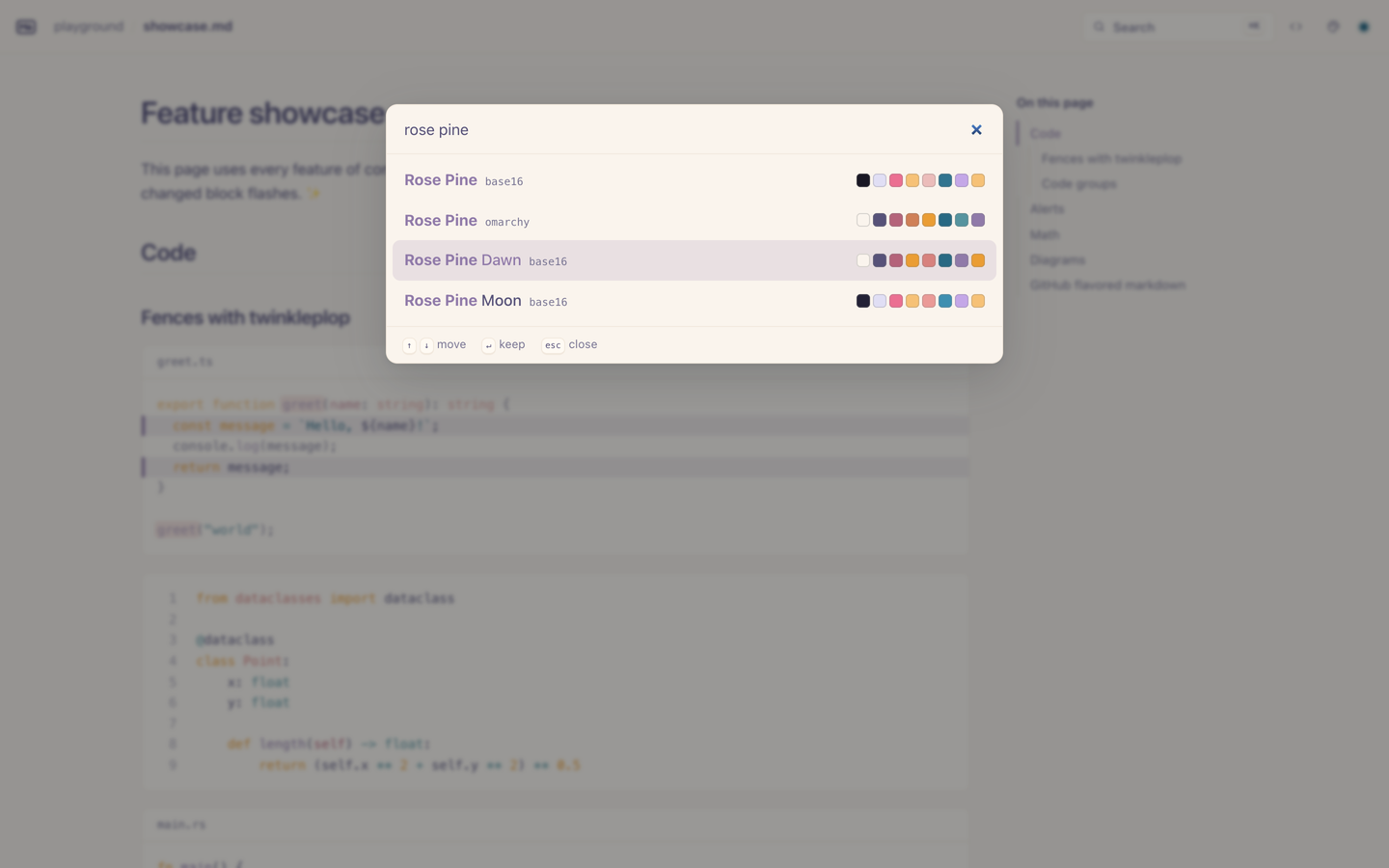
The GitHub theme is built in, with light, dark and system modes. comarkserv also loads more than 580 themes from their own repositories, when you choose one:
| --theme value | Themes |
| ----------------------------------- | ------------------------------------------------------------------------------------------- |
| github (default) | Built in |
| base16:<id> | 351 base16 schemes from tinted-theming/schemes |
| base24:<id> | 209 base24 schemes from the same repository |
| omarchy:<id> | The 22 themes of Omarchy |
| omarchy | The current Omarchy theme of this machine, live |
| ./my-scheme.yaml, ./colors.toml | A local base16 or base24 scheme, or an Omarchy colors.toml, live |
| https://… | A scheme at a URL |
- The picker. Click the palette button in the top bar, and type a part of a name. The arrow keys preview each theme on the whole page. ↵ keeps the theme in this browser, and esc restores the theme from before. Default follows the server again.
- How it works. A theme is 16 base16 colors. comarkserv maps the page colors and the syntax colors to the 16 slots, so each base16 and base24 scheme works. The keys of an Omarchy
colors.tomlmap one-to-one to the slots, and itsaccentis used too. - Just in time. comarkserv contains no theme data. The server downloads a theme the first time it is needed: the lists from UNGH, the files from
raw.githubusercontent.com. It keeps them in~/.cache/comarkserv/themes(or$XDG_CACHE_HOME) and serves them to the browser. So the browser contacts no other server, and a theme works offline after its first use. The browser keeps the chosen palette, so each later page gets its theme before the first paint, with no request. - Omarchy sync. With
--theme omarchy, or with Omarchy (live) in the picker, open pages change their theme when you runomarchy-theme-set. - For theme authors. With
--theme ./my-scheme.yaml, comarkserv watches the file. Each save updates the open pages. - Static builds contain the default theme in each page. Their picker loads the other themes from GitHub directly.
Library
import { serve } from "srvx";
import { createHandler } from "comarkserv";

const app = createHandler({ root: "./docs", theme: "base16:nord" });
serve({ fetch: app.fetch });
createHandler returns a web-standard fetch handler, so it works with srvx, Bun, Deno, or any server that uses Request and Response.
| Export | Use |
| --------------------------------------------------------- | ---------------------------------------------------------------------------------------- |
| createHandler(options) | The request handler: pages, listings, assets, search, themes and live reload. |
| startServer(options) | Starts a server with srvx: port search, request log, clean shutdown. |
| build(options) | Builds a static site. |
| createMarkdownRenderer(options) | Markdown to HTML, with the title, the TOC, the frontmatter and the features of the page. |
| createCodeHighlighter(options) | The twinkleplop components for Comark, for your own renderer. |
| createThemeStore(options), parseTheme(text, id, name) | Load, cache and read base16, base24 and Omarchy themes. |
| loadLanguage, resolveLanguage | The lazy grammar registry. |
createHandler, startServer and build accept these options:
root: the directory to serve or buildplugins: more Comark pluginscomponents: more Comark components, or replacements for the built-in oneslineNumbers,dotfiles,livereloadtheme: the default theme, as for--themethemeStore: replaces the store that downloads and caches the themes, for example to use no networkomarchyPath: thecolors.tomlof the current Omarchy themeeditor: show the Edit button (defaulttrue). Turn it off when other machines can reach the server.share: show the Share button (defaulttrue). Turn it off when other machines can reach the server.shareService: replaces the service that starts and stops the tunnelopenEditor: replaces the function that opens a file in the editor
How it stays fast
- The server listens before it imports Comark. The renderer loads right after that, before the first request needs it.
- Each twinkleplop grammar, KaTeX and the Mermaid renderer load only when a page needs them.
- A rendered page stays in memory until its file changes. A repeated request gets
304 Not Modified. - Pages are compressed with brotli or gzip one time, and the compressed bytes are cached.
- The assets have content hashes in their URLs, so browsers cache them for one year.
- Live reload sends only the changed paths. The page fetches itself and replaces only the changed blocks.
- The search index reads only titles and headings, with no full parse. After a change, it reads only the changed files.
- Mermaid SVGs are cached by source, so an edit elsewhere on the page does not render the diagram again.
- Themes load on first use, and from a disk cache after that. The theme list loads only when the picker opens, and each row loads its colors only when it comes into view.
Each response has a Server-Timing header with the render time.
Security
comarkserv is a tool for your own files. It binds to localhost by default, and it does not serve dotfiles or files outside the root. Markdown can contain raw HTML and scripts, as on markserv. Do not serve markdown that you do not trust on a network.
The Edit and Share buttons act on your machine, so their endpoints accept only a POST from a comarkserv page on this machine:
- The host name must be local, against DNS rebinding.
- The origin must match, and a custom header must be present. So another site needs a preflight, and the server answers no preflight.
- The request must not come through a tunnel or a proxy. cloudflared connects from
127.0.0.1, so the server also refuses each request withCf-Ray,Cf-Connecting-Ip,X-Forwarded-For,ForwardedorX-Real-Ip. Cloudflare adds these headers, and a visitor cannot remove them. - The page shows the buttons only after the server confirms that the viewer is local.
- The Edit endpoint opens only a visible file in the root.
The CLI turns both buttons off for a host that is not local, such as --host 0.0.0.0.
Theme files come from the network, and their colors go into CSS. So comarkserv accepts only hex colors from a theme, in the server and in the browser. The theme endpoint of the server downloads files only from the two theme repositories, so it is not an open proxy.
Development
vp install         # install the dependencies
vp test            # run the tests
vp check           # format, lint and type check
vp pack            # build dist/
vp run playground  # serve playground/ from the source
vp run bench       # compare with markserv
To write a new benchmark table into this README, run vp pack && node bench/run.ts --update-readme.
Credits
comarkserv builds on markserv, Comark, twinkleplop, srvx, KaTeX, beautiful-mermaid, chokidar, tinyglobby, citty, get-port-please, pathe and UNGH. The themes come from tinted-theming and Omarchy.