
create-conical-gradient
v1.1.5
Published
A pretty extension for CanvasRenderingContext2D to create a pattern of the conical gradient.

Maintainers
 parks
parksReadme
Create Conical Gradient
⚠️ Note: Modern browsers support conic gradients natively. In CSS, use
conic-gradient()(Chrome 69+, Firefox 83+, Safari 12.1+); in Canvas, useCanvasRenderingContext2D.createConicGradient()(Chrome 99+, Firefox 112+, Safari 16.1+).Please prefer these built-in APIs in new projects. This package is kept mainly for learning purposes and for legacy browsers without native support.
This package does not shadow the native API. On browsers that have
createConicGradient(),ctx.createConicalGradient()delegates a full turn to the native implementation, so you get the native quality and speed; only a partial sweep (an arc), which has no native equivalent, is rendered by the JavaScript simulation in this package.



A pretty extension for CanvasRenderingContext2D to create a pattern of the conical gradient.
🥐 Preface
CSS has long supported the conical gradients by the property conic-gradient, and the HTML Canvas API has since added its own createConicGradient(). This package implements the same capability by a method similar to CanvasRenderingContext2D.createLinearGradient() and CanvasRenderingContext2D.createRadialGradient(), which makes it handy for legacy browsers or as a reference implementation.
🥪 Demo Online
🌮 Install
Install the npm package for development.
npm i create-conical-gradientOf course, you can also use the umd resources for production:
<script src="https://unpkg.com/create-conical-gradient@latest/umd/create-conical-gradient.min.js"></script>🥯 Quickstart
Codes:
<canvas id="my-canvas" width="480" height="270">
  Your browser does not support canvas...
</canvas>
import 'create-conical-gradient'; // If you use the npm package.
const canvas = document.getElementById('my-canvas');
const ctx = canvas.getContext('2d');
const gradient = ctx.createConicalGradient(240, 135, -Math.PI, Math.PI);
gradient.addColorStop(0, '#f00');
gradient.addColorStop(0.2, '#00f');
gradient.addColorStop(0.4, '#0ff');
gradient.addColorStop(0.6, '#f0f');
gradient.addColorStop(0.8, '#ff0');
gradient.addColorStop(1, '#f00');
ctx.fillStyle = gradient.pattern;
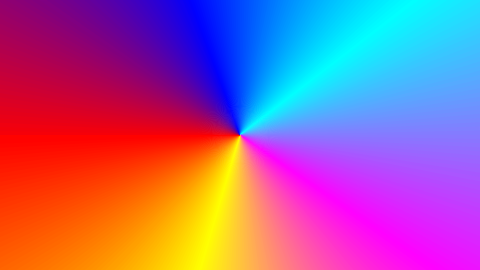
ctx.fillRect(0, 0, canvas.width, canvas.height);Output:
🍔 Docs
ctx.createConicalGradient
Syntax
void ctx.createConicalGradient(ox, oy, startAngle, endAngle, anticlockwise);Parameters
ox
The x-axis coordinate of the origin of the gradient pattern, which default value is 0.
oy
The y-axis coordinate of the origin of the gradient pattern, which default value is 0.
startAngle
The angle at which the arc starts in radians measured from the positive x-axis, which default value is 0.
endAngle
The angle at which the arc ends in radians measured from the positive x-axis, which default value is 2 * Math.PI.
anticlockwise
An optional Boolean. If true, draws the gradient counter-clockwise between the start and end angles. The default is false (clockwise).
gradient.addColorStop
Syntax
void gradient.addColorStop(offset, color);gradient.pattern
The gradient as a value you can assign to fillStyle / strokeStyle. It is a native
CanvasGradient when the browser has createConicGradient() and the requested sweep is a
full turn, and a CanvasPattern rendered by this package otherwise.
Parameters
offset
A number between 0 and 1, inclusive, representing the position of the color stop. 0 represents the start of the gradient and 1 represents the end; an INDEX_SIZE_ERR is raised if the number is outside that range.
color
A CSS <color> value representing the color of the stop. A SYNTAX_ERR is raised if the value cannot be parsed as a CSS <color> value.