
cursor-opencode-provider
v0.7.6
Published
Use Cursor subscription models from OpenCode via Cursor's Connect-RPC agent protocol

Maintainers
 oakimov
Readme
cursor-opencode-provider
Use Cursor subscription models from OpenCode and compatible coding agents by speaking Cursor's Connect-RPC agent protocol.
This project is a custom AI SDK provider (LanguageModelV3) plus an OpenCode plugin that handles authentication and model discovery. Instead of calling a generic chat-completions API, it encodes and decodes Cursor's protobuf agent protocol over HTTP/2 to Cursor's agent backend.
Runs unchanged across OpenCode, OpenCode 2.0, and four additional coding agents. OpenCode loads this plugin natively, including through the dedicated OpenCode 2.0 entrypoint. OCP — OpenCode Plugin Compatibility runs the same published plugin, without a provider fork, in Kilo Code, MiMo Code, pi, and oh-my-pi. See Coding-agent compatibility.
Status: Usable end-to-end for authentication, model discovery, streaming, and tools. See Known limitations.
Coding-agent compatibility
This package remains one OpenCode plugin and AI SDK provider. The external OCP compatibility layer adapts other hosts around that unchanged package: it translates their plugin surfaces, model catalogs, tool vocabulary, authentication, and streaming events instead of requiring a host-specific Cursor provider.
| Coding agent | How this package runs |
|---|---|
| OpenCode | Native plugin and AI SDK provider — OpenCode 1.x setup |
| OpenCode 2.0 | Native cursor-opencode-provider/plugin/opencode2 — OpenCode 2.0 setup |
| Kilo Code | Unchanged through OCP's OpenCode-clone compatibility layer |
| MiMo Code | Unchanged through OCP's OpenCode-clone compatibility layer |
| pi | Unchanged through @opencode-compat/pi-bridge and pi's provider extension API |
| oh-my-pi (omp) | Unchanged through the same Pi-family bridge |
Start with OCP's host guides:
OCP is designed to grow by adding host profiles and narrow adapters or bridges, so support for other coding agents can be added there while this provider and its package remain unchanged.
Demo
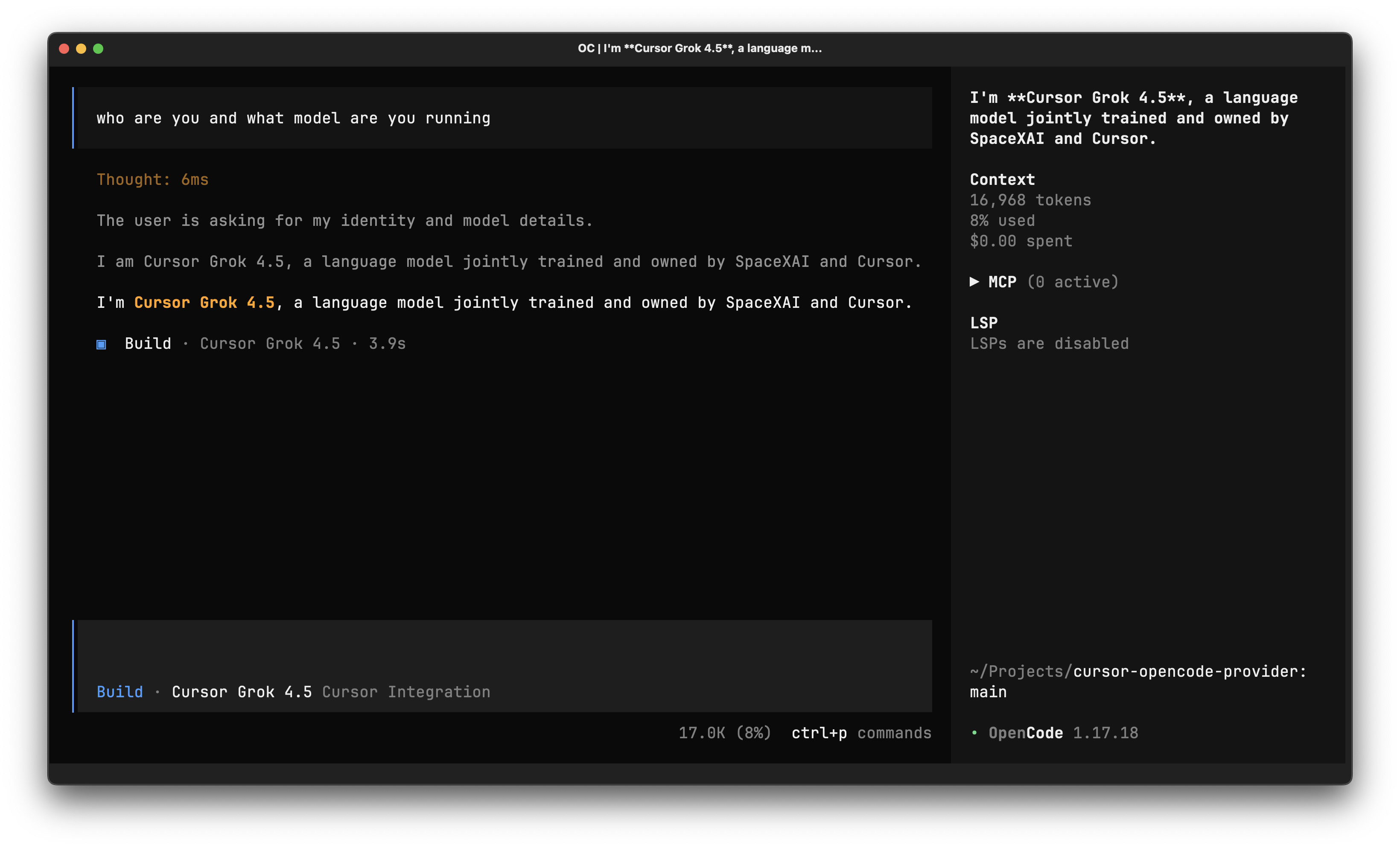
OpenCode driving a Cursor-routed Grok model through this provider:
Features
- Multi-host compatibility — the same plugin package runs natively in OpenCode and OpenCode 2.0, and unchanged through OCP in Kilo Code, MiMo Code, pi, and oh-my-pi; new host support belongs in the compatibility layer rather than a provider fork
- OpenCode integration — registers a
cursorprovider with auth hooks and cached model list - Authentication — browser OAuth (PKCE), or API key from cursor.com/settings
- Model discovery — fetches available models from Cursor's API and caches them locally
- Image input — advertises vision only for supported models and forwards OpenCode image attachments to Cursor
- Streaming — bidirectional Connect-RPC Runs with stale-session rotation, health checks, semantic/read-idle deadlines, bounded replay-safe recovery, and activity-aware held tool continuations
- Tool calls — maps Cursor exec-server messages to AI SDK / OpenCode tool-call parts using only the advertised canonical catalog. Exact advertised subagent names win; standard Cursor roles select compatible OpenCode agents, and native Task maps to OpenCode 1.x
taskor OpenCode 2.0subagent. OCP translates any alternate host vocabulary before it reaches this package. The bridge also covers Cursor's typed read/bash/edit/write/grep/find/ls request/result range, mirrors finalized display-only todo/plan state, and strips OpenCode 1.x and OpenCode 2 read envelopes before returning content to Cursor. - Thinking / reasoning — surfaces extended-thinking deltas where the model supports it
Requirements
- Bun (for development and tests)
- OpenCode, or a supported host configured through OCP
- An active Cursor account with API access
Installation
This package is one plugin with host-specific entrypoints. Use the guide for your OpenCode major version:
| Host | Guide |
|------|--------|
| OpenCode 1.x | docs/opencode-1.md — classic plugin plus optional 1.18 plugin/v2 |
| OpenCode 2.0 | docs/opencode-2.md — plugin/opencode2 only, including safe transition off ctx.catalog and the deprecated opencode.json catalog dump |
| Other agents | Coding-agent compatibility |
Do not load the 1.x and 2.0 entrypoints in the same host.
OpenCode 1.x (~/.config/opencode/opencode.json):
{
  "$schema": "https://opencode.ai/config.json",
  "plugin": ["cursor-opencode-provider"]
}
OpenCode 2.0 (prefer a dedicated OPENCODE_CONFIG_DIR):
{
  "plugin": ["cursor-opencode-provider/plugin/opencode2"]
}
Local clones, 1.18 plugin/v2, config isolation, and leftover providers.cursor cleanup are in the host guides. Shared catalog behavior (variants, 1M, Fast, images, Max Mode) is under Select a model.
git clone https://github.com/oakimov/cursor-opencode-provider.git
cd cursor-opencode-provider
bun install
bun run build
You can also install from npm (npm install cursor-opencode-provider or bun add cursor-opencode-provider). Pin a version in host config if you want, for example [email protected].
OpenCode setup
Host config, auth commands, and local-clone wiring differ by major version — follow OpenCode 1.x or OpenCode 2.0.
Authenticate
| Host | How |
|------|-----|
| OpenCode 1.x | opencode auth login → cursor (details) |
| OpenCode 2.0 | /connect → Cursor (details). CURSOR_API_KEY is also picked up automatically. |
Then choose a method:
| Method | Description |
|--------|-------------|
| Cursor account (browser login) | PKCE OAuth — opens cursor.com to sign in |
| API key | Paste a key from cursor.com/settings (crsr_...) |
After login, the plugin fetches your available models and writes them to <host-cache>/cursor-models.json. On later startups, a missing, empty, expired, or old-schema cache is refreshed during config load when Cursor auth is available; an existing stale cache remains usable if refresh fails. Completed conversation state is stored separately under <host-cache>/cursor-conversations/, with one independently replaced gzip-compressed protobuf snapshot per stable host session. Snapshots are refreshed at each successful Cursor TurnEnded and restored after provider restarts; records not updated for more than 24 hours are removed when the provider starts. Cursor's checkpoint is an index of content-addressed KV blobs rather than a self-contained transcript, so the snapshot retains the blobs reachable from the latest checkpoint and discards superseded blobs. This private Cursor state is not a copy of the host's session database.
Paths (host cache)
Model/version caches and Cursor project metadata live under a host cache root, resolved in this order:
- Explicit
createCursor({ cacheDir })/ host API cache override - A structural host path bridge installed before the provider loads
- Native OpenCode:
$XDG_CACHE_HOME/opencode, otherwise~/.cache/opencode
The provider never detects or names fork hosts. Compatibility layers own host identity and may inject cache, data, and config roots through the structural bridge; without one, standalone OpenCode behavior is unchanged.
| Kind | Default (OpenCode) | Notes |
|------|--------------------|-------|
| Model, version, and 24-hour conversation cache | ~/.cache/opencode/ | A host bridge may replace the root |
| Cursor project metadata (agent-tools, terminals, …) | ~/.cache/opencode/projects/<slug>/ | under <host-cache>/projects/ |
| OpenCode auth (auth.json) | ~/.local/share/opencode/ | $XDG_DATA_HOME/opencode/ when set |
| OpenCode config (AGENTS, skills, …) | ~/.config/opencode/ | still OpenCode-named for rule discovery |
Select a model
Pick a model from the cached list (for example composer-2.5, default, or a Claude/GPT model exposed by your subscription):
opencode run --model cursor/composer-2.5 "Hello from Cursor via OpenCode"Variants
Cursor models often expose parameterized variants (effort, thinking, fast, context tier, …). The plugin materializes those as OpenCode model variants. In the TUI, pick one from the variant dialog or cycle with OpenCode’s variant_cycle keybind (default ctrl+t).
The selected variant’s Cursor parameter map is forwarded on the Run as requested_model.parameters (isolated under providerOptions.cursor.cursorVariantParameters so unrelated OpenCode options are not leaked onto the wire). The provider validates that explicit selection against the current cached tuple; malformed, reordered, or stale selections fail clearly instead of silently falling back to another variant.
1M / long context
OpenCode’s context limit is static per model entry, while Cursor’s long-context tier is a variant parameter (context=1m). When a model has both a base tier and a 1m tier, the plugin emits a separate OpenCode entry <model-id>-1m (for example claude-opus-4-8-1m) with:
limit.contextset to the 1M window (so overflow checks and compaction match the tier)limit.outputset to128000(max generation tokens — not the context window; base entries use32000)- only the long-context variants in its picker
- the real Cursor model id carried in
options.cursorModelId(notconfig.id, which would make OpenCode merge base variants into the 1M entry)
The Run still uses Cursor’s original model id; OpenCode’s synthetic -1m id is only for picking and limits.
Fast variants with distinct prices
When Cursor publishes a different Fast rate for a model (currently Composer and Grok), the plugin emits a separate OpenCode entry <model-id>-fast (for example composer-2.5-fast) using the same pattern as -1m:
- only the Fast variants in its picker, with
" Fast"in the catalog name - the real Cursor model id in
options.cursorModelId, plus default Fast variant parameters - its own
costrow (composer-2.5-fastis not nested undercomposer-2.5)
Claude Fast variants stay on the base entry: Cursor does not publish a separate Fast price for them, so they remain picker variants instead of a second catalog id. Combinations with long context use <id>-1m-fast.
Context limit sources
The provider resolves each catalog context limit in this order:
- Live
AvailableModelsmetadata (variantcontextparameters first, then context-limit fields) - Cursor’s published model table, generated from
docs.mdalongside pricing data - A conservative
200000fallback when neither source publishes a limit
The docs fallback only fills static catalog metadata. It does not invent Cursor variants or enable a long-context tier that AvailableModels did not advertise.
Image input
The provider advertises text + image input only when the selected Cursor model supports images; model output remains text. This works in the classic plugin, the 1.18 v2 plugin, and OpenCode 2.0.
Image support is resolved in this order:
- Live
AvailableModels.supportsImagesmetadata, including authoritativefalsevalues - The
Capabilitiescolumn in Cursor'sdocs.md, generated alongside context and pricing metadata - Text-only when neither source describes the model
OpenCode image file parts are decoded from bytes, base64/data URLs, local file URLs, or HTTP(S) URLs and sent through Cursor's UserMessage.selected_context.selected_images field. On fresh or rebased Runs, the provider also harvests image file-data from tool results and file parts from assistant and historical user messages (the trailing user message stays owned by last-user extraction); previously sent history images are deduplicated by content hash per OpenCode session. Held-open continuation results remain text-only because Cursor's exec-result channel has no image field. Attachments are limited to 20 MiB total, matching OpenCode's desktop attachment budget. PDF, audio, and video inputs are not advertised or silently discarded.
Max mode
Cursor IDE has a separate Max Mode toggle that sets requested_model.max_mode and selects the default max / 1m variant. OpenCode has no equivalent custom toggle, so this provider approximates it:
- Selecting a
*-1mmodel (or any resolved params withcontext=1m) sets wiremax_modetotrue - An explicit
providerOptions.cursor.maxModehint also turns it on
There is no independent Max Mode chrome in OpenCode beyond choosing the 1M model / long-context variant.
Programmatic usage
import { createCursor } from "cursor-opencode-provider"

const cursor = createCursor({
  name: "cursor",
  accessToken: process.env.CURSOR_ACCESS_TOKEN,
  // apiBaseURL: "https://api2.cursor.sh",
  // agentBaseURL: "https://agentn.us.api5.cursor.sh", // explicit Run host override
  // telemetryEnabled: true, // opt in to GetServerConfig telemetry
  // cacheDir: "/path/to/host/cache", // optional; else active-host heuristic
  // retry: { maxAttempts: 3, baseDelayMs: 500, maxDelayMs: 8_000 },
  // continuation: { heartbeatMs: 5_000, semanticIdleMs: 120_000, hardCapMs: 600_000 },
})

const model = cursor.languageModel("composer-2.5")
// model implements AI SDK LanguageModelV3 (doStream / doGenerate)
Pass either accessToken (JWT from OAuth or key exchange) or apiKey (raw crsr_... key). Optional: apiBaseURL, agentBaseURL, cacheDir, headers, telemetryEnabled, retry, and continuation. cacheDir pins the host cache root for model/version caches and Cursor project metadata; when omitted, the provider uses an injected structural host path bridge or the native OpenCode XDG cache described in Paths. Transient failures resume from the latest checkpoint produced by that Run, matching Cursor CLI; without an eligible checkpoint, retries remain limited to replay-safe attempts so completed text or tool work is not duplicated. Once that budget is spent, or replay is unsafe, the terminal error does not re-arm OpenCode's outer retry loop. Pending-tool inactivity is renewed by OpenCode activity from the session or its descendants. The older baseURL option is still accepted as a legacy alias for agentBaseURL.
Environment variables
| Variable | Description |
|----------|-------------|
| CURSOR_WEBSITE_URL | Override OAuth login base URL (default https://cursor.com) |
| CURSOR_API_BASE_URL | Override API base for auth, model discovery, and GetServerConfig agent URL resolution (default https://api2.cursor.sh) |
| CURSOR_GET_SERVER_CONFIG_TELEMETRY | Set to 1 or true to opt the GetServerConfig lookup into telemetry in OpenCode/plugin usage |
| HTTPS_PROXY / https_proxy | HTTP CONNECT proxy for HTTPS. Bun fetch uses this for unary RPCs; the Run HTTP/2 session also tunnels through it (see NO_PROXY). The Run tunnel supports only http:// proxy URLs (Basic auth via userinfo); https:// and SOCKS proxy URLs leave the Run on a direct connection. HTTP_PROXY is not used for HTTPS |
| NO_PROXY / no_proxy | Comma/space hosts that bypass the proxy (*, exact host, or .suffix / suffix domain forms; a host:port entry bypasses only that port) |
| CURSOR_PROVIDER_DEBUG | Set to 1 or true to enable wire-level debug logging |
| CURSOR_PROVIDER_DEBUG_FILE | Debug log path (default: debug-<pid>.log under $TMPDIR/cursor-provider-logs-<uid>/) |
| CURSOR_OPENCODE2_DEV_ENTRY | Local OpenCode 2.0 only. Absolute path to a built entry file (usually dist/index.js). Rewrites the AI SDK package to aisdk:file://… so the daemon imports your local build instead of npm install-ing the published package. Export it before opencode2 service start, then restart after rebuilds. Unset in production. See OpenCode 2.0 local clone. |
| CURSOR_OPENCODE2_TODOS | OpenCode 2.0 only. Set to 1 or true to register plugin-owned todowrite/todoread (in-memory; no TUI sidebar). Off by default. OpenCode 1.x still uses the host builtin. |
| XDG_CACHE_HOME | Base for native OpenCode cache ($XDG_CACHE_HOME/opencode/) when no explicit cacheDir or structural host path bridge is installed |
| XDG_DATA_HOME | When set, OpenCode auth.json is read from $XDG_DATA_HOME/opencode/ instead of ~/.local/share/opencode/ |
createCursor({ agentBaseURL }) overrides the agent Run host. When unset, the provider resolves the host from Cursor's GetServerConfig API (agentUrlConfig.agentnUrl, region-specific — e.g. agentn.us.api5.cursor.sh, agent-gcpp-uswest.api5.cursor.sh) once per process and holds it in memory (never written to disk), so a held-open Run stream is never repointed mid-session. Explicit agent overrides and GetServerConfig results are validated as HTTPS *.cursor.sh hosts (Cursor's agent hostnames vary and may change); non-cursor.sh hosts are rejected. Shared HTTP/2 connections are rotated before they become server-aged, while existing Runs may finish on their original connection. The lookup sends { "telem_enabled": false } by default; set telemetryEnabled: true in provider config, or CURSOR_GET_SERVER_CONFIG_TELEMETRY=1 for OpenCode/plugin usage, to opt in. If the lookup fails or does not return a valid Cursor agent host, the model call fails clearly instead of falling back to agentn.global.api5.cursor.sh.
Development
bun install          # install dependencies
bun run build        # compile TypeScript → dist/
bun run typecheck    # type-check without emit
bun test             # run unit tests
bun run test:node-http2 # Node-specific HTTP/2 detach regression
bun run test:watch   # watch mode
bun run generate:pricing  # refresh src/pricing-data.ts from Cursor docs
bun run check:pricing     # fixture coverage for known model ids
HARD STOP before any version bump or v* tag: run generate:pricing and check:pricing in the same session, fix any unmapped Cursor display names, and commit mapping/pricing-data.ts updates before touching "version" or creating the tag. Publish CI regenerates rates from the live docs and will fail the release on an unmapped name — that is a last line of defense, not the primary check. See AGENTS.md.
Architecture
OpenCode
  └── CursorPlugin (auth, model cache, config hook)
        └── createCursor() → LanguageModelV3
              ├── session.ts  held-open Run stream + exec bridge
              ├── protocol/   protobuf messages, framing, tools, thinking
              └── transport/  Connect-RPC over HTTP/2 to Cursor's agent backend
| Module | Role |
|--------|------|
| src/plugin.ts | Classic OpenCode hooks: provider registration, OAuth, API key exchange, token refresh |
| src/plugin-v2.ts | OpenCode 1.18 Effect/Promise v2 plugin (ctx.aisdk.*); load via ./plugin/v2 only |
| src/plugin-opencode2.ts | OpenCode 2.0 plugin (provider.transform, integration, tools, aisdk, shell.create.before, websearch, plan kickoff); load via ./plugin/opencode2 or ./server |
| src/opencode2/ | 2.0-only provider inventory, integration/auth, and local API types |
| src/plugin-core.ts | Host-neutral SDK factory, package matching, API base/telemetry resolution |
| src/model-config.ts | Cursor model → OpenCode model mapping shared by every plugin surface |
| src/image-input.ts | AI SDK image attachment validation, decoding, and size limits |
| src/pricing.ts / src/pricing-data.ts | Cursor docs token rates → classic cost and OpenCode 2.0 cost tiers |
| src/index.ts | createCursor factory; default export is CursorPlugin |
| src/language-model.ts | AI SDK LanguageModelV3 adapter (doStream, doGenerate) |
| src/session.ts | Held-open agent Run session and pending exec correlation |
| src/debug.ts | Opt-in wire-level debug logging (CURSOR_PROVIDER_DEBUG) |
| src/auth.ts | PKCE OAuth, API key exchange, JWT refresh |
| src/models.ts | AvailableModels fetch and cursor-models.json cache |
| src/protocol/conversation-persistence.ts | Atomic per-session restart snapshots under the 24-hour cursor-conversations/ cache |
| src/context/paths.ts | Host cache root + Cursor project metadata under <host-cache>/projects/<slug>/ |
| src/agent-url.ts | GetServerConfig fetch + in-process memo (region-specific Run host) |
| src/transport/connect.ts | HTTP/2 bidi stream and unary RPC calls |
| src/transport/https-proxy.ts | HTTPS_PROXY / NO_PROXY CONNECT tunnel for Run sessions |
| src/protocol/ | Protobuf encode/decode, checksum/device ids, exec + display tool-call mapping (tool-call-bridge.ts) |
Injected system guidance
The provider adds OpenCode-specific system guidance to normal tool-capable conversations, including tool availability, canonical workspace-path grounding, preferring OpenCode todowrite / todoread over Cursor TodoWrite when those tools are advertised without inviting catalog-comparison narration, and preferring edit / write (or apply_patch, when the host advertises that instead) over shell-based file mutation when those tools are available. Compaction keeps its dedicated prompt unchanged.
Cursor keeps OpenCode skill and configured MCP tools off its native top-level function list on both OpenCode 1.x and OpenCode 2.0 — they appear as MCP descriptors and are reached through GetDynamicTools / CallDynamicTool. When the host advertises skill and/or tools of MCP servers configured in opencode.json, the provider names those routes in system guidance and mirrors OpenCode's load-when-matches / do-not-reinvoke rules. Mid-Conversation skill reminders fire only when the available-skills catalog changes after baseline admission (same contract as OpenCode SkillGuidance / SkillInstructions) — not on every user turn that happens to mention a skill id — so models prefer skill / MCP over Grep/Shell and do not narrate that those tools are unavailable. OpenCode 2 still moves MCP servers that did not set "codemode": true onto the direct AI SDK catalog first; without that placement they never reach Cursor's MCP ads at all (see OpenCode 2 MCP tools).
Native Cursor todo display updates (update_todos_tool_call / read_todos_tool_call) are mirrored into todowrite / todoread when those host tools are advertised. OpenCode 2 dropped the host builtins; set CURSOR_OPENCODE2_TODOS=1 (or true) to register the same canonical names when the catalog omits them (in-memory per session, cleared on session.deleted and process restart). With the flag unset, the plugin registers no todo tools. Enabled plugin tools are direct catalog tools (options.codemode: false plus an output schema), not Code Mode helpers. The provider retains the last known full list per OpenCode session — refreshed by bridged writes, direct host todowrite calls, and todoread results, surviving Run close, checkpoint resume, and later turns — so merge: true updates that omit Cursor's completed list still become a host replace-all snapshot (matched by id, then by content across id spaces). This snapshot is in-memory only and never enters the prompt, RequestContext, or persisted restart state, so Cursor's prompt-cache prefix is unaffected; a provider process restart clears it until the next write/read (intentional — see tasks/lessons.md).
If this guidance causes issues, update buildOpenCodeInteractionGuidance in src/language-model.ts and its focused coverage in test/prompt-history.test.ts.
Cursor edit handshakes
Cursor's legacy edit_tool_call is implemented internally as a correlated read_args followed by a whole-file write_args; the write is transport mechanics, not a new decision to replace OpenCode's edit tool. For regular files inside the workspace, the provider answers that private prerequisite read directly with the complete file (up to Cursor's own 50 MB edit limit), because routing it through OpenCode's ordinary 50 KB-capped read tool makes Cursor calculate a truncated replacement. This shortcut is restricted to the exact path named by the active edit call and rejects symlink escapes. External paths first take OpenCode's permission-aware read path; after that exact read succeeds, the provider upgrades its private result to complete content so an explicitly authorized external edit does not inherit OpenCode's preview cap.
The provider retains the correlation and exposes the resulting existing-file mutation as one unique, line-bounded OpenCode edit. It still returns Cursor's expected typed write_result. New-file creation remains a write, and an apply_patch-only catalog receives the same targeted change as an *** Update File: patch.
Ordinary complete native reads also preserve an existing final LF/CRLF. OpenCode's numbered read envelope cannot represent that terminator, and dropping it made exact edit matching fail. This restoration applies only to confirmed-complete, unbounded reads; paged and capped reads keep their existing truncation behavior.
apply_patch models (GPT-5 and friends)
OpenCode 1.x does not simply add apply_patch for GPT-series models — it removes edit and write from the tool catalog and advertises apply_patch in their place (ToolRegistry.tools; the model id must contain gpt- and neither oss nor gpt-4). Cursor keeps sending its native write/edit requests regardless, so without translation every file change on a gpt-5* model is refused as an unavailable tool.
The provider translates transparently: an uncorrelated native write becomes an *** Add File: patch, while a correlated legacy edit or Pi edit becomes a minimal *** Update File: chunk widened to whole lines. This is keyed purely off what the host advertises — it is inert whenever edit/write are offered normally, and inert again when the host offers neither those nor apply_patch. An edit that cannot be expressed faithfully (target unreadable, or the text to replace is absent or ambiguous) is refused with a specific message rather than applied to the wrong region.
OpenCode 2.0 does not perform this substitution, so the path is 1.x-only in practice. See src/protocol/apply-patch.ts for the upstream references.
Native subagent routing
The provider reads the permission-filtered subagent catalog from the current host task or subagent definition and advertises those recipients to Cursor as custom subagents. Native Cursor Task exec remaps onto task when advertised, otherwise onto OpenCode 2 subagent (agent / sessionID / background). Exact configured names are preserved; unknown future Cursor subtype strings fall back to general. If a complete catalog omits every compatible recipient, the request fails on Cursor's typed subagent channel instead of selecting an arbitrary specialist.
| Host | Executor | Recipients |
|------|----------|------------|
| OpenCode 1.x | task | Permission-filtered builtins such as general / explore, plus configured subagents |
| OpenCode 2.0 | subagent | The permission-filtered names listed by the host's tool definition |
Primary modes and hidden/internal agents are never selected unless OpenCode explicitly exposes them as spawnable. Alternate-host agents and schemas are OCP responsibilities; see its host guides under Coding-agent compatibility.
Package exports
| Import path | Export |
|-------------|--------|
| cursor-opencode-provider | createCursor, CursorPlugin (named + default) |
| cursor-opencode-provider/plugin | CursorPlugin (classic Hooks — auth) |
| cursor-opencode-provider/plugin/v2 | OpenCode 1.18 Effect/Promise v2 plugin (ctx.aisdk.*) |
| cursor-opencode-provider/plugin/opencode2 | OpenCode 2.0 plugin (self-registering: models + auth + tools) |
| cursor-opencode-provider/server | Same OpenCode 2.0 entry; OpenCode 2 Host.resolve and OpenCode 1.18 exports["./server"] |
| cursor-opencode-provider/errors | Structured provider error classes |
| cursor-opencode-provider/image-save | Host-neutral executeCursorImageSave (pi-bridge / non-plugin hosts) |
The package root intentionally stays plugin-safe for OpenCode's classic loader. CursorPluginV2 and non-plugin runtime APIs are not re-exported from the package root; load them through their dedicated subpaths.
Troubleshooting
| Problem | What to try |
|---------|-------------|
| No Cursor models in the picker (OpenCode 1.x) | Confirm Cursor auth (opencode auth login → cursor). Restart OpenCode — if auth is present and the cache is empty, models are fetched on startup. Confirm provider.cursor.npm is the package name (or a built file://…/dist/index.js). See OpenCode 1.x troubleshooting. |
| No Cursor models in the picker (opencode2) | Confirm /connect → Cursor (or shared auth.json). Use a dedicated OPENCODE_CONFIG_DIR (not mixed with 1.x). Ensure $OPENCODE_CONFIG_DIR/plugins/cursor/ is a package directory re-exporting plugin/opencode2 (not a bare .js). After auth, Cursor models appear in the picker from the in-memory inventory — no opencode.json model list is required. Filter by provider Cursor (time.released is 0, so models sort last). Leftover providers.cursor fights that inventory — safe transition. |
| Auth / 401 errors mid-session | Re-login. OAuth and exchanged API-key JWTs refresh automatically when near expiry; a revoked refresh token needs a fresh login. |
| Local OpenCode 2.0 still runs the published package | Set CURSOR_OPENCODE2_DEV_ENTRY to an absolute …/dist/index.js path before starting the daemon, persist it with opencode2 service set env CURSOR_OPENCODE2_DEV_ENTRY …, rebuild (bun run build), then opencode2 service restart. Loading only dist/plugin-opencode2.js is not enough — without the env var, 2.0 still npm installs the published package into the host cache. |
| “Too many connections from different devices” | Device IDs are derived from stable OS identifiers (same approach as the Cursor CLI). Avoid running multiple clients that invent different machine fingerprints for the same account. |
| Empty or stale model list | Delete <host-cache>/cursor-models.json (native default ~/.cache/opencode/) and restart OpenCode. A compatibility layer may supply a different host-cache root through the structural path bridge. Existing Cursor auth is enough to refill the cache; re-login only if auth itself is broken. Cache TTL is 24h; a failed background refresh keeps serving the previous cache. |
| Stream hangs or HTTP/2 errors | The provider keeps Cursor's Run open across OpenCode tool calls, rotates aged shared connections, resumes transient interruptions from the latest eligible Cursor checkpoint, and falls back to a fresh-history rebase only before stateful output when no checkpoint exists. Repeated interruption is surfaced as an error instead of a false successful stop; retry the turn after checking connectivity. Behind an HTTP proxy, set HTTPS_PROXY (and NO_PROXY as needed): unary fetch and the Run HTTP/2 CONNECT tunnel both honor them. With debug logging enabled, look for Run interrupted, resuming … checkpoint, rebasing fresh Run, or h2 connect via HTTPS proxy. Restart OpenCode after rebuilding a local file:// install. |
| No response / silent 200 + close | HTTP 200 alone is not a successful agent turn: the provider now requires Cursor's explicit turn_ended, captures HTTP/2 trailers/GOAWAY, and recovers once from bare EOF. The Run host still comes from in-memory GetServerConfig resolution; set CURSOR_PROVIDER_DEBUG=1 to confirm the host and termination reason. |
| Visible <shell_metadata> timeout text | Rebuild and restart a local install. Cursor's shell timeout is carried on its exec request; the provider now removes OpenCode's internal timeout envelope before it is rendered or stored, then returns Cursor's typed timeout or background-handoff event instead of treating the text as successful stdout. |
| Unsupported Cursor exec variant … | The error names the canonical Cursor CLI request field, its expected result field, and this provider's handling classification. Known handling=unsupported variants (Cursor-native capabilities without a safe OpenCode AI SDK bridge) are now soft-denied on the wire with a populated typed error/rejected/allowlisted:false result and the Run continues — look for exec: SOFT-DENIED … in the debug log and a Workspace root: … suffix in the deny text — while unknown request field still hard-fails as protocol drift; handling=opencode-tool or provider-control indicates a provider decoder/dispatch regression. Enable the debug log and report the full named error. |
| Need wire-level logs | Set CURSOR_PROVIDER_DEBUG=1 (optional CURSOR_PROVIDER_DEBUG_FILE; the default is debug-<pid>.log under $TMPDIR/cursor-provider-logs-<uid>/) and reproduce the issue. Every completed turn emits a turn usage validation: status=ok|mismatch line confirming token-accounting integrity and a cache diagnosis: line showing warm/cold checkpoint continuity, raw read/write/uncached tokens, cache-read coverage of the prior context, context/category deltas, stable RequestContext hashes, and Run step/tool counts. Checkpoint lines include Cursor's current category totals. Cursor does not expose per-model-call cache splits, so the diagnostic labels that value unavailable instead of inferring it from aggregate TurnEnded counters. |
| OpenCode token totals stay stuck until the turn ends | OpenCode TUI/GUI display the last assistant message with non-zero output, they do not sum occupancy. Tool-call steps emit Cursor's last-known checkpoint occupancy (with output > 0 so the footer accepts it) and providerMetadata.copilot.totalNanoAiu: 0 so those snapshots are not billed. The billed occupancy is emitted once at TurnEnded. If a checkpoint has not arrived yet, the previous turn's occupancy stays visible as stale. With no known snapshot, usage stays zero instead of mislabeling estimates or TurnEnded as context. Raw request counters remain in providerMetadata.cursor. |
| Context percentage jumps after a long tool turn or compaction | Cursor reports its authoritative context snapshot in checkpoint token_details. The provider makes AI SDK input + output equal usedTokens, proportionally partitions input into cached/uncached subsets, and exposes maxTokens, percentage, and category breakdown under providerMetadata.cursor.context. Mid-turn tool steps publish that occupancy as a display-only snapshot; compaction naturally replaces the prior snapshot with Cursor's smaller total. |
| Cache write tokens always show as 0 | Cursor's TurnEnded protobuf includes cache_write (field 4), but captured Runs set it to 0 even when cache_read is large. The provider forwards the request-local value when Cursor supplies one; it cannot infer a missing write count. With debug logging, confirm turn_ended raw wire fields: … f4:wt0=0. |
Security
Project instructions may reference absolute or ~/ paths (OpenCode parity). See SECURITY.md for the trust model and OPENCODE_DISABLE_PROJECT_CONFIG.
Known limitations
- Personal use / ToS — this provider speaks Cursor’s private agent protocol (CLI-shaped client identity). Use only with an account you own; Cursor may change or restrict the API without notice.
- Cursor's checkpoint controls displayed totals — live continuation captures show
TurnEndedcounters can decrease between turns and can represent aggregate model work rather than final context occupancy. When a checkpoint containsConversationStateStructure.token_details, the provider makes AI SDK input + output equal Cursor'sused_tokens; atTurnEnded, output/reasoning remain based onTurnEnded, while uncached/cache-read/cache-write input are proportionally normalized to the remaining context input. OpenCode TUI/GUI replace each assistant message's tokens (TUI requirestokens.output > 0) and add cost per step, so mid-turn tool boundaries emit the last-known occupancy snapshot rather than a delta or a billed zero. Those snapshots setoutput=1so the footer updates andproviderMetadata.copilot.totalNanoAiu: 0so OpenCode's getUsage reports $0 instead of charging occupancy as a new prompt. A Run without fresh token details retains the previous checkpoint snapshot and marksproviderMetadata.cursor.contextassource: "checkpoint-previous-turn", stale: true. If no checkpoint has ever supplied token details, standard usage is zero and context metadata is absent, soTurnEndedis never misrepresented as occupancy; its exact values remain underproviderMetadata.cursor.*Raw. The full known snapshot includesusedTokens,maxTokens, percentage, category breakdown, source, and staleness. Cursor consistently sendscache_write=0in captured Runs, so no alternate write count is available. request_contextfrom OpenCode — each Run sends CursorRequestContextbuilt from OpenCode project context (workspace env,AGENTS.md/instructions,.opencodeagents/skills/plugins, git, layout, plus.claude/.agentsskill fallbacks). Expensive workspace state (rules, environment, repository, git, and layout) is frozen per Cursor conversation and persisted for restart recovery. Tools/MCP descriptors, skills, subagents, and plugin metadata are rediscovered each Run then epoch-held (equal ids keep frozen bytes; new ids append); unchanged overlays reuse byte-identical encoded context. Concurrent first Runs share one base build, and compaction/reset clears it. Its canonical root is also used by the injected system guidance. Same discovery as OpenCode — including.cursor/paths only when listed ininstructions. Cursor-only cloud/sandbox marketplace surfaces are omitted.env.workspace_paths/process_working_directorystay on the real git workspace; Cursor's metadata root (project_folder, MCPworkspace_project_dir, terminals/transcripts) is advertised under<host-cache>/projects/<slug>/(default~/.cache/opencode/projects/…) so dumps likeagent-tools/do not land in the repo. OpenCode remains the permission authority: its coarse allow/ask/deny configuration is not fabricated into Cursor's unrelated allow/block instruction-list messages.- Configured MCP tools keep their upstream server id — OpenCode builtins and plugin/custom tools are advertised under a synthetic
opencodeMCP server. Tools whose flattened name matches an MCP server in mergedopencode.jsonconfiguration (github_create_pull_request, …) are grouped into that server'smcp_descriptors/provider_identifier(github, …). Unknown underscore-containing names stay underopencoderather than being guessed incorrectly. Cursor's MCP-state exec probe is answered from the same advertised descriptors before the actual tool request, using the full canonical tool-definition identity required by nativeget_mcp_tools/ GetDynamicTools; exec still reconstructs the full OpenCode tool id. That discovery call is Cursor-native (not an OpenCode catalog tool). Oversized catalogs spill throughwrite_argsintoagent-tools/<uuid>.txt;WriteSuccess.pathechoes the requested path so the model receives a realfilePathinstead of an empty spill. - Display completions are notifications, not execution requests — Cursor
tool_call_*frames use a typedToolCalloneof. The provider decodes them for diagnostics but only mirrors finalized todo/plan state (update_todos_tool_call→todowrite,read_todos_tool_call→todoread,create_plan_tool_call→todowrite); the completed payload already contains the authoritative final list. Interactive, data-returning, and side-effecting completions are never replayed as new tools because their result could not be returned to Cursor. Exec-backed native subagent/Task and Pi read/bash/edit/write/grep/find/ls calls use their typed request/result fields instead. Unknown display variants are logged. All 37 Cursor CLI exec request/result pairs are inventoried by field and name. Known-but-unsupported variants are soft-denied on the held Run with a populated typed error/rejected/allowlisted:falseresult (orthrowwhen the CLI has no typed error shape) so the turn continues; unknown future request fields still fail the Run explicitly rather than receiving a guessed response that could deadlock it. - Progress-only fragments can get one continuation — if a real tool-enabled turn ends with a short progress fragment ("Checking the workspace", "Looking into it now") and no host tool call, the provider opens one follow-up Run with a synthetic user nudge so the model can call a listed tool or finish the answer. Complete answers that merely start with those verbs are not continued. Title/compaction turns (
allowTools=false) never continue. If the continuation fails, the originalturn_endedis still reported as a successful stop. - Tool availability is per OpenCode agent — Cursor can request native capabilities such as Task even when a child or restricted OpenCode agent did not advertise the corresponding host tool. The provider prompts Cursor with the exact current catalog and checks every decoded host-tool exec request against it. An unavailable request is answered on Cursor's correlated typed result channel and is never emitted as OpenCode's
invalidtool. - Host web tools use collision-safe aliases — Cursor sees
custom_websearch/custom_webfetch, and the held Run maps each alias back to an executable OpenCode tool with its schema, permission check, and correlated result intact. OpenCode 2 shipswebsearchas a direct, permission-gated catalog tool; this plugin supplies it an Exa provider throughctx.websearch.transformand aliases the host tool for Cursor. It does not add a second direct fallback because OpenCode 2's public plugin tool context cannot raise the host permission prompt. Classic 1.x still registerscustom_websearchthrough its permission-aware tool API to avoid OpenCode's reservedwebsearchid filter. Exact hostwebfetchis translated the same way. Cursor's UI-bound native web interactions stay disabled because their approval replies cannot carry OpenCode tool results. - MCP resource tools (
list_mcp_resources/read_mcp_resource) also use collision-safe aliases, and Cursor's native resource exec is always answered — OpenCode's resource tools (advertised only when a connected MCP server declarescapabilities.resources) share bare names with two of Cursor's own native tool-call variants. Left unaliased, Cursor's client can route a call onto its native exec channel instead of the ordinary MCP tool path, which this provider does not translate — confirmed live: reading a resource was dispatched natively and killed the Run before this fix. The provider now aliases both names tocustom_list_mcp_resources/custom_read_mcp_resource(same mechanism as web search/fetch) so normal calls execute through OpenCode's tools, and separately answers Cursor's native resource-exec fields directly on the protocol floor — an empty list, or a "server not found" error for read — so an unsolicited native request from Cursor can never fail the Run. Downloads (download_path) have no OpenCode equivalent and are always refused; binary resource content is subject to the same 50 KB / attachment-type limits as other tool results. - Background shells are non-interactive — Cursor's native background-shell spawn and soft-background shell-stream timeouts are bridged through OpenCode's foreground-only
bashtool. With bash/zsh, the classic plugin keeps the original permission/UI command and executes the wrapper throughshell.env(BASH_ENV/ZDOTDIR); OpenCode's non-interactive sh/dash argv ignores those startup variables, so the plugin uses a shortexec /bin/sh '<wrapper-file>'command backed by the same private wrapper. Native background-spawn requests also carry a self-contained marker-producing fallback when the classic hooks are absent. Spawn/soft-bg wrappers detach withnohup, redirect output under${TMPDIR:-/tmp}/cursor-opencode-{bg,shell}.*, and return the real PID (or typed timeout/exit) to Cursor. Private markers and OpenCode's<shell_metadata>envelope are stripped before storage/render, with a short still-running / started / timed-out status line left for the bash bubble. Requests that requirewrite_shell_stdinare rejected explicitly because OpenCode does not expose an interactive background-process lifecycle through its AI SDK tool interface. The POSIX wrap path is not implemented for native Windows PowerShell/cmd. - Cursor-native AskQuestion reaches you through OpenCode's question tool — when Cursor asks a clarifying question, the provider translates the interaction into the host
questiontool, so the prompt appears in OpenCode with its real options and your answer is mapped back to Cursor's option ids (an answer you type yourself becomes Cursor's freeform text). Questions Cursor marks as non-blocking are acknowledged immediately and answered later, matching Cursor CLI. If the current agent does not offerquestion— most subagents deny it, and compaction turns have no tools — the request is declined with that reason and the model asks in its reply instead. - Cursor-native SwitchMode follows each OpenCode generation's planning model — on OpenCode 1.x, advertised
plan_enter/plan_exittools remain authoritative and Cursor waits for their approve/reject result. OpenCode 2.0 replaced those tools with vendor-maintained primaryplan/buildagents, so its plugin applies an approved Cursor mode change throughsession.switchAgentafter the owning Run is terminal; leaving plan still uses the advertisedquestiongate when noplan_exittool exists. Direct host UI agent switches are also observed. Any real host-agent or stable system-prompt change rotates and reseeds the Cursor conversation instead of resuming an incompatible checkpoint, while title/generation lifecycle prompts remain ephemeral and do not evict the primary cache. Provider-owned Cursor reminders remain the fallback when a host cannot switch agents. - Cursor image generation saves through OpenCode's permission where the host API exposes it — Cursor generates the image on its servers and then writes it like any other file. On the classic plugin/OCP surfaces, the provider holds raw bytes and asks for the same permissions as a normal write (
external_directory, thenedit) before saving byte-for-byte. OpenCode 2.0's public pluginToolContextdoes not expose a permission-request method, so its entrypoint deliberately does not advertisecursor_image_save; generation and binary writes are refused before staging instead of bypassing permissions or exposing an always-failing tool. By default supported-host images land in the Cursor project folder underassets/, kept out of the git tree as agent artifacts. Editing an existing image withreference_image_pathsis not supported yet. The classic implementation is adapted fromjkalasas/opencode-antigravity-image(MIT) by jkalasas. - Cursor-native CreatePlan writes a host plan file, then asks before executing it — when Cursor raises
create_plan_request_query, the provider writes plain markdown to your host's own plans directory (<hostGlobalDataDir>/plans/, never your repository and never Cursor's~/.cursor/plans), with no Cursor YAML frontmatter. Writing the plan does not ask; running it does. If you are in plan mode, the provider prints the plan into the conversation — Cursor sends it over a side channel that would otherwise never display it — and then asks "Plan at <path> is complete. Would you like to switch to the build agent and start implementing?" — the same prompt OpenCode's ownplan_exituses — and keeps Cursor waiting for your answer. Answer Yes and the plan is reported as approved and implementation begins; answer No (or dismiss it) and Cursor is told the plan was not accepted, so the model refines it and proposes again instead of starting work. Hosts that advertise their own plan-staging tool run their native review UI instead, and it reports the same approve/refine outcome. Empty args still get the CLI empty-plan_urisuccess ack. Displaycreate_plan_tool_callcontinues to mirror intotodowriteseparately. - Other Cursor-native interaction queries remain headless — remaining UI/approval queries (as distinct from display tool calls and the AskQuestion / SwitchMode / CreatePlan / GenerateImage bridges) still cannot be surfaced through the AI SDK provider interface. The normal system prompt redirects available web capabilities to executable host tools (
custom_websearch,custom_webfetch); native web/PR/MCP/SCM requests are declined so they remain behind host tool permissions. Compaction prompts are unchanged. Unknown future interaction variants fail the turn explicitly instead of hanging the Run stream. - Compaction resets Cursor conversation state without resetting stable workspace context — the classic plugin marks OpenCode's
compactionagent explicitly. On those turns the provider mints an isolated Cursorconversation_id, drops the prior checkpoint + KV blobs, preserves real tool outputs as OpenCode-host observations in the seed history, and re-advertises the session's last tool catalog while refusing execution during the summary itself. The first normal turn then rebases once more onto a fresh conversation seeded with OpenCode's compacted prompt and normal system instructions, so the summary-agent checkpoint cannot suppress later tool calls. Across both id rotations, the frozen workspace/rules/environment base and its prior encoded-context comparison seed are transferred instead of rebuilt; tools, skills, agents, plugins, and MCP state are still rediscovered, and the complete context is reused only when its bytes remain identical. Ordinary no-tool /toolChoice:nonecalls do not reset conversation state. Debug logs include system-prompt and encoded RequestContext hashes for cache-prefix verification. - Conversation bindings survive provider restarts — after each successful
TurnEnded, the OpenCode-session binding, latest checkpoint, checkpoint-reachable KV blob graph, frozen request-context base, last real tool catalog, host agent, stable system-prompt hash, and pending post-compaction rebase marker are atomically replaced in that session's private<host-cache>/cursor-conversations/*.pb.gzsnapshot. The protobuf stores checkpoints, blob ids/data, and request context as bytes without JSON/base64 expansion, then gzip compresses the complete record. A checkpoint alone is insufficient: Cursor requests its referenced hashes throughget_blobwhen the next Run starts. Reachability follows Cursor CLI's export traversal (turns, messages, steps, images, summaries, todos, prompts, and nested subagents), pruning superseded blobs; decode failure or a missing referenced hash conservatively retains the complete blob set. The stable OpenCode session id selects the file; Cursor conversation ids may rotate during compaction, agent switches, or prompt changes and remain inside the snapshot. Independent files prevent concurrent OpenCode processes from losing unrelated sessions by replacing a shared aggregate cache. Startup restores records updated within 24 hours and safely flushes older ones without deleting a concurrently published fresh replacement. Experimental legacy JSON snapshots are discarded rather than migrated. Debug logs report hydration asrestored,missing,invalid, orexpired, plus the compressed and protobuf snapshot sizes. The restored catalog is a fallback only for lifecycle turns such as compaction; an ordinary restricted/no-tool turn never resurrects it. Process-global bindings and prompt/catalog state still use a 256-session LRU bound; memory eviction drops the live checkpoint, blobs, and frozen context, which can be rehydrated from the restart cache on later use. - Oversized / incomplete checkpoint graphs warn but do not remint — before reusing a checkpoint, the provider measures its reachable KV graph. State above 100 MiB (Cursor CLI export/transfer budget) or an incomplete graph is logged (
action=warm-reuse) and the sticky conversation is kept, matching CLI soft-reuse. KV, request-context, MCP-state, interaction, and heartbeat writes are ordered per Run and await HTTP/2 drain, so a large blob reply cannot create an unbounded queue later misreported as heartbeat backpressure. Debug logs distinguish checkpoint-envelope bytes, reachable blob bytes, seed size, and encoded Run-request estimate; raw blob bytes are never presented as tokens. - Interrupted Runs resume from checkpoints — a remote EOF, Connect end-stream, or trailer error is never emitted as a successful
stop. When the failed Run produced an eligible checkpoint, the provider opens a new RPC for the same conversation and sends that state withResumeAction, so completed text and tool work are not replayed. Before any stateful output, an interruption without a checkpoint can still rebase from OpenCode history. Stateful interruptions without a checkpoint are surfaced because replay would be ambiguous; retry exhaustion remains explicit. A transport closure afterturn_endedis treated as successful completion. - Large reads are capped by OpenCode, and the cap is reported — OpenCode 1.x
readstops atMAX_BYTES = 50 * 1024and appends(Output capped at 50 KB. Showing lines X-Y. Use offset=N to continue.). OpenCode 2 printsRead file <path>, lines <start>-<end>withN:prefixes and, when the page ends before EOF,[Output truncated. Continue reading with offset: N](50 KB or 2,000 lines); it also shortens each individual line after 2,000 characters. The provider strips either envelope before returning content to Cursor so the model cannot echo wrappers into a later write, but it re-states every partial result: a native read appends a[Partial read: …]marker after the content, an MCP read gets a separate notice content item, and a Pi read carries structuredPiReadExecSuccess.truncation. Relative grep, glob, and directory entries are resolved against the workspace root. Shell stdout absolutizes only relative path tokens, not prose. Checkpointed turns, which do not resend the system prompt, get that same root on the user message. The structuredtruncatedflag alone is not enough — verified against livegpt-5.4-miniandgrok-4.5sessions, both of which asserted "highly confident" that partial content was the whole file until the textual marker was added. Deliberately paged reads (explicitoffset/limit) are not marked unless the host also hits the byte cap or character-truncates a line. Whole-file writes and overwritingAdd Filepatches that echo the marker are rejected before OpenCode executes them; targeted edits remain possible, including edits to source that quotes the warning text. Cursor's private legacy-edit read is handled separately as described above, so an edit can operate on a workspace file larger than 50 KB without turning the capped preview into a replacement. The cap is hardcoded in OpenCode's read tool — it is not the configurabletool_output.max_bytes, which governsTruncate.Serviceand not read's line accumulation — so ordinary model reads still require paging withoffset. - No fallback models — if Cursor’s
AvailableModelsAPI is unreachable and there is no local cache, the provider exposes no models.
License
MIT