
decisionlint
v1.0.1
Published
Lint Jev and Luna decision-model questions. TypeSafe's Jev, OpenAI's Decisions API (gpt-6-luna), OpenRouter, Vercel AI Gateway, LiteLLM, LLM Gateway, Eden AI, Liquid AI, llama.cpp. A command line for CI and a library for the editor, with the MCP server be

Maintainers
 nolindnaidoo
Keywords
Readme
decisionlint
Lint Jev and Luna questions before they are sent: the questions you write
for TypeSafe's Jev model and for OpenAI's Decisions API (gpt-6-luna). Either model answers a
badly written question as confidently as a good one, so the mistake shows up
later as wrong answers. This finds it in the code.
The rules and their defaults were set by measuring what each defect costs Jev. Luna keeps Jev's cutoffs: they were run on Luna and catch most defects there, and a finding from Luna says its cutoff was set on Jev.
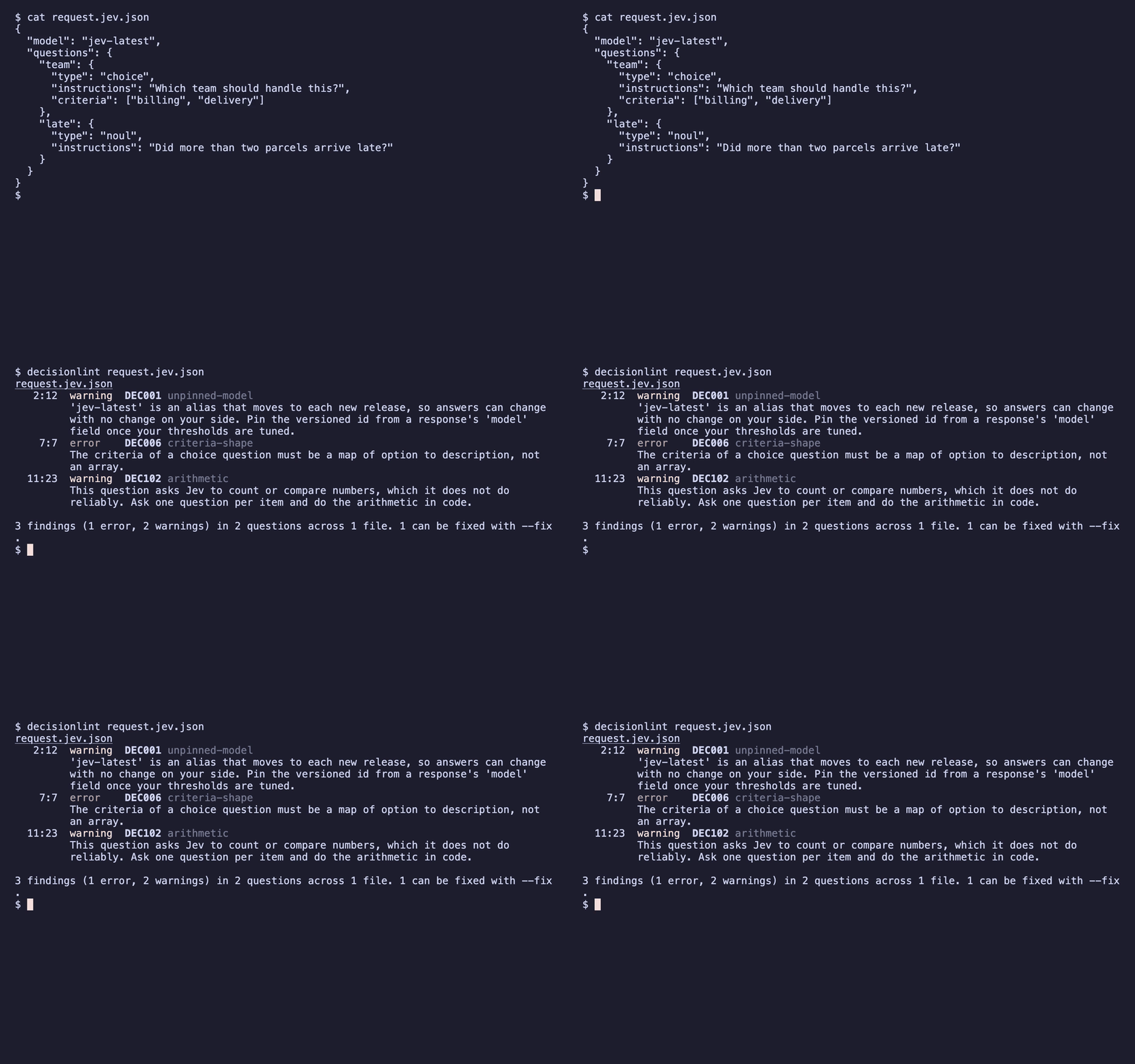
This package is the command line and the library, with the MCP server behind
--mcp. An agent host installs the server on its own as
decisionlint-mcp. None of it
needs an API key or uses the network, unless you pass --ask to the command
line.
Command line
npx decisionlint src/                 # a directory, searched for files it reads
npx decisionlint request.jev.json     # one file
npx decisionlint --format github .    # annotations on a pull request
It reads JSON, JavaScript, TypeScript, Python, Rust and Go, in TypeSafe's
request shape and in OpenAI's Decisions API shape. For any other language,
have your program write the request it sends to a .jev.json file and lint
that.
It exits 0 when the run passes, 1 when a finding fails it, and 2 when it
could not do what was asked. Errors always fail a run. Warnings fail it only
past --max-warnings.
| Option | What it does |
|---|---|
| --format <stylish\|compact\|json\|github\|sarif\|junit> | How findings are printed. stylish groups them by file and is the default. compact is one per line as path:line:column. sarif is for code scanning and junit for test reporters. Also -f |
| --rule <CODE=level> | Set one rule to off, hint, info, warning or error. A rule's name works in place of its code, and warn means warning |
| --config <file> | Use this settings file, and no decisionlint.json found near the files. Also -c |
| --max-warnings <n> | Fail when more than n warnings are reported |
| --stdin-filename <path> | Lint standard input as if it were that file |
| --fix | Write the fixes that only mend what the API would refuse |
| --quiet | Print errors only |
| --ask | Also ask the model about each question. Sends them to the platform the model id names: TypeSafe with TYPESAFE_API_KEY by default, OpenAI with OPENAI_API_KEY under --ask-model gpt-6-luna, OpenRouter, Vercel AI Gateway, LLM Gateway or Liquid AI under their spellings, or wherever --ask-endpoint says |
| --ask-plan | Say what --ask would send, and send nothing |
| --ask-platform <id> | Where --ask sends, named outright: typesafe, openai, openrouter, vercel, llmgateway or liquid, each with its own key variable and a default model in its own spelling. Without it a model id goes where its spelling says |
| --ask-model <id> | The model --ask asks: a Jev version, gpt-6-luna for OpenAI's Decisions API, or a model id in another platform's spelling. Default jev-1.13.0 |
| --ask-endpoint <url> | The full URL --ask posts to, for a platform you host or a gateway spelling of the model that names no host. Also read from DECISIONLINT_ASK_ENDPOINT. A host the tool does not know is sent the key of the shape, or none |
| --ask-shape <shape> | The shape sent to --ask-endpoint where its path does not end in /systemone or /decisions: typesafe or openai. Also read from DECISIONLINT_ASK_SHAPE |
| --ask-max-calls <n> | The most requests --ask may send in the run. Default 25 |
| --ask-send-state | With --ask, also send state written out in a file |
| --color, --no-color | Colour the default format, or do not. Without either it is coloured in a terminal, unless NO_COLOR is set |
| --no-error-on-unmatched-pattern | Pass when the paths hold no file to lint |
| --mcp | Run as an MCP server |
Asking a model
--ask runs the checks that ask a decision model, DEC301 to DEC312, after
the linting. It is the only option that uses the network, and nothing in a
settings file can turn it on.
npx decisionlint --ask-plan src/                    # what it would send. No key, nothing sent
TYPESAFE_API_KEY=... npx decisionlint --ask src/ # send it--ask-platformnames where it goes:typesafe,openai,openrouter,vercel,llmgatewayorliquid, each with a default model in its own spelling and its own key variable,TYPESAFE_API_KEY,OPENAI_API_KEY,OPENROUTER_API_KEY,AI_GATEWAY_API_KEY,LLM_GATEWAY_API_KEYorLIQUID_API_KEY. Without it,--ask-modelwith a platform's spelling,~typesafe/jev-latestfor OpenRouter, sends there, and a bare id goes to its vendor. The key is read from that variable and from nowhere else, and is never printed. Each finding from any model butjev-1.13.0says that its cutoff was set on Jev.--ask-endpoint, orDECISIONLINT_ASK_ENDPOINT, sends to a platform you host, with--ask-shapewhere the path does not say which shape it takes. A spelling that names no host is refused without it, with nothing sent.- A question with a part built at runtime is never sent. The summary counts the ones held back.
- State is not sent unless you add
--ask-send-state. --ask-max-callsis a limit for the whole run. A run that needs more exits 2, so a job cannot pass after checking part of a project.- A rejected key, a failed request or a run you stop also exits 2, and says how many requests were answered of how many were planned.
- These findings are warnings or less by default, so they fail a run only
when
--ruleraises one or--max-warningsis passed.
In the editor
Installed in a project's dev dependencies, this package is also what the DecisionLint extension lints with in VS Code, so the editor and CI report the same findings from the same version. It needs 0.3.0 or newer and a trusted workspace.
Settings
A decisionlint.json in your project sets rule levels, and the VS Code
extension reads the same file, so the editor and CI agree.
{
  "rules": { "DEC004": "error", "DEC112": "off" },
  "ignore": ["DEC004:department"],
  "exclude": ["fixtures", "**/*.generated.ts"]
}
exclude lists files and folders not to lint, relative to the settings file.
The nearest one to each file is used, looking no higher than the directory the command is run in.
MCP server
For an AI agent that writes Jev or OpenAI Decisions questions. It can lint what it wrote and fix it before you see it. The tool descriptions and the server's instructions name both vendors, so an agent knows to call it for either shape.
An agent host should install
decisionlint-mcp, which is
this server and nothing else, with no flag to forget. A project that already
has this package reaches the same server with the flag:
{
  "mcpServers": {
    "decisionlint": { "command": "npx", "args": ["-y", "decisionlint", "--mcp"] }
  }
}
| Tool | What it does |
|---|---|
| lint_text | Lints a request body or source code passed as text. Each finding carries the edit that would mend it |
| lint_paths | Lints files or directories on disk |
| fix_text | Returns the text with the safe fixes applied, and the report of what is left. Writes nothing |
| list_rules | Lists every rule with what it means, its default level and its pages |
| explain_rule | A rule's own page as Markdown: an example that is flagged, one that is not, how to fix it and how to silence it |
| plan_ask | What ask_model would send, and sends nothing |
| ask_model | Asks Jev or Luna to check the questions in text or files, with your key, as --ask does |
| probe_question | Sends one question with its layout varied and reports whether the answer held, with your key |
Every tool answers as structured content beside the text. The first six send
nothing and need no key. The two that send read TYPESAFE_API_KEY or
OPENAI_API_KEY from the server's environment, or from .env.local or
.env in its working directory, never from an argument. The server is listed
on the MCP registry as io.github.nolindnaidoo/decisionlint.
As a library
const decisionlint = require('decisionlint');

const { findings } = decisionlint.lint(text, options, 'js');
const { text: mended, fixed } = decisionlint.fix(text, options, 'js');
lint and fix are pure: no filesystem, no network. options takes the
same rules, fallbackOptions and ignore as decisionlint.json. The third
argument is the syntax, one of syntaxes: js for JSON, JavaScript and
TypeScript, then python, rust and go. Any other value throws, naming
those four. rules lists every rule
with its name, default level and pages, and api is the number an editor
checks before loading a copy. Names here are only added to. A change that
removes or alters one raises api.
What it does not do
Nothing here reaches the network unless asked to: --ask on the command
line, and ask_model and probe_question on the server, each with your
key. Linting, fixing and the rule pages are offline.