
depbisect
v0.1.5
Published
git bisect, but for dependency updates — find the minimal set of dependency changes (npm, pnpm, yarn, Cargo, Go, uv, Composer, pip) between two commits that breaks your build, and prove it's minimal.

Maintainers
 teslatickles
Readme
You merge a PR that bumps 40 dependencies. CI goes red. Which bump broke it?
git bisect walks commits — DepBisect bisects the dependency changes themselves: it diffs the direct dependencies in your manifest (package.json, Cargo.toml, go.mod, pyproject.toml, composer.json, or requirements.txt) between two revisions, then narrows them to the exact minimal subset that makes your command fail — and proves no smaller set does. Every install runs in a throwaway git worktree, so it never touches your checkout.
Why DepBisect
Reach for it when a dependency-update PR (Dependabot, Renovate, or a manual bump) turns CI red and you can't tell which bump did it — especially when dozens changed at once, or when the culprit only breaks in combination with another bump.
| Instead of… | The catch | DepBisect |
| ------------------------- | --------------------------------------------------------------------------------- | ------------------------------------------ |
| git bisect | Bisects commits — useless when the break is inside one dependency-bump commit | Bisects the dependency changes themselves |
| Reverting bumps by hand | O(n) reinstalls, easy to miss interacting deps, no proof you found the real cause | ddmin + an automatic 1-minimality proof |
| Reading the lockfile diff | Shows what resolved differently, not what broke | Pinpoints the exact minimal breaking set |
| npm why / npm ls | Explains the dependency tree, not the failure | Ties the failure to specific version bumps |
How it works
DepBisect diffs the direct dependencies declared in your manifest between two revisions, then runs Zeller's ddmin delta-debugging algorithm to find the smallest failing subset — followed by a one-by-one removal pass that certifies the result is 1-minimal (removing any single package from the set makes the failure stop reproducing).
Install
npm install -g depbisect
# or: pnpm add -g depbisect

# …or run without installing:
npx depbisect run --base origin/main -- npm test
This package ships a prebuilt binary for your platform as an optional dependency. There is no Go toolchain to install, no post-install script, and no network fetch at install time — just the binary for your os/cpu.
Quick start
cd your-repo   # your tests fail after a dependency bump

# Preview which dependencies changed (installs nothing):
depbisect run --base origin/main --dry-run -- npm test

# Bisect, re-running each candidate 3x to absorb flaky tests:
depbisect run --base origin/main --runs 3 -- npm test

# Interrupted? Resume where you left off:
depbisect run --base origin/main --runs 3 --resume -- npm test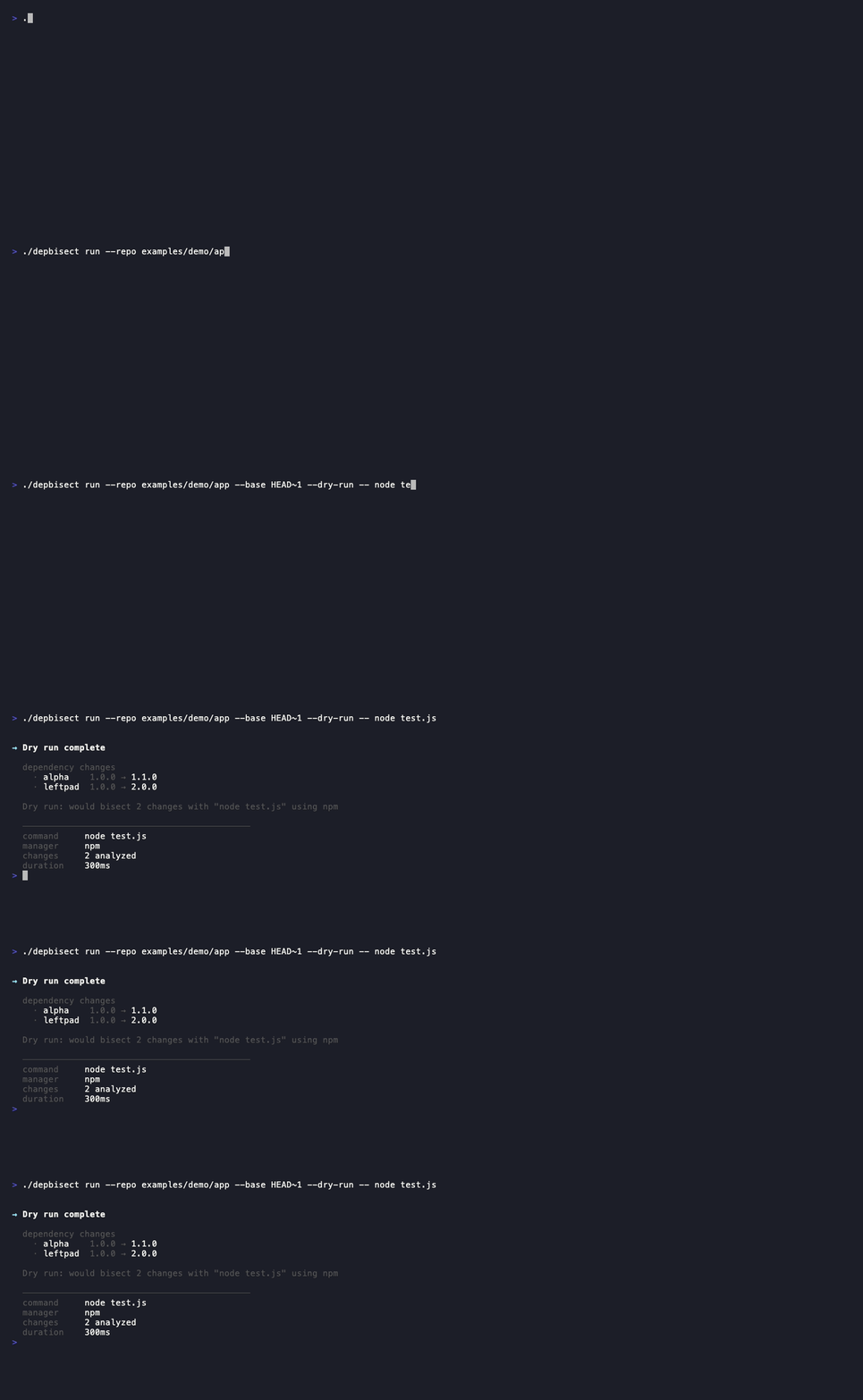
Example output
$ depbisect run --base origin/main --runs 3 -- npm test

  baseline  all reverted  → pass  (3/3)
  baseline  all applied   → fail  (3/3)

  ddmin     12 changes → 6 → 3 → 5 → 4 → …
  reproduced            → 5 packages

  minimality  removing eslint-plugin-react        → pass ✓
  minimality  removing @typescript-eslint/parser  → pass ✓
  minimality  removing webpack                    → pass ✓
  minimality  removing react-scripts              → pass ✓
  minimality  removing jest-environment-jsdom     → pass ✓

  result  1-minimal failing set (5 of 12 changes)

    react-scripts              4.0.3  →  5.0.1
    jest-environment-jsdom    27.5.1  →  29.7.0
    webpack                   5.75.0  →  5.97.1
    @typescript-eslint/parser 5.62.0  →  7.18.0
    eslint-plugin-react       7.31.2  →  7.37.2

  report  depbisect-report.md
  report  depbisect-report.json
Supported ecosystems
| Manager | Manifest | Lockfile |
| ------- | ---------------- | ------------------------------- |
| npm | package.json | package-lock.json (v1–v3) |
| pnpm | package.json | pnpm-lock.yaml (v5/v6/v9) |
| yarn | package.json | yarn.lock (classic + Berry) |
| cargo | Cargo.toml | Cargo.lock |
| go | go.mod | go.sum |
| uv | pyproject.toml | uv.lock |
| composer | composer.json | composer.lock |
| pip | requirements.txt | requirements.txt (exact == pins) |
Auto-detected from the manifest, or force one with --pm <npm|pnpm|yarn|cargo|go|uv|composer|pip>.
Parallel bisection with --jobs
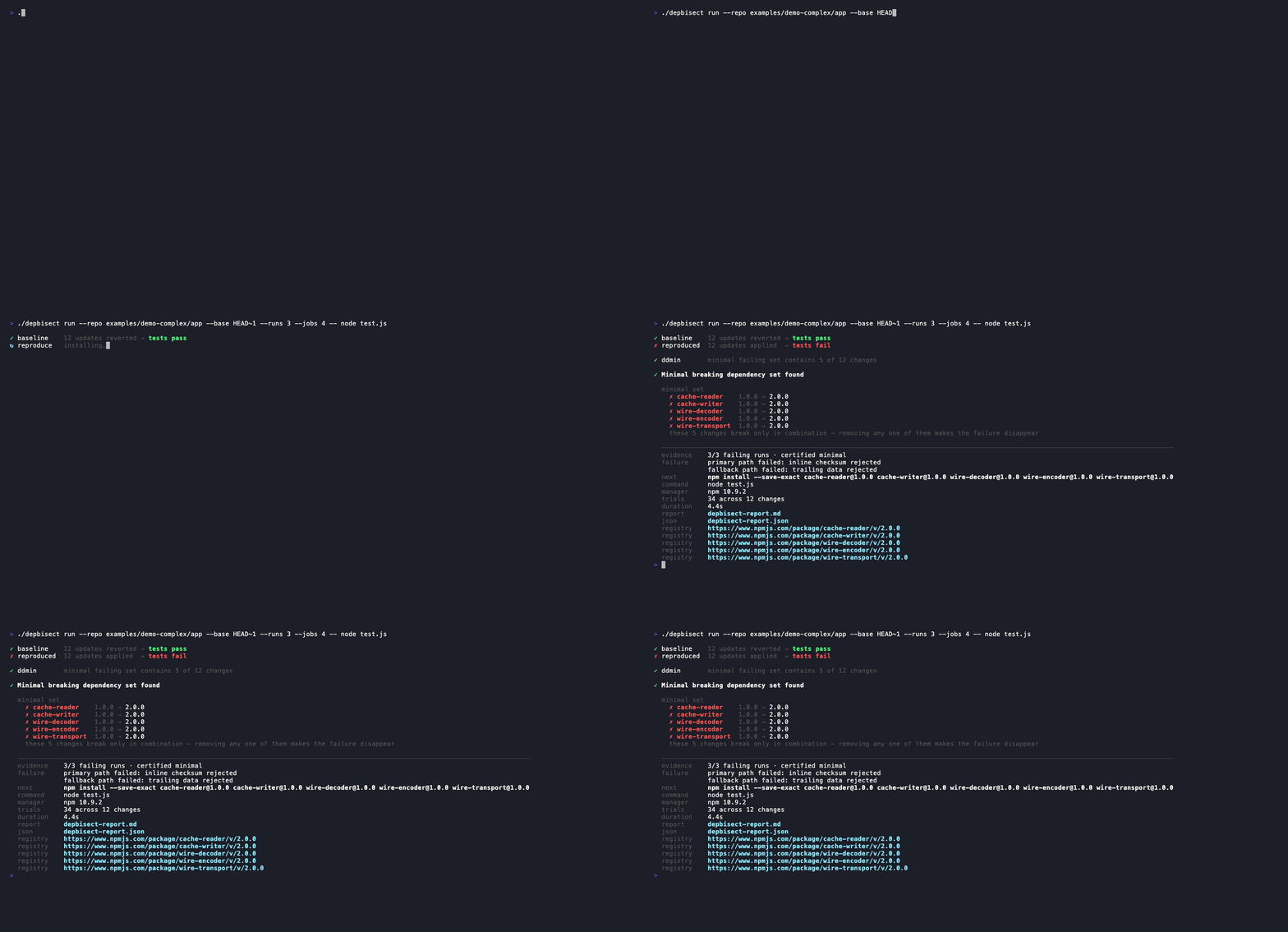
Candidate subsets are independent — DepBisect can evaluate them across several isolated worktrees at once. Same minimal result at any job count; only the wall time changes.
Sequential (--jobs 1):

Parallel (--jobs 12):

Resume after interrupt
Press Ctrl-C mid-bisection and DepBisect checkpoints completed trials to disk. Re-run with --resume to restore them instead of starting over.

Common flags
| Flag | Description |
| ----------------------- | ----------------------------------------------------------------------------- |
| --base <rev> | Base revision to compare against (required) |
| --to <rev> | Target revision (default HEAD) |
| --runs <n> | Verification runs per candidate; raises confidence on flaky tests (default 1) |
| --jobs / -j <n> | Evaluate candidates in parallel across isolated worktrees (default 1) |
| --dry-run | Show detected changes and plan, then exit without bisecting |
| --resume | Resume completed trials from the checkpoint |
| --quiet / --verbose | Print only the final result / stream all subprocess output |
| --pm <manager> | Force a package manager (default: auto-detected) |
Exit codes
| Code | Meaning |
| ---- | ---------------------------------------------------------- |
| 0 | Minimal failing set found |
| 1 | Usage or runtime error |
| 2 | Failure did not reproduce with all updates applied |
| 3 | Command fails even with all updates reverted |
| 4 | Inconclusive: flaky verification or minimality unprovable |
| 5 | No direct dependency changes between the revisions |
GitHub Action
- uses: skyneticist/depbisect@v0
  with:
    base: ${{ github.event.pull_request.base.sha }}
    command: npm test
    runs: "3"
Safety
- Your checkout is never modified — all installs happen in a DepBisect-owned temporary worktree.
git reset --hardandgit clean -ffdxrun only inside that worktree.- The worktree is removed and pruned afterward, even on Ctrl-C.
- Arguments are preserved exactly — no shell evaluation unless you invoke one.
Installing dependencies runs their lifecycle scripts, exactly as a manual
npm installwould. Bisecting untrusted version ranges therefore executes untrusted code — run it in the same sandbox you'd trust fornpm installof those versions.
More
Licensed under the MIT License.