
dialit
v1.0.0
Published
TypeScript conversational flow engine for versioned chatbot definitions.

Maintainers
 pailletjp
Readme
Dialit
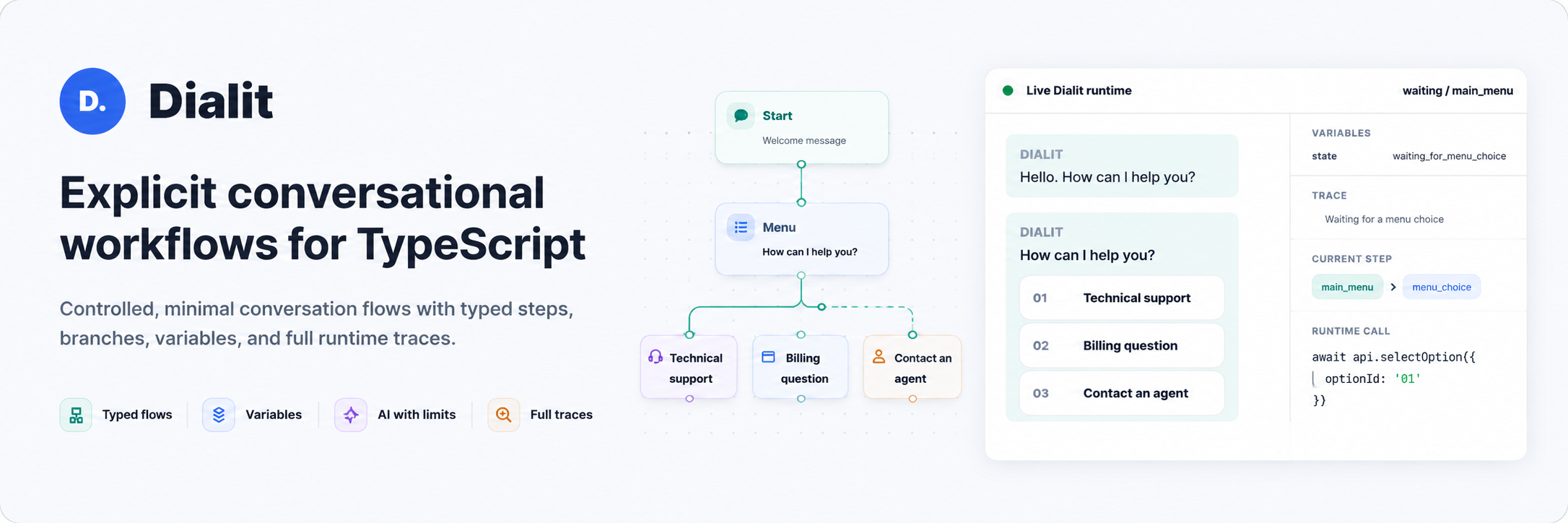







Dialit is a framework-agnostic TypeScript runtime for explicit conversational workflows.
It gives product teams a small, typed engine for the part of chatbot systems that usually becomes hard to reason about: steps, routes, variables, operations, emitted events, LLM boundaries, and decision traces. Your application keeps control of HTTP, persistence, UI, queues, observability, authentication, and model providers.
Quick Links
- Documentation: https://dialit.netlify.app/
- npm: https://www.npmjs.com/package/dialit
- Repository: https://github.com/PailletJuanPablo/dialit
- Issues: https://github.com/PailletJuanPablo/dialit/issues
Why Dialit
| Need | Dialit provides | | --- | --- | | Model conversations as source-controlled data | Versioned TypeScript flow definitions for steps, routes, variables, operations, and endings. | | Debug real runtime behavior | Every turn returns messages, choices, variables, events, status, and trace data. | | Keep AI usage explicit | Generated responses and semantic input depend on declared services instead of hidden fallbacks. | | Integrate with existing systems | Action, handoff, custom-operation, and repository interfaces stay owned by your app. | | Avoid framework lock-in | The runtime can sit behind Express, Fastify, Next.js, serverless handlers, workers, queues, or local tests. | | Ship a lean dependency tree | The package has zero runtime dependencies and no peer dependency requirements. |
Install
npm install dialitDialit is ESM-only, includes TypeScript declarations, and requires Node.js 20 or newer.
Package Surface
import {
  createConversationApi,
  createConversationEngine,
  validateFlowDefinition,
  type FlowVersion,
} from "dialit";

import {
  InMemoryConversationRepository,
  InMemoryConversationStateRepository,
  InMemoryConversationEventRepository,
  InMemoryDecisionTraceRepository,
  InMemoryFlowVersionRepository,
} from "dialit/runtime-support";
| Entry point | Use it for |
| --- | --- |
| dialit | Engine creation, API adapter, flow validation, and public TypeScript contracts. |
| dialit/runtime-support | In-memory repositories, default clocks, IDs, event/message factories, traces, and variable helpers. |
Design the Flow
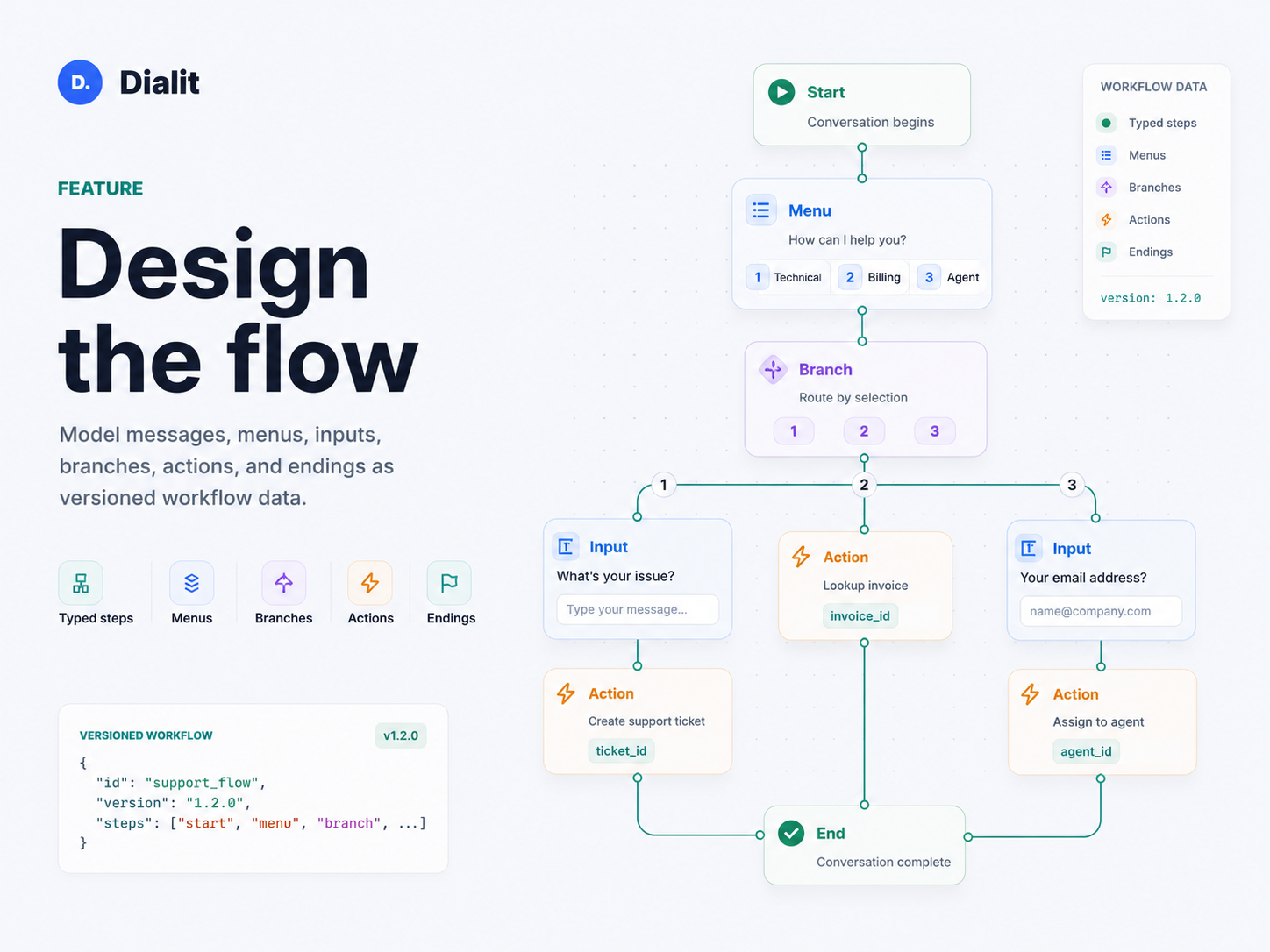
Dialit flows are plain data. A flow version declares how a conversation starts, which steps can run, how user input is resolved, which variables can change, and where each route can go.
- Built-in steps:
message,menu,input,attachment,condition,end, andcustom. - Built-in operations:
send_message,set_variable,unset_variable,invalidate_variable,run_action,call_flow,emit_event,handoff, andcustom. - Input tools: normalizers, extractors, validators, semantic resolvers, global commands, and attachment rules.
- Integration boundaries: actions, handoffs, custom operations, semantic input, and generated responses are explicit capabilities.
First Flow
import {
  createConversationApi,
  validateFlowDefinition,
  type FlowVersion,
} from "dialit";

const flowVersion: FlowVersion = {
  flowVersionId: "support-v1",
  flowId: "support",
  version: "1.0.0",
  status: "draft",
  schemaVersion: "0.1",
  createdAt: "2026-05-22T12:00:00.000Z",
  definition: {
    flowId: "support",
    startStepId: "welcome",
    variables: [],
    steps: [
      {
        stepId: "welcome",
        type: "message",
        config: {
          messages: [{ mode: "static", text: "How can we help?" }],
        },
        routes: [
          {
            routeId: "finish",
            match: { type: "outcome", outcome: "next" },
            branch: { target: { type: "end", status: "completed" } },
          },
        ],
      },
    ],
  },
};

const report = validateFlowDefinition(flowVersion.definition);
if (!report.valid) {
  throw new Error(report.issues.map((issue) => issue.message).join("\n"));
}

const api = createConversationApi({
  flowVersions: [flowVersion],
});

const response = await api.start({
  conversationId: "conversation-1",
  flowVersionId: "support-v1",
  channel: "web",
});

console.log(response.statusCode);
console.log(response.body.messages[0]?.text);
console.log(response.body.trace.finalStepId);
createConversationApi returns transport-neutral HTTP-style responses. Map those responses to your controller, worker, queue consumer, or UI boundary.
Runtime API
Use the API adapter for common channel interactions:
await api.start({
  conversationId: "conversation-1",
  flowVersionId: "support-v1",
});

await api.sendMessage({
  conversationId: "conversation-1",
  text: "I need billing help",
});

await api.selectOption({
  conversationId: "conversation-1",
  optionId: "billing",
});
Use the lower-level engine when you want direct access to turn results:
import { createConversationEngine } from "dialit";

const engine = createConversationEngine({
  flowVersions: [flowVersion],
});

const result = await engine.startConversation({
  conversationId: "conversation-2",
  flowVersionId: "support-v1",
});

for (const event of result.events) {
  console.log(event.type);
}

console.log(result.trace.fragments);
Event subscribers run after events are persisted:
const subscription = engine.subscribeToEvents((envelope) => {
  console.log(envelope.event.type, envelope.result.state.status);
});

subscription.unsubscribe();
Subscriber failures are not swallowed, so integration errors remain visible.
Debug Without Guessing
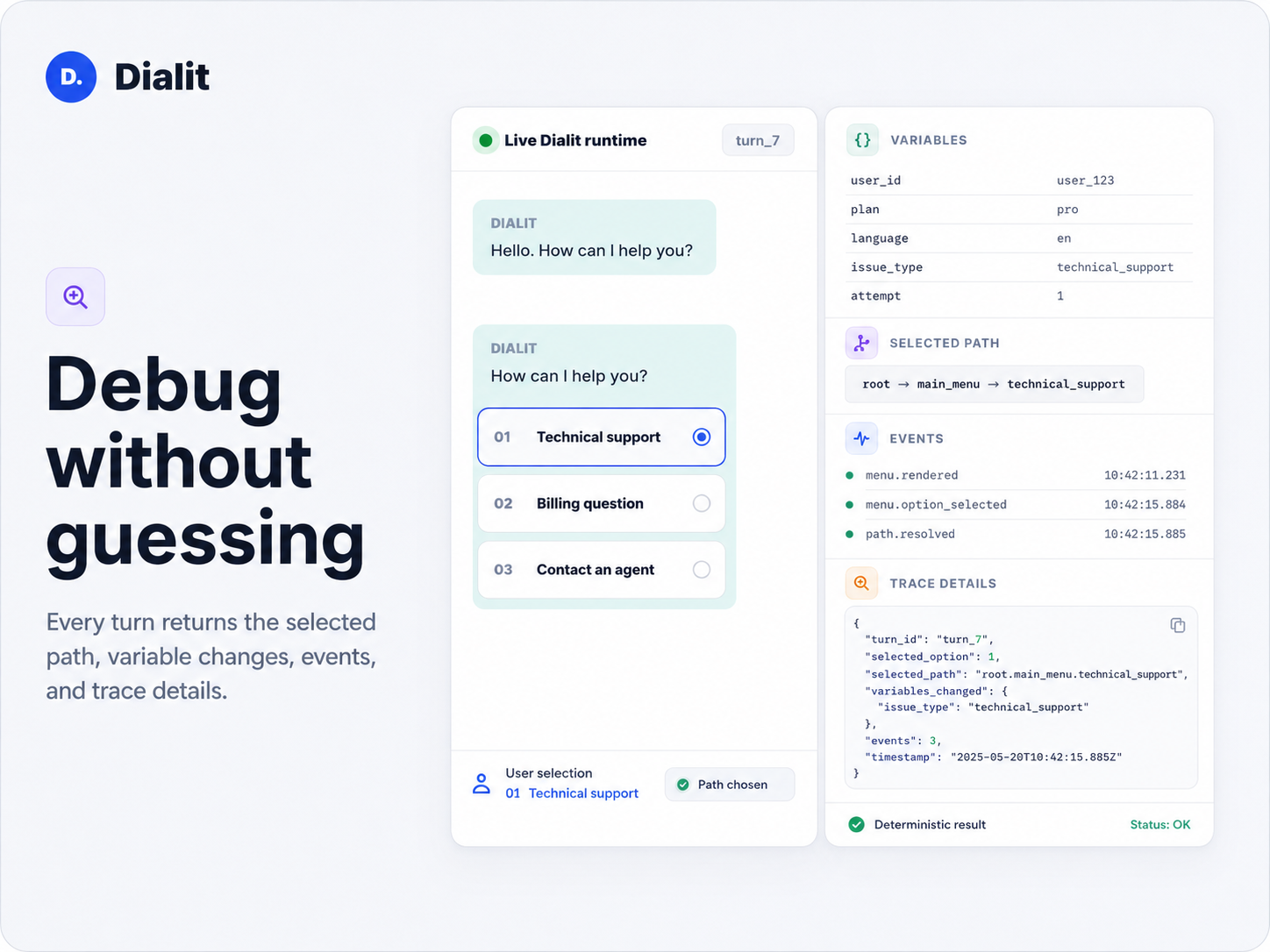
Every turn produces inspectable runtime data:
| Field | Purpose |
| --- | --- |
| messages | Outbound content ready for your channel adapter. |
| choices | Menu options normalized for UI or transport responses. |
| variables | Current variable values with scope, source, metadata, and timestamps. |
| events | Committed conversation events for auditing and integrations. |
| trace | Turn fragments, variable reads, variable patches, operation results, action results, handoff results, flow calls, and LLM usage. |
| error | Structured runtime failures when a flow references missing capabilities or invalid contracts. |
The same artifacts support automated tests, audit trails, support tooling, and production diagnostics.
Zero Runtime Dependencies
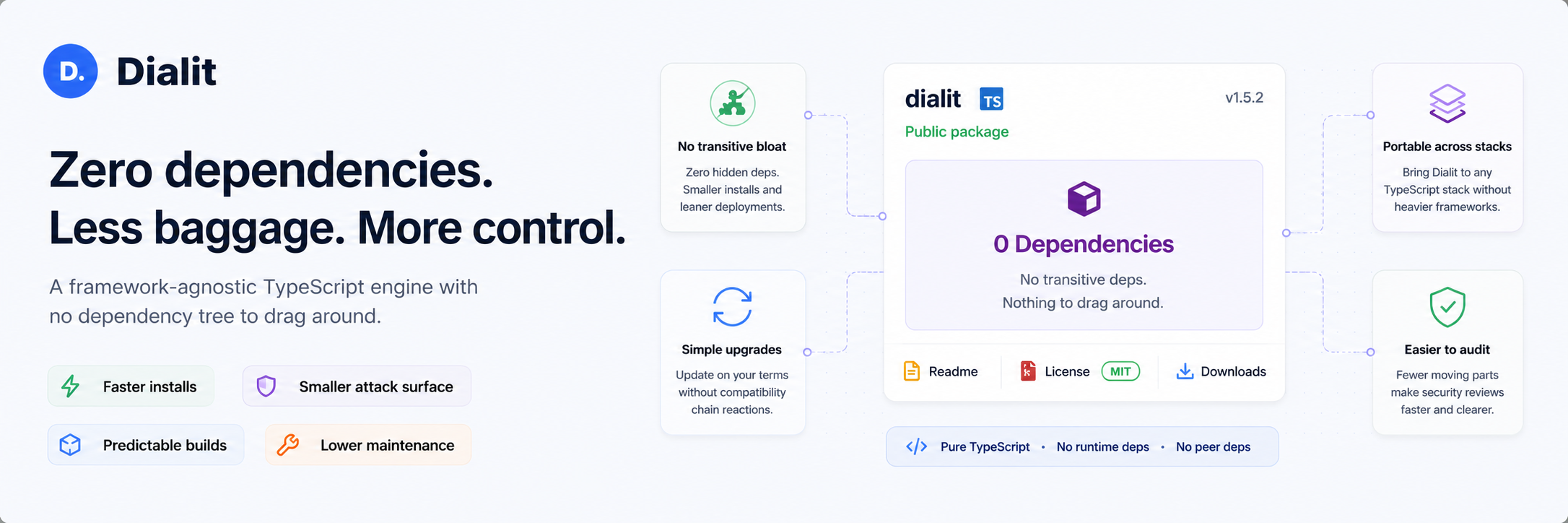
Dialit is intentionally small:
- no runtime dependencies
- no peer dependencies
- no hosted service requirement
- no framework adapter requirement
- no bundled UI layer
The engine is designed to be embedded in existing TypeScript systems without dragging a platform into the application.
Persistence
Prototype code can use the in-memory repositories from dialit/runtime-support. Production applications should provide durable repository implementations.
import { createConversationEngine } from "dialit";

const engine = createConversationEngine({
  repositories: {
    flowVersions,
    conversations,
    states,
    events,
    traces,
  },
});
Repository implementations can target SQL, document stores, event stores, or application-specific persistence.
Validation
Validate flow definitions before they are published or executed:
const report = validateFlowDefinition(flowVersion.definition, {
  registeredStepTypes: ["message", "menu", "input", "end"],
  registeredOperationTypes: ["send_message", "set_variable", "run_action"],
});

if (!report.valid) {
  for (const issue of report.issues) {
    console.error(issue.path, issue.message);
  }
}
Validation is explicit by design. If a flow depends on custom steps, custom operations, semantic input, generated responses, actions, or handoffs, register the capabilities your runtime actually supports.
Documentation
The full documentation site includes the public API reference, authoring guide, integration patterns, and runnable examples:
License
MIT. See LICENSE.