
doppler-gpu
v0.5.1
Published
Browser-native WebGPU inference engine for local intent and inference loops

Maintainers
 clocksmith
Readme
doppler-gpu




Doppler turns inference engineering into a verifiable search problem. Optimizers edit JSON manifests, execution plans, and WGSL kernels; parity and benchmark gates accept or reject each candidate against correctness and speed.
These contracts and gates are used by operators to tune a configurable and pure JavaScript and WGSL sourced WebGPU runtime for supported RDRR artifacts in browser, Node, and Bun. Doppler runs text generation, embeddings, and reranking locally, with CLI and OpenAI-compatible server entry points.
Read this first: getting started → Root API → open source evidence
Try the live demo | npm | docs
npx doppler-gpuSupported RDRR model types
Doppler classifies artifacts by what they consume and produce. This is
separate from lineage (family), runtime implementation (modelType), and
artifact-size tier.
| Type | Verified / Cataloged | What it does |
| --- | --- | --- |
| Text generators | 12 / 14 | text → text |
| Multimodal generators | 3 / 3 | audio + image + text → text |
| Diffusion language models | 0 / 1 | text → text |
| Translation specialists | 2 / 2 | text → text |
| Language embedders | 2 / 2 | text → embedding |
| Rerankers | 2 / 2 | text-pair → relevance-score |
| Protein encoders | 3 / 3 | sequence → embedding + token outputs |
| Nucleotide encoders | 1 / 1 | dna-seq → embedding |
The full model-support matrix lists every lane and its lifecycle evidence. Classification says what an artifact is shaped to do; only lifecycle receipts establish what is verified, and a runtime pass does not by itself qualify every declared input modality.
LoRA: runtime loading and training
Doppler supports:
- SafeTensors LoRA loading and hot-swap at runtime.
- Experimental SFT/LoRA training in Node, Bun, and browser via
doppler-gpu/training. - Native packed-Q4K LoRA for
qwen-3-5-0-8b-q4k-ehaf16inwebgpu_native(frozen base, LoRA A/B updates only). - External backends for other packed-Q4K training targets.
npx doppler-gpu lora --config ./workload.json --surface nodeActive adapters are registered in models/adapters/catalog.json. The training API, workload schema, and adapter families live in the LoRA Format specification, Training handbook, and Training API.
Evidence
Doppler has higher steady-state inference throughput than Transformers.js in accepted, throughput-comparable browser WebGPU comparisons indexed below where the throughput gate passes.
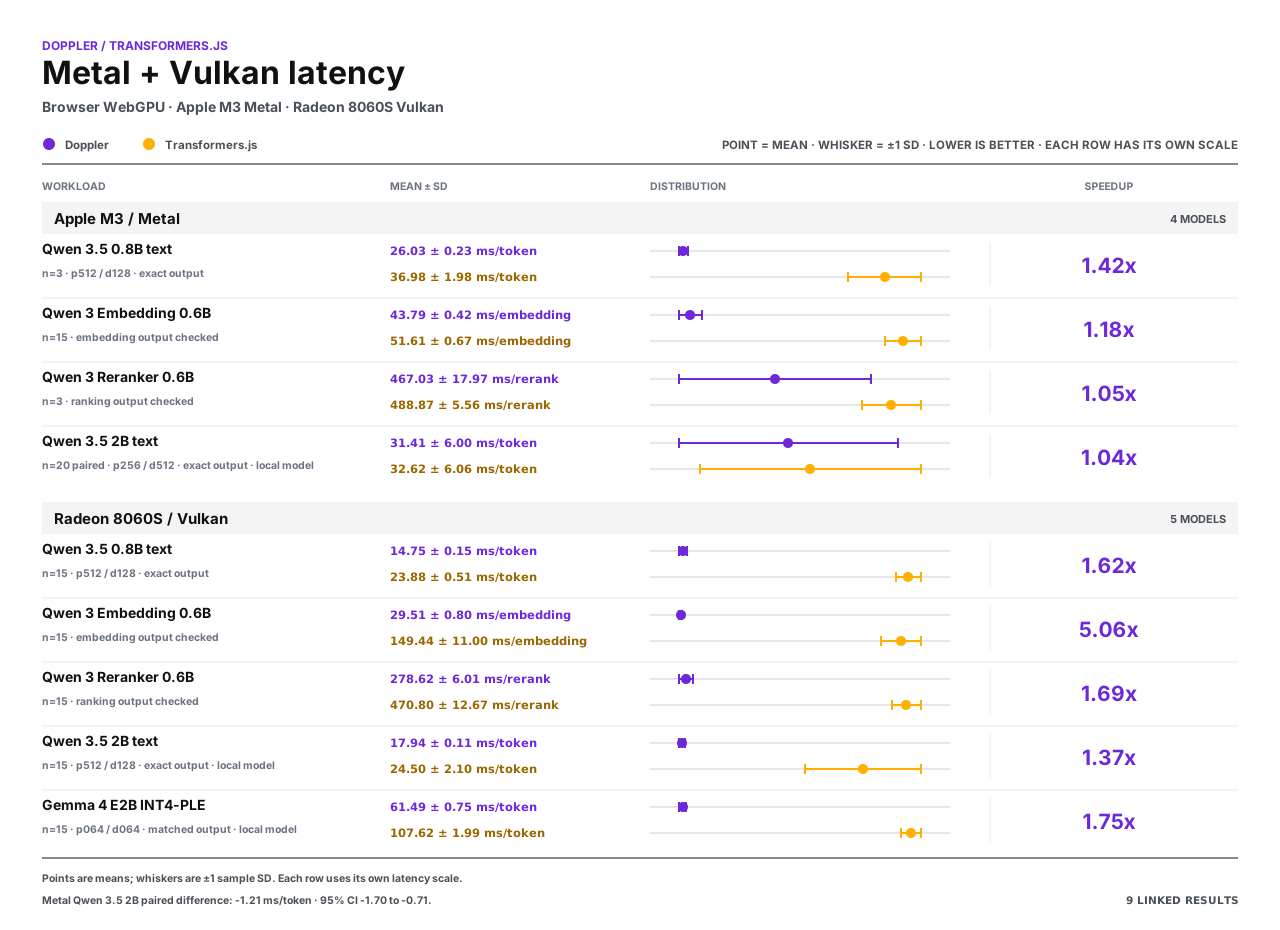
Text uses tok/s, embeddings use embedding/s, and reranking uses rerank/s; higher is faster. Every comparison passes its declared workload correctness gate. Model loading is separate: Transformers.js loads the Vulkan embedding and reranker artifacts faster. The competition scoreboard links every receipt, and the methodology defines the gates.
Why these lanes are faster
Doppler speedups come from specific, explicit runtime changes:
- Fusion: projection + FFN path reductions reduce kernel count.
- Attention/layout tuning: lowers prefill overhead.
- Batched decode: amortizes readback overhead.
- Packed kernels: Q4_K + INT4-PLE reduce projection traffic.
Evidence receipts:
Retention is gated: a lane moves forward only when both parity and benchmark receipts pass in the challenger framework.
Long-term direction
Humans run this loop today. WGSL-distillation is experimental. Automation in kernel generation/autotuning is a roadmap item, not shipped yet. New checkpoints and GPUs still go through the same parity and benchmark gate flow.
How it works
flowchart TB
  subgraph Propose["1 · Propose"]
    direction LR
    HUMAN["Engineer or optimizer"]
    CANDIDATE["Candidate edit<br/>manifest · plan · WGSL"]
    HUMAN --> CANDIDATE
  end

  subgraph Run["2 · Resolve and run"]
    direction LR
    ARTIFACT["RDRR artifact<br/>manifest · weights · tokenizer"]
    REQUEST["Request + runtime profile"]
    VALIDATE["Validate contracts"]
    RESOLVE["Resolve execution graph<br/>kernel refs · session"]
    LOAD["Load + bind<br/>GPU buffers · cache"]
    DISPATCH["Dispatch WGSL<br/>prefill · decode · retrieval"]
    OUTPUT["Tokens · embeddings · scores"]

    ARTIFACT --> VALIDATE
    REQUEST --> VALIDATE
    CANDIDATE --> VALIDATE
    VALIDATE --> RESOLVE --> LOAD --> DISPATCH --> OUTPUT
  end

  subgraph Verify["3 · Evidence disposes"]
    direction LR
    PARITY{"Parity gate<br/>correct vs reference"}
    BENCH{"Benchmark gate<br/>comparable speed vs prior"}
    RETAIN["Retain<br/>versioned lane + receipt"]
    REJECT["Reject<br/>finding + negative result"]

    OUTPUT --> PARITY
    PARITY -- pass --> BENCH
    PARITY -- mismatch --> REJECT
    BENCH -- pass --> RETAIN
    BENCH -- fail --> REJECT
  end

  RETAIN -. reusable asset .-> HUMAN
  REJECT -. search memory .-> HUMAN

  classDef proposal fill:#fff1f3,stroke:#ff6b7a,color:#08090c,stroke-width:2px;
  classDef runtime fill:#eef4ff,stroke:#5d8dff,color:#08090c,stroke-width:2px;
  classDef gate fill:#f7f1ff,stroke:#b98cff,color:#08090c,stroke-width:2px;
  classDef accepted fill:#08090c,stroke:#5d8dff,color:#ffffff,stroke-width:3px;
  classDef rejected fill:#fff1f3,stroke:#ff6b7a,color:#08090c,stroke-width:2px;

  class HUMAN,CANDIDATE proposal;
  class ARTIFACT,REQUEST,VALIDATE,RESOLVE,LOAD,DISPATCH,OUTPUT runtime;
  class PARITY,BENCH gate;
  class RETAIN accepted;
  class REJECT rejected;

  style Propose fill:#fffafa,stroke:#ff6b7a,stroke-width:1px
  style Run fill:#f8faff,stroke:#5d8dff,stroke-width:1px
  style Verify fill:#fcfaff,stroke:#b98cff,stroke-width:1px
  linkStyle default stroke:#5d8dff,stroke-width:2px;
The full resolve, load, bind, dispatch, and readback flow lives in the architecture document. Unsupported paths fail closed. Doppler owns artifact and execution contracts; applications own policy.
New model families need RDRR conversion and may need tokenizer, graph, or kernel support.
Ouroboros/Reploid keeps orchestration above this boundary. Program Bundles preserve program identity for downstream backends.
Quick start
Browser
The live demo runs locally and works offline after its first model download. Its public API boundary, observation tiers, generated PWA shell, and independent contract/hardware smoke receipts are documented in demo/README.md.
CLI
npx doppler-gpu "Summarize WebGPU in one sentence"
npx doppler-gpu --model qwen3-0.8b --prompt "Write a haiku about GPUs"
npx doppler-gpu --list-models
Root API
The dr facade is the primary app API. Advanced APIs use package subpaths.
import { dr } from 'doppler-gpu';

// Explicit scoped API with a stable result envelope
const session = await dr.open('qwen3-0.8b');
const result = await session.generate('Describe WebGPU briefly');
console.log(result.outputText, result.fingerprint);
await session.close();

// Stream tokens
const model = await dr.load('qwen3-0.8b');
for await (const token of model.generate('Describe WebGPU briefly')) {
  process.stdout.write(token);
}

// One-shot
const text = await model.generateText('Explain WebGPU in one sentence');

// One-shot with a hash-bound execution receipt
const evidence = await model.generateWithEvidence('Explain WebGPU in one sentence', {
  maxTokens: 64,
  temperature: 0,
});
console.log(evidence.outputText, evidence.transcriptHash);

await model.unload();
generateWithEvidence() returns the text and token IDs together with canonical
SHA-256 hashes for the transcript, resolved generation config, runtime profile,
WebGPU backend, and execution-plan identity. The receipt records what ran; it
does not by itself establish output correctness.
OpenAI-compatible server
npx doppler-serve --model qwen3-0.8b --port 8080Point an OpenAI client at http://localhost:8080/v1:
import OpenAI from 'openai';
const client = new OpenAI({ baseURL: 'http://localhost:8080/v1', apiKey: 'unused' });
const response = await client.chat.completions.create({
  model: 'qwen3-0.8b',
  messages: [{ role: 'user', content: 'Hello' }],
});
Registry IDs resolve to hosted RDRR artifacts from clocksmith/rdrr by default. See the Root API guide.
Start here
Pick a path
- Application builders: start with getting started, Root API, and the OpenAI-compatible server.
- Integrators: use the RDRR format, support matrix, and Program Bundles.
- Kernel/inference engineers: follow architecture, performance optimization, and the challenger framework.
- Evidence reviewers: review the scoreboard, methodology, and release matrix.
The docs index owns the complete model, subsystem, API, architecture, and operator inventory.
Environment requirements
WebGPU is required. Use a current Chromium browser; Node installs the webgpu
provider as an optional dependency.