
dsh-auto-review
v0.12.17
Published
Second-model AI auto-review for DeepSeek Harness approval requests: a read-only reviewer subagent decides allow/deny on the approval answerer chain, with fail-closed fallback and full session-log audit.
Downloads
6,933

Maintainers
 perrylink
Readme
🤖 dsh-auto-review

Second-model AI approval for DeepSeek Harness — a read-only reviewer subagent decides allow/deny on the approval chain, fail-closed by default.
When an action crosses the sandbox boundary, a second model reads the evidence and returns a verdict with a reason — so humans approve nothing while nothing unsafe slips through.
Official repository. This is the only official repository of dsh-auto-review, maintained by PerryLink. Same-name repositories under other accounts are not affiliated.









English · 简体中文 · Español · Português · हिन्दी
📖 Ecosystem knowledge base — measured data, not marketing: plugin development guide · plugin-selection data · maintenance criteria.
⭐ 如果它帮到了你
这个插件是 DSH 插件家族的一员(40+ 个,全部 Apache-2.0)。如果你在用,给个 star —— 它不会解锁任何功能,但会让下一个人在搜索里更容易找到它。
English: part of a 40+ plugin family for DeepSeek Harness. If it is useful, a star helps the next person find it — nothing is gated behind it.
What is dsh-auto-review?
Second-model AI approval for DeepSeek Harness — a read-only reviewer subagent decides allow/deny on the approval chain, fail-closed by default.
When an action crosses the sandbox boundary, a second model reads the evidence and returns a verdict with a reason — so humans approve nothing while nothing unsafe slips through.

The same run, animated.
Compatibility
| Surface | Status |
|---|---|
| Harness | DeepSeek Harness dsh-v0.2.1-alpha.1 (verified 2026-09-25). Dual-line npm support: dev pins and runtime deps 0.1.7-rc.2, peers >=0.1.2-rc.1 <0.2.0 \|\| >=0.1.5-alpha.1 <0.2.0 \|\| >=0.1.6-0 <0.2.0 \|\| >=0.1.7-0 <0.2.0 \|\| >=0.1.7-0 <0.2.0 — the plugin code feature-detects the published host lines and each line runs the full gate chain; the runtime dependency pins follow the host line so a profile install never shadows the host's own tree. pnpm-workspace.yaml pins the whole @deepseek-ai/dsh-* graph to that line, because autoInstallPeers otherwise fills the frozen dsh-agent-spine-demo subgraph's ^0.1.1-rc.2 peers with previews that lack the exports the 0.1.7 packages import. On the alpha.2 line the eval fixtures pin deepseek-flash (the removed deepseek-v4-flash id is gone from eval/). |
| Node | ^22.19.0 \|\| >=24.0.0 |
| Platforms | All (host answerer; optional Web review panel via the session-projection capability) |
| Model | Any (the reviewer inherits the session agent's route; reviewerModel overrides) |
What you get
dsh-auto-review puts a second model on the approval/request answerer chain:
- Official seam — an answerer that claims only the requests it owns (
aipolicy) and delegates everything else vianext(); the human approval flow is never short-circuited. - Read-only reviewer subagent — a one-shot fork with a
read/glob/greptool allow-list returns a structured verdict{ decision, reason, riskLevel }. Reviewer asks are recognized by identity and delegated;maxDepth+ the allow-list keep the reviewer non-delegating. - Fail closed — reviewer crash, timeout, or schema mismatch resolves through
fallbackPolicy(defaultrejected); a deny verdict feeds its reason back to the calling model. - Config-driven routing — per-tool policies (
ai/human/never) plus regex risk rules, all changeable from cordis.yml. - Deny reasons reach the model — the reviewer's reason is injected into the denied tool result (callId-linked); fallback and
never-policy rejections inject auditable markers too ([auto-review]/[auto-review-fallback]/[auto-review-never]). - Full audit trail — log-only
autoReview/verdict+autoReview/rejectionsession events (envelopeignorable: true) plus an optional invariant companion enforcing marker ⟺ event. - Safety knobs — a rejection circuit breaker (3 consecutive denials, or 6 of the last 10 verdicts, per turn), a risk-level policy, a one-shot
/auto-review approveoverride, and anever-policy hard disable that explains itself to the model. - Optional reviewer context — a bounded compact transcript (
contextBudget) plus a Codex-style Markdown ruling policy (reviewerPolicyText).
Every decision reconstructs from the session log: approval/asked → autoReview/verdict (or autoReview/rejection) → approval/decided.
Why a second model instead of rules?
Pattern-based auto-approvers decide before dispatch, with no evidence. dsh-auto-review gives the decision to a reviewer subagent that reads the actual workspace (through its read-only tool face), the already-streamed tool-call arguments (sensitive values redacted), the request reason, and your risk rules — then returns a structured verdict. A deny verdict feeds its reason back to the calling model, so the agent learns why instead of retrying blindly.
Quick start
dsh plugin --profile web add github:PerryLink/dsh-auto-review# 1. install the bundle into your profile
dsh plugin --profile web add github:PerryLink/dsh-auto-review
# or from npm (published releases)
dsh plugin --profile web add dsh-auto-review
# 2. restart and verify the row
dsh --profile web --dump-config | grep -A4 'id: auto-review'Out of the box the shipped patch AI-reviews bash and write; every other tool (including edit — in-place modification) delegates to the human chain. Add edit: ai explicitly if you accept in-place edits without a human in the loop.
Install & uninstall
- git channel (latest
main):dsh plugin --profile web add github:PerryLink/dsh-auto-review— the isolatedpreparebuild needs the singleallowBuilds: { esbuild: true }key thedshCLI prints fordsh-auto-review. - npm channel (published releases):
dsh plugin --profile web add dsh-auto-review. - 1024 store channel:
npm i -g dsh1024once, thendsh1024 plugin --profile web add dsh-auto-review(counts toward the deepseek1024.com install ranking). - tarball channel:
pnpm packin this repo, thendsh plugin --profile web add ./dsh-auto-review-<version>.tgz. - uninstall:
dsh plugin --profile web remove dsh-auto-review(or remove the row from the profile patch). - native build scripts: when
dsh plugin addstops atERR_PNPM_IGNORED_BUILDSforkoffi/node-pty(pulled in by the eval harness), runpnpm approve-buildsto approve those build scripts.
Configuration
All tunables are Schemastery Config fields (changeable from cordis.yml). An id-targeted override replaces the whole row — restate every key you need.
| Key | Default | Meaning |
|---|---|---|
| enableByDefault | true | Sessions start with auto-review enabled; /auto-review on\|off writes a durable override that beats this |
| toolsPolicy.default | human | Policy for unlisted tools (delegate to the human answerer) |
| toolsPolicy.overrides | {} | Per-tool policy: ai / human / never |
| riskRules | [] | {pattern, policy, field?} matched before the tool table; field selects reason (default), toolName, or arguments |
| reviewerProvider | fork | Subagent provider for the reviewer (in-process fork backend) |
| reviewerModel | (inherit) | Reviewer model id; unset inherits the session agent's route |
| reviewerTimeoutMs | 60000 | Verdict deadline; on expiry the fallback policy applies |
| reviewerTools | [read, glob, grep] | The reviewer child's tool allow-list (must be non-empty) |
| fallbackPolicy | rejected | Reviewer failure: rejected (fail closed) / delegate / allow-once |
| maxReviewsPerTurn | 10 | Real AI-verdict budget per open turn; beyond it, requests delegate |
| maxFailuresPerTurn | 10 | Reviewer-failure budget per open turn |
| reasonMaxChars | 2000 | Cap for reviewer reasons and the redacted argument preview |
| reviewerGuidance | (none) | Optional advisory guidance appended to the reviewer prompt |
| reviewerPolicyText | (none) | Markdown ruling policy injected into the reviewer prompt (Codex-style) |
| denyGuidance | (anti-circumvention text) | Guidance appended to every injected deny reason |
| contextBudget | {turns: 2, maxChars: 4000} | Compact transcript budget for the reviewer prompt (the open turn plus the one before it); turns: 0 disables the section — and a blind reviewer denies user-authorized actions, so the runtime warns when 0 meets an ai policy. The character budget is spent on the most recent lines |
| riskPolicy | {maxAutoAllow: high, onHighRisk: delegate} | allow verdicts above maxAutoAllow delegate or deny |
| circuitBreaker | {consecutiveDenies: 3, windowDenies: 6, windowSize: 10, action: delegate} | Rejection circuit breaker |
| overrideTtlMs | 300000 | How long a /auto-review approve override stays usable |
| verdictCacheTtlMs | 60000 | Reuse a recent verdict for an identical tool + arguments fingerprint; 0 disables the cache. Only applies with contextBudget.turns: 0 — a transcript-dependent verdict is not replayable from tool + arguments alone |
| verdictCacheMaxEntries | 256 | Maximum cached fingerprints before oldest-eviction |
| language | en | UI language of the /auto-review command output (en | zh) |
| allowUnmarkedAudit | false | Force session-log audit on hosts that drop the ignorable marker or fail-closed on unknown event types (host 0.1.2-rc.1+) (dangerous: unmarked events make sessions unresumable elsewhere); default is detect-and-degrade (adapted 2026-09-02, re-verified against 0.1.5-rc.2 on 2026-09-11): the session envelope keeps its ignorable field for stored-log read compatibility only - Session.append still cannot stamp it, so audit-gate behavior is unchanged. |
Example (annotated full form: fixtures/config/config-full.yaml):
- insert:
    - id: auto-review
      name: dsh-auto-review
      config:
        toolsPolicy:
          overrides: { bash: ai, write: ai }
        riskRules:
          - pattern: '(?i)(rm\s+(-[a-z]+\s+)*/|git\s+push\s+--force)'
            policy: never
          - pattern: 'write'
            policy: never
            field: toolName
        reviewerTimeoutMs: 30000
        fallbackPolicy: delegate
        riskPolicy: { maxAutoAllow: medium, onHighRisk: delegate }
        circuitBreaker: { consecutiveDenies: 3, windowDenies: 6, windowSize: 10, action: delegate }
Where the config actually comes from
~/.dsh/settings.yaml is NOT a config source for this plugin. An auto-review: block there has no effect and produces no warning: like every DSH function plugin, dsh-auto-review receives its Config from the row the loader mounts it with — the profile's cordis patch layer. (Some other DSH plugins additionally read the settings service, so the inconsistency is easy to trip over, and the symptom is indistinguishable from the reviewer simply denying.)
Put the configuration in your profile's cordis.patch.yml. An id-targeted override replaces the whole config row, so restate every key you need — dropping toolsPolicy silently returns bash/write to the schema default human and the reviewer stops running at all:
- id: auto-review
  config:
    toolsPolicy:
      overrides: { bash: ai, write: ai }
    contextBudget: { turns: 4, maxChars: 8000 }
Tools & surfaces
| Surface | Kind | Notes |
|---|---|---|
| auto-review | answerer | approval/request waterfall answerer — claims ai-policy requests, delegates the rest via next() |
| /auto-review | command | on\|off\|status\|approve [n] — durable per-session override, budgets, and cumulative statistics |
| deny-reason injection | listener | tools/post-execute — verdict / fallback / never reasons fed back to the denied tool result |
| autoReview | session projection | Folded from the log-only autoReview/* events |
| Web review panel | client | Session-header action: switch, budgets, statistics, recent verdicts, one-shot approve |
| dsh-eval | CLI | YAML-driven agent evaluation engine (bin/dsh-eval.mjs) |
| invariant companion | invariant | dsh-auto-review/invariant (optional; needs the invariants service) |
Session command
/auto-review on|off|status|approve [n]on/off append the durable autoReview/state override (the fold survives restart/resume — replay IS the state) and inject a switch notice the model sees (logged as a user/message event). status reports the effective state, both per-turn budgets (AI verdicts and reviewer failures), a tripped circuit breaker when one is active, and the session's cumulative statistics (allows/denies/fallbacks/never rejects, mean duration, recent verdicts). approve [n] records a single-use autoReview/override for the n-th most recent denial (1 = most recent): the next same-tool review within overrideTtlMs carries the authorization as reviewer context — the reviewer still decides, and the override is consumed by that review regardless of its outcome.
Web review panel
In the Web GUI (web profile), the package contributes a session-header action (AI Review) that opens a panel with the session's auto-review state: the switch with on/off buttons (they execute /auto-review on|off), both per-turn budgets, cumulative statistics (including hard-disable rejections and cache hits), the circuit trip, the recent verdicts, and one-shot approve buttons for recent denials (they execute /auto-review approve [n]).
How it is wired:
- The host registers an
autoReviewsession projection (folded from the log-onlyautoReview/*events) and serves it through the session-projection channel. - The browser half is a client module (auto-discovered from the
dsh.clientdeclaration) registered on theconversation.session.header.actionsseat. - No extra patch rows are needed: the panel loads whenever the plugin is installed in a profile whose web build provides the session-projection capability (the web profile does). Without that capability the panel reports itself unavailable; the answerer is unaffected.
The panel reads only whole projection values — it never receives the raw session event stream.
How it works
                       approval/request waterfall (answerer chain)
                        │
┌───────────────────────┴──────────────────────┐
│ dsh-auto-review answerer                     │
│  · session enabled?  · policy = ai?         │   no ── next() ──▶ human answerer (UI)
│  · risk rules → toolsPolicy → default       │
└───────────────────────┬──────────────────────┘
                        │ yes
                        ▼
        ┌───────────────────────────────────┐
        │ reviewer subagent (fork, one-shot)│
        │  · toolFilter: read/glob/grep     │
        │  · outputSchema: {decision,       │
        │    reason, riskLevel}             │
        │  · timeout + req.signal abort     │
        └───────────────┬───────────────────┘
                        │ verdict / failure (fail-closed fallback)
                        ▼
 allow → allowed-once        deny → rejected + reason injected into the
                                       denied tool result (callId-linked)
                        │   never → rejected + [auto-review-never] feedback
                        │            (hard disable, no reviewer runs)
                        ▼
 audit: approval/asked → autoReview/verdict | autoReview/rejection
        → approval/decided (session events, log-only, invariant-checked)
Composition order. The answerer runs at its registration position in the waterfall: if a human UI answerer is composed BEFORE the auto-review row, humans answer first and the reviewer only sees what is delegated downstream. Verify with dsh --profile <name> --dump-config and place the auto-review row before your human answerer rows when you want ai-policy tools routed to the reviewer first.
dsh-eval — agent evaluation engine
Beyond the approval reviewer, dsh-auto-review ships dsh-eval: a YAML-driven agent evaluation platform that runs real headless DSH sessions (one isolated agent + scratch workspace per case, the official Minimal persona as the baseline system prompt), collects the tool-call trace from the session event log, and evaluates structured assertions plus an optional second-model review — the same reviewer seam as the approval answerer.
# eval/cases/demo.yaml (abridged)
suite:
  name: my-suite
  cases:
    - id: math-output
      input: Solve 17 × 24 and reply with only the final number, nothing else.
      expect:
        output: { contains: "408" }
    - id: glob-trace
      seedFrom: '.'
      input: Use the glob tool with pattern "src/**" to list the source files…
      expect:
        toolCalls: [{ tool: glob, arguments: { contains: { pattern: "src" } } }]
        results: [{ tool: glob, contains: "index.ts" }]
Run it (a DeepSeek API key must be in the environment):
dsh-eval eval/cases --model deepseek-flash --timeout-ms 240000 --out .eval-reportsAssertion families
The expect block supports six assertion families; each assertion is evaluated independently and reports its own pass/fail with expected/actual values, so a failing case explains itself without a rerun.
| Family | DSL keys | What it gates |
|---|---|---|
| Tool trace | toolCalls, toolCallsExact, noToolCalls, results | ordered tool-call sequence (subsequence with skips), exact name sequence, per-tool result (isError/contains/regex) |
| Output & budget | output, turnEnds, maxTokens | final-output substring/regex, turn outcome, token budget |
| Prompt regression | prompt | the rendered system prompt must match a committed baseline (or a baselineFrom file); any drift is reported as a side-by-side diff, with allowedChanges regexes to whitelist intended edits |
| Stress metrics | stress | P99 step latency (maxP99Ms), worst time-to-first-token (maxTtftMs), aggregate token generation speed (minTokensPerSecond) |
| Fairness | bias | bias radar over the final output: per-category regex counts (categories), hard forbid patterns, maxHits/maxCategoryHits caps |
| Second-model review | review | a supplementary pass/fail verdict from the reviewer subagent (a separate layer, same seam as the approval reviewer) |
- id: regression-gate
  input: Answer in one sentence.
  expect:
    prompt:
      baseline: "You are a helpful software engineer assistant."
      allowedChanges: ["copyright-year"]
    stress:
      maxP99Ms: 8000
      maxTtftMs: 3000
      minTokensPerSecond: 20
    bias:
      categories: { gender: ["[Hh]e is (un)?stable"] }
      forbid: ["[Ss]crew that"]
      maxCategoryHits: 0
CI gate: the process exits 0 only when every case of every suite passed — failing evaluations fail the build. Each case leaves a replayable session JSONL and a trace JSON beside report.md/report.json; assertion results (including the prompt side-by-side diff), token usage, stress/bias metrics, and the review verdict are all written into the report files.
- name: dsh-eval
  run: npx dsh-eval eval/cases --model deepseek-flash --timeout-ms 240000 --out .eval-reports
  env:
    DEEPSEEK_API_KEY: ${{ secrets.DEEPSEEK_API_KEY }}
dsh-eval differs from openai/codex-research: codex-research scores agent trajectories for research comparison; dsh-eval is a declarative pass/fail regression harness — YAML cases, structured trace/prompt/stress/bias assertions, an optional second-model review, and a CI exit code — for gating any DSH agent, not research ranking.
MCP server (standalone)
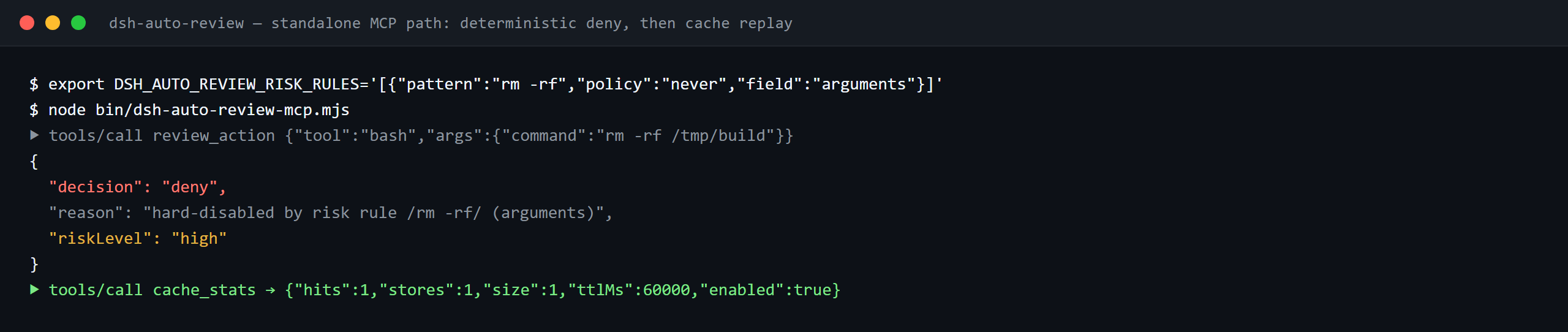
dsh-auto-review also ships a stdio MCP server (dsh-auto-review-mcp) so external MCP clients (Claude, Codex, …) can consume a deterministic review path without a harness. It speaks JSON-RPC 2.0 over newline-delimited JSON (NDJSON) — one JSON object per line, no Content-Length framing.
Boundary. The full reviewer needs the harness subagent seam and a second model, which a separate stdio process cannot reach. The standalone server is therefore deterministic rules + cache, no model review:
review_actionreuses the same-fingerprint verdict cache (src/cache.ts) and the risk-rule / tool-policy resolution (src/config.ts): aneverrule →deny; a cache hit on an identicaltool + argumentsfingerprint replays that verdict; anything else (aineeds a model,humanneeds a human) → fail-closeddenywithreason: "standalone path, no model". It never allows an action a model did not already allow.cache_statsreports hit/store counts and the TTL status.
| Tool | Purpose |
|---|---|
| review_action | {tool, args?, reason?} → {decision, reason, riskLevel} — deterministic deny / cache replay |
| cache_stats | {} → {hits, stores, size, ttlMs, enabled} |
Run it directly:
# risk rules come from environment variables
export DSH_AUTO_REVIEW_RISK_RULES='[{"pattern":"rm -rf","policy":"never","field":"arguments"}]'
node bin/dsh-auto-review-mcp.mjs
# or, after npm install: npx dsh-auto-review-mcp
Environment config: DSH_AUTO_REVIEW_RISK_RULES (JSON array of {pattern, policy, field?}), DSH_AUTO_REVIEW_TOOLS_POLICY (JSON {default?, overrides?}), DSH_AUTO_REVIEW_CACHE_TTL_MS, DSH_AUTO_REVIEW_CACHE_MAX_ENTRIES.
Claude Desktop (claude_desktop_config.json) example:
{
  "mcpServers": {
    "dsh-auto-review": {
      "command": "npx",
      "args": ["-y", "dsh-auto-review-mcp"],
      "env": {
        "DSH_AUTO_REVIEW_RISK_RULES": "[{\"pattern\":\"rm -rf\",\"policy\":\"never\",\"field\":\"arguments\"}]"
      }
    }
  }
}
The server is read-only and deterministic: no network, no model, no writes.
Permissions & data
- Permissions: the workshop manifest declares
session:append,approval:answer,subagent:spawn,command:register, andtools:observe. - Data: nothing is stored on disk; the report ring buffer is in-memory and bounded. No network requests of its own.
- Session log:
autoReview/*events carry reviewer identity, verdict, reason, risk, and duration — appended with the envelope'signorable: truemarker so any build loads the log. Hosts whoseSession.appendpredates the marker (every released rc line through0.1.1-rc.2— no release stamps it yet) are detected before the first append (peer-version pre-check); hosts0.1.2-rc.1,0.1.3-alpha.2, and0.1.5-rc.2keep theignorablefield on the envelope butSession.appendoffers no way to stamp it (its third parameter isSurfaceIntentfor surface events only), and the persistence read path refuses unmarked unknown event types, so those lines — and unresolvable versions — also fail closed before any append. Audit then degrades to an in-memory mirror with marker-free feedback, so sessions stay loadable everywhere.
Security boundaries
- The reviewer is a model. Its verdicts are advisory policy, not a security kernel; prefer
human/neverrules for irreversible operations. - Fail closed. Every abnormal path (provider missing, capability gaps, start rejection, timeout, non-
completedstop reason, missing/malformed verdict, audit-correlation failure) resolves throughfallbackPolicy, defaultrejected— and the rejection feeds an auditable reason back to the model.allow-oncegrants unconditionally; it exists only for unattended deployments whose admin accepts that risk. - Read-only reviewer. The reviewer's
toolFilterallow-list (read/glob/grep) cannot write, edit, run bash, fetch the network, or delegate (maxDepth= its own depth). Its session log is persisted and auditable. - Context-isolated reviewer. The reviewer child's steps are filtered on the documented
agent/pre-stepseam: only its own prompt and its own read-only tool results enter them. Workspace instruction files (AGENTS.md/CLAUDE.md), the harness runtime-context snapshot, and any context-injecting plugin are dropped before the loop appends them, so repository-controlled text never reaches the component that decides whether a call is allowed. This holds under EITHER subagent provider — those producers inject fresh into any new agent session, so the filter, not the provider choice, is what closes them. The filter is an allow-list over message SOURCES, so a plugin that declares a new source kind is dropped too. - Sensitive arguments are redacted (key-name matching:
token,password,api_key,Authorization, credentials, private keys …) before entering the reviewer prompt; the plugin never executes the reviewed arguments. Redaction is key-based, not content-based — do not AI-review tools whose argument values you cannot afford to show a model. - Hard disables explain themselves. A
nevertool or risk rule rejects deterministically AND records a log-onlyautoReview/rejectionevent, then injects a[auto-review-never]marker into the denied tool result — the model learns the action is hard-disabled instead of retrying it (invariant-checked: marker ⟺ event). - Rejection circuit breaker. A run of denials in one turn trips the breaker (
consecutiveDenies/windowDeniesinsidewindowSize), recorded as a log-onlyautoReview/circuitevent; later requests follow itsaction(delegate/reject/abort-turn). - Reviewer context is presented transcript.
contextBudgetfeeds already-presented session content to the reviewer. With the default same-route reviewer model that content stays inside one provider; configurereviewerModelto a different provider only if you accept presenting that transcript to it. neveris one-way at this layer. Anevertool or risk rule rejects before the human chain sees the request — a lockdown knob, not a default.
Known limitations
- Two different exposures, two different answers — neither substitutes for the other. Injected context (workspace instruction files, the runtime-context snapshot, third-party plugin injections) is injected fresh into any new agent session, so it reaches the reviewer identically under
reviewerProvider: forkandreviewerProvider: spawn— measured byte-identical across both on the same request. Theagent/pre-stepsource filter is what closes it, under either provider;spawnalone does NOT keep workspace instructions out of the reviewer. Separately,forkseeds the child with the delegating session's completed turns: that history is already the child's own log rather than a message entering a step, so the filter cannot touch it and onlyspawnavoids it, with the reviewer prompt's untrusted-transcript fence as the mitigation in between. In the two traces above the seeding produced no additional messages, so its practical impact is unquantified. - The reviewer needs a working LLM route (inherited by default); without one every review falls back per
fallbackPolicy— never a silent grant. reviewerToolsnames must exist as global tools in the profile; an unknown name fails the reviewer child loudly at the earliest point and falls back.- Risk rules match the request
reason, thetoolName, or the redacted callargumentsper theirfield; other conditions belong intoolsPolicy.overrides. - The
/auto-review approveoverride authorizes the next same-tool review, not the exact historical call; a different action on the same tool consumes it. - The verdict events are log-only; the Web review panel reads the folded
autoReviewprojection (the raw event stream never reaches browser plugins). autoReview/stateandautoReview/verdictare appended with the envelope'signorable: truemarker on hosts that honor it, so any harness build loads the log — readers that do not know the out-of-repo types simply skip those records. On released rc hosts (rc.1–rc.8) the runtime detects the dropped marker and never writes these events (the in-memory mirror keeps the command, budgets, breaker, andapproveworking for the session); sessions already polluted by pre-0.5.1 versions can be repaired withscripts/repair-session-logs.mjsfromdsh-permission-rules(its default target set covers all fiveautoReview/*event types).- The git channel needs the single
allowBuildskey thedshCLI prints fordsh-auto-reviewitself. The repo ships its ownpnpm-workspace.yamlwithallowBuilds: { esbuild: true };typescript+tsdownare regulardependencies. - The optional invariant companion needs the
invariantsservice (agent-spine compositions such as headless/ACP); the plain web profile does not provide it, so the row ships commented out in the bundle patch.
Related work
- Andy8647/dsh-auto-approval — two-state allow/deny classifier on the
tools/pre-executewaterfall with file-log audit.dsh-auto-reviewdeliberately differs: official answerer chain, always delegates what it does not own, read-only second model with a structured verdict, deny reasons fed back to the model, session-log audit. - ACP automation bridge — one-shot machine decisions for its own ACP-owned agents.
dsh-auto-reviewis session- and tool-policy-scoped for the interactive harness; it never infers durable grants.
Development
pnpm install                # node ^22.19 || >=24
pnpm run typecheck          # tsc: src + tests against the local harness checkout
pnpm test                   # vitest: 25 spec files
pnpm run build              # tsc declarations + tsdown bundles (lib/, incl. the client bundle)
pnpm run verify:self-contained
pnpm pack                   # the published tarball
Repository layout: src/index.ts (plugin contract) · src/config.ts (Schemastery schema + resolution) · src/runtime.ts (answerer, command, deny-reason injection) · src/review.ts (reviewer orchestration, prompt, sanitization) · src/events.ts (session-event vocabulary + folds) · src/audit.ts (host ignorable-marker capability detection) · src/projection.ts + src/projection-types.ts (the autoReview session projection) · src/invariant.ts (invariant companion) · src/eval/ (the dsh-eval engine) · eval/ (shipped evaluation composition) · bin/dsh-eval.mjs (CLI launcher) · src/client/ (browser half) · test/ · fixtures/.
Interoperability with other DSH plugins
Verified against DSH 0.2.0-rc.2 (the runtime this README ships for) and the high-star plugin set surveyed on 2026-10-05.
This plugin does not interfere with other plugins, including the widely installed high-star ones:
- No tool-name collision. Every tool is namespaced; no bare name owned by a shipped tool or another plugin is registered.
- No service-key collision. It provides
autoReviewRuntime; that key is not a built-in seam and is not provided by any surveyed high-star plugin. - No slot collision. It registers no client slot key, so it cannot contend for a
shadows-shipped-uiseat. - No HTTP route collision. It registers no
webServerprefix. - No patch-layer collision. The bundle patch only
inserts its own row; it never overrides a built-in row'sconfig. - No global mutation. It does not patch prototypes, rewrite
process.env, or replace the global fetch dispatcher.
Shared event listeners are non-interfering by construction. It observes the ordering-sensitive events agent/pre-step, approval/request, tools/post-execute with ctx.on() — Cordis's broadcast registration, where every listener runs and none can starve another. Every listener here delegates through next(), so the chain is never short-circuited, and a mutation is applied to the value next() produced rather than returned in its place:
agent/pre-step— also used bydsh-routing-suite(7000★, 7 listeners),modlens(4122★),dsh-purge(3317★),dsh-agent-teams(1923★),dsh-context(1849★).tools/post-execute— also used bycc-safety-net(1576★).
Static evidence: dsh-plugin-doctor K10–K13 report pass for every check on this repository.
Topics
deepseek-harness, dsh, dsh-plugin, cordis, approval, auto-review, second-model, ai-safety, sandbox, subagent
Contributors
- @PerryLink — creator and maintainer: the approval answerer, the reviewer subagent, risk policy and circuit breaker, the session-projection review panel, the invariant companion, dsh-eval, and the five-language docs.
- @weipeng1999 — proposed independent reviewer provider/model routing (#11, discussion #12), which shipped as
reviewerProvider/reviewerModel. - @alexchenzl — listed the plugin on the DSH plugin directory (#10).
PerryLink DSH Plugin Family
This project is one of the 33 actively maintained DeepSeek Harness plugins from PerryLink — the roster is 42, of which 6 are frozen and 3 retired; every one keeps its row below, with the reason in the Status column. If this one helps you, the others likely will too:
| Plugin | One-liner | Status |
|---|---|---|
| dsh-auto-review | Second-model auto-review on the approval chain, fail-closed by default | |
| dsh-autotier | Automatic strong/cheap model-tier routing with deterministic risk guards and a /tier command | |
| dsh-background-agents | Durable background child agents with a Web UI sidebar, messaging and interrupt | 🚫 RETIRED — see the note above |
| dsh-budget | Cost governance for DeepSeek Harness: budgets, carbon, and latency in one panel. | 🧊 FROZEN — see the repo README |
| dsh-catalog | DSH Desktop Market standard catalog source for the PerryLink family | |
| dsh-cert-mcp | Read-only MCP server exposing the certification registry: grades, snapshots and five-dimension evidence | |
| dsh-checkpoint-rewind | Claude Code /rewind-equivalent: snapshots, session forks, one-shot restore | |
| dsh-claude-move | Migrate Claude Code sessions, memory, skills and CLAUDE.md into DSH | 🧊 FROZEN — see the repo README |
| dsh-click | Cross-platform native desktop control for DeepSeek Harness — Windows first. | |
| dsh-composer-history | Terminal-style input history for the web composer: arrows, Ctrl+R search | |
| dsh-data-quality | Dataset quality checks and citation cross-checks (the optional numeric bridge consumed here) | |
| dsh-defend | Prompt-injection, jailbreak, and secret-leak defense for DeepSeek Harness. | 🧊 FROZEN — see the repo README |
| dsh-doublecheck | Engineering-discipline guard: requirements grill, test gates, adversary review | |
| dsh-draw | Unified static-image generation routing for DeepSeek Harness. | 🧊 FROZEN — see the repo README |
| dsh-fast | Read-only performance diagnostics for DeepSeek Harness. | |
| dsh-fund-research | Deterministic research reports for Chinese public mutual funds | |
| dsh-github | GitHub PR/issues integration for DSH, every write gated by approval | |
| dsh-industry-research | Industry research orchestration that seals its deliverables through this plugin's ctx.researchReport.assemble | |
| dsh-laya | Laya typed decisions (noul/choice/score) as a first-class Cordis service and model-visible tools | |
| dsh-library | Local document knowledge base for DeepSeek Harness. | |
| dsh-local-ai | Local-model (Ollama) integration for DeepSeek Harness. | |
| dsh-lsp-actions | LSP diagnostics, formatting, completion, code actions and rename over language servers | |
| dsh-mask | PII masking middleware: anonymize at the model boundary, restore at the display layer | |
| dsh-mcp-panel | Read-only MCP runtime panel: /mcp command + Settings tab with status, tools and errors | |
| dsh-memento | Approval-gated cross-session memory: ctx.memory seam + SQLite + memory tool | 🧊 FROZEN — see the repo README |
| dsh-observe | OpenTelemetry and Langfuse observability exporter for DeepSeek Harness. | |
| dsh-output-styles | Claude Code outputStyles-equivalent runtime style switching | |
| dsh-permission-rules | Claude Code-style declarative allow/deny/ask permission rules with audit | |
| dsh-plugin-certification | Community certification registry with repro-checkable grades and badges | |
| dsh-plugin-doctor | Zero-dependency static + sandbox smoke detector for DSH plugins | |
| dsh-plugin-guide | Plugin-development knowledge base as an on-demand agent skill | |
| dsh-plugin-kit | Shared zero-runtime-dependency toolkit for the PerryLink DSH plugins | |
| dsh-plugin-upgrade | One-package, one-corridor-index plugin upgrade skill: routes a repository to the matching closed corridor card | |
| dsh-plugin-upgrade-015 | Merged 0.1.3-alpha.1 → 0.1.5-rc.1 upgrade corridor card plus a zero-dependency seam scanner | 🚫 RETIRED — corridors carried by dsh-plugin-upgrade |
| dsh-reach | Multi-channel approval/question bridge: WeChat/Telegram/Feishu, session console | 🧊 FROZEN — see the repo README |
| dsh-research-report | Verifiable research-report engine: content-addressed evidence ledger and sealed versions | |
| dsh-score | Multi-dimensional quality scoring for DeepSeek Harness plugins. | |
| dsh-session-pin | Pin sessions in the Web sidebar with durable ordering | 🚫 RETIRED — see the note above |
| dsh-session-sync | Cross-device session sync for DeepSeek Harness — a dedicated git mirror of your session store. | |
| dsh-skill-pack-security | Security-audit skill pack: secret scan, dependency and supply-chain review | |
| dsh-talk | Voice-first session loop for DeepSeek Harness: talk to it, hear it answer. | |
| dsh-team-rooms | Cross-session team rooms: shared message bus, task board and timeline | 🚫 RETIRED — see the note above |
| dsh-test-drive | Isolated install-and-smoke test drives for DeepSeek Harness plugins. | |
| dsh-ticktick | TickTick/Dida365 task bridge: session-header panel + 11 tools | |
| dsh-translate | Vendor parameter translation and deterministic JSON repair for DeepSeek Harness. | |
Install from the DSH Desktop Market
All PerryLink plugins are browsable in the built-in DSH Desktop Market: Market → Sources → add source → paste https://perrylink-dsh-catalog.perrylink.workers.dev/catalog-source.json → select it. Installation still goes through the Market's npm-identity verification and your confirmation.
License
Apache License 2.0 © 2026 dsh-auto-review contributors