
dsh-forecast-penalty
v0.2.3
Published
预测准确率考核核对(按准确率、门槛与考核单价核对考核费用的算术自洽,仅提示差异,不作出定性结论)

Maintainers
 perrylink
Readme
dsh-forecast-penalty — Forecast-accuracy assessment register and assessment-charge arithmetic verification

dsh-forecast-penalty reads one forecast-accuracy assessment register — the subject header plus one row per assessment period — and verifies that register's own completeness and arithmetic: that the period, the subject and the market are identified, that the forecast, actual and accuracy figures parse as numbers, that the stored accuracy agrees with the definition formula you configure and the assessment charge with the charge formula you configure, that the currency is written as a three-letter code, that no assessment period repeats, and that no unreplaced placeholder survives in the remark column. Every check that cannot run is reported in skipped with its reason.
What it looks like
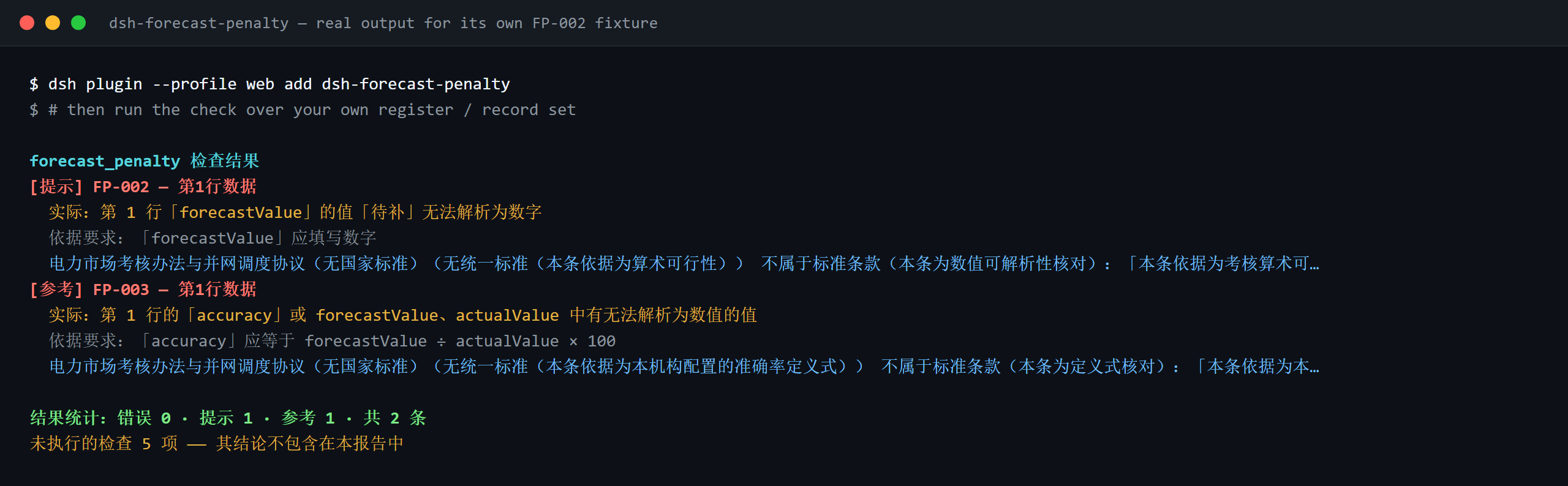
Real output from this plugin over its own FP-002 test fixture — not a mock-up. The rule pack ships no invented quotations, so a finding names both the clause it applied and the fact that the clause text was not obtained.
What it answers
| You ask | What it answers |
|---|---|
| The register never says which station or which market it covers, and one forecast figure reads --. | FP-001 requires the subject and the market to be identified, and FP-002 requires the forecast figure to parse as a number; a -- is reported. FP-001 checks that the two are filled in, not that the station name is the right one, and FP-002 does not decide whether the forecast was accurate. |
| The accuracy I store differs from my own market's definition formula, and the charge differs from base times unit rate. | FP-003 compares the stored figure with the definition formula configured in the rule pack — the shipped expression is one common convention and an example, not your market's rule, so replace expression or disable the rule — with a 1.5-point tolerance. FP-004 compares the charge with 考核基数 × 考核单价 at a 0.01 tolerance; the base is entered by you. Neither decides whether the assessment method applies or whether a charge should be levied. |
| The currency column is blank on some rows and says 元 on others. | FP-005 requires a three-letter uppercase code such as CNY or USD, so a blank and a 元 are both reported; the rule's limit is that it judges the format only and does not decide which code your institution should use for the renminbi. It also does not decide whether the currency chosen is the right one. |
| The same assessment period appears on more than one row. | FP-006 reports a period that repeats, because a duplicate makes the charge accumulate twice and leaves it unclear whether the period was registered twice or assessed twice; the comparison ignores whitespace. One period assessed by time block and band legitimately produces several rows — distinguish those in the remark column or by a different period identifier, or disable the rule. It does not decide which row is the duplicate. |
| The remark column still holds 【】, XXX or TBD. | FP-007 reports the row when the remark column contains one of the placeholders configured in the rule pack, because a register copied from a template invites the reader to assume the assessment was actually carried out. The terms list is yours to adjust, and the rule does not decide whether the remark text is true. |
| A whole column is missing from my material — does the rule quietly pass? | No. The column-level rules (FP-002, FP-005, FP-006, FP-007) report themselves under skipped with the reason that the material carries no such column, and the report distinguishes that from a rule that ran and found no differing row. A check that never ran is never presented as a pass. |
Standards it follows
| Document | Number | Cited by rules | |---|---|---| | 电力市场考核办法与并网调度协议(无国家标准) | 无统一标准(本条依据为台账可追溯性) | FP-001 | | 电力市场考核办法与并网调度协议(无国家标准) | 无统一标准(本条依据为算术可行性) | FP-002 | | 电力市场考核办法与并网调度协议(无国家标准) | 无统一标准(本条依据为本机构配置的准确率定义式) | FP-003 | | 电力市场考核办法与并网调度协议(无国家标准) | 无统一标准(本条依据为本机构配置的考核算式) | FP-004 | | 《表示货币的代码》 | GB/T 12406—2022(表示货币的代码;2022-12-30 发布并实施;全部代替 GB/T 12406—2008(该版名称为「表示货币和资金的代码」)——注意旧版名称含"资金";修改采用 ISO 4217:2015,非等同采用;条号本次未取得) | FP-005 | | 电力市场考核办法与并网调度协议(无国家标准) | 无统一标准(本条依据为台账唯一性) | FP-006 | | 电力市场考核办法与并网调度协议(无国家标准) | 无统一标准(本条依据为台账真实性) | FP-007 |
Boundary: this plugin checks a 预测准确率考核台账 for arithmetic — that the period and subject are identified, that forecast and actual figures parse, that the accuracy figure matches the definition formula you configure, that the assessment charge matches your charge formula, that the currency follows its format, that periods do not repeat, and that no placeholder survives. It does not decide whether a charge should be levied, whether accuracy passes, or whether a waiver or appeal applies. Those depend on the market rules, the exemption cases and the dispute procedure.
⚠️ This is a market rule, not a national standard — and the pack says so
The accuracy definition, the exemption threshold, the unit rate and the settlement basis are set by each power market's assessment rules and the grid-connection dispatch agreement. Provinces differ sharply (some use
1 − deviation, some use root-mean-square error, some assess by time block and band), and no unified national standard exists. So this pack does not fabricate a standard number: every rule'sexcerptstates plainly that its basis is arithmetic self-consistency or a locally configured convention and that no citable clause exists.Two formulas ship as examples, and both are marked as such:
FP-003accuracy defaults to预测值 ÷ 实际值 × 100with a 1.5-point tolerance. That is one common convention, not any market's rule. Before use, replaceexpressionwith the formula from your market's rules — or disable the rule. The note spells this out.FP-004charge checks考核费用 = 考核基数 × 考核单价. The base is entered by you after working it out under your market's rules, because the threshold, the bands and the volume basis are the market's business and this plugin will not derive them. No unit rate is built in anywhere.A consequence worth knowing: the accuracy rule ships at
infoseverity precisely because its formula is a deployment choice rather than a verified requirement.
Compatibility
| Surface | Status |
|---|---|
| Harness | Peer range >=0.1.2-rc.1 <0.2.0 \|\| >=0.2.0-0 <0.3.0 — verified to accept both 0.2.0-rc.2 and 0.2.1-alpha.1. engines.dsh is deliberately not declared: it has no reader and cannot reject a host |
| Node | ^22.19.0 || >=24.0.0 |
| Platforms | All (plain ESM; no native code, no network, no model call) |
| Tool mode | Works in native, ptc and both; for a year of periods use ptc |
What it does
Registers the forecast_penalty tool. It reads one assessment register — the subject header plus one row per
period — applies a versioned rule pack, and returns a report.
| Rule | Check | Severity | Basis |
|---|---|---|---|
| FP-001 | the register names its subject and market | warn | traceability |
| FP-002 | the forecast figure parses as a number | warn | arithmetic feasibility |
| FP-003 | accuracy matches your definition formula | info | local formula |
| FP-004 | the charge matches your charge formula | info | local formula |
| FP-005 | the currency is a three-letter code | warn | GB/T 12406 |
| FP-006 | assessment periods are unique | warn | register uniqueness |
| FP-007 | the remark column holds no unreplaced placeholder | warn | register integrity |
Install
dsh plugin --profile <name> add dsh-forecast-penalty
dsh --profile <name> --dump-config | grep 'dsh-forecast-penalty'
Configuration
| Key | Type | Default | Description |
|---|---|---|---|
| rulesFile | string | rules/forecast-penalty.yaml | Rule-pack path, relative to the package root |
| disabledRules | string[] | [] | Rule ids to stop running; each appears in skipped |
| onlyRules | string[] | [] | Run only these rule ids; empty runs every rule |
| skipNotes | string | "" | Note appended to every skipped reason |
| timeoutMs | number | 120000 | Cooperative tool timeout budget |
Rule-level parameters worth knowing:
FP-003expression— the accuracy definition. Ops aredivide,product,sum,subtract(first field minus the rest) andpercent(first field ÷ second × 100), with an optionalscalemultiplier.tolerancedefaults to 1.5 points; set it to your rounding convention.FP-004expression/tolerance— the charge formula,考核基数 × 考核单价by default with a 0.01 tolerance.FP-005pattern— the currency shape; three upper-case letters by default.FP-007terms— the placeholders to look for.
Material format
The tool accepts JSON or YAML:
subject: 某某风电场
market: 省内现货
rows:
  - { 考核期: 2026-03, 预测值: '966', 实际值: '1000', 准确率: '96.60',
      考核门槛: '95', 考核基数: '80', 考核单价: '50', 考核费用: '4000', 币制: CNY }
Column names are matched case-insensitively and ignoring spaces, underscores and hyphens; the register's own column names are kept, so a finding names the column it read. Numeric cells may carry thousands separators and a percent sign.
Rule sources
Rule data lives in rules/forecast-penalty.yaml. Because the assessment regime is a market rule rather than a
standard, the pack's basis entries say so explicitly instead of citing one; the only external reference is
the currency-code standard, whose excerpt admits the clause text was not obtained. The load-time guard still
requires a document, clause, excerpt and source per rule, and still forbids a locally configured check from
being error.
Troubleshooting
FP-003fires on every row. The accuracy figure was computed under a different formula than the one configured. Replaceexpressionwith your market's, or disable the rule — do not widen the tolerance to hide a definition mismatch.FP-004reports itself as skipped. The register carries no 考核基数 column, or no charge. The base is yours to compute and record; the plugin will not derive it.FP-005fires on元. The default pattern wants three upper-case letters. Narrow or widen it to match your settlement documents' convention.FP-006fires twice on one period. That can be legitimate for time-block assessment (peak/flat/valley rows). Distinguish the rows in the period column or say so in the remark.- The plugin installs but the tool never appears. Check that
mainresolves tolib/index.mjsand thatpnpm run buildproduced it; a wrongmainmakes the loader skip the entry silently. dsh plugin addrefuses the package as incompatible. The peer range covers0.1.xand0.2.x; if your runtime sits outside it, grant an explicit exemption:dsh plugin --profile <name> allow-version [email protected] --dsh-version <runtime> --accept-riskcheckreportsmanifest-peersas failed. The static checker compares against a hard-coded peer range that predates the 0.2 line. The runtime enforces peer compatibility at install time, so the declared range is the correct one; this is a known upstream issue indsh-plugin-dev.
Development
pnpm install
pnpm run typecheck   # tsc --noEmit
pnpm test            # vitest, the shared table-plugin suite plus paired fixtures
pnpm run build       # tsdown -> lib/index.mjs + lib/index.d.mts
node ../scripts/sync-shared.mjs dsh-forecast-penalty   # refresh src/shared from ../_shared
The plugin is data-only: src/model.ts declares the table shape, the shared kit supplies the reader and
the check engine, and the rule pack declares every check.
License
Apache License 2.0 © 2026 dsh-forecast-penalty contributors.