
eslint-plugin-polymer-security
v0.0.4
Published
ESLint rules for securing Polymer applications against common XSS sinks.

Maintainers
 kw0
kw0Readme
eslint-plugin-polymer-security
ESLint rules for securing Polymer applications against common DOM-based XSS sinks.


The "Pit of Failure" in Polymer
Unlike modern frameworks like React and Angular, which are Secure by Default, Polymer (v3.5.2 and below) allows unsanitized data binding to sensitive DOM properties directly through its template syntax. This creates a "Pit of Failure" where legitimate developers can unintentionally introduce XSS vulnerabilities.
This plugin provides a proactive defense against these design-level flaws by detecting and blocking unsafe patterns at development time.
Installation
You'll first need to install ESLint:
npm i eslint --save-devNext, install eslint-plugin-polymer-security:
npm install eslint-plugin-polymer-security --save-devNote: You can also install it directly from GitHub:
npm install https://github.com/JoshuaProvoste/eslint-plugin-polymer-security.git --save-dev
Usage
Add polymer-security to the plugins section of your .eslintrc configuration file. You can omit the eslint-plugin- prefix:
{
    "plugins": [
        "polymer-security"
    ]
}
Then configure the rules you want to use under the rules section.
{
    "rules": {
        "polymer-security/no-inner-h-t-m-l-binding": "error",
        "polymer-security/no-insecure-url-resolution": "error"
    }
}
Supported Rules
no-inner-h-t-m-l-binding
Disallows the use of the inner-h-t-m-l property in Polymer templates and object properties (like the properties getter).
Vulnerable Code:
static get template() {
  return html`<div inner-h-t-m-l="[[untrustedData]]"></div>`;
}
Secure Alternative:
Implement a custom sanitizer via window.Polymer.sanitizeDOMValue and use safe data binding patterns.
no-insecure-url-resolution
Disallows calling resolveUrl() or this.resolveUrl() with dynamic (non-literal) input. Polymer's URL resolution utility uses a weak regular expression that fails to filter dangerous protocol schemes like javascript:, data:, and vbscript:.
Vulnerable Code:
_resolve(url) {
  return this.resolveUrl(url); // Vulnerable if 'url' is untrusted
}
Secure Alternative:
Only pass hardcoded string literals to resolveUrl() or implement a robust protocol whitelist/sanitizer before resolution.
Security Best Practices for Polymer
To proactively prevent DOM-based XSS in Polymer applications, follow these recommendations:
1. Avoid inner-h-t-m-l Bindings
Always prefer standard data binding to textContent or safe attributes. If you must render HTML:
- Never bind untrusted data directly to
inner-h-t-m-l. - Use a battle-tested library like DOMPurify to sanitize any HTML before it reaches a Polymer property.
- Register a global sanitizer using
Polymer.sanitizeDOMValue(if using Polymer 2.x/3.x) to intercept and clean all property-to-attribute bindings.
2. Sanitize URL Inputs
Polymer's resolveUrl is a path normalization utility, not a security sanitizer.
- Whitelist Protocols: Before passing a string to
resolveUrl, verify that it starts with an approved scheme (e.g.,https:,http:,mailto:, or a relative/). - Use the URL API: Use the native
new URL(input)constructor to parse and validate the protocol. If the protocol isjavascript:, reject the input immediately.
3. Use Content Security Policy (CSP)
Implement a strict CSP to act as a secondary defense layer. A well-configured CSP can block the execution of inline scripts and unauthorized protocols even if an injection occurs.
Proof of Concept (PoC)
Complete Proof of Concepts demonstrating these vulnerabilities are included in the poc/ directory.
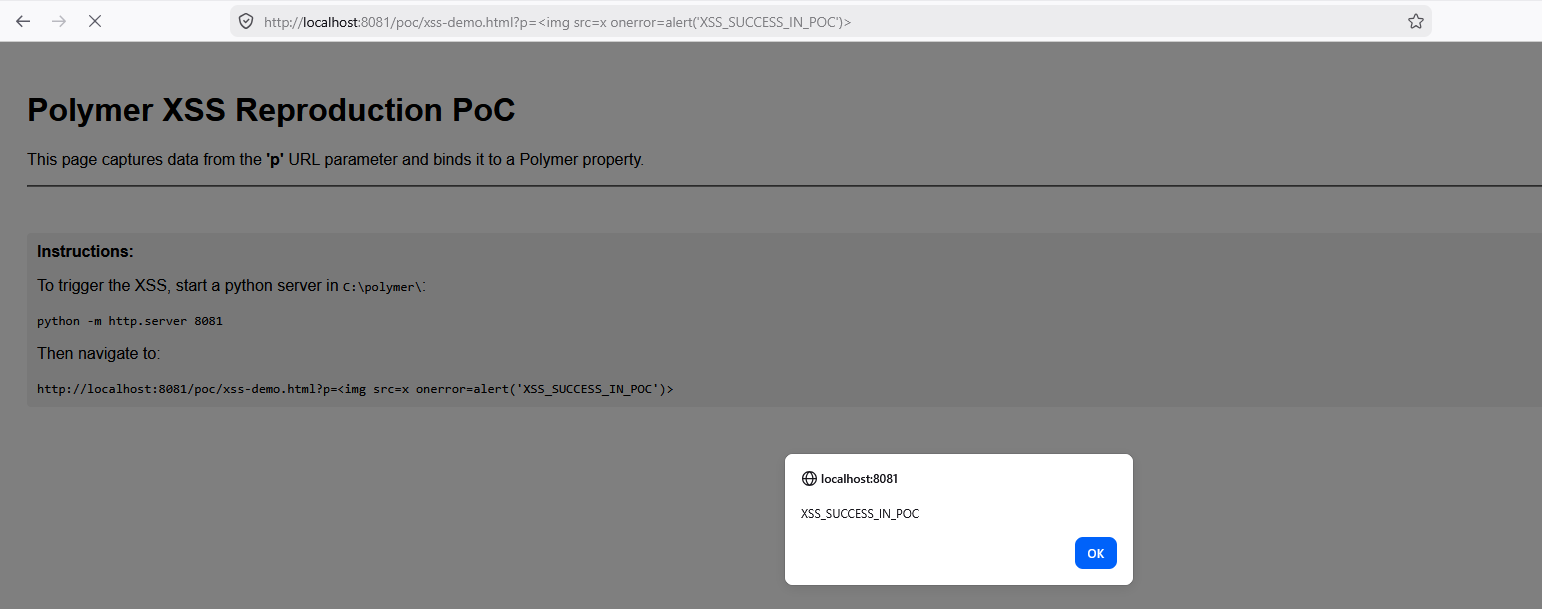
1. Unsanitized inner-h-t-m-l Binding
- Location:
poc/inner-h-t-m-l-binding/poc.html - Description: Demonstrates direct injection into the DOM via unsanitized data binding.
- Evidence:
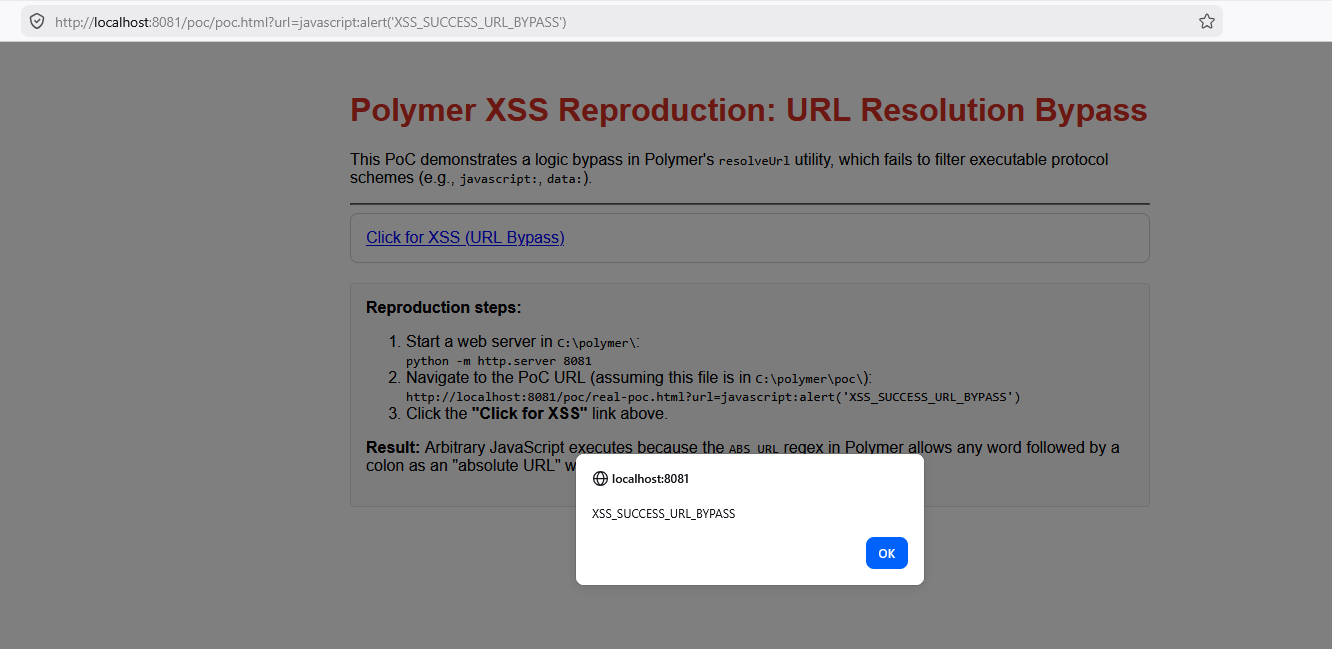
2. Insecure URL Resolution (ABS_URL Bypass)
- Location:
poc/xss-url-bypass/poc.html - Description: Demonstrates how
resolveUrlfails to filter malicious protocols, leading to XSS on user interaction. - Evidence:
How to run the PoCs:
- Clone this repository.
- Serve the root directory using a local web server (e.g.,
python -m http.server 8081). - For inner-h-t-m-l: Navigate to
http://localhost:8081/poc/inner-h-t-m-l-binding/poc.html?p=<img src=x onerror=alert('XSS_SUCCESS_IN_POC')> - For URL Bypass: Navigate to
http://localhost:8081/poc/xss-url-bypass/poc.html?url=javascript:alert('XSS_SUCCESS_URL_BYPASS')and click the link.
License
MIT