
fuseter
v0.5.0
Published
Rank-identical, much faster replacement for Fuse.search (ignoreLocation: true) with js, wasm and wasm-simd backends

Maintainers
 tamnac
Readme
"Fuseter" = Fuse + Faster
Fuseter is a replacement for Fuse.js that is significantly faster and comes with some heuristics for improved scoring. Full parity is a WIP.
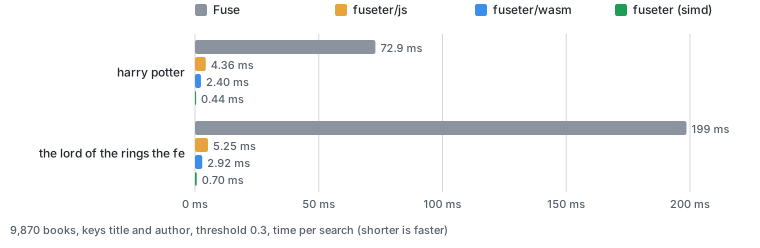
Fuseter is 10-40x faster with the plain js tier and 100-300x faster with the simd tier.
ESM only; require() works on Node 20.19+ and 22.12+.
Usage:
import { Fuseter } from "fuseter";          // or "fuseter/js", "fuseter/wasm", "fuseter/simd"
const ff = await Fuseter.create(books, { keys: [{ name: "title", weight: 3 }, "author"], threshold: 0.3, includeScore: true });
ff.search("hary poter", { limit: 10 });        // [{ item, refIndex, score }]
ff.backend;                                    // the tier that is really running
Backends
Fuseter has three implementations of the same search.
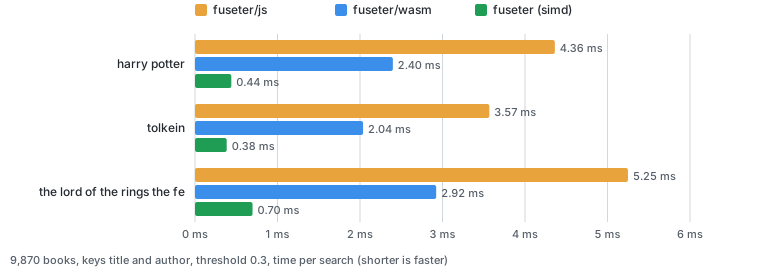
The same measurements without Fuse, using a linear scale to better see differences between the three variants.
| tier | needs | download (gzip) | search, 10K docs, threshold 0.3 |
|---|---|---|---|
| simd | WebAssembly SIMD (all current browsers and Node) | 31.2 KB | 0.4-0.7 ms |
| wasm | WebAssembly | 15.9 KB | 2-3 ms |
| js | nothing | 11.6 KB | 4-5 ms |
| Fuse 7.5 | nothing | | 40-200 ms |
Download sizes are the entry point minified with esbuild and gzipped; the simd entry includes the base64 wasm module (about 4/3 of its raw size).
What to choose:
- Default:
import { Fuseter } from "fuseter"uses simd and falls back to the js build automatically if needed (no WebAssembly, blocked by a Content-Security-Policy, out of memory). - Smallest bundle: import from
fuseter/jsorfuseter/wasm.fuseter/jscontains no wasm at all, andfuseter/wasmonly the small scalar module. - A specific tier:
Fuseter.create(docs, options, { backend: "wasm" }).fallbacksets how far it may degrade:"js"(default),"wasm", or"throw"to fail instead. - Without await:
Fuseter.createSync(docs, options)returns a js instance immediately, because wasm compiles asynchronously.
To see what you end up with, check ff.backend and ff.fallbackReason.
Differences from Fuse
Will be fixed in later versions:
ignoreLocationis always on (and is the default here).location,distanceandfindAllMatchesare accepted and ignored (withignoreLocation,findAllMatcheschanges nothing in Fuse either).- Not supported, rejected with a
TypeError:useExtendedSearch, unknown options, non-string queries. - Not provided:
Fuse.match,Fuse.parseQuery,Fuse.use.
Supported: string collections, keys (names, dotted paths, path arrays, weights), array values (each element is a separate string like in Fuse, at most 64 strings per document), numbers and booleans as text, threshold (also per search), limit, shouldSort, sortFn, getFn (also per key), minMatchCharLength, includeScore, includeMatches (see below), isCaseSensitive, ignoreDiacritics, useTokenSearch with tokenize and tokenMatch (see below), ignoreFieldNorm, fieldNormWeight, blank queries (return every document, like Fuse), patterns longer than 32 characters (chunked like Fuse, slower: no in-wasm combine). sortFn, shouldSort: false and minMatchCharLength > 1 also skip the in-wasm combine; minMatchCharLength additionally locates the matched fragments of every candidate string in js.
Deliberate differences:
ignoreDiacriticsstrips\p{M}, Fuse uses a fixed list of marks; 73 recently added code points differ.- Objects inside array values are ignored (Fuse indexes
"[object Object]").
Changing the collection, indexes
add(doc), remove(predicate), removeAt(index), setCollection(docs, index?) and getIndex() work like Fuse's, including which arrays are modified: add pushes onto the array you passed in, removeAt splices it, remove keeps a filtered copy. The index (Fuse's format, see below) is updated at once, and the next search flattens it again, which costs about as much as creating the instance. That is fine for a batch of changes, not for adding one document between every two searches.
Fuseter.createIndex(keys, docs) and Fuseter.parseIndex(json) use Fuse's index format in both directions: an index made by Fuse.createIndex (as the object or its parsed JSON) can be loaded here and the other way round. Pass it as Fuseter.create(docs, options, { index }). It saves extracting the strings from the documents; the field norms and strings of the index are used as they are (also by includeMatches and sortFn, so a getFn runs once per document and key). The documents must be the ones the index was made from, and, as in Fuse, add and remove update the index object you passed in. getIndex() returns it, or makes one on first use. Fuseter.config holds the defaults of new instances (Fuseter.config.getFn is Fuse's default getFn, which a custom getFn can wrap) and Fuseter.version the package version.
Token search
useTokenSearch: true searches the words of the query separately, like Fuse 7.5. "wen co" becomes two patterns, wen and co, and a string scores 1 - sum(idf * (1 - score)) / sum(idf) over the terms that match. A term's idf comes from how many indexed strings contain it, so rare terms count more. A string needs to match only one term, unless tokenMatch: "all" requires every term to be matched by some string of the document.
const ff = await Fuseter.create(books, { keys: ["title"], useTokenSearch: true, tokenMatch: "all", threshold: 0.3 });
ff.search("lord rings");
Terms are what tokenize returns for the normalised text: by default runs of letters, marks, digits and _, otherwise the matches of a global RegExp or the array a function returns. Results, scores and includeMatches are identical to Fuse's on every backend, and add, remove and setCollection keep the document frequencies current. A tokenize RegExp without the global flag is rejected (Fuse warns and uses only its first match).
Each distinct term is scanned like an ordinary query (a repeated term once), and the scores are accumulated in wasm on the wasm and simd tiers. The in-wasm combine step is not used: a search costs the scans plus a js combine, and the simd tier sorts the hits in wasm. The simd tier scans several short terms in one pass when their lengths add up to 16 characters or less (not with minMatchCharLength or any typing option, nor for terms over 16 characters). On 10K books at threshold 0.3 a token search of 1-7 terms takes 0.3-1.1 ms on simd, 1.6-5.7 ms on wasm and 2.7-10 ms on js, against 0.25-0.5 ms, 1.3-2.2 ms and 2-4 ms for a plain search of the same text. The typing heuristics apply to each term; as with any typing option, results then differ from Fuse's.
Match highlighting
includeMatches: true adds matches to every result, in Fuse's format and with Fuse's indices:
const books = [{ title: "The Hobbit", tags: ["fantasy", "hobbit"] }];
const ff = await Fuseter.create(books, { keys: ["title", "tags"], includeMatches: true });
ff.search("hobit")[0].matches;
// [{ indices: [[4, 9]], value: "The Hobbit", key: "title" }, { indices: [[0, 5]], value: "hobbit", key: "tags", refIndex: 1 }]
indices are inclusive [start, end] ranges into value. key is the key as written (paths joined with .) and is absent for collections of strings; refIndex is the position in the array when the key's value is an array.
Like Fuse, the ranges mark every exact occurrence of the query, or else every character of the best approximate match that also occurs in the query. They are computed in js for the returned results only, so they cost little with a limit and the same on every backend. This also works with the typing heuristics, which then decide where the best match is.
indicesIn: "original" makes the ranges refer to value as it is written. By default (and in Fuse) they refer to the text after lower-casing and, with ignoreDiacritics, stripping, which has a different length for ß and for decomposed accents (e + a combining mark). For other text the two are the same.
Experimental highlighting
highlighting: { aligned: true, allOccurrences: true } (either one, needs includeMatches) replaces Fuse's ranges with ones found by aligning the query with the text, using the same costs as the search (also with typing). The ranges no longer match Fuse's.
aligned: a range is the text the query was aligned with. Forhary poterinSweet Savage Love Rosemary RogersFuse marksary Roander, aligned marksmary Roger.allOccurrences: every place where the query matches within the threshold is marked (lordalso markslardandlorrdat a threshold that allows one error), not only the best one. Withoutalignedeach place gets Fuse's character window.
Typing heuristics (experimental)
A couple of heuristics to better match how people type and make typos.
They change the ranking, so results no longer match Fuse, and the options are not stable yet. Without typing, results are identical to Fuse.
Fuseter.create(models, { keys: ["name"], typing: { firstLetter: true, transposition: true } });firstLetter: the first letter of each query word counts double. A wrong or missing first letter costs 2 errors. This is based on research suggesting that the first letter is rarely wrong (Pollock & Zamora, 1983; abbreviation expansion for users with motor disabilities).{ weighted: "first" }weights only the first letter of the whole query instead of every word.{ midWord: 2 }makes a correct first letter in the middle of a word cost as much as a wrong one (default 1).- Words start after spaces and punctuation, and at camelCase humps (
myValue). Queries over 32 characters ignore the option.
transposition: swapping two adjacent letters costs 1 error instead of 2.
Cost on 10K books: transposition makes searches 20-25% slower, firstLetter roughly 2x slower (simd: 0.3 ms becomes 0.5 ms; see scripts/bench-typing.mjs). On the simd tier each option set loads an extra 13-17 KB (gzip) wasm module the first time it is used.
Development
npm install, thennpm test: runs the equivalence suite (random corpora, all tiers, thresholds 0-1, limits, every supported option, forced fallbacks) against the Fuse 7.5 dev dependency. Takes about a minute.npm run build:wasmrebuildswasm/*.wasmand the embeddedsrc/wasm/*.mjsfromzig/(needs zig 0.17; the generatedsrc/wasm/*.mjsare committed and CI fails if a rebuild changes them).node scripts/browser-check.mjs [chromium] [firefox] [webkit]bundles the library with esbuild (code splitting) and runs the Fuse comparison, the typing options and the fallback logic in real browsers, once normally and once under a CSP that blocks wasm. Setup:npm i --no-save playwright esbuild && npx playwright install chromium firefox. Last run: Chromium 156 and Firefox 157 pass; Safari is untested.node scripts/bench.mjs [books.json] [--fuse] [--json=file]prints a timing table (--jsonsaves it,node scripts/chart.mjsturns it into the charts indocs/);node scripts/bench-typing.mjs [books.json]compares the typing heuristics with the standard kernels, andnode scripts/bench-tokens.mjs [books.json]compares token search with plain search and Fuse's token search (FUSE=0skips Fuse).