garlic-nan
v0.1.1
Published
Add some flavor to your NaN


Readme
Garlic NaN
Add some flavor to your NaN
Did you know that there are 2^53 - 2 distinct values of NaN in JavaScript? I
didn't! I was told there was only a single NaN in the language.
There is the regular plain NaN that you get when you type those characters
into the console. However the IEEE 754 Double Floating Point format allows for
a great deal more bit patterns that JavaScript engines are happy to call
NaN.
What identifies a 64 bit floating point number as a NaN? There are only two
rules that need to be followed:
- All 11 exponent bits need to be set to 1.
- At least 1 fractional bit has to be set to 1. Interestingly, this is
because if all fractional bits are set to 0 you get
Infinityor-Infinitydepending on if the sign bit is set.
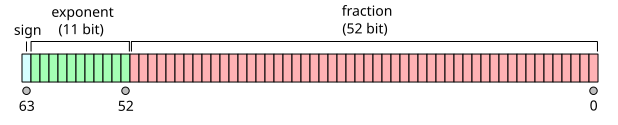
Image credit Codekaizen (via Wikipedia) [link]

As you can see, there are a lot of bit patterns that could qualify as NaN
under those rules. The regular NaN that you get when you type NaN into the
console (I refer to this as plain NaN) follows these rules but only sets the
first bit of the fractional bits to 1 and leaves the rest as 0. That means that
we can set the remainder of the fractional bits to whatever we want (and even
the sign bit) and so long as we don't touch the exponent bits we can
effectively encode a hidden 2^52 bit value. I refer to these as garlic NaN.
This library allows you to easily do just that!
Here is an example in Deno (you can do just about the same thing in Node):
import { read, write } from "jsr:@synaptogenic/garlic-nan"
import { assert } from "jsr:@std/assert";

// The number that we will hide inside a NaN 🤫
const secretNumber = 42;

// Write the number into the NaN.
const myNan = write(secretNumber);

// Prove that the number is indeed NaN. Nothing shady going on here 😉
assert(Number.isNaN(myNan));

// At a later time read the secret number back out 😈
assert(read(myNan) === secretNumber);
You can store any value from: -2_251_799_813_685_247, to:
2_251_799_813_685_247 this way and it will appear to just be a regular
NaN.
This works fine in any V8 host environment (Deno, Node, Chrome, etc). Any
JavaScriptCore or SpiderMonkey host environment (Bun, Safari, Firefox) eagerly
convert garlic NaN back into plain NaN 😞 According to ECMA 262:
In some implementations, external code might be able to detect a difference between various Not-a-Number values, but such behaviour is implementation-defined; to ECMAScript code, all NaN values are indistinguishable from each other.
Why?