
gesture-audio
v0.2.3
Published
Gesture-gated Tone.js bus graph + Howler sprite resolver + preferences bridge. Solves browser autoplay unlock.

Maintainers
 jbdevprimary
Readme
gesture-audio
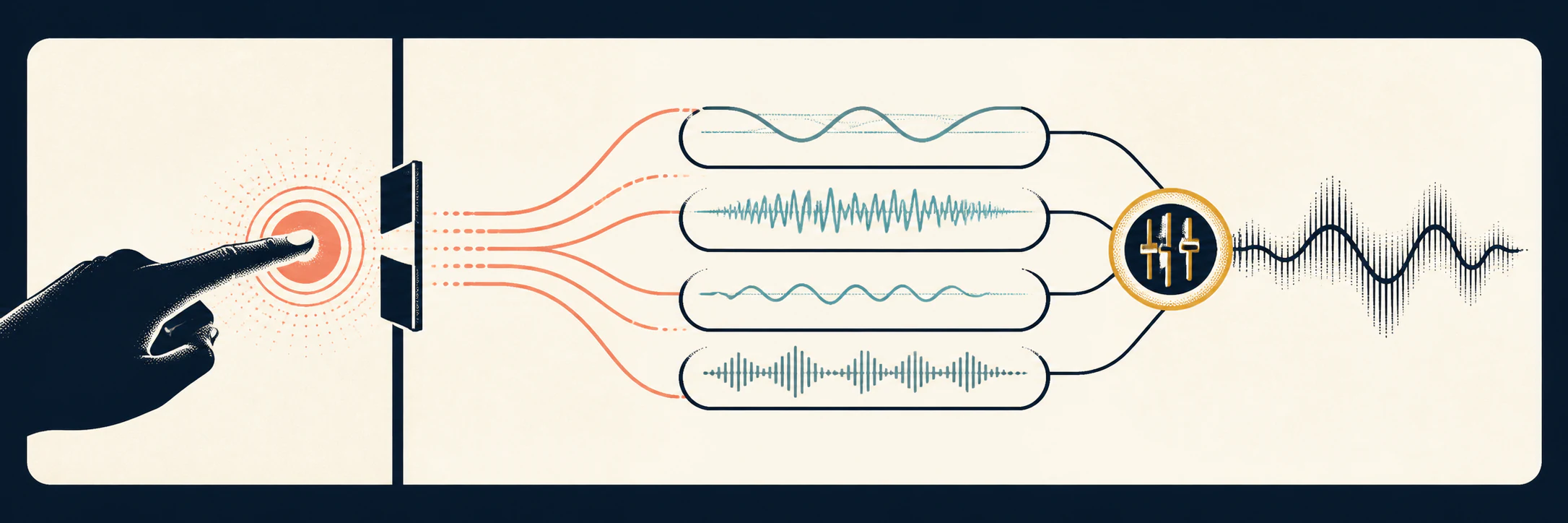


Gesture-gated browser audio that starts reliably, mixes predictably, and keeps application policy in your application.
Browsers will not resume a Web Audio context until a person interacts with the
page. A partial unlock is especially troublesome: the context can resume while
sample loading or preference hydration fails, leaving an app that believes
audio is ready when it is not. gesture-audio treats unlock and bootstrap as
one concurrent-safe, retryable transaction.
It also provides the infrastructure most interactive apps need around that boundary:
- a typed, caller-named Tone.js bus graph with a master limiter;
- non-destructive, independently layered mute and timed ducking behavior;
- a validated Howler sprite-map resolver whose active sounds follow live mix changes;
- a persistence bridge for any small async preferences store; and
- a Node-only asset verifier for sprite structure, duration, loudness, orphans, and size.
The package deliberately does not define cue names, gameplay policy, or a persistence framework. Those remain local to the application.
Install
Node 22 or newer is required for build tooling. The runtime supports modern
browsers with Web Audio, fetch, and the event APIs used by Tone.js and Howler.
npm install gesture-audio tone howlertone and howler are peer dependencies, so the application owns their versions.
Quick start
import {
  applyPersistedAudioPrefs,
  buildBuses,
  initSpriteResolver,
  playCue,
  registerAudioGestureTrigger,
  setResolverMasterBus,
} from 'gesture-audio';
// The application owns persistence; implement AudioPrefsStore against your
// own store. See examples/browser-bootstrap.ts for a full local-storage-
// backed implementation.
import { preferences } from './audio-preferences.js';

const BUS_NAMES = ['master', 'music', 'sfx', 'voice'] as const;

async function bootstrapAudio() {
  buildBuses(BUS_NAMES);
  setResolverMasterBus('master');
  await initSpriteResolver({
    spriteMapUrl: '/audio/sprite-map.json',
    audioBaseUrl: '/audio',
    strict: true,
  });
  await applyPersistedAudioPrefs(preferences, BUS_NAMES);
}

// Keep this registration early in application startup. Audio work itself does
// not run until click, keydown, or touchstart supplies the required gesture.
const removeGestureTrigger = registerAudioGestureTrigger(bootstrapAudio);

// Later, after bootstrap has completed:
const soundId = playCue('drawer-open', 'sfx');
The returned cleanup function is useful during hot reload or component
unmount. Concurrent gestures and direct startAudioEngine() calls share one
in-flight attempt. Listeners are removed only after both Tone unlock and the
application bootstrap succeed; a rejected attempt stays retryable.
See examples/browser-bootstrap.ts for a
complete local-storage-backed example. The published documentation has a
complete integration guide
covering teardown, strictness, SSR boundaries, and the intended lifecycle.
Sprite maps
Both flat and file-grouped maps are accepted. Times are milliseconds and
file is relative to audioBaseUrl, without an extension.
{
  "ui/sprite": {
    "drawer-open": {
      "start_ms": 0,
      "end_ms": 450,
      "file": "ui/sprite"
    }
  }
}
The default formats are webm and m4a. Invalid offsets, empty file names,
duplicates, and malformed entries are filtered with an actionable warning.
Use strict: true in production bootstrap or tests to reject the entire map
instead. A missing map degrades to a no-op resolver by default.
Preferences contract
The bridge accepts any store with this shape:
interface AudioPrefsStore {
  get(): Promise<{
    audioVolumes: Record<string, number>; // integer percentages, 0-100
    muteOnFocusLoss?: boolean;
    muteAll?: boolean;
  }>;
  update(patch: { audioVolumes: Record<string, number> }): Promise<void>;
}
Values are rounded and clamped before runtime application and persistence. Writes are serialized per store, and failed writes restore the previous live mix before rethrowing without racing newer changes. Focus-loss and global-preference mutes are separate layers, so regaining focus cannot accidentally undo an explicit user mute. The bridge never writes settings while applying runtime mute behavior.
Public API
| Area | Exports |
| --- | --- |
| Lifecycle | startAudioEngine, registerAudioGestureTrigger, isAudioEngineStarted |
| Tone buses | buildBuses, getBuses, setBusVolume, muteBus, duckBus, disposeBuses |
| Sprites | initSpriteResolver, playCue, stopCue, setResolverVolume, setResolverMute, setResolverMasterBus, disposeSpriteResolver |
| Preferences | applyPersistedAudioPrefs, setAndPersistBusVolume, setAndPersistBusMute, syncAudioPrefsFromSettings, registerFocusLossMute |
| Build tools | verifySprites, runVerifySpritesCli from gesture-audio/build-tools |
Bus gain is linear from 0 to 1. Preference volume is an integer percentage
from 0 to 100. The first bus passed to buildBuses is the master/root bus;
names must be non-empty and unique, and limiter is reserved. Rebuilding with
a different topology requires disposeBuses() first.
duckBus(name, negativeDb, durationMs?) replaces any existing duck for that
bus. A volume change during ducking updates the remembered base level without
removing the attenuation.
Asset verification
The build-only entry point uses Node APIs and is kept out of the browser entry:
import { runVerifySpritesCli } from 'gesture-audio/build-tools';

await runVerifySpritesCli({
  audioRoot: 'public/audio',
  spriteBuses: ['ui', 'impact'],
  flatGroups: [{ dir: 'music', keys: ['menu', 'gameplay'], required: true }],
  maxTotalBytes: 12 * 1024 * 1024,
  fast: process.argv.includes('--fast'),
});
Full mode requires ffmpeg and ffprobe on PATH for duration and LUFS
checks. fast: true performs structural and budget checks without decoding
audio. Declared sprite buses are required; optional flat groups warn, while
required: true makes missing files fail.
Architecture and compatibility
The runtime dependency direction is intentionally one-way: lifecycle unlocks the caller bootstrap; Tone owns the continuous bus graph; Howler owns sample playback; the preference bridge mirrors policy into both. Details and invariants are in the architecture guide.
The package ships ESM and CommonJS builds with distinct declarations and
exports. CI checks real packed imports plus publint and
are-the-types-wrong. Browser globals are accessed only when the relevant API
is called, so server-side importing is safe; starting playback still requires a browser.
The API reference records every public function's input ranges, return behavior, and cleanup contract.
Troubleshooting
Common autoplay, silent-cue, sprite-format, and ffmpeg failures are covered
in the troubleshooting guide. The most important
rule is to register the gesture trigger early and do all audio bootstrap work
inside its callback.
Development
mise install
pnpm install --frozen-lockfile
pnpm verify
pnpm verify runs formatting/lint checks, strict TypeScript, behavioral tests
with enforced coverage thresholds, both module builds, packed import smoke
tests, and package metadata/type validation. See
CONTRIBUTING.md and SECURITY.md.
Releases use Conventional Commit titles and release-please; npm publishing is performed from the generated Git tag with provenance. See the releasing guide.
License
MIT © 2026 Jon Bogaty