
graphkeeper
v0.4.1
Published
Grounded, auditable memory for coding agents.

Maintainers
 anusbutt
Readme
GraphKeeper


Coding agents shouldn't just remember. They should be able to prove why they remember.
GraphKeeper gives coding agents grounded, auditable memory—stored beside the code, reviewable in Git, and traceable to exact evidence.
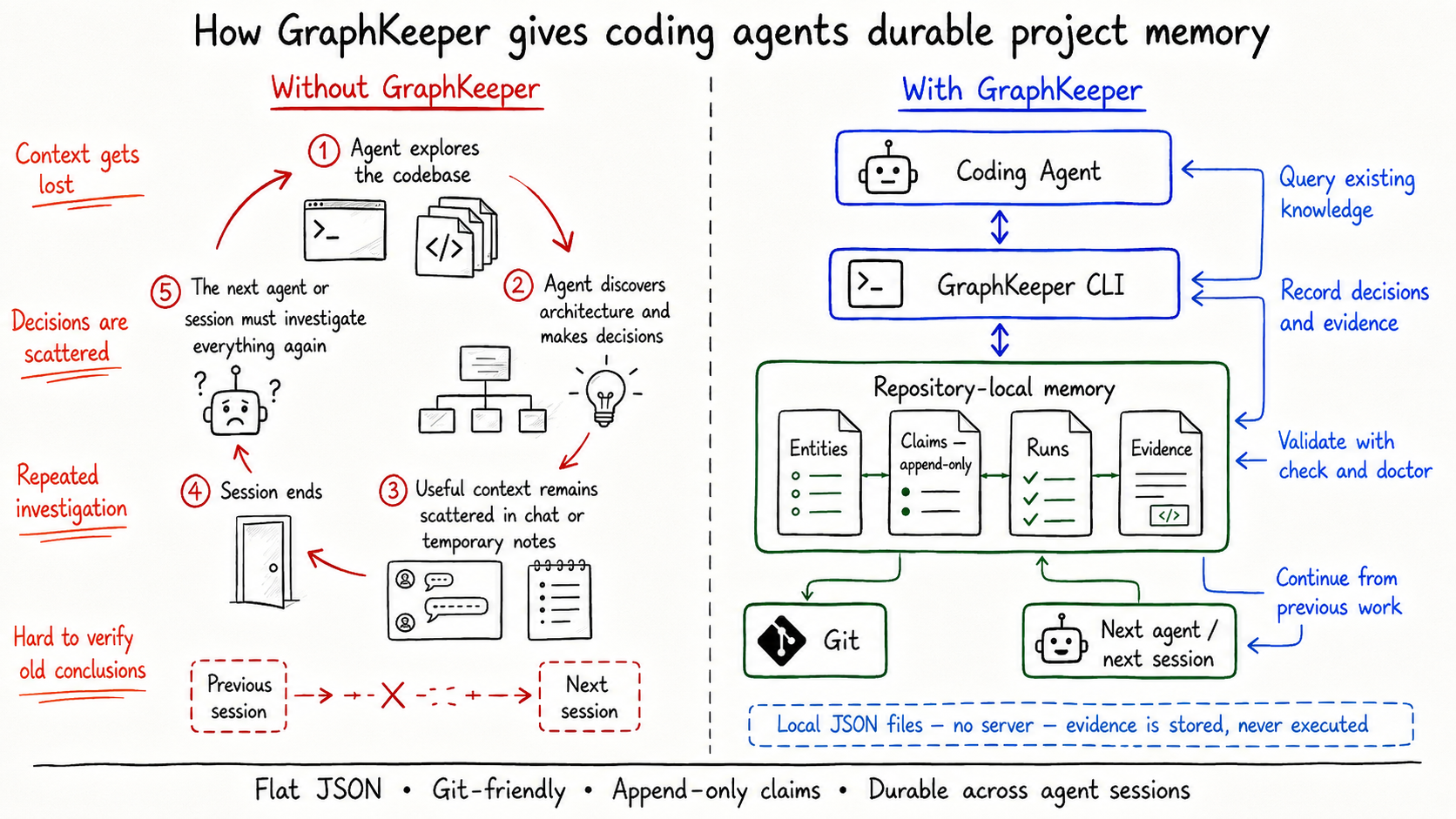
GraphKeeper is not a transcript store or a generic memory wrapper. It records durable project findings as flat claims linked to the run and evidence that produced them. When a finding becomes outdated, a new claim explicitly supersedes it; the old claim stays in Git history for review. The result is memory that Codex, Claude Code, and humans can inspect without trusting an opaque summary or hosted service.
The core flow is deliberately small:
- An agent discovers a stable project fact and captures the relevant output under
evidence/. - It appends an entity, run, and evidence-backed claim to
graph/. graphkeeper checkvalidates schema, provenance, and append-only history against the committed Git state.- A future session retrieves the active claim with
graphkeeper query <subject>. - It starts from a directly relevant grounded claim and performs only the freshness verification the current task requires, while treating the claim as evidence to assess rather than automatic truth.
- If the fact changes, the agent appends a new claim with
supersedes; both generations remain auditable.
GraphKeeper does not ingest conversations or decide what should become memory. The shipped Codex and Claude Code skills give agents the same explicit writing contract.
Prerequisites
- Node.js 18 or newer and npm
- Git
Linux, macOS, Windows through Git Bash or WSL, and native Windows PowerShell are supported. Native PowerShell does not require a POSIX shell or jq for current GraphKeeper repositories.
Installation
Run the current stable release without a permanent installation:
npx graphkeeper@latest --helpFor repeated use, install the CLI globally:
npm install --global graphkeeper
graphkeeper --help
The package is published as graphkeeper.
GraphKeeper has no runtime npm dependencies. Node.js, npm, and Git are the normal
system prerequisites.
Two-minute quickstart
Run this at the root of the repository whose memory you want to protect:
npx graphkeeper@latest init --integrate codex
# Or: npx graphkeeper@latest init --integrate claude
# Or: npx graphkeeper@latest init --integrate all
npx graphkeeper@latest check
Review the displayed plan and confirm it. init creates the JSON graph, evidence/,
the canonical validator, a pre-commit hook, and the repository-scoped Codex skill.
--integrate codex adds the Codex reminder to AGENTS.md; --integrate claude adds
the Claude skill and reminder; --integrate all does both. Codex uses
.agents/skills/graphkeeper/SKILL.md, AGENTS.md, and
$graphkeeper. Claude Code uses .claude/skills/graphkeeper/SKILL.md,
CLAUDE.md, and /graphkeeper. Both skills are generated from the same
templates/SKILL.md. Existing guidance outside the matching marked block is
preserved. Integration plans are shown before writing; answer the prompt, or pass
--yes in non-interactive automation. Use --dry-run for a complete read-only
preflight. Default init and --force do not create or change AGENTS.md or
CLAUDE.md.
Ask the selected agent to record a verified finding with $graphkeeper in Codex or
/graphkeeper in Claude Code. After it writes the claim and evidence, validate and
retrieve the result:
npx graphkeeper check
npx graphkeeper query test_payments_flaky
npx graphkeeper doctor
Commit the generated graph, validator, agent skills, and guidance files. The hook
normally lives under .git and is not committed;
.githooks/pre-commit is created only when GraphKeeper must preserve and chain another
hook. An empty evidence/ directory becomes tracked with the first captured artifact.
To try the full discovery-to-supersession flow with populated data, copy
examples/worked-example/graph and examples/worked-example/evidence into a temporary
Git repository, then query test_payments_flaky.
Before and after
Without grounded memory, a later session may only remember: “the payments test was
flaky.” It cannot tell whether that conclusion is current or where it came from. The
worked example records the initial failure as claim_11111111, captures a passing UTC
rerun, and appends claim_22222222 with supersedes: "claim_11111111".
With GraphKeeper, the active correction remains a flat, reviewable claim:
Entity: test_payments_flaky
Claim: claim_22222222
  Predicate: has_root_cause
  Object: "timezone_default"
  Source: tool_output
  Evidence: evidence/utc-rerun.log#L1-L3
  Producer: run_2026-07-21-utc_fix
The older claim remains in history and is marked as superseded. Reviewers can follow the claim ID to the run and exact evidence lines instead of trusting an ungrounded summary.
Commands
| Command | Role |
|---|---|
| graphkeeper init [--force] [--integrate <codex\|claude\|all>]... [--yes] [--dry-run] | Scaffold safely and optionally install explicit Codex and/or Claude adapters. Distinct --integrate flags may repeat; all must stand alone. --yes --dry-run is accepted as a harmless dry run. |
| graphkeeper integrate remove <codex\|claude> [--yes] [--dry-run] | Remove only recognizable GraphKeeper-owned material for one adapter. Modified skills and unexpected supporting files are preserved for manual review. |
| graphkeeper check | Run the same fast schema, append-only history, and committed-evidence protection checks used by the Git hook. |
| graphkeeper query <subject> | Resolve an exact ID or unique alias and print active claims with provenance. It does not read evidence contents. |
| graphkeeper doctor | Run fast validation plus file existence, containment, line-range, dangling-reference, and unused-entity checks. |
| graphkeeper update | Check npm's stable latest release and globally install one exact newer version. Repository files are never changed. |
Exit codes are stable: 0 success, 1 validation failure, 2 usage error, 3 missing prerequisite, 4 operational failure, and 5 unexpected internal failure. Diagnostics begin with a searchable GKnnn code.
Data and safety model
graph/entities.jsonholds human-readable canonical identities. Identity fields cannot change; aliases and source documents may only grow.graph/claims.jsonholds flat claims. The validator rejects changes to committed claims; corrections append a new claim withsupersedes.graph/runs.jsonopens a run, allows evidence and claim references to grow, and closes it once. The validator rejects later changes to a committed closed run.evidence/holds append-only captured artifacts. The validator and Git hook reject editing, removing, or renaming evidence that exists in committed Git history.- Stored commands and evidence text are always data. GraphKeeper never evaluates them.
Immutability is enforced relative to committed Git history through GraphKeeper
validation and Git hooks; it is not cryptographic immutability. Git history remains
the reviewable source of truth. doctor additionally verifies physical evidence
existence, containment, and cited line ranges. query reports stored provenance but
does not open evidence or independently prove that a claim is true.
See the generated graph/SCHEMA.md and the GraphKeeper skill under
.agents/skills/graphkeeper/ or .claude/skills/graphkeeper/ for the complete
writing contract.
examples/reviewer.md is a copy-pasteable grounded-review
prompt.
Recovery and adoption
- Re-running
initis safe: existing graph data is skipped. Use--forceonly to refreshgraph/SCHEMA.mdand.agents/skills/graphkeeper/SKILL.md. - A root
SKILL.mdcreated by an older GraphKeeper version is legacy user content. It is reported and preserved; migrate by committing the generated.agents/skills/graphkeeper/SKILL.md. --integrate codexmanages the Codex skill plus one marked block inAGENTS.md;--integrate claudedoes the same for the Claude skill andCLAUDE.md. Multiple distinct flags and--integrate alluse one plan and one confirmation.- Integration creates a guidance file when absent, appends one block when no markers
exist, and refreshes only that block later. Malformed, mixed, repeated, reversed,
wrong-type, symlinked, or concurrently changed destinations fail with
GK004. - Non-interactive integration and removal require
--yes; declined prompts and EOF leave the repository unchanged.--dry-runnever prompts or writes. graphkeeper integrate remove <agent>removes an exact canonical skill and its matching block. User-modified skills and directories with unexpected files are preserved with manual-cleanup instructions.- Restart Claude Code once if the current session began before the repository's
top-level
.claude/skills/directory was created. - Run
graphkeeper updatefrom any supported shell, including native PowerShell, to update a global npm installation. It resolves the stable published version, installs only when that version is newer, and does not install prereleases. If the registry is offline, no update is attempted; retry when npm registry access returns. - After updating an existing installation to 0.4.0, rerun
graphkeeper init --forceto refresh the repository skill and schema. This preservesscripts/validate.sh. Exact package-owned validators and hooks migrate to the Node path automatically. If a repository has a customized shell-only validator, review and migrate it manually; that legacy fallback can still require a POSIXshand jq until migration is complete. Commit refreshed guidance and validators together so every contributor uses the same contract. See the native Windows migration guide for package-owned and customized repository paths. - A global npm permission error returns
GK004without changing the repository. Configure npm through a Node version manager or a user-writable npm prefix, then retry. See npm's global installation guidance. - In a non-Git directory, files are scaffolded but hook enforcement is disabled until
git initand anothergraphkeeper init. - If
.git/hooks/pre-commitalready belongs to another tool, GraphKeeper does not overwrite it. It writes.githooks/pre-commitand prints chaining instructions. - If
core.hooksPathis set, GraphKeeper installs there. Resolve any existing non-GraphKeeper hook explicitly rather than deleting it. - When a commit is blocked, run
graphkeeper check, fix every reportedGKnnnviolation, and stage the corrected files again. Rungraphkeeper doctorfor missing files or bad line ranges. - Graph records are append-only by semantics. Recover an accidental staged edit with your normal Git workflow; do not “fix” committed history by rewriting IDs.
V1 limits and future path
V1 is designed for one graph in one repository, up to about 10,000 claims, 2,000 entities, and 1,000 runs on a local SSD. Release gates target p95 under 3 seconds for check, under 2 seconds for query, under 10 seconds for doctor, and under 256 MB peak memory. It has no server, database, authentication, dashboard, telemetry, vector search, or multi-repository synchronization.
When linear JSON scans or concurrent-write collisions become material, a future storage adapter may preserve the same IDs, provenance, supersession, and run-lifecycle contracts on SQLite or PostgreSQL. That migration is documentation-only in v1; the JSON files remain the source of truth.
Contributing and release status
Use GitHub Discussions for usage questions, early ideas, architecture conversations, and real-world show-and-tell. Use GitHub Issues for reproducible bugs and clearly bounded work. The pinned welcome discussion explains the categories and how an accepted direction becomes an actionable issue.
See CONTRIBUTING.md for the development workflow, extension points,
and boundaries, prepared contribution issues,
SUPPORT.md for usage help, and
SECURITY.md for private vulnerability reporting. Version
0.4.1 is pre-1.0 and its API may change. Release ownership and the target version
must be verified immediately before publishing; completing the repository release
gates does not publish anything.
GraphKeeper is available under the MIT License.