
imara
v0.2.0
Published
Runtime governance layer for AI agents — audit trails, policy enforcement, and compliance for MCP tool calls

Maintainers
 kifarukubwa
Readme
Imara




Policy enforcement for MCP agents. Define rules in YAML. Imara intercepts every tool call, evaluates it, and decides: allow, deny, rate-limit, or escalate — before it reaches the server.
Ships with sensible defaults. Zero config changes to your agent.
Imara and Mavryn. Imara is the policy and audit layer for a single MCP server's tool calls: it intercepts each call, applies your rules, and writes the hash-chained record. Mavryn is the gateway that consolidates many MCP servers behind one endpoint. They compose: run Mavryn to route across your servers, wrap it with Imara to govern and audit what flows through. Different layers of the same stack.
npx imara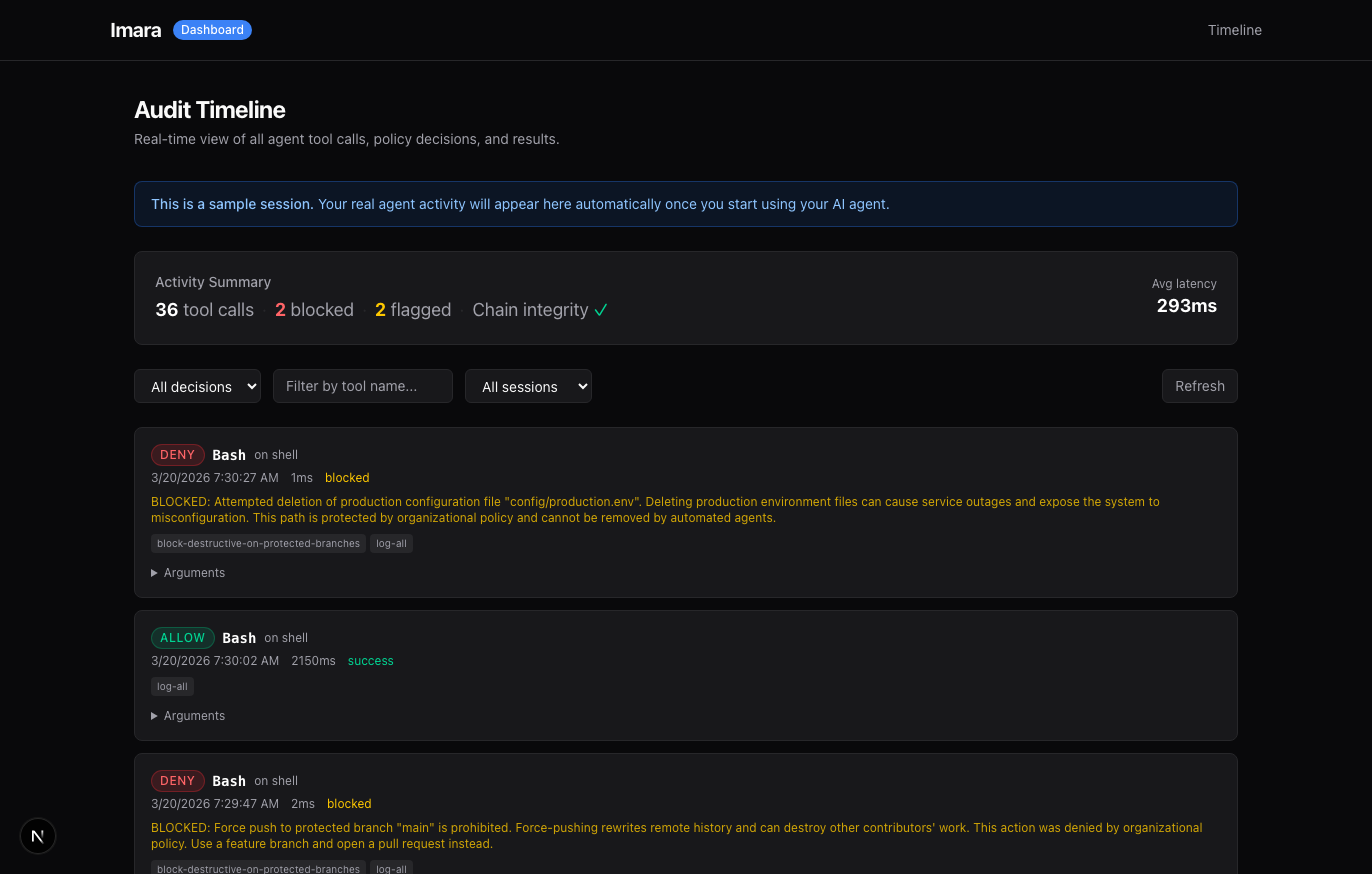
Why this exists
AI agents now do real work: writing files, running shell commands, pushing to git, calling APIs. Most teams have no way to say "don't let the agent touch main" or "rate-limit writes to 20/minute" without forking the agent itself.
Imara solves this at the transport layer. Your agent is unchanged. The rules live in a YAML file you own.
Timely context: The EU AI Act's Art. 12 (automatic event logging) and Art. 14 (human oversight) obligations for high-risk AI systems take effect August 2, 2026. If you're deploying agents in healthcare, finance, HR tooling, or any system affecting consequential decisions, Imara's policy engine and audit trail cover both requirements out of the box.
Get started
npx imaraThis runs the full setup: initializes ~/.imara/, patches your MCP config to route through the proxy, loads a demo session, and opens the dashboard at http://localhost:3838.
To add Imara to an existing project:
imara wrap    # patches .mcp.json or Claude Desktop config
imara unwrap  # restores the original anytime
Policy engine
Rules are YAML files in ~/.imara/policies/. Imara ships four default rules and evaluates them on every tool call, in priority order.
Default rules
# Block destructive operations on protected branches
- name: block-destructive-on-protected-branches
  priority: 10
  match:
    tools:
      - tool: git_push
      - tool: git_reset
      - tool: git_force_push
    arguments:
      - field: branch
        operator: in
        value: [main, master, production]
  action: deny
  reason: Destructive operations on protected branches are not allowed
  complianceFrameworks: [SOC2-CC6.1, SOC2-CC8.1]

# Rate-limit write operations
- name: rate-limit-writes
  priority: 20
  match:
    tools:
      - tool: write_file
      - tool: create_file
      - tool: edit_file
      - tool: "insert_*"
      - tool: "update_*"
      - tool: "delete_*"
  action: allow
  rateLimit:
    maxCalls: 20
    windowSeconds: 60

# Flag destructive operations for review
- name: flag-destructive-ops
  priority: 50
  match:
    tools:
      - tool: delete_file
      - tool: remove_directory
      - tool: git_push
      - tool: git_reset
      - tool: "drop_*"
      - tool: "rm_*"
  action: log
  reason: Destructive operation flagged for review
  complianceFrameworks: [SOC2-CC6.1]

# Log everything
- name: log-all
  priority: 100
  match:
    tools:
      - tool: "*"
  action: log
Rule actions
| Action | Behavior |
|--------|----------|
| deny | Block the tool call. Returns a reason to the agent. |
| allow | Explicitly allow (overrides lower-priority rules). |
| escalate | Flag for human review. |
| log | Record the call without affecting the decision. |
Matching
Match by tool name (exact or glob), server name, and argument values:
- name: read-only-mode
  priority: 5
  match:
    tools:
      - tool: "write_*"
      - tool: "create_*"
      - tool: "delete_*"
  action: deny
  reason: Agent is in read-only mode
- name: block-external-http
priority: 15
match:
tools:
- tool: fetch
- tool: http_request
arguments:
- field: url
operator: not_starts_with
value: "https://internal.example.com"
action: deny
reason: External HTTP requests are not allowedAudit trail
Every tool call is logged to a local SQLite database with a SHA-256 hash chain anchored at its genesis event. If anyone edits or reorders an event, the chain breaks. imara verify also records a head anchor in ~/.imara/anchor.json, so deletion or truncation of already-verified events is caught on the next run.
imara verify   # check chain integrity
imara tail     # stream events in real time
imara tail -f  # follow mode
Upgrading from 0.1.x? 0.2.0 changes the audit hash format: events are canonically serialized before hashing, so a log written by 0.1.x will not verify under 0.2.0. Treat 0.2.0 as a fresh baseline. Archive any
~/.imara/audit.dbyou need to keep, then runimara verifyto establish a new anchor. Details in the CHANGELOG.
For team deployments with multi-user attribution and richer session data, the audit store lives in Mavryn. The two work together: Imara handles policy enforcement, Mavryn handles persistence and observability.
Dashboard
imara dashboardOpens at http://localhost:3838. Shows a timeline of every agent action, policy decision badges (allowed / denied / flagged), latency per call, and a risk summary for the session.
CLI reference
| Command | Description |
|---------|-------------|
| imara | Full setup: init + wrap + dashboard |
| imara init | Initialize ~/.imara/ |
| imara wrap | Patch MCP config to route through proxy |
| imara unwrap | Restore original MCP config |
| imara tail | Stream audit events |
| imara tail -f | Follow mode |
| imara dashboard | Open the web dashboard |
| imara verify | Verify hash chain integrity |
| imara status | Show monitoring stats |
How it works
Your Agent          Imara Proxy              Real MCP Server
    |                    |                        |
    |-- tools/call ----> |                        |
    |                    |-- evaluate policy       |
    |                    |-- log audit event       |
    |                    |-- tools/call ---------> |
    |                    |                        |
    |                    | <----- result --------- |
    |                    |-- log result + hash     |
    | <---- result ----- |                        |
Imara runs as a local proxy between your agent and your MCP servers. The agent sees the same tool interface it always has. No SDK changes, no agent config changes.
Compliance mapping
| Requirement | Framework | How Imara addresses it |
|-------------|-----------|------------------------|
| Automatic event logging | EU AI Act Art. 12 | Hash-chained audit trail for every tool call |
| Human oversight | EU AI Act Art. 14 | escalate action routes calls for human review |
| Change management | SOC 2 CC6.1, CC8.1 | Policy rules with compliance tags |
| Access controls | HIPAA audit controls | Per-tool deny rules with logged reasons |
| AI management | ISO 42001 | Policy-as-code with versioned YAML |
Install
npx imaraOr install packages for programmatic use:
npm install @imara/core     # types, schemas, hash chain
npm install @imara/policy   # policy engine
npm install @imara/proxy    # MCP proxy
npm install @imara/store    # local SQLite audit store
Architecture
Monorepo with clean package boundaries:
- @imara/core — types, Zod schemas, SHA-256 hash chaining
- @imara/policy — policy evaluation engine
- @imara/proxy — MCP proxy with tool call interception
- @imara/store — local SQLite audit store
- @imara/dashboard — Next.js web UI
Roadmap
- [x] MCP proxy with transparent interception
- [x] SHA-256 hash-chained audit trail
- [x] YAML policy engine with glob matching and rate limiting
- [x] Real-time dashboard with timeline view
- [x] Zero-config
imara wrap/imara unwrap - [ ]
imara policy test --tool <name> --args '{...}'— test rules without running the proxy - [ ] Compliance report export (EU AI Act Art. 12 + Art. 14)
- [ ] Human-in-the-loop escalation workflows
- [ ] SSE/WebSocket MCP transport support
- [ ] Team mode via Mavryn
Development
git clone https://github.com/dnakitare/imara.git
cd imara
pnpm install
pnpm build
node packages/cli/dist/cli.js
See CONTRIBUTING.md.
License
Apache 2.0 — see LICENSE.