
impronta
v0.3.0
Published
Canonical form and content hash in one call, over the whole JavaScript value graph. Byte-exact RFC 8785 (JCS) for the JSON subset, plus an extended mode that gives BigInt, Map, Set, TypedArray, Date, RegExp, class instances and cycles distinct, tested enc

Maintainers
 destbreso
Readme
impronta
Canonical form and content hash in one call, over the whole JavaScript value graph.
import { digest, imprint, jcs } from "impronta";

await digest({ user: "ada", roles: new Set(["admin"]) });  // SHA-256, hex
imprint(new Map([["a", 1]]));                              // the canonical form
jcs({ b: 1, a: 2 });                                       // '{"a":2,"b":1}'  RFC 8785
Zero dependencies. Web Crypto for the digest, so the same code runs on Node 18+, Deno, Bun, browsers and edge runtimes.
The problem
Every JSON-subset canonicalizer collapses the types JSON cannot express, and does it silently:
canonicalize({ v: new Map([["a", 1]]) })      // '{"v":{}}'   the entries are gone
canonicalize({ v: new Uint8Array([1,2,3]) })  // '{"v":{"0":1,"1":2,"2":3}}'
Nothing throws and nothing warns. The cache returns an entry stored under a different value; the signature verifies over data that is not what was signed. Silence is the failure mode, which is why it survives code review.
What impronta does about it
Two modes, because two different jobs are hiding under the word "canonical".
jcs(value) is byte-exact RFC 8785, for when the bytes have to match a JCS
implementation in Go, Java or Python. It refuses what JSON cannot express rather
than guessing, and it inherits JSON's own conflations by definition: a Date and
its ISO string are the same JSON document.
imprint(value) is the extended form, and the reason this package exists. It
covers BigInt, Map, Set, every TypedArray, ArrayBuffer, Date,
RegExp, class instances, null-prototype objects and cycles, giving each a
distinct encoding. It is injective by construction, not by inspection:
- Every value carries a type tag, so no two types can share an encoding. A Map
is not an object. A
Uint8Arrayis not anInt8Array. - Every variable-length payload is length-prefixed, so the grammar is self-delimiting and needs no escaping. A key containing the encoding's own punctuation cannot imitate a different structure.
Measured, not claimed
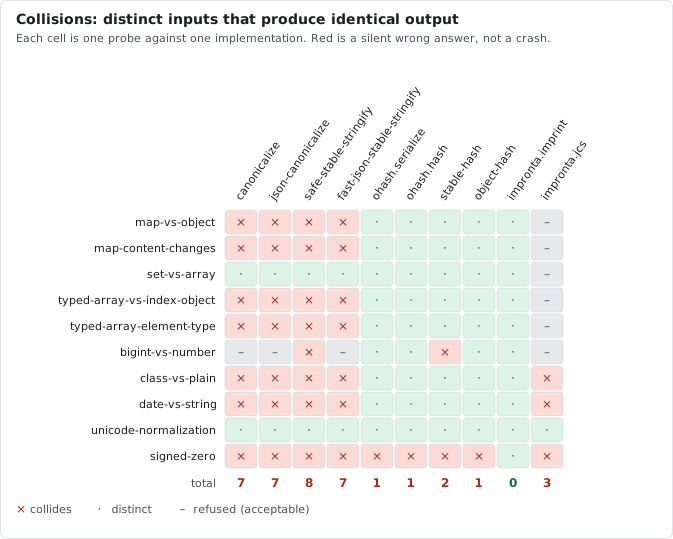
Run by serializer-conformance, a neutral harness built before this library and which treats it as one more adapter:
| | collisions | RFC 8785 | max nesting depth | |---|---|---|---| | canonicalize | 7 | 6/6 | ~4,100 | | json-canonicalize | 7 | 6/6 | ~1,800 | | safe-stable-stringify | 8 | 6/6 | ~4,100 | | fast-json-stable-stringify | 7 | 6/6 | ~5,900 | | ohash.serialize | 1 | not JCS | ~1,500 | | ohash.hash | 1 | not JCS | ~4,800 | | stable-hash | 2 | not JCS | ~7,000 | | object-hash | 1 | not JCS | ~4,800 | | impronta.imprint | 0 | not JCS | unbounded | | impronta.jcs | 3, all inherent to JSON | 6/6 | unbounded |
Zero collisions is trivially achievable by refusing everything, and the harness counts a refusal as acceptable. impronta answers every probe and the answers are distinct, which the test suite asserts separately.
The full run of every suite is committed at docs/REPORT.md,
and npm run report regenerates it and the charts below from this repository's
own build, so these numbers describe the code in the tree rather than a release.
npx serializer-conformance all reproduces it against whatever you have
installed. A number in a README is a claim; a command that regenerates it is
evidence.
The harness publishes its own numbers with impronta deliberately not installed, because an instrument should describe the field rather than the thing its author also ships. This is the other half, where the conflict of interest belongs to the package making the claim.
Depth is not a footnote
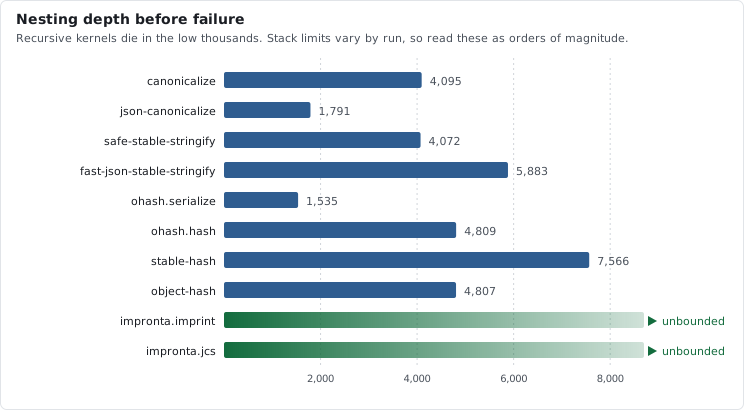
Every implementation measured is recursive and dies with a RangeError somewhere
in the low thousands of levels. Anything doing content addressing eats untrusted
input by definition, and "send a deeply nested document" is the cheapest denial
of service there is: a few dozen kilobytes of JSON that JSON.parse handles
without complaint and the fingerprinting step does not. impronta's traversal is
iterative, so depth costs heap, not call stack.
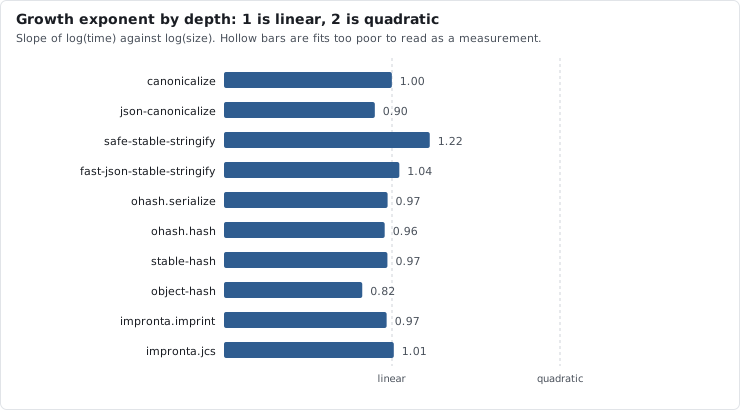
Iterative is necessary but not sufficient. The first version here was iterative and quadratic, because it buffered every item and so copied the deeper encoding once per level. It passed every correctness test and took 26 seconds where it now takes 0.2. A test asserts the ratio stays linear, because moving a denial of service from the call stack to the clock is not a fix.
That is not a claim you have to take on trust either. The harness fits log(time) against log(size), so the number below is an exponent: 1 is linear, 2 is quadratic. Both modes come out linear on both axes.
Ordering: the one debatable choice
Map and Set preserve iteration order by default, so two Maps with the same
entries in a different order get different imprints. Iteration order is part of
what a Map observably is.
imprint(new Map([["a",1],["b",2]]), { order: "sorted" }) // order-insensitiveThe default is the conservative direction, chosen by failure mode rather than by taste. Sorting when you should not produces a false match: a cache serves an entry stored under a different value. Not sorting when you could produces a false miss: the lookup fails and the work is redone. One is a correctness bug, the other is a performance cost, so the default is the one that can only ever be slow.
Plain object keys are always sorted, in both modes: property order is not part of the value, and RFC 8785 says the same.
Every subtree is addressable too
The grammar is length-prefixed and self-delimiting, and that has a consequence
worth using: a container's token is its header followed by its children's tokens
verbatim, so every node inside a value already carries a complete canonical form
of its own. imprintTree annotates the whole graph in one traversal.
import { imprintTree } from "impronta";

const before = { rows: [{ id: "a" }, { id: "b" }, { id: "c" }] };
const after  = { rows: [{ id: "b" }, { id: "c" }, { id: "a" }] };

const t0 = imprintTree(before);
const t1 = imprintTree(after);

t0.get(before.rows[0]) === t1.get(after.rows[2]); // true: the same row, moved
t0.root === t1.root;                              // false: the value changed
Afterwards, structural equality between any two nodes, from any two values, is a
string comparison, and it is exact in both directions: equal imprints mean equal
values, different imprints mean different values. That is a content identity for
arrays of objects, the thing structural diffs usually ask you to hand-write as an
objectHash callback, and it works for Map, Set, TypedArray and class
instances rather than only for plain JSON.
One node in the graph has no standalone form, and get returns undefined for
it: a subtree containing a back-reference to an ancestor above it. The cycle
token counts levels to climb, so that subtree does not mean the same thing
anywhere else, and refusing is the only honest answer. A cycle that closes inside
the node is fine and gets an imprint like anything else.
imprint is linear; imprintTree is not. A string per node costs the sum of all
subtree lengths, so O(n × depth). Documents are usually wide and shallow, where
that is a small constant, but imprint remains the right call when you only want
the root form.
API
imprint(value, { order?: "insertion" | "sorted" }): string
imprintTree(value, { order? }): { root: string, get(node: object): string | undefined }
jcs(value, { unrepresentable?: "throw" | "json" }): string
canonicalize(value, { mode?: "imprint" | "jcs", ... }): string
digest(value, {
  mode?: "imprint" | "jcs",
  algorithm?: "SHA-256" | "SHA-384" | "SHA-512" | "SHA-1",
  encoding?: "hex" | "base64url" | "bytes",
}): Promise<string | Uint8Array>
UnrepresentableValueError carries a path pointing at the offending value.
What it refuses, and why that is the honest answer
imprint throws only for values whose meaning is their identity: functions,
symbols, WeakMap, WeakSet, WeakRef, Promise. An identity has no canonical
form, and inventing one would be the same silent lie this library exists to
avoid.
jcs additionally throws for everything outside the JSON data model, unless you
ask for unrepresentable: "json", which reinstates JSON.stringify's lossy
coercions for bug-compatibility with an existing pipeline.
Known limits, stated rather than hidden
- Symbol-keyed properties are ignored, as
Object.keysand JSON ignore them. - Two different classes sharing a name encode identically. Fixing that needs identity, which is exactly what a content hash must not depend on.
- A shared non-cyclic reference is expanded, so a diamond and its fully expanded twin agree. Only true cycles become back-references.
-0and0are distinct inimprintand identical injcs, because JSON has no way to say otherwise.
Install
npm i improntaLicense
MIT